

RCEP Green Packaging Mutual Recognition Takes Effect
On April 16, 2026, the RCEP Secretariat officially implemented the Implementation Rules for Green Packaging Mutual Recognition, enabling Chinese eco-friendly packaging certified under GB/T 37659–2019 to clear customs without retesting in Australia, New Zealand, Japan, and South Korea. This development directly affects exporters of sustainable packaging, raw material suppliers, converters, logistics providers, and compliance service firms — particularly those engaged in cross-border trade of FSC-certified paper, PLA biopolymer films, and water-based ink printed goods.
Event Overview
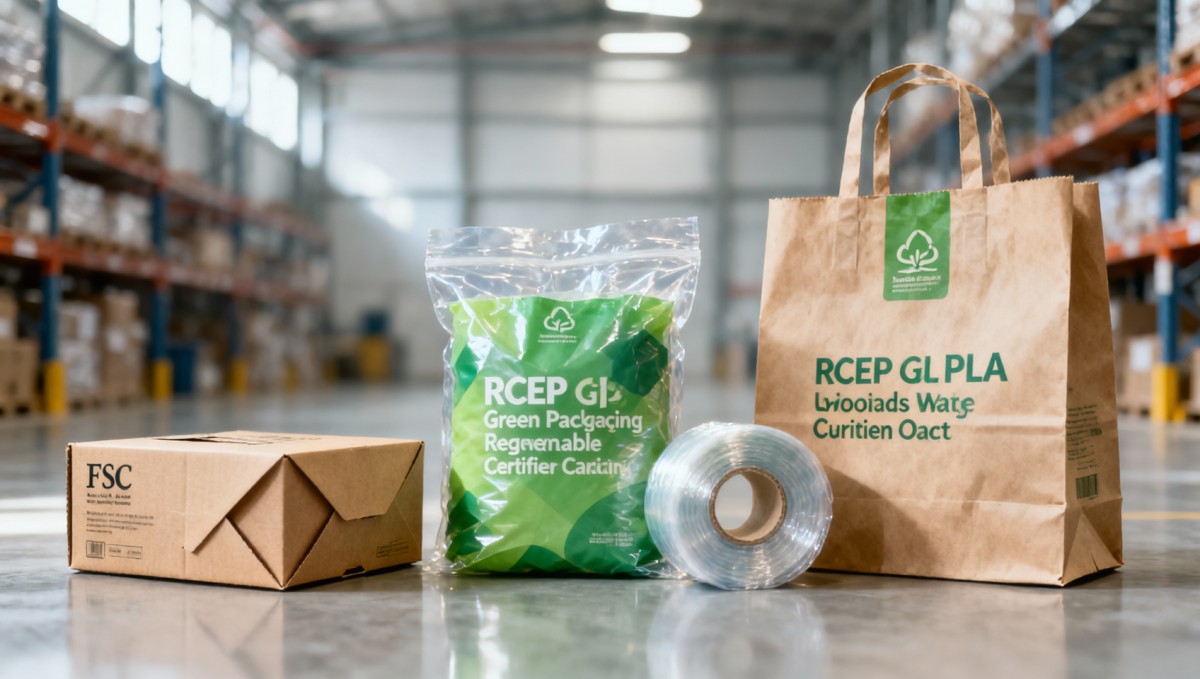
On April 16, 2026, the RCEP Secretariat announced the formal entry into force of the Implementation Rules for Green Packaging Mutual Recognition. Under this framework, Chinese eco-friendly packaging products certified to GB/T 37659–2019 — including FSC-certified recycled paper, polylactic acid (PLA) biobased films, and water-based ink printed items — are now eligible for exemption from duplicate testing at ports of entry in Australia, New Zealand, Japan, and South Korea. Eligibility requires submission of a Chinese green declaration accompanied by a valid third-party certification certificate. The measure reduces average customs clearance time by 3–5 working days and lowers inspection-related costs by approximately 60%.
Industries Affected by This Development
Direct Exporters of Packaging Products
Exporters shipping certified eco-friendly packaging to Australia, NZ, Japan, or South Korea will experience faster clearance and lower compliance overhead. The exemption applies only to products explicitly covered under GB/T 37659–2019 and verified by an RCEP-recognized third-party certifier — meaning eligibility is conditional, not automatic.
Raw Material Suppliers (e.g., PLA resin producers, FSC pulp mills)
Suppliers whose downstream customers produce certified final packaging may see increased demand for traceable, standards-aligned inputs. However, the mutual recognition does not extend upstream: resin batches or pulp lots themselves are not exempt from origin or conformity checks unless embedded in a finished, certified product.
Converters and Printers (e.g., folding carton manufacturers, flexible packaging converters)
Manufacturers applying water-based inks or laminating PLA films onto substrates must ensure full chain documentation — including material declarations, process records, and final product certification — is available for submission. The exemption covers the finished article, not individual production steps.
Logistics and Customs Brokerage Firms
Service providers handling documentation for these shipments must verify that submitted declarations reference the correct version of GB/T 37659–2019 and that the third-party certificate is issued by an accreditation body accepted under the RCEP arrangement. Inconsistent or incomplete paperwork may still trigger examination despite eligibility.
Supply Chain Compliance & Certification Service Providers
Firms offering certification, gap analysis, or audit support may see rising demand for verification services aligned with GB/T 37659–2019. However, no new RCEP-endorsed certifiers have been publicly listed to date; current acceptance relies on pre-existing national accreditation frameworks recognized under the agreement.
What Enterprises and Practitioners Should Focus On Now
Monitor official updates from national customs and standardization bodies
The RCEP Secretariat’s announcement is high-level. Country-specific implementation guidelines — such as acceptable certificate formats, list of authorized certifiers, or definitions of ‘green declaration’ — are expected to be issued separately by Australia, NZ, Japan, and South Korea. These documents will determine operational readiness.
Verify coverage of specific product categories and certifications
GB/T 37659–2019 defines technical criteria for eco-friendly packaging but does not automatically cover all biobased or recyclable materials. Firms should confirm whether their exact product configuration (e.g., PLA-coated board, multi-layer compostable laminate) falls within the scope of the standard and its associated certification protocols.
Distinguish between policy intent and on-the-ground execution
While the rules are effective as of April 16, 2026, port-level enforcement may vary during initial rollout. Early adopters should treat the first 2–3 months as a calibration phase — tracking actual clearance times, requesting written feedback upon rejection, and documenting inconsistencies for future reference.
Prepare documentation packages in advance for priority SKUs
Rather than waiting for shipment, exporters should compile standardized dossiers per SKU: (1) Chinese green declaration template, (2) copy of valid third-party certificate, (3) summary of conformity evidence against GB/T 37659–2019 clauses. This reduces delays caused by last-minute document assembly or translation.
Editorial Perspective / Industry Observation
From an industry perspective, this development is best understood not as an immediate operational shift, but as a formalized signal of regulatory alignment — one that reflects growing convergence in sustainability-related trade infrastructure across RCEP economies. Analysis来看, the mutual recognition mechanism remains narrowly scoped: it applies only to a defined standard, four partner markets, and a limited set of material types. It does not replace national environmental labelling schemes (e.g., Japan’s Eco Mark or Australia’s GECA), nor does it imply harmonization of broader ESG reporting requirements. Observation来看, early uptake will likely be concentrated among exporters already certified to GB/T 37659–2019 and serving B2B buyers with established sustainability procurement policies. Current more relevant interpretation is that this is a procedural enabler — valuable where applicable, but not a substitute for market-specific compliance strategies.
Conclusion
The RCEP green packaging mutual recognition framework introduces a targeted, standards-based pathway to reduce non-tariff barriers for a defined subset of sustainable packaging exports. Its practical impact is real but bounded: it streamlines clearance for compliant products entering four key markets, yet places new emphasis on documentation rigor and standard-specific conformity. For stakeholders, the most rational approach is to treat it as a tactical advantage — usable where conditions align — rather than a strategic transformation of packaging trade compliance.
Source Attribution
Main source: Official announcement issued by the RCEP Secretariat on April 16, 2026.
Points requiring ongoing observation: National implementation guidance from Australian Border Force, New Zealand Customs Service, Japan Customs, and Korea Customs Service — none published as of the announcement date.
Recommended News
 EU CBAM Carbon Tariff Starts Oct 2026 for Chinese Battery, Cement, Chemical ExportsEU CBAM carbon tariff hits Chinese battery, cement & chemical exports from Oct 2026 — mandatory emissions reporting starts now. Avoid €98/t default fees.
 Mexico NOM-019-SCFI-2026 Effective: Automotive Electronics Require New EMC CertificationMexico NOM-019-SCFI-2026 takes effect May 1, 2026 — new EMC certification mandatory for automotive electronics, EV accessories & aftermarket parts entering Mexico.
 Vietnam Suspends China Irrigation Equipment SASO Mutual RecognitionVietnam suspends China irrigation equipment SASO mutual recognition—urgent QCVN certification now required for drip tapes, sprinklers & smart controllers.
 Red Sea Diversion Normalized; Asia-Europe Freight Premium at $1,850/TEURed Sea diversion normalized: Asia-Europe freight premium holds at $1,850/TEU — impacting manufacturing, retail & procurement. Act now to optimize costs & resilience.
 FDA Drafts AI Bias Assessment Rule for Imported Medical DevicesFDA's new AI bias assessment rule for imported medical devices demands third-party verified fairness reports—act now to prep your 510(k)/De Novo submissions.
 TÜV Rheinland Updates CE Requirements for Servo DrivesTÜV Rheinland updates CE requirements for servo drives: integrated PLd + EN 61800-3 validation mandatory from July 1, 2026. Act now to avoid EU market delays!
 SABER Phase II Launch: Building Hardware Must Submit Digital Type Test Reports & Unique Product IDsSABER Phase II is live: Building hardware exporters must now submit digital type test reports & secure unique SABER Product IDs—avoid customs delays. Act now!
 IMDG Code 41-24 Enforced: New UN3480 Class 9 Label for Lithium Battery Sea FreightIMDG Code 41-24 enforced: UN3480 Class 9 label now mandatory for lithium battery sea freight — avoid delays in US, EU, UAE & Chile ports.
 RCEP Green Packaging Mutual Recognition Takes EffectRCEP Green Packaging Mutual Recognition takes effect Apr 21, 2026—unlock faster customs clearance for compostable, recycled & bio-based packaging in AU, NZ, JP, KR.
 China’s 10-Dept AI Ethics Review Rule for Exported AI DevicesChina’s 10-dept AI ethics review rule mandates algorithmic bias assessments for exported AI devices—key for EU, ME & SEA markets. Stay compliant ahead of enforcement.
 US CPSC Updates Child Sleep Sack Standard Effective July 2026US CPSC updates child sleep sack standard with new DSST test—mandatory for all U.S.-bound infant sleep sacks from July 2026. Act now to ensure compliance and market access.
 Red Sea Rerouting Pushes Asia-Europe Freight Premium to $1,850/TEURed Sea rerouting pushes Asia-Europe freight premium to $1,850/TEU—impacting importers, manufacturers & logistics providers. Act now to reassess costs, lead times & contracts.
 Mexico NOM-019-SCFI-2026 Effective May 1, 2026: EMC Certification Mandatory for Auto ElectronicsNOM-019-SCFI-2026 EMC certification is now mandatory for auto electronics in Mexico—effective May 1, 2026. Ensure compliance for infotainment, ADAS, OBD-II & more.
") TÜV Rheinland Updates CE Requirements for Servo Drives (PLd + EMC Class 3)TÜV Rheinland updates CE requirements for servo drives: PLd + EMC Class 3 joint validation mandatory from Q3 2026. Act now to avoid delays, rejections, or compliance risks.
TÜV Rheinland Updates CE Requirements for Servo Drives (PLd + EMC Class 3)TÜV Rheinland updates CE requirements for servo drives: PLd + EMC Class 3 joint validation mandatory from Q3 2026. Act now to avoid delays, rejections, or compliance risks. SABER Phase II Launch: Building Hardware Must Submit Digital e-CoC & UPISABER Phase II mandates digital e-CoC & UPI for building hardware imports to Saudi Arabia—act now to ensure customs clearance and market access.
 FDA AI Diagnostic Device Draft Rules: Bias Assessment for ImportsFDA AI diagnostic device draft rules mandate bias assessment for imports — discover how algorithmic fairness impacts 510(k)/De Novo submissions and what to do now.
 RCEP Green Packaging Mutual Recognition Starts June 1, 2026RCEP Green Packaging Mutual Recognition starts June 1, 2026 — unlock faster exports to Australia, NZ, Japan & Korea with GB/T 37572-2025 certification.
 Vietnam Suspends SASO Mutual Recognition for Chinese Irrigation EquipmentVietnam suspends SASO mutual recognition for Chinese irrigation equipment—impacting exporters, testers & suppliers. Act now to avoid 6–8 week delays & 35% cost hikes.
 IMDG Code 41-24 Enforces UN3480 Class 9 Labeling for Li-ion Battery Sea FreightIMDG Code 41-24 enforces UN3480 Class 9 labeling for Li-ion battery sea freight—learn mandatory QR labels, compliance actions & port enforcement risks.
 EU CBAM Enters Enforcement Phase on April 1, 2026EU CBAM enforcement starts April 1, 2026 — critical for Chinese battery materials, construction profiles & industrial coatings exporters. Act now to avoid customs delays.
 Mexico Enforces NOM-019-SCFI-2026 EMC Certification for Auto Electronics from May 2026Mexico enforces NOM-019-SCFI-2026 EMC certification for auto electronics from May 2026 — mandatory local testing, stricter standards, and urgent compliance action required.



















Popular Tags
Global Trade Insights & Industry
Our mission is to empower global exporters and importers with data-driven insights that foster strategic growth.
Search News
Popular Tags
Industry Overview
The global commercial kitchen equipment market is projected to reach $112 billion by 2027. Driven by urbanization, the rise of e-commerce food delivery, and strict hygiene regulations.