

SABER Phase II Launch: Building Hardware Must Submit Digital Type Test Reports & Unique Product ID
Saudi Arabia’s SABER platform Phase II went live on April 15, 2026, introducing mandatory digital type test reporting and unique product identification for building materials and hardware & tools — specifically affecting fasteners, scaffolding components, and metal door/window hardware. This update directly impacts exporters, manufacturers, and compliance service providers targeting the Saudi market, as non-compliant submissions will block SCOC certificate issuance and trigger full-container rejections.
Event Overview
Effective April 15, 2026, the Saudi Standards, Metrology and Quality Organization (SASO) fully activated Phase II of the SABER platform. Under this update, all imported products falling under the Building Materials and Hardware & Tools categories — including but not limited to fasteners, scaffolding accessories, and metal门窗 hardware (e.g., hinges, handles, locks) — must meet two new requirements: (1) submission of a digital type test report issued by a SASO-recognized laboratory, featuring a PDF digital signature and a blockchain hash value; and (2) assignment and physical printing of a unique SABER Product ID on the smallest retail packaging unit. Products failing either requirement will be unable to generate a valid Shipment Conformity Certificate (SCOC), resulting in customs rejection and container return.
Which Subsectors Are Affected
Direct Exporters & Trading Companies
These entities face immediate operational impact because SCOC generation is now contingent on pre-submitted, digitally verified reports and visible product IDs. Delays or errors in report formatting, lab accreditation status, or ID placement may halt shipment clearance — increasing lead time risk and demurrage exposure.
Manufacturers of Building Hardware
Producers supplying fasteners, scaffolding parts, or metal architectural hardware must now align internal quality documentation with SASO’s digital reporting standard. Each product variant requires its own validated report and assigned ID — meaning SKU-level traceability is no longer optional but embedded in packaging and certification workflows.
Supply Chain & Compliance Service Providers
Firms offering SABER registration, testing coordination, or SCOC facilitation must update their service scope to include blockchain-hash verification, PDF signature validation, and ID labeling verification. Their ability to support clients now depends on integration with SASO-recognized labs and familiarity with SABER’s updated UI and data fields.
What Relevant Enterprises or Practitioners Should Focus On & How to Respond Now
Verify current lab partnerships against SASO’s updated list of recognized laboratories
Only reports from labs explicitly approved by SASO under Phase II are accepted. Exporters should confirm lab accreditation status *before* initiating new tests — especially for legacy product lines previously certified under older protocols.
Map product SKUs to required SABER Product ID generation and packaging updates
Each distinct product configuration (e.g., stainless steel M8×50 bolt vs. carbon steel M8×50 bolt) requires its own ID. Manufacturers must revise packaging artwork and production line labeling processes to ensure the ID appears legibly on the smallest retail package — not just master cartons or pallets.
Validate digital report format compliance ahead of submission
SABER now checks for embedded PDF digital signatures and matching blockchain hash values. Internal QA teams or third-party validators should test sample reports using SASO’s publicly available validation tool (if available) or request confirmation from the issuing lab that both elements are present and verifiable.
Monitor official SABER announcements for transitional allowances or phased enforcement
Although Phase II launched fully on April 15, 2026, SASO may issue clarifications on grace periods for existing stock or grandfathering of certain report formats. Stakeholders should subscribe to SABER email alerts and review updates via the official portal weekly.
Editorial Perspective / Industry Observation
From industry perspective, this rollout signals a structural shift — not merely a procedural update — toward end-to-end digital traceability in Saudi import compliance. The inclusion of blockchain hashing suggests an intent to prevent report tampering and enable audit transparency across supply tiers. Analysis来看, it reflects SASO’s broader alignment with Gulf Cooperation Council (GCC) digital trade initiatives, though formal GCC harmonization remains unconfirmed. Current more appropriate interpretation is that this is a fully enforced operational requirement, not a pilot or soft launch. Observation来看, early adopters are already adjusting lab engagement models and packaging workflows; lagging firms risk shipment delays starting Q2 2026.
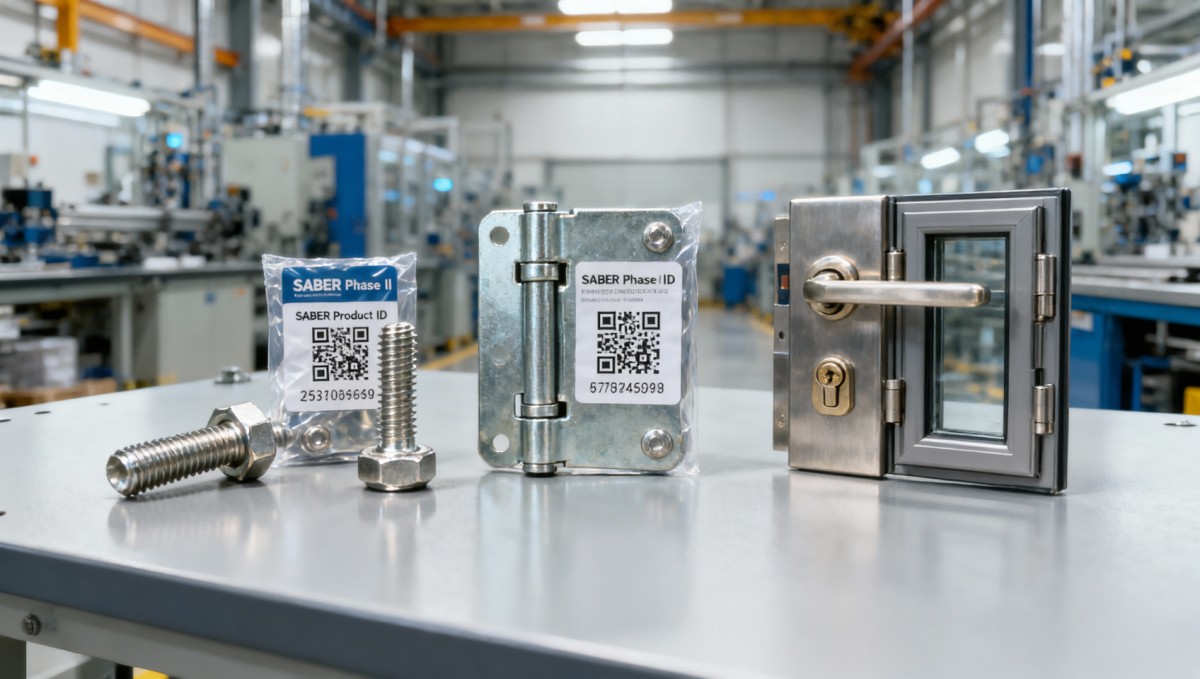
In summary, the SABER Phase II update establishes a new baseline for market access in Saudi Arabia’s construction hardware segment — one defined by verifiable digital evidence and physical product traceability. It is neither a temporary measure nor a symbolic policy gesture, but a binding technical gate for customs clearance. For stakeholders, the current priority is not speculation about future phases, but precise execution against today’s stated requirements.
Source: Official SABER platform notice (SASO, April 2026); SASO Circular No. SABER-PH2-2026-001 (publicly accessible via saber.gov.sa).
Areas under ongoing observation: Potential extension to additional subcategories (e.g., plumbing fixtures, electrical conduits); possible alignment timelines with UAE’s EHS platform or GCC-wide conformity frameworks.
Recommended News
 EU CBAM Carbon Tariff Starts Oct 2026 for Chinese Battery, Cement, Chemical ExportsEU CBAM carbon tariff hits Chinese battery, cement & chemical exports from Oct 2026 — mandatory emissions reporting starts now. Avoid €98/t default fees.
 Mexico NOM-019-SCFI-2026 Effective: Automotive Electronics Require New EMC CertificationMexico NOM-019-SCFI-2026 takes effect May 1, 2026 — new EMC certification mandatory for automotive electronics, EV accessories & aftermarket parts entering Mexico.
 Vietnam Suspends China Irrigation Equipment SASO Mutual RecognitionVietnam suspends China irrigation equipment SASO mutual recognition—urgent QCVN certification now required for drip tapes, sprinklers & smart controllers.
 Red Sea Diversion Normalized; Asia-Europe Freight Premium at $1,850/TEURed Sea diversion normalized: Asia-Europe freight premium holds at $1,850/TEU — impacting manufacturing, retail & procurement. Act now to optimize costs & resilience.
 FDA Drafts AI Bias Assessment Rule for Imported Medical DevicesFDA's new AI bias assessment rule for imported medical devices demands third-party verified fairness reports—act now to prep your 510(k)/De Novo submissions.
 TÜV Rheinland Updates CE Requirements for Servo DrivesTÜV Rheinland updates CE requirements for servo drives: integrated PLd + EN 61800-3 validation mandatory from July 1, 2026. Act now to avoid EU market delays!
 SABER Phase II Launch: Building Hardware Must Submit Digital Type Test Reports & Unique Product IDsSABER Phase II is live: Building hardware exporters must now submit digital type test reports & secure unique SABER Product IDs—avoid customs delays. Act now!
 IMDG Code 41-24 Enforced: New UN3480 Class 9 Label for Lithium Battery Sea FreightIMDG Code 41-24 enforced: UN3480 Class 9 label now mandatory for lithium battery sea freight — avoid delays in US, EU, UAE & Chile ports.
 RCEP Green Packaging Mutual Recognition Takes EffectRCEP Green Packaging Mutual Recognition takes effect Apr 21, 2026—unlock faster customs clearance for compostable, recycled & bio-based packaging in AU, NZ, JP, KR.
 China’s 10-Dept AI Ethics Review Rule for Exported AI DevicesChina’s 10-dept AI ethics review rule mandates algorithmic bias assessments for exported AI devices—key for EU, ME & SEA markets. Stay compliant ahead of enforcement.
 US CPSC Updates Child Sleep Sack Standard Effective July 2026US CPSC updates child sleep sack standard with new DSST test—mandatory for all U.S.-bound infant sleep sacks from July 2026. Act now to ensure compliance and market access.
 Red Sea Rerouting Pushes Asia-Europe Freight Premium to $1,850/TEURed Sea rerouting pushes Asia-Europe freight premium to $1,850/TEU—impacting importers, manufacturers & logistics providers. Act now to reassess costs, lead times & contracts.
 Mexico NOM-019-SCFI-2026 Effective May 1, 2026: EMC Certification Mandatory for Auto ElectronicsNOM-019-SCFI-2026 EMC certification is now mandatory for auto electronics in Mexico—effective May 1, 2026. Ensure compliance for infotainment, ADAS, OBD-II & more.
") TÜV Rheinland Updates CE Requirements for Servo Drives (PLd + EMC Class 3)TÜV Rheinland updates CE requirements for servo drives: PLd + EMC Class 3 joint validation mandatory from Q3 2026. Act now to avoid delays, rejections, or compliance risks.
TÜV Rheinland Updates CE Requirements for Servo Drives (PLd + EMC Class 3)TÜV Rheinland updates CE requirements for servo drives: PLd + EMC Class 3 joint validation mandatory from Q3 2026. Act now to avoid delays, rejections, or compliance risks. SABER Phase II Launch: Building Hardware Must Submit Digital e-CoC & UPISABER Phase II mandates digital e-CoC & UPI for building hardware imports to Saudi Arabia—act now to ensure customs clearance and market access.
 FDA AI Diagnostic Device Draft Rules: Bias Assessment for ImportsFDA AI diagnostic device draft rules mandate bias assessment for imports — discover how algorithmic fairness impacts 510(k)/De Novo submissions and what to do now.
 RCEP Green Packaging Mutual Recognition Starts June 1, 2026RCEP Green Packaging Mutual Recognition starts June 1, 2026 — unlock faster exports to Australia, NZ, Japan & Korea with GB/T 37572-2025 certification.
 Vietnam Suspends SASO Mutual Recognition for Chinese Irrigation EquipmentVietnam suspends SASO mutual recognition for Chinese irrigation equipment—impacting exporters, testers & suppliers. Act now to avoid 6–8 week delays & 35% cost hikes.
 IMDG Code 41-24 Enforces UN3480 Class 9 Labeling for Li-ion Battery Sea FreightIMDG Code 41-24 enforces UN3480 Class 9 labeling for Li-ion battery sea freight—learn mandatory QR labels, compliance actions & port enforcement risks.
 EU CBAM Enters Enforcement Phase on April 1, 2026EU CBAM enforcement starts April 1, 2026 — critical for Chinese battery materials, construction profiles & industrial coatings exporters. Act now to avoid customs delays.
 Mexico Enforces NOM-019-SCFI-2026 EMC Certification for Auto Electronics from May 2026Mexico enforces NOM-019-SCFI-2026 EMC certification for auto electronics from May 2026 — mandatory local testing, stricter standards, and urgent compliance action required.


















Popular Tags
Global Trade Insights & Industry
Our mission is to empower global exporters and importers with data-driven insights that foster strategic growth.
Search News
Popular Tags
Industry Overview
The global commercial kitchen equipment market is projected to reach $112 billion by 2027. Driven by urbanization, the rise of e-commerce food delivery, and strict hygiene regulations.