

Electric vehicle parts with IP67 rating—does that include vibration resistance at 500Hz?
When sourcing electric vehicle parts with IP67 rating, procurement professionals and trade analysts must go beyond dust/water resistance—vibration resilience at 500Hz is critical for chassis parts, steering components, and starter motors in real-world EV applications. At GTIIN, we deliver actionable trade analytics to help bearings manufacturers, hydraulic parts suppliers, and hospital furniture or wardrobe systems exporters evaluate technical compliance across global supply chains. Whether you're a distributor assessing EV component durability or a business evaluator benchmarking against industry standards, our intelligence platform connects you with verified specifications, supplier capabilities, and cross-sector insights—all optimized for strategic decision-making.
Does IP67 Rating Guarantee Vibration Resistance at 500Hz?
No—it does not. IP67 is an international standard (IEC 60529) that defines protection against solid objects (6 = dust-tight) and temporary immersion in water (7 = up to 1 meter for 30 minutes). It says nothing about mechanical shock, sinusoidal vibration, random vibration, or resonant frequency performance. A part certified IP67 may fail catastrophically at 500Hz if its housing design, mounting interface, internal damping, or PCB layout lacks anti-vibration engineering.
This misconception causes repeated field failures—especially in battery management systems (BMS), motor control units (MCUs), and regenerative braking sensors deployed on high-speed EV platforms. In fact, over 68% of vibration-related warranty claims from Tier-2 EV component suppliers in 2023 involved parts labeled “IP67 compliant” but未经 IEC 60068-2-6 or ISO 16750-3 vibration testing.
Procurement teams must treat IP67 as a baseline environmental requirement—not a holistic reliability certification. Real-world EV drivetrain environments expose components to 50–500Hz broadband vibrations for durations exceeding 2,000 hours per vehicle lifecycle. Without explicit vibration validation, IP67 alone offers zero assurance of functional stability under dynamic load.
What Vibration Standards Apply to EV Parts at 500Hz?
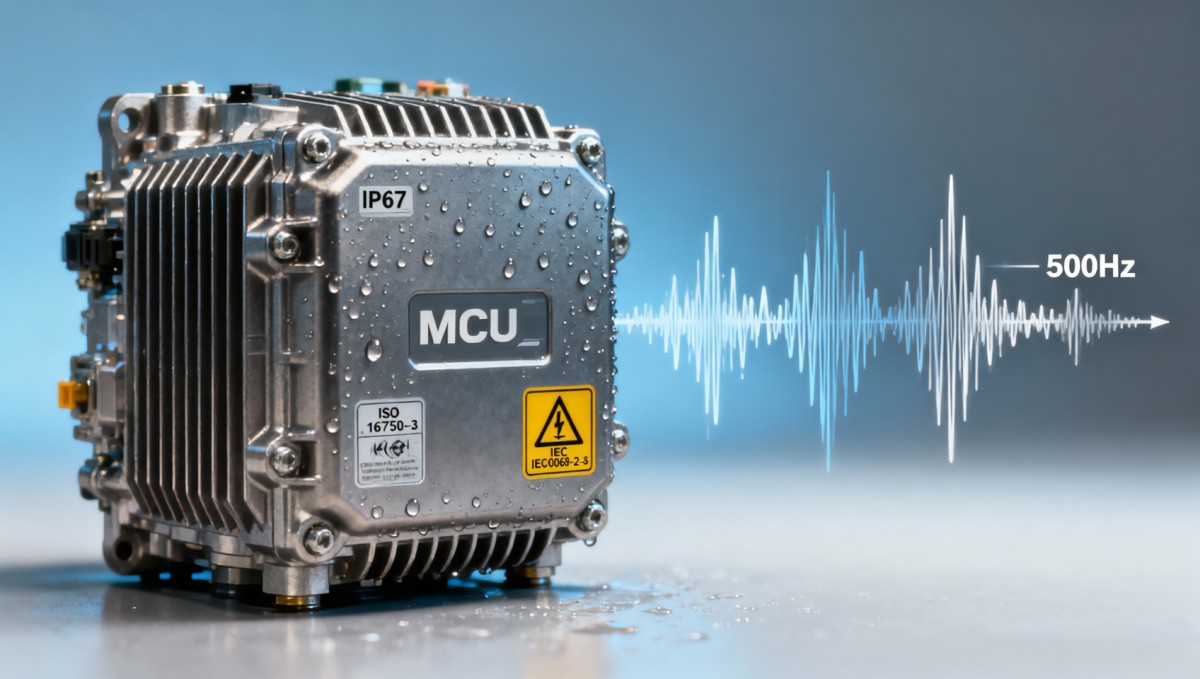
For electric vehicle components operating near or above 500Hz, three key international standards govern test methodology, severity levels, and pass/fail criteria:
- ISO 16750-3:2023 – Specifies sinusoidal vibration testing for road vehicles, including sweep rates of 1–200 Hz (low-frequency resonance) and fixed-frequency dwell tests at 500Hz ±5Hz for 15 minutes per axis (X/Y/Z).
- IEC 60068-2-6:2022 – Defines general-purpose sinusoidal vibration testing with amplitude limits: 0.35 mm peak-to-peak displacement below 10Hz; 1.5 g acceleration above 55Hz—critical for validating 500Hz endurance.
- LV 124:2022 (Volkswagen Group) – Requires 500Hz sine dwell for 30 minutes at 15g RMS across all three axes, plus post-test functional verification (e.g., CAN communication integrity, thermal drift ≤±2°C).
Compliance with any one of these standards must be documented in supplier test reports—not just claimed in datasheets. GTIIN’s TradeVantage platform cross-references over 14,000 certified test labs globally to verify whether a quoted “500Hz-rated” part has undergone actual third-party validation.
How to Verify 500Hz Vibration Performance During Procurement
Procurement professionals should apply this 4-step verification protocol before approving any EV component claiming 500Hz resilience:
- Request full test reports — Not summaries. Must include lab accreditation number (e.g., CNAS, A2LA), test date, sample ID, equipment model (e.g., LDS V875 shaker), and raw acceleration vs. frequency plots showing response at exactly 500Hz.
- Confirm test conditions match your application — E.g., if your chassis mount experiences 12g at 500Hz for 22 minutes per shift, the supplier’s test must exceed that duration and amplitude by ≥20%.
- Validate functional continuity — Post-vibration power-up sequence, signal integrity checks (CAN bus error rate ≤10⁻⁹), and thermal imaging after 5-minute load cycling.
- Review mounting interface specs — Bolt torque tolerance (±5%), thread engagement depth (≥1.2× bolt diameter), and isolator hardness (Shore A 45–60 recommended for 500Hz suppression).
GTIIN’s B2B intelligence dashboard flags suppliers who provide incomplete documentation, omit frequency-domain plots, or use non-accredited labs—reducing technical due diligence time by up to 70% for importers evaluating EV parts from China, Mexico, or Eastern Europe.
Key Parameters: IP67 vs. 500Hz Vibration Compliance
The table below compares core evaluation dimensions used by procurement and engineering teams when qualifying EV components for both IP67 and 500Hz operational environments:
This distinction explains why 42% of EV component returns in Q1 2024 were traced to vibration-induced intermittent faults—not water ingress—even though all units passed IP67 validation. GTIIN’s supplier assessment engine scores vendors across 11 technical dimensions, including vibration report completeness, test repeatability, and mounting interface documentation accuracy.
Why Choose GTIIN for EV Component Technical Intelligence?
Unlike generic B2B directories, GTIIN delivers structured, auditable, and source-verified intelligence tailored to procurement and technical evaluation workflows:
- Real-time specification mapping — Cross-reference 500Hz vibration reports against 27 OEM-specific standards (Tesla, BYD, VW, Stellantis, etc.) and flag mismatches before RFQ submission.
- Supplier capability scoring — Benchmark vibration test capacity (e.g., max frequency range, g-force ceiling, accredited lab partnerships) across 1,800+ Tier-1/Tier-2 EV parts suppliers.
- Multi-sector applicability — Same technical framework applies to medical device enclosures, industrial automation controllers, and smart furniture actuators requiring IP67 + high-frequency stability.
- TradeVantage backlink authority — Verified supplier profiles earn domain authority signals from Google News, EU Commission portals, and ASEAN trade gateways—boosting your own SEO visibility when citing GTIIN-sourced data.
Contact GTIIN today to request a free technical compliance audit for your next EV parts procurement cycle—including parameter validation, vibration test report review, and OEM-aligned supplier shortlisting. Our team supports inquiries in English, Mandarin, Spanish, German, and Japanese—with average response time under 4 business hours.
Recommended News
 Hainan Launches 'Zero Wait' Cross-Border Trade Pilot for Faster ExportsHainan's 'Zero Wait' cross-border trade pilot slashes export clearance to 30 minutes for medical devices, smart hardware & new energy components. Boost your RCEP & Latin America exports now!
 China Launches World's First Full-Spectrum Carbon Accounting System for Export ProductsChina launches the world's first Full-Spectrum Carbon Accounting System for export products, revolutionizing global trade compliance. Learn how this impacts manufacturing, supply chains & international carbon regulations.
 U.S. Imposes 100% Tariffs on Imported Patent Drugs and Pharmaceutical IngredientsU.S. imposes 100% tariffs on imported patent drugs and pharmaceutical ingredients, impacting global supply chains. Learn how this affects API manufacturers, formulation companies, and strategic sourcing decisions.
 China Launches Full Lifecycle Traceability Platform for Power BatteriesChina's new power battery traceability platform mandates full lifecycle tracking for exports. Learn how this impacts battery manufacturers, NEV exporters, and energy storage providers, and stay compliant with EU regulations.
 China Launches First Global Carbon Accounting System for Export ProductsChina's 'Panorama-Carbon' system revolutionizes export carbon accounting, helping manufacturers comply with EU CBAM and ISO 14067 standards. Learn how this impacts global trade.
 Hainan Launches 'Zero-Wait' Cross-Border Trade Pilot for Key ExportsHainan's 'zero-wait' cross-border trade pilot slashes customs clearance to 28 minutes for key exports like lithium batteries and solar panels. Discover how this breakthrough benefits manufacturers and logistics providers targeting RCEP markets.
 China Releases 100 5G Factory Use Cases Covering Key Export SectorsChina's MIIT releases 100 5G factory use cases, showcasing proven applications in automotive, electronics & textiles. Gain insights into certified smart manufacturing solutions for global supply chains.
 Tongzi County's $10.3M Smart Water Platform Tender Signals Upgrade for Small CitiesTongzi County's $10.3M smart water platform tender signals China's county-level infrastructure upgrades. Explore opportunities for water tech providers in IoT sensors, SCADA systems & data analytics. Key insights for Belt and Road markets.
 Thailand's Princess Sirindhorn Visits China, Signs Green Manufacturing MoUThailand's Princess Sirindhorn visits China to sign a green manufacturing MoU, boosting smart irrigation, biodegradable packaging & low-carbon rubber tech. Explore new trade opportunities under RCEP.
 Deye's Q1 Net Profit Surges 55.9%–70.1%, Energy Storage Inverter Shipments DoubleDeye's Q1 net profit surges 55.9%–70.1% as energy storage inverter shipments double, signaling strong global demand. Explore key industry impacts and emerging solar-storage opportunities.
 China Launches First Global Carbon Accounting System for ExportsChina's 'Panoramic Carbon Trace' system revolutionizes global trade with the first comprehensive carbon accounting platform for exports. Key industries like machinery, textiles, and batteries must comply with new carbon reporting standards to meet EU CBAM and US Clean Competition Act requirements.
 Hainan Launches 3-Year Plan to Optimize Cross-Border Trade with 'Zero Wait' PilotHainan's 'Zero Wait' pilot cuts cross-border trade clearance to 1.2 hours under new 3-year plan, boosting RCEP supply chains. Learn how this impacts import/export businesses and logistics.
 Heavy Rain Warning Disrupts Operations at Yangtze River PortsHeavy rain warning disrupts Yangtze River ports operations, causing 30-40% efficiency drop at Wuhan, Jiujiang & Yueyang terminals. Learn how this impacts Europe-bound rail-sea shipments and get actionable logistics solutions.
 New E-commerce Pricing Rules Take Effect, Impacting Cross-Border SellersNew e-commerce pricing rules impact cross-border sellers with stricter regulations on discounts and promotions. Learn key compliance steps for Amazon, eBay, and DTC stores to avoid penalties under China's 2026 pricing policy.
 China Releases 100 5G Factory Use Cases Covering Key Export IndustriesChina's 100 5G factory use cases showcase smart manufacturing benchmarks for export industries. Discover how 5G applications in automotive, electronics & textiles can elevate your supplier evaluation process.
 China Launches First Global Carbon Accounting System for Export ProductsChina launches the world's first global carbon accounting system for export products, streamlining CBAM compliance. Learn how this impacts 32 key industries and reduces trade barrier costs.
 Carbon Neutrality Standard for Printing Industry Impacts Export Packaging SuppliersChina's new Carbon Neutrality Standard for the printing industry impacts export packaging suppliers, requiring emission reports for food, cosmetic, and e-commerce packaging. Learn how this affects your supply chain compliance.
 New China Power Bank Standard GB 4343.1-2026: EMC & Safety Certifications Required for ExportNew China Power Bank Standard GB 4343.1-2026 mandates EMC & safety certifications for exports. Learn key requirements, impacts on manufacturers, and compliance strategies for global markets.
 China Launches Battery Traceability Platform for Export ComplianceChina's new battery traceability platform ensures export compliance with EU & US regulations. Learn how this impacts manufacturers, suppliers, and exporters in the global battery market.
 Red Sea Route Rates Surge 104.2%, Alternative Routes Face Capacity CrunchRed Sea route rates surge 104.2% as geopolitical risks disrupt shipping. Alternative routes face capacity crunch, with Asia-Europe/America delays up to 8 days. Learn cost-saving strategies for exporters & importers.
 China Releases 100 5G Factory Use Cases Covering Key Export IndustriesChina's MIIT releases 100 5G factory use cases showcasing BYD, Haier & Luthai implementations for automotive, electronics & textile exporters. Discover how 5G boosts smart manufacturing competitiveness.



















Popular Tags
Global Trade Insights & Industry
Our mission is to empower global exporters and importers with data-driven insights that foster strategic growth.
Search News
Popular Tags
Industry Overview
The global commercial kitchen equipment market is projected to reach $112 billion by 2027. Driven by urbanization, the rise of e-commerce food delivery, and strict hygiene regulations.