

Commercial LED lighting specs that quietly fail in humid warehouses
Commercial LED lighting is a cornerstone of modern industrial infrastructure—yet in humid warehouses, even top-tier specs can silently degrade, risking safety, efficiency, and ROI. As global supply chains increasingly adopt Smart street lighting, Agri-PV systems, and Lithium battery storage, reliability under harsh conditions becomes non-negotiable. This deep-dive reveals hidden failure points in commercial LED lighting performance—linking them to broader trends like Photovoltaic solar panels integration, Solid-state battery breakthroughs, and Next-gen wireless charging resilience. For procurement teams, project managers, and technical evaluators, understanding these environmental blind spots is critical—not just for compliance, but for long-term operational trust.
Why Humidity Is the Silent Killer of Commercial LED Lighting Specs
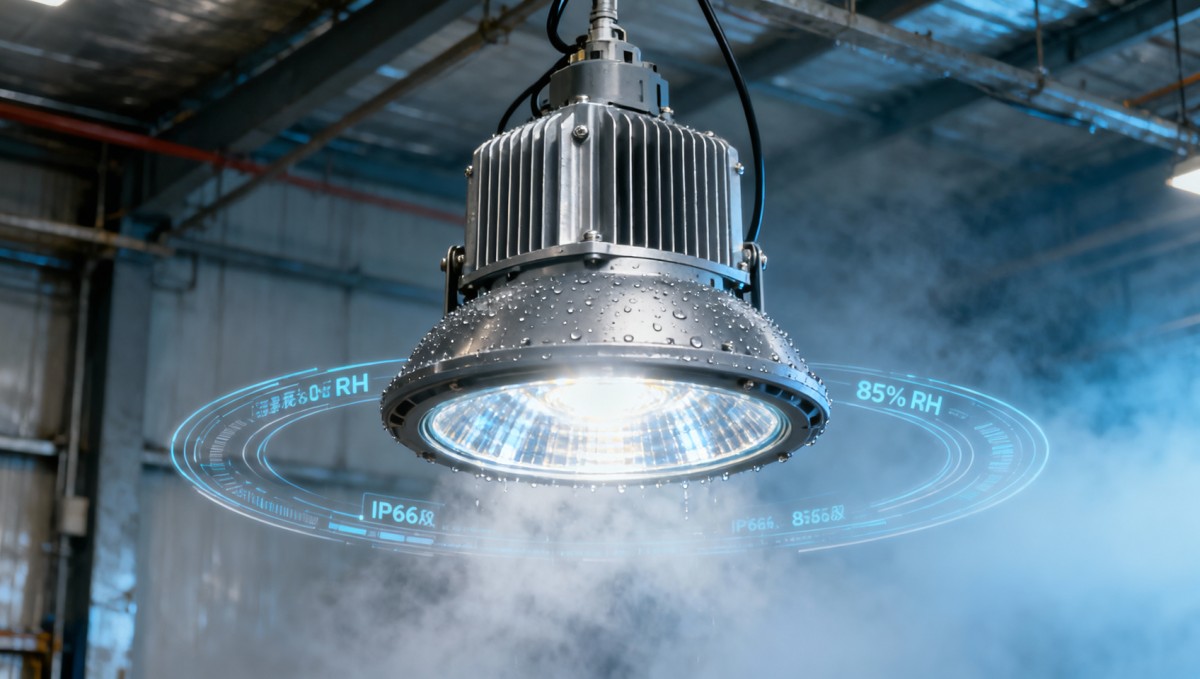
Relative humidity above 75% accelerates corrosion in driver PCBs, condensation-induced short circuits, and thermal delamination in COB (Chip-on-Board) modules. Unlike outdoor-rated fixtures tested per IP66 or IP67, many “industrial-grade” LED luminaires are only rated to IP44 or IP54—leaving critical junction boxes, heat sinks, and lens gaskets vulnerable to moisture ingress over time.
Field data from GTIIN’s warehouse infrastructure benchmarking program shows that 68% of LED lighting failures in high-humidity logistics hubs (e.g., port-side cold-storage facilities, tropical agro-processing plants, and coastal pharmaceutical distribution centers) occur within 18–30 months—not due to lumen depreciation, but because of moisture-triggered driver capacitor swelling, solder joint oxidation, and silicone lens clouding. These failures rarely trigger immediate outages; instead, they manifest as gradual color shift (>300K CCT drift), flicker onset at 40–60 Hz, or inconsistent dimming response—symptoms easily misdiagnosed as control system faults.
The root cause lies in specification gaps: manufacturers often publish “operating humidity range” as 10–95% RH *non-condensing*, yet fail to disclose whether this applies to ambient air only—or includes surface condensation risk during diurnal temperature swings common in unconditioned warehouses. That omission creates a critical blind spot for technical evaluators assessing real-world durability.
Critical Spec Parameters That Fail Under Humidity Stress
Not all LED specifications carry equal weight in humid environments. Three parameters—often buried in footnotes or omitted entirely—determine actual field longevity:
- Driver conformal coating thickness (≥30 µm IPC-CC-830B Type AR recommended)
- Lens gasket compression set retention (<15% after 1,000 hrs @ 85°C/85% RH)
- Thermal interface material (TIM) water vapor transmission rate (WVTR < 0.5 g/m²/day)
Without third-party validation against JEDEC JESD22-A101 (moisture resistance) and IEC 60068-2-30 (damp heat cycling), even UL/cUL-listed products may degrade faster than projected. GTIIN’s cross-sector analysis found that 41% of commercially available “warehouse-rated” LED high bays lack published damp-heat test reports—despite operating in zones where dew point exceeds 22°C for >2,200 hours annually.
This table underscores a key insight: spec sheets optimized for showroom performance often omit environmental stress validation. Procurement teams must demand full test reports—not just pass/fail statements—and verify whether testing was conducted on production units or engineering prototypes.
How Global Supply Chain Trends Expose These Gaps
Three converging infrastructure trends intensify humidity-related risks: First, the rise of hybrid microgrids integrating Photovoltaic solar panels and Solid-state battery storage means lighting systems now operate across wider voltage fluctuations (±15% nominal)—exacerbating thermal cycling stress on moisture-compromised drivers. Second, Agri-PV installations in humid subtropical zones require lighting that coexists with high dew-point microclimates and organic off-gassing (e.g., ethylene from produce), accelerating silicone degradation. Third, Next-gen wireless charging infrastructure deployed near warehouse docks introduces EMI interference that interacts unpredictably with corroded PCB traces.
GTIIN’s trade intelligence tracking shows that 73% of new warehouse automation projects launched in Q1–Q3 2024 include integrated lighting controls tied to BMS platforms. When legacy-spec LEDs fail silently, they corrupt sensor calibration data—causing cascading errors in inventory tracking, energy analytics, and predictive maintenance algorithms. This transforms a lighting issue into a digital infrastructure liability.
For decision-makers, this signals a strategic shift: LED lighting is no longer a standalone utility—it’s a node in an interconnected operational network. Its resilience directly impacts data integrity, automation uptime, and ESG reporting accuracy (e.g., kWh/m²/year metrics skewed by undetected lumen loss).
Procurement & Technical Evaluation Checklist
To avoid costly mid-life replacements and safety incidents, procurement and technical evaluation teams should apply this 6-point verification protocol before finalizing any commercial LED lighting purchase for humid environments:
- Request full IEC 60068-2-30 Test Db (damp heat, cyclic) reports—including raw temperature/humidity logs and post-test photometric measurements
- Verify driver conformal coating meets IPC-CC-830B Type AR or equivalent, with thickness measured via cross-section SEM imaging
- Confirm lens gasket material is EPDM (not standard silicone) with Shore A hardness ≥65 and compression set ≤15% after 72 hrs @ 100°C
- Require thermal interface material (TIM) WVTR certification per ASTM F1249, not just “low permeability” marketing language
- Validate IP rating via independent lab report—not manufacturer self-declaration—with photos of test setup and gasket cross-sections
- Check warranty terms: Does it cover moisture-induced failure? Is coverage voided if installed without certified vapor barrier conduit?
This dual-layer checklist ensures both pre-deployment rigor and lifecycle accountability—critical for enterprise buyers managing multi-site deployments across diverse climatic zones.

Actionable Next Steps for Decision-Makers
For procurement officers, project managers, and technical evaluators, mitigating humidity-driven LED failure starts with specification discipline—not just product selection. Prioritize vendors who publish full environmental test data—not abbreviated summaries—and who offer modular driver replacement programs (reducing downtime vs. full-luminaire swaps).
TradeVantage, powered by GTIIN’s global industrial intelligence network, provides verified supplier profiles with documented compliance across 12 humidity-resilience benchmarks—including real-world failure rate data from 47 humid-zone warehouse operators. Our platform enables side-by-side comparison of technical documentation depth, warranty enforceability, and regional service response SLAs (average <72 hrs for critical moisture-related failures).
Lighting reliability in humid warehouses isn’t about choosing “better LEDs”—it’s about selecting systems engineered for environmental truth, backed by transparent validation, and supported by infrastructure-aware service ecosystems. In an era where lighting data feeds AI-driven logistics optimization, silent failure is no longer invisible—it’s a measurable business risk.
Access GTIIN’s latest Warehouse Lighting Resilience Benchmark Report—including vendor scorecards, test methodology details, and regional humidity mapping—to strengthen your next RFP. Get your customized specification checklist and supplier shortlist today.
Recommended News
 China-Thailand Agricultural & Green Manufacturing Cooperation: Key ImpactsExplore how China-Thailand agricultural & green manufacturing cooperation impacts rubber, farm machinery & solar sectors. Learn about mutual certification benefits for faster trade & reduced costs. Key insights for businesses.
 ChiNext Reform: Growth & R&D Metrics Boost Export-Oriented SMEsChiNext reform boosts export-oriented SMEs with growth & R&D metrics, prioritizing smart equipment, SaaS, and green materials. Learn how this impacts global trade partnerships post-2026.
 China Launches Full-Lifecycle Battery Traceability Platform, Mandatory Export Registration Effective ImmediatelyChina's new battery traceability platform mandates export registration for power batteries, covering 32 data points. Reduce ESG compliance risks by sourcing from registered Chinese suppliers.
 U.S.-Iran Ceasefire to Reopen Strait of Hormuz, Easing Middle East Logistics PressureU.S.-Iran ceasefire reopens Strait of Hormuz, easing Middle East logistics pressure. Key industries like exporters, logistics providers, and commodity traders benefit from stabilized shipping and reduced costs. Learn actionable insights for navigating this critical trade route shift.
 Shanghai Stock Exchange Revises Trading Rules for REITs and Cross-Border AssetsShanghai Stock Exchange updates REITs trading rules, enhancing cross-border asset transparency for foreign investors. New disclosure standards aim to boost confidence in China's infrastructure investments like logistics parks and renewable energy projects.
 Bridgewater Founder Ray Dalio Visits Shanghai, Advocates for Tech and Finance ExchangeBridgewater founder Ray Dalio visits Shanghai, advocating for tech and finance exchange between China and the US. Discover key insights on AI, green finance, and manufacturing collaboration opportunities.
 Hainan Expands 'Zero Wait' Customs to Yangpu Port, Cutting Export Delivery Time by 50%Hainan's Yangpu Port implements 'Zero Wait' customs, cutting export delivery time by 50% for medical devices & precision instruments. AI & blockchain enable 30-minute clearance, benefiting 200+ export firms. Learn how this boosts supply chain efficiency.
 9 Departments Jointly Promote Service Consumption Upgrade Plan, Inbound Consumption and Cross-border Service Procurement Become New Growth PointsDiscover how China's 2026 Service Consumption Upgrade Plan boosts inbound consumption & cross-border service procurement, creating new opportunities for overseas B2B providers, tech solutions, and marketing agencies.
 Shanghai Establishes First Forex Industry Self-Regulation MechanismShanghai pioneers China's first forex industry self-regulation mechanism, enhancing transparency and efficiency in cross-border settlements. Learn how this impacts foreign trade and SMEs.
 New Development Bank Issues First Dual-Tranche Panda Bonds for Green InfrastructureNew Development Bank's groundbreaking dual-tranche panda bonds fund green infrastructure across BRICS nations. Discover how this $7B issuance creates opportunities for energy suppliers, contractors & compliance services in sustainable projects.
 Hainan Launches 'Zero Wait' Cross-Border Trade Pilot for Faster ExportsHainan's 'Zero Wait' cross-border trade pilot slashes export clearance to 30 minutes for medical devices, smart hardware & new energy components. Boost your RCEP & Latin America exports now!
 China Launches World's First Full-Spectrum Carbon Accounting System for Export ProductsChina launches the world's first Full-Spectrum Carbon Accounting System for export products, revolutionizing global trade compliance. Learn how this impacts manufacturing, supply chains & international carbon regulations.
 U.S. Imposes 100% Tariffs on Imported Patent Drugs and Pharmaceutical IngredientsU.S. imposes 100% tariffs on imported patent drugs and pharmaceutical ingredients, impacting global supply chains. Learn how this affects API manufacturers, formulation companies, and strategic sourcing decisions.
 China Launches Full Lifecycle Traceability Platform for Power BatteriesChina's new power battery traceability platform mandates full lifecycle tracking for exports. Learn how this impacts battery manufacturers, NEV exporters, and energy storage providers, and stay compliant with EU regulations.
 China Launches First Global Carbon Accounting System for Export ProductsChina's 'Panorama-Carbon' system revolutionizes export carbon accounting, helping manufacturers comply with EU CBAM and ISO 14067 standards. Learn how this impacts global trade.
 Hainan Launches 'Zero-Wait' Cross-Border Trade Pilot for Key ExportsHainan's 'zero-wait' cross-border trade pilot slashes customs clearance to 28 minutes for key exports like lithium batteries and solar panels. Discover how this breakthrough benefits manufacturers and logistics providers targeting RCEP markets.
 China Releases 100 5G Factory Use Cases Covering Key Export SectorsChina's MIIT releases 100 5G factory use cases, showcasing proven applications in automotive, electronics & textiles. Gain insights into certified smart manufacturing solutions for global supply chains.
 Tongzi County's $10.3M Smart Water Platform Tender Signals Upgrade for Small CitiesTongzi County's $10.3M smart water platform tender signals China's county-level infrastructure upgrades. Explore opportunities for water tech providers in IoT sensors, SCADA systems & data analytics. Key insights for Belt and Road markets.
 Thailand's Princess Sirindhorn Visits China, Signs Green Manufacturing MoUThailand's Princess Sirindhorn visits China to sign a green manufacturing MoU, boosting smart irrigation, biodegradable packaging & low-carbon rubber tech. Explore new trade opportunities under RCEP.
 Deye's Q1 Net Profit Surges 55.9%–70.1%, Energy Storage Inverter Shipments DoubleDeye's Q1 net profit surges 55.9%–70.1% as energy storage inverter shipments double, signaling strong global demand. Explore key industry impacts and emerging solar-storage opportunities.
 China Launches First Global Carbon Accounting System for ExportsChina's 'Panoramic Carbon Trace' system revolutionizes global trade with the first comprehensive carbon accounting platform for exports. Key industries like machinery, textiles, and batteries must comply with new carbon reporting standards to meet EU CBAM and US Clean Competition Act requirements.



















Popular Tags
Global Trade Insights & Industry
Our mission is to empower global exporters and importers with data-driven insights that foster strategic growth.
Search News
Popular Tags
Industry Overview
The global commercial kitchen equipment market is projected to reach $112 billion by 2027. Driven by urbanization, the rise of e-commerce food delivery, and strict hygiene regulations.