

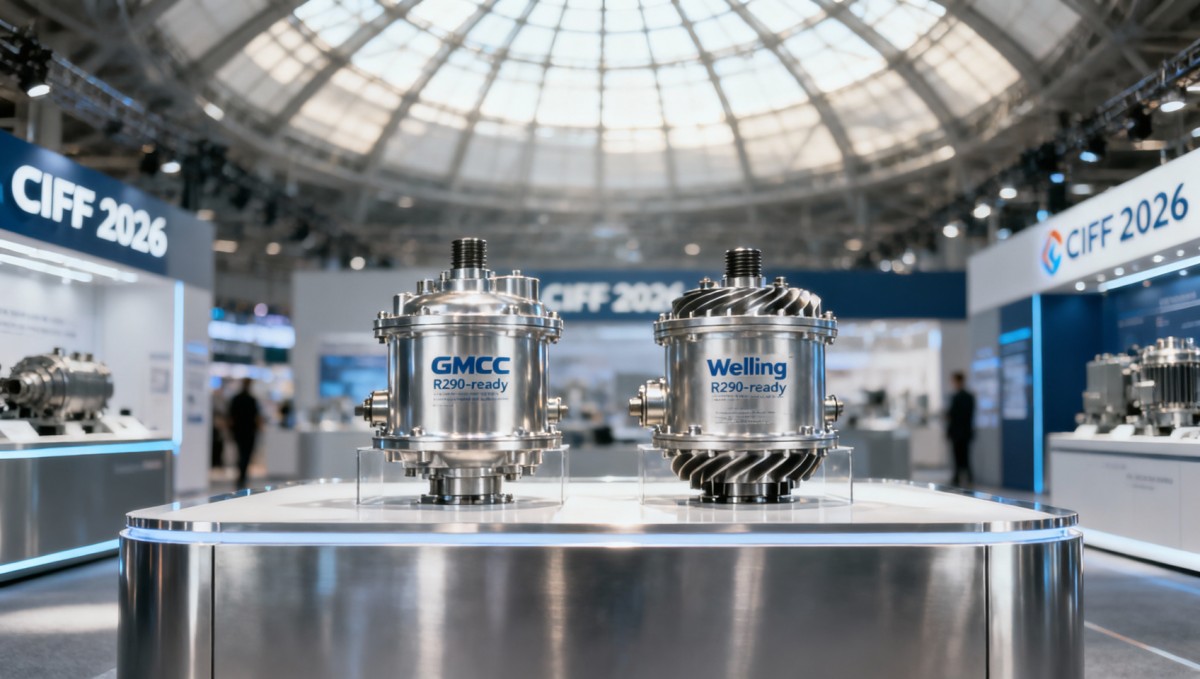
GMCC & Welling Showcase R290-Ready Compressors at CIFF 2026
From April 15–17, 2026, GMCC (Meizhi) and Welling showcased R290-compatible scroll and rotary compressors at the China Import and Export Fair (CIFF), highlighting ultra-low noise (≤22 dB(A)), high IPLV efficiency, and adaptation to EU F-Gas III, US DOE 2026, and Middle East high-temperature operating conditions. HVAC system integrators in key export markets have begun specifying ‘R290-ready’ as a mandatory technical requirement in 2026 tenders — a development with direct implications for exporters, component suppliers, and HVAC OEMs serving regulated regions.
Event Overview
Between April 15 and 17, 2026, GMCC Meizhi and Welling presented scroll and rotary compressors at the Canton Fair. These units are certified for use with R290 refrigerant, achieve an IPLV rating classified as ‘ultra-high efficiency’, and operate at sound pressure levels of ≤22 dB(A). The compressors are engineered for compliance with the EU’s F-Gas Regulation Phase III, the U.S. Department of Energy’s 2026 efficiency standards, and thermal resilience under Middle Eastern ambient conditions. Publicly reported information confirms that overseas HVAC system integrators have incorporated ‘R290-ready’ as a non-negotiable clause in 2026 procurement specifications.
Industries Affected by This Development
Direct Exporters of HVAC Equipment
Exporters supplying packaged or split-system air conditioners to the EU, U.S., or Gulf Cooperation Council (GCC) markets may face immediate tender disqualification if their current compressor supply chain lacks R290 compatibility. Impact manifests in bid eligibility, certification timelines, and post-sale service documentation requirements — especially where refrigerant handling, labeling, and safety training are mandated under local regulations.
Component Procurement & Sourcing Teams
Procurement functions at HVAC OEMs must now verify not only compressor efficiency ratings but also refrigerant-specific safety certifications (e.g., A2L classification, charge limits, enclosure testing). Impact includes revised vendor qualification checklists, extended lead times for R290-compliant validation reports, and potential re-engineering of condensing units to accommodate lower-charge R290 systems.
Contract Manufacturers & Tier-2 Assembly Facilities
Manufacturers performing final assembly or sub-assembly for branded HVAC products may need to adjust production line protocols: updated leak detection procedures, modified charging stations, staff retraining on A2L handling, and revised packaging to meet transport regulations for flammable refrigerants. Impact is operational — affecting throughput, audit readiness, and compliance documentation traceability.
Distribution & Aftermarket Service Providers
Wholesalers and service networks distributing compressors or servicing field-installed units will encounter stricter logistics and storage rules for R290-capable components. Impact includes warehouse zoning requirements, technician certification mandates, and limitations on cross-border shipment documentation — particularly relevant for distributors operating across EU member states or GCC countries.
What Relevant Enterprises or Practitioners Should Focus On Now
Monitor official updates on refrigerant-specific implementation timelines
While EU F-Gas III and U.S. DOE 2026 standards are confirmed, national-level enforcement guidance — such as acceptable R290 charge thresholds per equipment type, or certification pathways for imported compressors — remains under active revision. Stakeholders should track updates from the European Commission’s Joint Research Centre (JRC), U.S. AHRI, and GCC Standardization Organization (GSO).
Verify R290-readiness beyond marketing claims
‘R290-ready’ is increasingly used in supplier communications, but actual compliance requires documented evidence: third-party test reports for flammability classification (ISO 817), charge limit validation, and mechanical safety design verification (e.g., burst pressure margins, electrical isolation). Buyers should request full technical dossiers — not just datasheets — before committing to new compressor platforms.
Distinguish between regulatory signal and commercial readiness
The inclusion of ‘R290-ready’ in 2026 tenders signals growing buyer-side risk mitigation — not yet universal market adoption. Analysis来看, this reflects procurement caution rather than full-scale product redesign across all tiers. Enterprises should prioritize pilots in high-compliance markets (e.g., Germany, California, UAE) before scaling across broader portfolios.
Prepare for upstream coordination on safety documentation and training
Supply chain alignment is required on refrigerant-specific safety data sheets (SDS), technician training records, and field service bulletins. Current more suitable preparation includes initiating internal cross-functional reviews (R&D, QA, Logistics, Regulatory Affairs) and mapping documentation gaps against IEC 60335-2-40 and EN 378-1:2022 requirements.
Editorial Perspective / Industry Observation
This CIFF 2026 showcase is better understood as a policy-aligned capability signal — not yet a de facto market standard. From industry angle, it confirms that R290 transition is moving from R&D labs into procurement gateways, but adoption remains conditional on application scope, regional enforcement rigor, and end-user acceptance of A2L safety protocols. Observation来看, the ≤22 dB(A) noise specification alongside R290 compatibility suggests a convergence of environmental, efficiency, and user-experience requirements — indicating that future compliance will be multidimensional, not refrigerant-only. Continued attention is warranted because tender language shifts often precede formal regulation updates by 12–18 months.
Conclusion
At present, this development signifies tightening technical gatekeeping in HVAC export markets — driven less by blanket bans and more by granular, performance-linked procurement clauses. It does not imply immediate obsolescence of R410A or R32 platforms, but does require targeted readiness for R290 integration in specific product lines and geographies. More appropriately, it should be interpreted as an early-stage operational benchmark for exporters aiming to retain access to high-compliance markets beyond 2026.
Information Sources
Primary source: Official announcements and technical briefings issued by GMCC Meizhi and Welling during CIFF Spring 2026 (April 15–17, 2026).
Note: Ongoing monitoring is recommended for national-level implementation guidance from EU Member States, U.S. DOE rulemaking dockets, and GSO technical circulars — none of which were finalized or publicly referenced in the original event materials.
Recommended News
 2026 Jan–Feb Paper Industry Profits +6.1%; Green Packaging Export Premium EmergesGreen packaging export premium drives +6.1% paper industry profits in Jan–Feb 2026 — discover how FSC/PEFC certification and water-based processes boost margins for eco-friendly, food & cosmetics packaging exporters.
 Desay SV Automotive Files for H-Share Listing, Boosts Supply Chain TransparencyDesay SV Automotive's H-share listing filing boosts supply chain transparency — key for car electronics exporters, PCB suppliers & IATF 16949-certified manufacturers.
 NetEase Interactive Entertainment Market Head Moves OverseasNetEase Interactive Entertainment's marketing head moves overseas—key signal for AI, mobile accessories & wearables exporters targeting NA, EU, JP, KR markets.
 Nanchang Qingyunpu Solar+EMC Project Tender Signals Global ShiftNanchang Qingyunpu Solar+EMC tender signals global shift to performance-based energy solutions—key for solar, lighting & smart factory exporters.
 China Launches Battery Lifecycle Traceability PlatformChina’s Battery Lifecycle Traceability Platform is live: mandatory GS1 registration for NEV & C&I battery exports starts April 1, 2026—ensure compliance now!
 US Military Restricts Arabian Sea East of Strait of HormuzUS Military Restricts Arabian Sea east of Strait of Hormuz—impacting solar PV, water treatment & fire safety exports to GCC. Act now to mitigate 12–18 day delays & 25% insurance hikes.
 Horizon Robotics Launches 'Starry Sky' Cockpit-ADAS Fusion ChipHorizon Robotics 'Starry Sky' cockpit-ADAS fusion chip launches April 2026 — cut BOM costs up to $400/vehicle. Key for exporters targeting MENA & ASEAN.
 China's Construction Machinery Exports Up 33.4% YoY in Jan–Feb 2026China's construction machinery exports surged 33.4% YoY in Jan–Feb 2026—driven by localized service in MEA & LatAm. Discover what this means for your global equipment strategy.
 EU CBAM Steel Carbon Tariff Takes Full Effect on Jan 1, 2026EU CBAM steel carbon tariff takes full effect Jan 1, 2026—exporters must submit verified lifecycle emissions data now. Act before delays & rejections hit.
 Japan Boosts Rapidus with ¥631.5B; China Semiconductor Export Opportunities RiseJapan’s ¥631.5B Rapidus boost unlocks China semiconductor export opportunities—especially in high-purity chemicals, precision components & cleanroom equipment. Act now.
 EU REACH Adds 12 SVHCs: Impact on China's Chemical, Plastic & Coating ExportsEU REACH adds 12 SVHCs, impacting China's chemical, plastic & coating exports. Learn key compliance actions & market risks before the Oct 2026 deadline.
 China Launches First Global Battery Lifecycle Traceability PlatformChina launches the first global battery lifecycle traceability platform, revolutionizing EV and energy storage compliance. Learn how this impacts manufacturers, exporters, and recyclers worldwide.
 Vietnam's Home Energy Storage Demand Doubles, Boosting Chinese ExportsVietnam's home energy storage demand doubles, boosting Chinese exports of inverters & LFP batteries. Learn how 217% export growth creates opportunities amid power instability.
 EU REACH Adds 12 SVHCs: China's Chemical, Plastic, and Coating Exports Must Comply Within 6 MonthsEU REACH adds 12 new SVHCs, impacting China's chemical, plastic, and coating exports. Companies must comply with SCIP notifications within 6 months. Learn key actions for affected industries.
 China Releases 100 5G Factory Applications Covering Key Export IndustriesChina's MIIT releases 100 5G factory applications, transforming key export industries like automotive, PCB, and textiles. Discover how these smart manufacturing solutions impact global supply chains and supplier evaluations.
 U.S.-Iran Ceasefire Takes Effect, Strait of Hormuz Shipping Returns to Normal, Middle East Logistics Costs Drop 35%U.S.-Iran ceasefire stabilizes Strait of Hormuz shipping, cutting Middle East logistics costs by 35%. Learn how exporters of industrial goods & solar equipment can benefit from improved trade routes.
 China-Thailand Agricultural & Green Manufacturing Cooperation: Key Impacts on Rubber, Farm Machinery, and Solar SectorsExplore how China-Thailand agricultural & green manufacturing cooperation impacts rubber, farm machinery, and solar sectors. Learn about reduced compliance costs and faster market access for exporters.
 Hainan Launches 'Zero Wait' Customs for Medical Devices & Smart SensorsHainan's 'zero wait' customs for medical devices & smart sensors slashes export cycles by 50% at Yangpu Port. Urgent orders to ASEAN, Middle East & Latin America now clear in 30 minutes. Learn how this boosts time-sensitive exports.
 China Launches Full Lifecycle Battery Traceability Platform, Mandates Export ComplianceChina's new battery traceability platform mandates export compliance for EU, US & South Korea markets. Learn how battery manufacturers, NEV producers, and energy storage providers can adapt to avoid clearance barriers and secure certifications.
 U.S. Imposes 100% Tariffs on Imported Patent Drugs and Pharmaceutical IngredientsU.S. imposes 100% tariffs on imported patent drugs and pharmaceutical ingredients, impacting global API supply chains. Learn how this affects manufacturers, importers, and compliance strategies.
 China-Thailand Agricultural & Green Manufacturing Cooperation: Key ImpactsExplore how China-Thailand agricultural & green manufacturing cooperation impacts rubber, farm machinery & solar sectors. Learn about mutual certification benefits for faster trade & reduced costs. Key insights for businesses.





















Popular Tags
Global Trade Insights & Industry
Our mission is to empower global exporters and importers with data-driven insights that foster strategic growth.
Search News
Popular Tags
Industry Overview
The global commercial kitchen equipment market is projected to reach $112 billion by 2027. Driven by urbanization, the rise of e-commerce food delivery, and strict hygiene regulations.