

China Holds 68% of Global Autonomous Sanitation Vehicle Patents
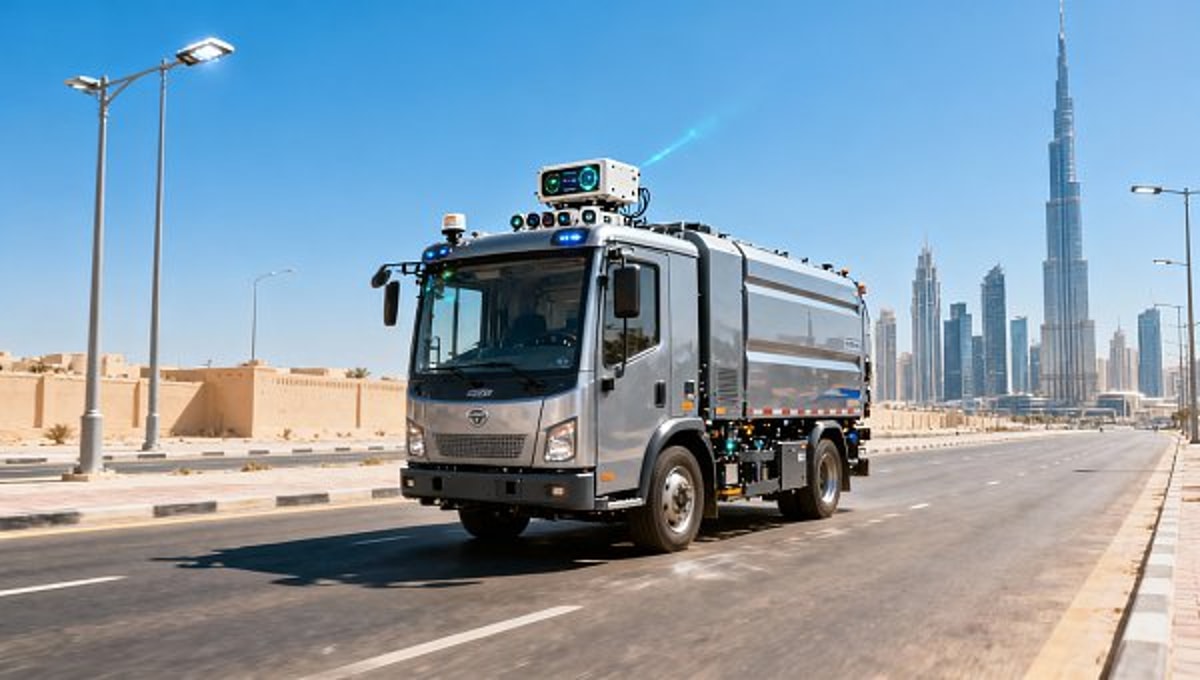
According to the Global Patent Analysis Report on Autonomous Sanitation Vehicles, released on May 6, 2026, Chinese applicants have filed 12,743 publicly disclosed patents in this field—accounting for 68% of the global total. This development signals growing technical influence in laser SLAM navigation, multi-vehicle coordination, and municipal IoT platform integration—and carries tangible implications for smart infrastructure exporters, AI application developers, and edge-computing hardware suppliers serving international municipal markets.
Event Overview
The Global Patent Analysis Report on Autonomous Sanitation Vehicles, published on May 6, 2026, states that Chinese applicants account for 12,743 publicly disclosed patents in the autonomous sanitation vehicle domain—68% of the worldwide total. Technical emphasis is confirmed to be on laser SLAM navigation, multi-robot collaborative scheduling, and interoperability with municipal IoT platforms. Separately, tender documents for NEOM City Phase II (Saudi Arabia) and Dubai’s 2030 Smart City Cleaning Program explicitly require bidders to demonstrate ‘localization capability for unmanned operation and maintenance systems’.
Impact on Specific Industry Segments
Smart factory equipment exporters: These firms supply integrated control units—including onboard edge controllers—for automated municipal vehicles. The tender requirement for ‘localization capability’ implies demand shifts from standalone hardware to system-integrated solutions validated for regional operational environments (e.g., dust tolerance, thermal management, Arabic-language UI/APIs). Impact manifests as tighter integration testing cycles and increased pre-bid technical validation needs.
AI software and SaaS providers: Remote fleet management platforms—especially those embedding AI-driven route optimization or predictive maintenance—face new functional expectations. Tender language emphasizes ‘localization’, which, in practice, refers to adaptability to local regulatory data formats, municipal service KPIs, and Arabic-language reporting dashboards—not just linguistic translation. Impact centers on modular architecture design and configurable compliance modules.
CCTV and sensor system integrators: As laser SLAM and real-time perception form core patent clusters, demand is rising for ruggedized, high-accuracy sensing stacks compatible with municipal deployment conditions (e.g., sand resistance, solar glare mitigation). Impact appears in accelerated qualification timelines for environmental certifications (IP66+, MIL-STD-810G) and localized calibration protocols.
What Relevant Companies or Practitioners Should Focus On
Monitor official tender addenda and localization definition documents
NEOM and Dubai authorities have not yet published standardized technical specifications for ‘localization capability’. Current tenders reference it as a pass/fail criterion without defining minimum thresholds. Observably, companies should track upcoming addenda or supplementary guidelines—particularly any annexes specifying data sovereignty, Arabic-language API schema, or local cloud hosting requirements.
Prioritize edge controller compatibility with GCC municipal IoT frameworks
Analysis shows that ‘localization’ in these tenders correlates strongly with interoperability with existing GCC municipal digital infrastructure—such as Dubai’s Smart City Platform or Saudi’s National Unified Platform for Municipal Services. Firms should verify whether their edge controllers support MQTT/HTTP-based ingestion into these frameworks and whether firmware updates can be delivered via approved OTA channels.
Distinguish between policy signal and commercial readiness
The 68% patent share reflects R&D intensity—not necessarily field-deployed maturity. From industry perspective, many cited Chinese patents remain at prototype or lab-validation stage. Companies should cross-reference patent families with verified pilot deployments (e.g., Shenzhen or Hangzhou municipal trials) before assuming technical readiness for GCC-scale rollout.
Prepare modular documentation packages for prequalification
Tenders require demonstration of localization capability during prequalification—not post-award. Current more suitable preparation includes assembling modular evidence: Arabic-language UI screenshots, GCC-specific environmental test reports, API integration diagrams with named municipal platforms, and letters of intent from local system integrators. Standalone whitepapers are insufficient.
Editorial Perspective / Industry Observation
This patent concentration and tender language shift is best understood as an early-stage institutional signal—not yet a mature market outcome. Analysis shows that while China leads in patent volume, only ~17% of those patents cite GCC-relevant environmental or regulatory constraints. Observably, the trend reflects tightening procurement criteria in fast-growing smart city projects, rather than widespread adoption of fully localized unmanned systems. From industry angle, it marks the transition from technology export (hardware-only) to solution export (system + support + compliance), where differentiation increasingly lies in certification agility—not just algorithmic novelty.
Conclusion
China’s dominant patent share in autonomous sanitation vehicles—combined with explicit localization mandates in major Gulf infrastructure tenders—signals a structural shift toward system-level, regionally adapted smart municipal solutions. It does not indicate immediate market saturation or technical parity across regions. Rather, it highlights an emerging threshold: successful participation now requires demonstrable capacity to integrate, certify, and sustain solutions within specific municipal digital and physical environments. Currently, this is better interpreted as a procurement evolution than a technology dominance milestone.
Information Sources
Main source: Global Patent Analysis Report on Autonomous Sanitation Vehicles, released May 6, 2026.
Note: Tender requirements for NEOM Phase II and Dubai 2030 Smart City Cleaning Program are confirmed via publicly accessible procurement portals as of May 2026. Technical definitions of ‘localization capability’ remain pending formal specification and are subject to ongoing observation.
Recommended News
 China's Smart Electric Wheelchair Exports Face EU MDR Compliance Shift from Q3 2026China's smart electric wheelchair exports must meet EU MDR + CE dual certification by Q3 2026 — only 12 manufacturers comply. Act now to secure market access.
 Apple Opens AI Service Hub to Third Parties: New Export Path for Chinese AIoT HardwareApple's AI Service Hub opens new export opportunities for Chinese AIoT hardware—enabling iFLYTEK, SenseTime & others to power HomeKit, CarPlay & HealthKit with on-device AI.
 GPT-5.5 Instant Rollout Impacts AI SaaS Exporters’ SLAsGPT-5.5 Instant rollout reshapes AI SaaS exporters’ SLAs—learn how P95 latency, multimodal context, and contract compliance impact your global clients now.
 Red Bull SA15 Uses Tiantai Energy Solutions: China OEM Compliance Gains ASEAN AttentionRed Bull SA15 adopts Tiantai’s China OEM energy solutions—triple-registered (TH FDA, SG HSA, EU EFSA). A benchmark for ASEAN importers & nutraceutical manufacturers seeking compliant, scalable sourcing.
 China’s New GB 4343.1-2026 Mobile Power Bank Standard Takes Effect Nov 2026GB 4343.1-2026 mobile power bank standard takes effect Nov 2026—learn key compliance steps, dual-protocol requirements & global certification strategy.
 Morocco Ranks 4th in EU Africa Energy Aid; China PV Mounting & ESS Export Path WidensMorocco ranks 4th in EU Africa energy aid—unlocking new PV mounting & ESS export opportunities for certified Chinese suppliers. Act now to leverage the white-list advantage.
 China Holds 68% of Global Autonomous Sanitation Vehicle PatentsChina holds 68% of global autonomous sanitation vehicle patents—key for smart infrastructure exporters, AI developers & edge hardware suppliers targeting GCC tenders.
") China’s Petrochemical Plant Upgrade Policy (2026–2029)China’s Petrochemical Plant Upgrade Policy (2026–2029) mandates safety assessments & intelligent upgrades for aging equipment—key for exporters, EPC firms, and certified equipment suppliers.
China’s Petrochemical Plant Upgrade Policy (2026–2029)China’s Petrochemical Plant Upgrade Policy (2026–2029) mandates safety assessments & intelligent upgrades for aging equipment—key for exporters, EPC firms, and certified equipment suppliers. U.S. Natural Gas Inventory Rise Below Expectations: Export Cost Pressure on PVC, ABS, CoatingsU.S. natural gas inventory rise fell short—impacting PVC, ABS & coatings exporters. Discover cost risks, mitigation steps & pricing insights now.
 EN 62368-1:2026 Enforced in EU: Thermal Runaway Protection Required for Wearables & Smart Home DevicesEN 62368-1:2026 mandates thermal runaway protection for wearables & smart home devices in the EU—act now to ensure CE compliance and avoid market access delays.
 Portable oxygen concentrators are quieter now, but are they easier to maintain?Portable oxygen concentrators are quieter, but are they easier to maintain? Explore service challenges, scenario-based insights, and smart ways to reduce downtime.
 Interactive whiteboards are underused when training stops after installationInteractive whiteboards often underperform when training ends at installation. Learn how continuous, role-based support boosts adoption, productivity, and ROI.
 Medical diagnostic equipment buying mistakes often start with workflow mismatchMedical diagnostic equipment buying mistakes often stem from workflow mismatch. Learn how to assess fit, avoid hidden costs, and choose scalable systems that support real clinical operations.
![]() Eco-friendly building materials can add compliance work, not just green valueEco-friendly building materials can boost sustainability but also add compliance work. Learn how they affect approvals, costs, timelines, and risk across key project scenarios.
Eco-friendly building materials can add compliance work, not just green valueEco-friendly building materials can boost sustainability but also add compliance work. Learn how they affect approvals, costs, timelines, and risk across key project scenarios. Ergonomic workspace design fails when posture is treated as the whole answerErgonomic workspace design fails when posture is the only focus. Learn how integrated planning improves productivity, retention, and workplace performance.
 Outdoor garden supplies demand changes faster than seasonal forecasts suggestOutdoor garden supplies demand is changing faster than seasonal forecasts. Discover key signals, sourcing strategies, and inventory tactics to stay competitive and capture growth.
 Sustainable home decor sells better when the material story is verifiableSustainable home decor wins more buyers when material claims are verifiable. Discover how traceable sourcing, certifications, and clear proof build trust and drive sales.
 Modern office furniture choices can raise complaints instead of comfortModern office furniture can improve productivity—or trigger costly complaints. Learn how to choose ergonomic, durable, flexible office solutions that support comfort and long-term value.
 Smart street lighting saves energy only when controls are tuned properlySmart street lighting saves energy only when controls are tuned to real traffic, safety, and maintenance needs. Learn how proper settings turn connected lighting into measurable ROI.
 Solid-state battery breakthroughs are real, but scaling is another storySolid-state battery breakthroughs are real, but scaling remains the real test. Explore where commercialization starts first, what limits adoption, and which markets may gain the earliest edge.
![]() Commercial LED lighting upgrades often disappoint in high-heat spacesCommercial LED lighting often underperforms in high-heat spaces. Learn the hidden causes, warning signs, and smart upgrade choices to improve reliability, safety, and long-term value.
Commercial LED lighting upgrades often disappoint in high-heat spacesCommercial LED lighting often underperforms in high-heat spaces. Learn the hidden causes, warning signs, and smart upgrade choices to improve reliability, safety, and long-term value.











Popular Tags
Global Trade Insights & Industry
Our mission is to empower global exporters and importers with data-driven insights that foster strategic growth.
Search News
Popular Tags
Industry Overview
The global commercial kitchen equipment market is projected to reach $112 billion by 2027. Driven by urbanization, the rise of e-commerce food delivery, and strict hygiene regulations.