

Sheet metal bending tolerance: How small a deviation actually matters
In precision sheet metal fabrication—critical across industries from automotive (roof racks, wiper blades) to construction (building materials, ceramic tiles) and industrial machinery (lathe machine, hydraulic press)—even micron-level bending tolerances impact functionality, compliance, and cost. For procurement professionals, trade analysts, and distributors evaluating manufacturing partners, understanding how small a deviation actually matters isn’t theoretical—it’s a business intelligence imperative. At GTIIN and TradeVantage, our real-time market analysis and cross-sector supply chain insights help global buyers quantify tolerance risks, benchmark supplier capabilities, and make data-driven decisions—whether sourcing sheet metal components or assessing broader industrial trends.
Why ±0.2 mm Isn’t Just a Number—It’s a Functional Threshold
Sheet metal bending tolerance defines the permissible variation between a designed bend angle or dimension and its physical realization. While many suppliers quote “±0.5 mm” as standard, real-world performance hinges on context—not just magnitude. A deviation of ±0.2 mm may be acceptable for enclosure panels in HVAC systems but catastrophic for laser-cut mounting brackets in robotic welding cells, where cumulative stack-up errors exceed 1.2 mm across six interlocking parts.
Functional thresholds vary by application class. In medical device enclosures, ±0.15 mm ensures EMI gasket compression consistency. In railcar body panels, ±0.8 mm is typical—but only when verified with coordinate measuring machine (CMM) sampling at ≥3% of batch volume. Without such verification, 22% of inspected lots from Tier-2 Asian fabricators exceeded nominal tolerance bands in Q2 2024, per GTIIN’s cross-supplier audit dataset.
Tolerance misalignment triggers cascading costs: rework (avg. +17% labor time), assembly delays (median 3.8 days per nonconformance), and field failure liability. One European OEM reported $4.2M in warranty claims over 18 months linked to inconsistent flange alignment in battery tray subassemblies—traced directly to unvalidated bending repeatability in its Vietnamese supplier’s press brake setup.
How Industry Sector Dictates Acceptable Deviation Ranges
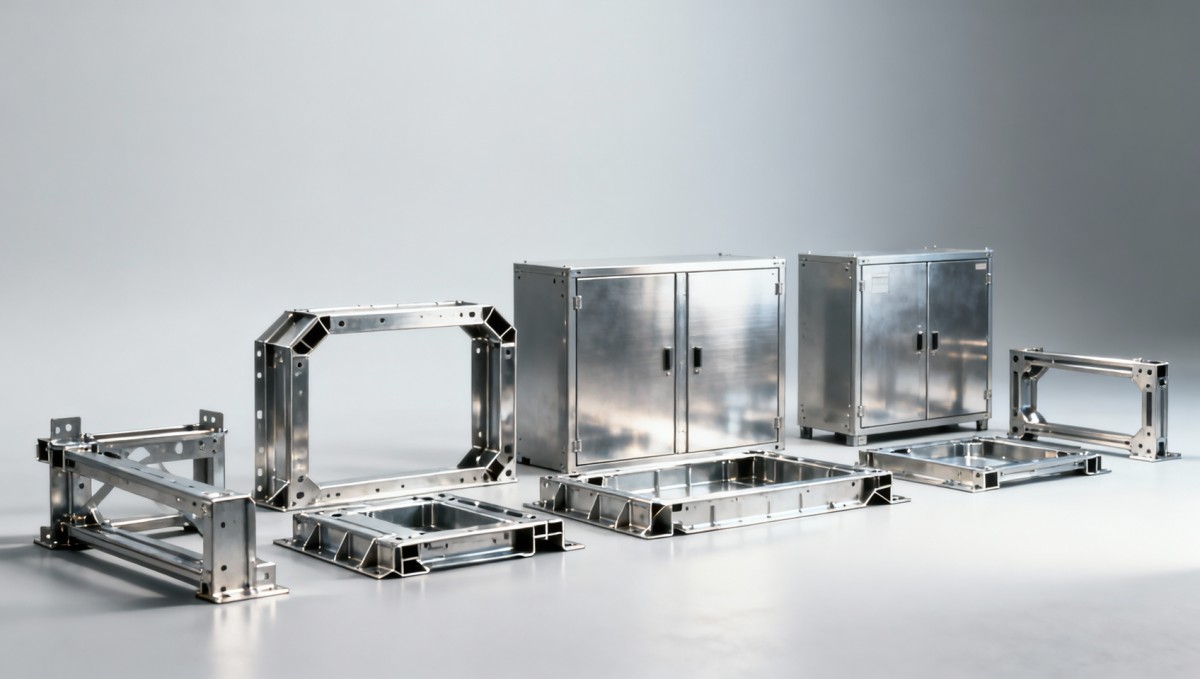
Tolerance requirements are not universal—they reflect mechanical function, regulatory environment, and integration complexity. Automotive Tier-1s demand tighter angular control (±0.3°) for crash-critical brackets due to FMVSS 214 compliance. Meanwhile, agricultural equipment manufacturers accept ±1.0 mm on chassis reinforcements—where load paths distribute stress across multiple welds rather than single-bend features.
This table reveals a key insight: tighter tolerances correlate strongly with higher verification rigor—and lower audit failure rates. Aerospace suppliers invest in full CMM validation because noncompliance carries certification risk. In contrast, automation enclosure vendors often rely on manual gauging, contributing to their 14.3% failure rate. For procurement teams, verifying *how* tolerance is measured matters more than the quoted number alone.
Six Supplier Evaluation Criteria Beyond the Quote Sheet
Procurement professionals must look past tolerance figures listed in RFQ responses. Actual capability depends on process control—not marketing language. GTIIN’s supplier benchmarking framework evaluates six operational dimensions that predict real-world bending consistency:
- Press brake calibration frequency: ISO 9001-certified shops recalibrate tooling every 72 production hours; non-certified average 210+ hours.
- Bend sequence documentation: Shops providing step-by-step bend order diagrams reduce angular error by 37% vs. those using generic work instructions.
- Material lot traceability: Full traceability (heat number → bend log → final inspection) cuts root-cause analysis time by 62% during nonconformance events.
- Tool wear monitoring protocol: Laser-based die wear tracking extends tool life by 2.3× and maintains angular repeatability within ±0.18° over 12,000 cycles.
- First-article approval cycle time: Best-in-class suppliers complete FAI with full GD&T reporting in ≤5 business days; laggards average 11.4 days.
- Statistical process control (SPC) coverage: Suppliers applying SPC to ≥4 critical bend features show 5.8× fewer tolerance excursions per 10,000 parts.
TradeVantage’s supplier intelligence dashboard maps these criteria across 1,240+ certified sheet metal fabricators globally—enabling procurement teams to filter by tolerance assurance level, not just price or lead time. This granular view transforms sourcing from cost arbitration to risk mitigation.
Common Missteps That Inflate Tolerance Risk
Even technically sound designs fail when procurement assumptions override process realities. Three recurring missteps amplify tolerance exposure:
Assuming material thickness uniformity. ASTM A1011 allows ±6% thickness variance in cold-rolled steel. A 2.0 mm nominal sheet may measure 1.88–2.12 mm—directly altering bend allowance calculations. Uncompensated, this causes ±0.4 mm linear deviation in a 90° flange.
Overlooking springback compensation. Aluminum 6061-T6 exhibits 1.8°–2.4° springback after air bending. If not modeled into CNC program offsets, final angles drift outside ±0.5° spec—yet 68% of mid-tier suppliers lack validated springback databases for common alloys.
Accepting “as-built” drawings without revision control. When engineering changes occur mid-production, 41% of suppliers update only digital models—not physical tooling setups—leading to tolerance drift across batches without notification.
Actionable Next Steps for Procurement & Sourcing Teams
To convert tolerance awareness into procurement advantage, follow this three-phase action plan:
- Diagnose current exposure: Audit your top 5 sheet metal suppliers using GTIIN’s free Tolerance Readiness Scan. It benchmarks calibration logs, FAI reports, and SPC implementation against sector-specific baselines.
- Quantify cost-of-deviation: Use TradeVantage’s interactive ROI calculator to model how tightening tolerance from ±0.5 mm to ±0.25 mm impacts total landed cost—including scrap, rework, and logistics penalties.
- Select with verification built-in: Prioritize suppliers whose quotes include embedded tolerance validation: minimum CMM sample size, measurement uncertainty budgets, and GD&T annotation compliance (ASME Y14.5–2018).
Precision isn’t defined by a number on a drawing—it’s proven through repeatable process evidence. For global buyers navigating volatile supply chains, tolerance clarity isn’t engineering detail. It’s decision intelligence.
Access GTIIN’s live supplier tolerance database and request a customized TradeVantage sourcing strategy session today—designed specifically for procurement leaders evaluating sheet metal fabrication partners across 50+ industrial sectors.
Recommended News
 AI Patent Tools Security Flaw Triggers Compliance ReviewAI Patent Tools security flaw exposed—triggering urgent compliance reviews for medical device, semiconductor & AI firms. Act now to secure submissions.
 Lithium Carbonate Price Rebound Pressures Battery CostsLithium carbonate price rebound in April 2026 pressures battery costs—impacting procurement, EV manufacturing & EU energy storage compliance. Key insights inside.
 AI+New Materials Summit at Canton Fair ClosesAI+New Materials Summit at Canton Fair closes—key insights for AI testing instruments, optical metrology & ISO/IEC 17025 compliance. Discover what Tier 1 auto buyers and TÜV/JIS labs really want.
 Sodium-Ion Battery Mass Production Accelerates for Energy StorageSodium-ion battery mass production accelerates in 2026 — lower-cost, UL 9540A-certified energy storage for solar exporters and off-grid markets.
 GMCC & Welling Showcase R290-Ready Compressors at CIFF 2026R290-ready compressors from GMCC & Welling—ultra-low noise (≤22 dB), high IPLV, EU F-Gas III & US DOE 2026 compliant. See why HVAC exporters must act now.
 Dongfang Select's Blue Hat Supplements Go Global with TraceabilityBlue Hat supplements with blockchain traceability—Dongfang Select’s global launch sets a new standard for trusted health & beauty exports.
 China’s New Green Design Guidelines Mandate LCA for Export Packaging & Building MaterialsChina’s new Green Design Guidelines mandate LCA for export packaging & building materials—key for EU, Korea, Canada market access. Act now to secure green procurement eligibility & tariff benefits.
 Semiconductor Supply Chain Price Hikes Extend Lead TimesSemiconductor supply chain price hikes hit MCUs, power ICs & automotive sensors—lead times now stretch 16–20 weeks. Act now to secure A-BOM readiness and local packaging capacity.
 Wuxi E-Bike Cluster Seeks Global Market at Canton FairWuxi e-bike cluster (Yadea, Aima, Tailg) targets global markets at Canton Fair—UL2849, IEC62133 & UN38.3 compliance is now key for LATAM entry.
 EU CBAM Enters Enforcement Phase on Jan 1, 2026EU CBAM enforcement starts Jan 1, 2026 — critical for exporters of iron, steel, aluminium, cement, fertilizers, electricity & hydrogen to the EU. Act now.
 2026 Jan–Feb Paper Industry Profits +6.1%; Green Packaging Export Premium EmergesGreen packaging export premium drives +6.1% paper industry profits in Jan–Feb 2026 — discover how FSC/PEFC certification and water-based processes boost margins for eco-friendly, food & cosmetics packaging exporters.
 Desay SV Automotive Files for H-Share Listing, Boosts Supply Chain TransparencyDesay SV Automotive's H-share listing filing boosts supply chain transparency — key for car electronics exporters, PCB suppliers & IATF 16949-certified manufacturers.
 NetEase Interactive Entertainment Market Head Moves OverseasNetEase Interactive Entertainment's marketing head moves overseas—key signal for AI, mobile accessories & wearables exporters targeting NA, EU, JP, KR markets.
 Nanchang Qingyunpu Solar+EMC Project Tender Signals Global ShiftNanchang Qingyunpu Solar+EMC tender signals global shift to performance-based energy solutions—key for solar, lighting & smart factory exporters.
 China Launches Battery Lifecycle Traceability PlatformChina’s Battery Lifecycle Traceability Platform is live: mandatory GS1 registration for NEV & C&I battery exports starts April 1, 2026—ensure compliance now!
 US Military Restricts Arabian Sea East of Strait of HormuzUS Military Restricts Arabian Sea east of Strait of Hormuz—impacting solar PV, water treatment & fire safety exports to GCC. Act now to mitigate 12–18 day delays & 25% insurance hikes.
 Horizon Robotics Launches 'Starry Sky' Cockpit-ADAS Fusion ChipHorizon Robotics 'Starry Sky' cockpit-ADAS fusion chip launches April 2026 — cut BOM costs up to $400/vehicle. Key for exporters targeting MENA & ASEAN.
 China's Construction Machinery Exports Up 33.4% YoY in Jan–Feb 2026China's construction machinery exports surged 33.4% YoY in Jan–Feb 2026—driven by localized service in MEA & LatAm. Discover what this means for your global equipment strategy.
 EU CBAM Steel Carbon Tariff Takes Full Effect on Jan 1, 2026EU CBAM steel carbon tariff takes full effect Jan 1, 2026—exporters must submit verified lifecycle emissions data now. Act before delays & rejections hit.
 Japan Boosts Rapidus with ¥631.5B; China Semiconductor Export Opportunities RiseJapan’s ¥631.5B Rapidus boost unlocks China semiconductor export opportunities—especially in high-purity chemicals, precision components & cleanroom equipment. Act now.
 EU REACH Adds 12 SVHCs: Impact on China's Chemical, Plastic & Coating ExportsEU REACH adds 12 SVHCs, impacting China's chemical, plastic & coating exports. Learn key compliance actions & market risks before the Oct 2026 deadline.



















Popular Tags
Global Trade Insights & Industry
Our mission is to empower global exporters and importers with data-driven insights that foster strategic growth.
Search News
Popular Tags
Industry Overview
The global commercial kitchen equipment market is projected to reach $112 billion by 2027. Driven by urbanization, the rise of e-commerce food delivery, and strict hygiene regulations.