

IMDG Code 41-24 Enforces UN3480 Class 9 Labeling for Li-ion Battery Sea Freight
As of April 19, 2026, the International Maritime Organization’s (IMO) International Maritime Dangerous Goods Code Amendment 41-24 has entered into full global force. This update mandates new packaging and labeling requirements for lithium-ion batteries shipped by sea (UN3480), directly impacting exporters, freight forwarders, battery manufacturers, and logistics service providers across global supply chains.
Event Overview
The IMO’s IMDG Code Amendment 41-24 became globally mandatory on April 19, 2026. Under this amendment, all lithium-ion batteries classified as UN3480 must be packed in compliant composite packaging and affixed with a new diamond-shaped label marked ‘UN3480 Class 9’. The label must include a scannable QR code linking to verified batch-specific product data and authorized carrier credentials. Shipments bearing non-compliant labels are subject to rejection or detention at destination ports, along with associated demurrage fees.
Industries Affected by Segment
Direct Exporters & Trading Companies
These entities bear primary responsibility for regulatory compliance at origin. Non-compliant labeling triggers immediate operational risk — including cargo hold-ups, rework delays, and port-level penalties. Since labeling is tied to both batch traceability and carrier authorization, exporters must now verify and document carrier eligibility before shipment, not just after booking.
Battery Manufacturers & Packagers
Manufacturers supplying UN3480 cells or finished battery packs must adapt production workflows to integrate the new label design, QR code generation, and secure linkage to batch records. Packaging specifications now require structural compatibility with the mandatory label placement and durability under maritime conditions — potentially requiring validation of new label adhesives, substrates, and print resolution.
Logistics & Freight Forwarding Providers
Forwarders handling UN3480 cargo must confirm label compliance prior to vessel loading — not merely accept shipper-provided documentation. Their role shifts toward active verification: scanning QR codes to validate batch–carrier alignment and checking physical label dimensions, color contrast, and placement per IMDG 41-24 Annex 5. Failure to do so may expose them to joint liability for port rejections.
Distribution & E-commerce Fulfillment Operators
Operators managing cross-border battery shipments — especially those consolidating multiple SKUs into single containers — face heightened sorting and documentation complexity. Each UN3480 unit or inner pack must now carry its own compliant label, even within mixed-load containers. This affects labeling automation systems, warehouse SOPs, and customs declaration accuracy.
Key Actions for Enterprises and Practitioners
Verify current labeling against IMDG 41-24 Annex 5 specifications
Confirm label size (minimum 100 mm × 100 mm), black-on-white contrast ratio, correct Class 9 symbol, UN number placement, and QR code scannability using ISO/IEC 15415-compliant readers — not generic smartphone apps.
Map batch–label–carrier linkage processes end-to-end
Ensure internal ERP or MES systems generate unique, non-reusable QR codes that embed immutable batch identifiers and reference only pre-approved, IMDG-authorized carriers — with audit logs retained for at least 24 months per IMO guidance.
Update shipping instruction templates and carrier onboarding checklists
Require forwarders and carriers to self-certify IMDG 41-24 compliance status, including proof of training records for dangerous goods staff and evidence of updated safety data sheets (SDS) referencing Amendment 41-24.
Conduct dry-run validations with high-volume destination ports
Prioritize test shipments to key gateways (e.g., Rotterdam, Los Angeles, Singapore) where port authorities have publicly announced enhanced 41-24 enforcement protocols — documenting label acceptance criteria and turnaround times.
Editorial Perspective / Industry Observation
From industry perspective, IMDG Code 41-24’s enforcement marks a shift from procedural compliance to digital traceability as a core condition of market access. Analysis来看, the QR-linked label requirement is less about symbolic classification and more about enabling real-time verification at port checkpoints — effectively turning the label into an interoperable data interface. Current更值得关注的是 how national maritime administrations interpret ‘carrier authorization’ — whether it refers solely to IMO-recognized DG training certificates, or extends to commercial licensing or port-specific registration. This remains jurisdictionally uneven and warrants ongoing monitoring.
Observation来看, the rule functions primarily as an enforcement accelerator: it does not introduce new hazard classifications or transport bans, but significantly raises the cost of non-compliance through automated rejection points. It is better understood as an operational checkpoint upgrade than a strategic policy pivot.
Conclusion: While the technical requirements are clearly defined, their implementation velocity depends heavily on local port authority capacity and digital infrastructure readiness — meaning early adopters gain predictability, while laggards face fragmented enforcement timelines.
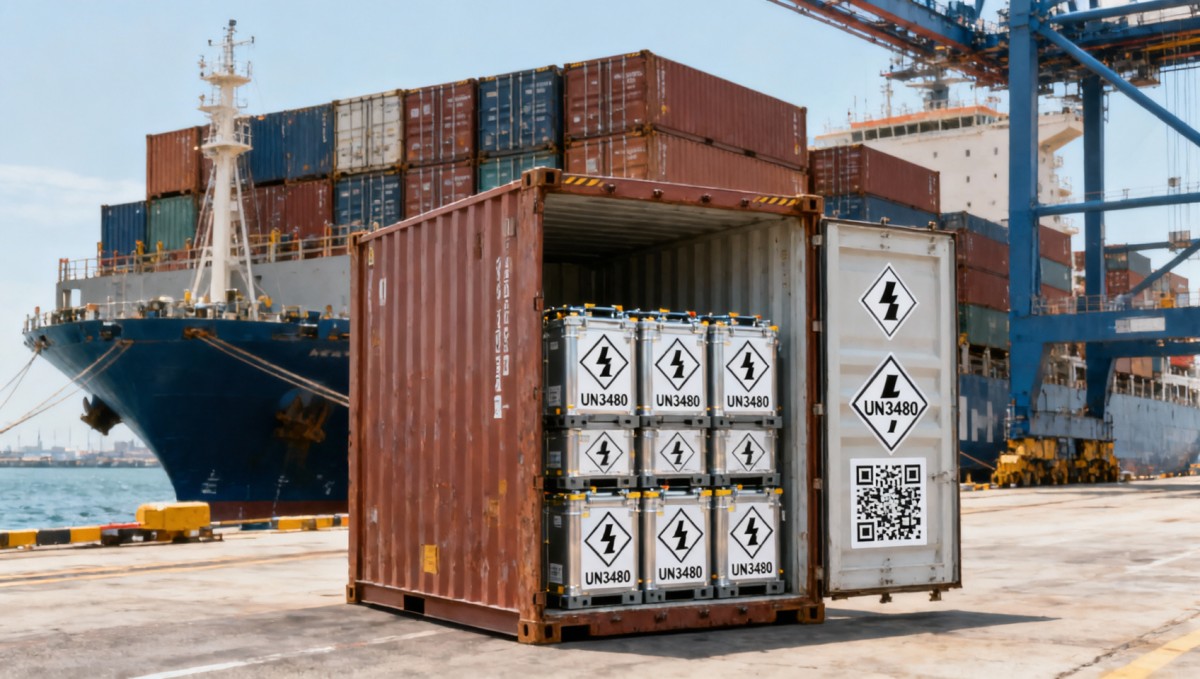
This update reflects a broader trend toward digitally anchored regulatory enforcement in hazardous goods logistics. It signals increasing reliance on machine-readable compliance markers — not just human-readable symbols — as standard practice in international maritime regulation.
Information Sources:
– International Maritime Organization (IMO), IMDG Code Amendment 41-24, effective April 19, 2026
– IMO Circular Letter No. 4327, dated March 2026 (clarifying transitional provisions)
– Note: Interpretation of ‘carrier authorization’ and port-level enforcement thresholds remains under observation and varies by flag state and terminal operator.
Recommended News
 US CPSC Updates Child Sleep Sack Standard Effective July 2026US CPSC updates child sleep sack standard with new DSST test—mandatory for all U.S.-bound infant sleep sacks from July 2026. Act now to ensure compliance and market access.
 Red Sea Rerouting Pushes Asia-Europe Freight Premium to $1,850/TEURed Sea rerouting pushes Asia-Europe freight premium to $1,850/TEU—impacting importers, manufacturers & logistics providers. Act now to reassess costs, lead times & contracts.
 Mexico NOM-019-SCFI-2026 Effective May 1, 2026: EMC Certification Mandatory for Auto ElectronicsNOM-019-SCFI-2026 EMC certification is now mandatory for auto electronics in Mexico—effective May 1, 2026. Ensure compliance for infotainment, ADAS, OBD-II & more.
") TÜV Rheinland Updates CE Requirements for Servo Drives (PLd + EMC Class 3)TÜV Rheinland updates CE requirements for servo drives: PLd + EMC Class 3 joint validation mandatory from Q3 2026. Act now to avoid delays, rejections, or compliance risks.
TÜV Rheinland Updates CE Requirements for Servo Drives (PLd + EMC Class 3)TÜV Rheinland updates CE requirements for servo drives: PLd + EMC Class 3 joint validation mandatory from Q3 2026. Act now to avoid delays, rejections, or compliance risks. SABER Phase II Launch: Building Hardware Must Submit Digital e-CoC & UPISABER Phase II mandates digital e-CoC & UPI for building hardware imports to Saudi Arabia—act now to ensure customs clearance and market access.
 FDA AI Diagnostic Device Draft Rules: Bias Assessment for ImportsFDA AI diagnostic device draft rules mandate bias assessment for imports — discover how algorithmic fairness impacts 510(k)/De Novo submissions and what to do now.
 RCEP Green Packaging Mutual Recognition Starts June 1, 2026RCEP Green Packaging Mutual Recognition starts June 1, 2026 — unlock faster exports to Australia, NZ, Japan & Korea with GB/T 37572-2025 certification.
 Vietnam Suspends SASO Mutual Recognition for Chinese Irrigation EquipmentVietnam suspends SASO mutual recognition for Chinese irrigation equipment—impacting exporters, testers & suppliers. Act now to avoid 6–8 week delays & 35% cost hikes.
 IMDG Code 41-24 Enforces UN3480 Class 9 Labeling for Li-ion Battery Sea FreightIMDG Code 41-24 enforces UN3480 Class 9 labeling for Li-ion battery sea freight—learn mandatory QR labels, compliance actions & port enforcement risks.
 EU CBAM Enters Enforcement Phase on April 1, 2026EU CBAM enforcement starts April 1, 2026 — critical for Chinese battery materials, construction profiles & industrial coatings exporters. Act now to avoid customs delays.
 Mexico Enforces NOM-019-SCFI-2026 EMC Certification for Auto Electronics from May 2026Mexico enforces NOM-019-SCFI-2026 EMC certification for auto electronics from May 2026 — mandatory local testing, stricter standards, and urgent compliance action required.
 Global Port Congestion Eases, but Red Sea Rerouting PersistsRed Sea rerouting persists amid easing port congestion—Shanghai–Rotterdam freight rates surge 4.2% to $5,280/TEU. Critical insights for exporters, importers & logistics leaders.
 RCEP Green Packaging Mutual Recognition Starts June 2026RCEP Green Packaging Mutual Recognition starts June 2026 — streamline exports to Australia, NZ, Japan & SK with GB/T 37572-2025 certification. Save time & costs!
 FDA AI Diagnostic Device Rules: ABIA Required from Q3 2026FDA AI diagnostic device rules now require ABIA reports from Q3 2026 — essential for 510(k)/De Novo submissions. Stay compliant, avoid delays & secure U.S. market access.
 Vietnam Suspends SASO Mutual Recognition for Chinese Irrigation EquipmentVietnam suspends SASO mutual recognition for Chinese irrigation equipment—sprinkler systems, drip controllers & irrigation systems now require local QUATEST 3 testing. Act now to avoid 12-week delays & 35% cost hikes.
") TÜV Rheinland Updates CE Certification for Industrial Robot Drives (2026 Q3)TÜV Rheinland’s 2026 Q3 CE certification update for industrial robot drives mandates PLd safety + EN 61800-3 EMC — act now to avoid EU market delays.
TÜV Rheinland Updates CE Certification for Industrial Robot Drives (2026 Q3)TÜV Rheinland’s 2026 Q3 CE certification update for industrial robot drives mandates PLd safety + EN 61800-3 EMC — act now to avoid EU market delays. IMDG Code Amendment 41-24 Takes Effect for Lithium Battery Sea FreightIMDG Code Amendment 41-24 is live: New QR labels, bilingual handling tags & SOC disclosure required for UN3480 lithium battery sea freight—act now to avoid delays.
 SASO SABER Phase II: Digital Type Test Reports Required for Building Hardware from Jun 2026SASO SABER Phase II requires digital type test reports & unique product IDs for building hardware exports to Saudi Arabia — effective June 2026. Act now to ensure compliance and avoid customs delays.
 CPSC Updates 16 CFR Part 1236: New Suffocation Test for Children's Sleep Sacks Effective July 2026CPSC Updates 16 CFR Part 1236: New suffocation test for children's sleep sacks takes effect July 2026 — ensure compliance, avoid delays & protect your U.S. market access.
 EN IEC 62471-2:2026 Effective Oct 2026 for EU LED Lighting ExportsEN IEC 62471-2:2026 mandates full-spectrum photobiological safety testing (200–3000 nm) for all EU-bound LED lighting — effective 1 Oct 2026. Act now to secure CE marking & avoid market access delays.
 AI Patent Tools Security Flaw Triggers Compliance ReviewAI Patent Tools security flaw exposed—triggering urgent compliance reviews for medical device, semiconductor & AI firms. Act now to secure submissions.




















Popular Tags
Global Trade Insights & Industry
Our mission is to empower global exporters and importers with data-driven insights that foster strategic growth.
Search News
Popular Tags
Industry Overview
The global commercial kitchen equipment market is projected to reach $112 billion by 2027. Driven by urbanization, the rise of e-commerce food delivery, and strict hygiene regulations.