

RCEP Green Packaging Mutual Recognition Starts June 2026
RCEP member customs authorities — including those of Australia, New Zealand, Japan, and South Korea — jointly launched the Green Packaging Mutual Recognition Program on April 19, 2026, with implementation effective June 1, 2026. This initiative directly affects exporters of eco-friendly packaging from China, particularly manufacturers and traders of pulp-molded, corn-starch-based, and PLA-composite packaging. It matters because it introduces a standardized, certificate-based clearance pathway that eliminates redundant testing — a shift with measurable implications for cost, lead time, and compliance strategy across supply chains.
Event Overview
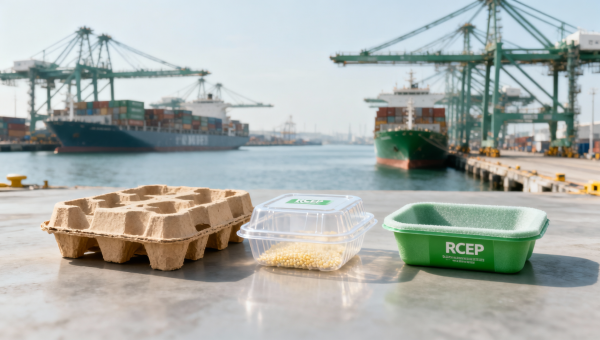
On April 19, 2026, the RCEP Secretariat, together with the customs authorities of Australia, New Zealand, Japan, and South Korea, announced the launch of the ‘Green Packaging Mutual Recognition Program’. Effective June 1, 2026, exported Chinese eco-friendly packaging products conforming to the national standard GB/T 37572-2025 ‘Evaluation Criteria for Green Packaging’ — specifically pulp-molded, corn starch-based, and PLA composite types — may enter these four markets using certification issued by CNAS-accredited laboratories. Such certification will serve as the basis for exemption from duplicate testing at destination ports.
Which Subsectors Are Affected
Direct Exporters (Trading Companies & OEM Exporters)
These entities are directly impacted because their shipments to Australia, New Zealand, Japan, and South Korea will now rely on GB/T 37572-2025 certification instead of country-specific conformity assessments. The impact manifests in reduced customs clearance time (by 3–5 days) and an estimated 18% decrease in testing-related export costs — but only if documentation aligns precisely with the scope defined in the standard and accepted by each importing authority.
Manufacturers (Packaging Converters & Molders)
Producers of pulp-molded trays, biopolymer films, or starch-based cushioning must verify whether their current product formulations, process controls, and material declarations meet all evaluation criteria under GB/T 37572-2025 — including requirements for recyclability, hazardous substance limits, and life-cycle assessment elements. Non-conforming production lines or unverified raw material suppliers could delay eligibility for certification.
Raw Material Suppliers (Biopolymer Producers, Fiber Pulp Mills)
Suppliers providing PLA resin, modified starch blends, or molded fiber substrates face upstream demand pressure: downstream converters will increasingly require documented compliance evidence (e.g., migration test reports, heavy metal certificates, fiber origin traceability) to support GB/T 37572-2025 certification applications. Absence of such data may constrain converter capacity to qualify products.
Supply Chain Service Providers (Certification Bodies, Logistics Integrators)
CNAS-accredited labs gain a defined role in issuing recognized certificates; however, only those explicitly authorized for GB/T 37572-2025 evaluation criteria — not just general environmental testing — will be accepted. Freight forwarders and customs brokers must update internal guidance to reflect the new certificate format, validity period, and submission protocols required by each RCEP partner’s electronic customs system.
What Relevant Enterprises or Practitioners Should Focus On Now
Confirm official implementation guidelines per market
Although the program launches June 1, 2026, individual countries may issue supplementary notices — e.g., Australia’s ABF or Japan’s Customs and Tariff Bureau — specifying acceptable certificate templates, digital submission channels, or transitional arrangements. Monitoring these updates is essential before initiating first shipments.
Validate product scope against GB/T 37572-2025’s technical boundaries
The standard applies only to specific material categories (pulp-molded, corn starch-based, PLA composites) and excludes other bioplastics (e.g., PHA, PBAT blends) or hybrid structures unless explicitly covered in its annexes. Exporters should cross-check their SKUs against the standard’s definitions — not assumptions — to avoid misclassification.
Distinguish policy announcement from operational readiness
The April 19 announcement confirms intent and timeline, but does not guarantee immediate harmonization of inspection systems or real-time data exchange between CNAS labs and overseas customs databases. Early adopters should treat initial months as a pilot phase — allowing buffer time for certificate verification delays or interpretation discrepancies.
Prepare documentation workflows ahead of June 2026
Companies should map internal processes for generating required test reports (e.g., heavy metal content, disintegration rate, ink migration), aligning them with CNAS lab scheduling and turnaround times. Concurrently, update commercial invoices and packing lists to include certificate numbers and standard references — a step necessary for automated customs risk assessment in some jurisdictions.
Editor Perspective / Industry Observation
Observation shows this initiative is best understood as a procedural alignment milestone — not yet a fully integrated regulatory framework. While mutual recognition simplifies one layer of compliance, it does not replace import licensing, labeling rules, or post-entry market surveillance obligations in each destination. From an industry perspective, the value lies less in immediate deregulation and more in signaling coordinated intent among RCEP members to prioritize green trade infrastructure. Analysis suggests the program’s durability will depend on consistent enforcement and transparent dispute resolution mechanisms — both of which remain unconfirmed in publicly available documents. Current relevance stems from its function as a leading indicator: it reflects growing convergence around lifecycle-aware packaging standards, making early alignment strategically advantageous — especially for firms targeting multiple RCEP markets simultaneously.
This development marks a concrete step toward interoperable sustainability credentials in regional trade — but its operational impact remains contingent on execution fidelity across five national systems. For now, it is more accurately interpreted as a structured opportunity for efficiency gains than a de facto harmonization of environmental regulation.
Source: Official joint statement released by the RCEP Secretariat and customs authorities of Australia, New Zealand, Japan, and South Korea on April 19, 2026. Scope and eligibility criteria are defined in GB/T 37572-2025 (People’s Republic of China National Standard). Note: Implementation details, including certificate formatting, digital submission portals, and contingency procedures, are pending further notice from individual member customs administrations and are subject to observation beyond June 2026.
Recommended News
 US CPSC Updates Child Sleep Sack Standard Effective July 2026US CPSC updates child sleep sack standard with new DSST test—mandatory for all U.S.-bound infant sleep sacks from July 2026. Act now to ensure compliance and market access.
 Red Sea Rerouting Pushes Asia-Europe Freight Premium to $1,850/TEURed Sea rerouting pushes Asia-Europe freight premium to $1,850/TEU—impacting importers, manufacturers & logistics providers. Act now to reassess costs, lead times & contracts.
 Mexico NOM-019-SCFI-2026 Effective May 1, 2026: EMC Certification Mandatory for Auto ElectronicsNOM-019-SCFI-2026 EMC certification is now mandatory for auto electronics in Mexico—effective May 1, 2026. Ensure compliance for infotainment, ADAS, OBD-II & more.
") TÜV Rheinland Updates CE Requirements for Servo Drives (PLd + EMC Class 3)TÜV Rheinland updates CE requirements for servo drives: PLd + EMC Class 3 joint validation mandatory from Q3 2026. Act now to avoid delays, rejections, or compliance risks.
TÜV Rheinland Updates CE Requirements for Servo Drives (PLd + EMC Class 3)TÜV Rheinland updates CE requirements for servo drives: PLd + EMC Class 3 joint validation mandatory from Q3 2026. Act now to avoid delays, rejections, or compliance risks. SABER Phase II Launch: Building Hardware Must Submit Digital e-CoC & UPISABER Phase II mandates digital e-CoC & UPI for building hardware imports to Saudi Arabia—act now to ensure customs clearance and market access.
 FDA AI Diagnostic Device Draft Rules: Bias Assessment for ImportsFDA AI diagnostic device draft rules mandate bias assessment for imports — discover how algorithmic fairness impacts 510(k)/De Novo submissions and what to do now.
 RCEP Green Packaging Mutual Recognition Starts June 1, 2026RCEP Green Packaging Mutual Recognition starts June 1, 2026 — unlock faster exports to Australia, NZ, Japan & Korea with GB/T 37572-2025 certification.
 Vietnam Suspends SASO Mutual Recognition for Chinese Irrigation EquipmentVietnam suspends SASO mutual recognition for Chinese irrigation equipment—impacting exporters, testers & suppliers. Act now to avoid 6–8 week delays & 35% cost hikes.
 IMDG Code 41-24 Enforces UN3480 Class 9 Labeling for Li-ion Battery Sea FreightIMDG Code 41-24 enforces UN3480 Class 9 labeling for Li-ion battery sea freight—learn mandatory QR labels, compliance actions & port enforcement risks.
 EU CBAM Enters Enforcement Phase on April 1, 2026EU CBAM enforcement starts April 1, 2026 — critical for Chinese battery materials, construction profiles & industrial coatings exporters. Act now to avoid customs delays.
 Mexico Enforces NOM-019-SCFI-2026 EMC Certification for Auto Electronics from May 2026Mexico enforces NOM-019-SCFI-2026 EMC certification for auto electronics from May 2026 — mandatory local testing, stricter standards, and urgent compliance action required.
 Global Port Congestion Eases, but Red Sea Rerouting PersistsRed Sea rerouting persists amid easing port congestion—Shanghai–Rotterdam freight rates surge 4.2% to $5,280/TEU. Critical insights for exporters, importers & logistics leaders.
 RCEP Green Packaging Mutual Recognition Starts June 2026RCEP Green Packaging Mutual Recognition starts June 2026 — streamline exports to Australia, NZ, Japan & SK with GB/T 37572-2025 certification. Save time & costs!
 FDA AI Diagnostic Device Rules: ABIA Required from Q3 2026FDA AI diagnostic device rules now require ABIA reports from Q3 2026 — essential for 510(k)/De Novo submissions. Stay compliant, avoid delays & secure U.S. market access.
 Vietnam Suspends SASO Mutual Recognition for Chinese Irrigation EquipmentVietnam suspends SASO mutual recognition for Chinese irrigation equipment—sprinkler systems, drip controllers & irrigation systems now require local QUATEST 3 testing. Act now to avoid 12-week delays & 35% cost hikes.
") TÜV Rheinland Updates CE Certification for Industrial Robot Drives (2026 Q3)TÜV Rheinland’s 2026 Q3 CE certification update for industrial robot drives mandates PLd safety + EN 61800-3 EMC — act now to avoid EU market delays.
TÜV Rheinland Updates CE Certification for Industrial Robot Drives (2026 Q3)TÜV Rheinland’s 2026 Q3 CE certification update for industrial robot drives mandates PLd safety + EN 61800-3 EMC — act now to avoid EU market delays. IMDG Code Amendment 41-24 Takes Effect for Lithium Battery Sea FreightIMDG Code Amendment 41-24 is live: New QR labels, bilingual handling tags & SOC disclosure required for UN3480 lithium battery sea freight—act now to avoid delays.
 SASO SABER Phase II: Digital Type Test Reports Required for Building Hardware from Jun 2026SASO SABER Phase II requires digital type test reports & unique product IDs for building hardware exports to Saudi Arabia — effective June 2026. Act now to ensure compliance and avoid customs delays.
 CPSC Updates 16 CFR Part 1236: New Suffocation Test for Children's Sleep Sacks Effective July 2026CPSC Updates 16 CFR Part 1236: New suffocation test for children's sleep sacks takes effect July 2026 — ensure compliance, avoid delays & protect your U.S. market access.
 EN IEC 62471-2:2026 Effective Oct 2026 for EU LED Lighting ExportsEN IEC 62471-2:2026 mandates full-spectrum photobiological safety testing (200–3000 nm) for all EU-bound LED lighting — effective 1 Oct 2026. Act now to secure CE marking & avoid market access delays.
 AI Patent Tools Security Flaw Triggers Compliance ReviewAI Patent Tools security flaw exposed—triggering urgent compliance reviews for medical device, semiconductor & AI firms. Act now to secure submissions.



















Popular Tags
Global Trade Insights & Industry
Our mission is to empower global exporters and importers with data-driven insights that foster strategic growth.
Search News
Popular Tags
Industry Overview
The global commercial kitchen equipment market is projected to reach $112 billion by 2027. Driven by urbanization, the rise of e-commerce food delivery, and strict hygiene regulations.