

China’s Q1 2026 Logistics Volume Rises 6.2%: Shipping Rates Stabilize
China’s national social logistics total reached RMB 96.4 trillion in Q1 2026, up 6.2% year-on-year — the fastest growth since late 2024 — according to data released by China’s National Development and Reform Commission (NDRC) on April 30, 2026. With maritime and air freight pricing stabilizing across key trade lanes and port clearance times improving, import/export-dependent sectors — including electronics exporters, apparel brands, automotive component suppliers, and cross-border e-commerce logistics providers — should monitor evolving cost dynamics and operational efficiency signals closely.
Event Overview
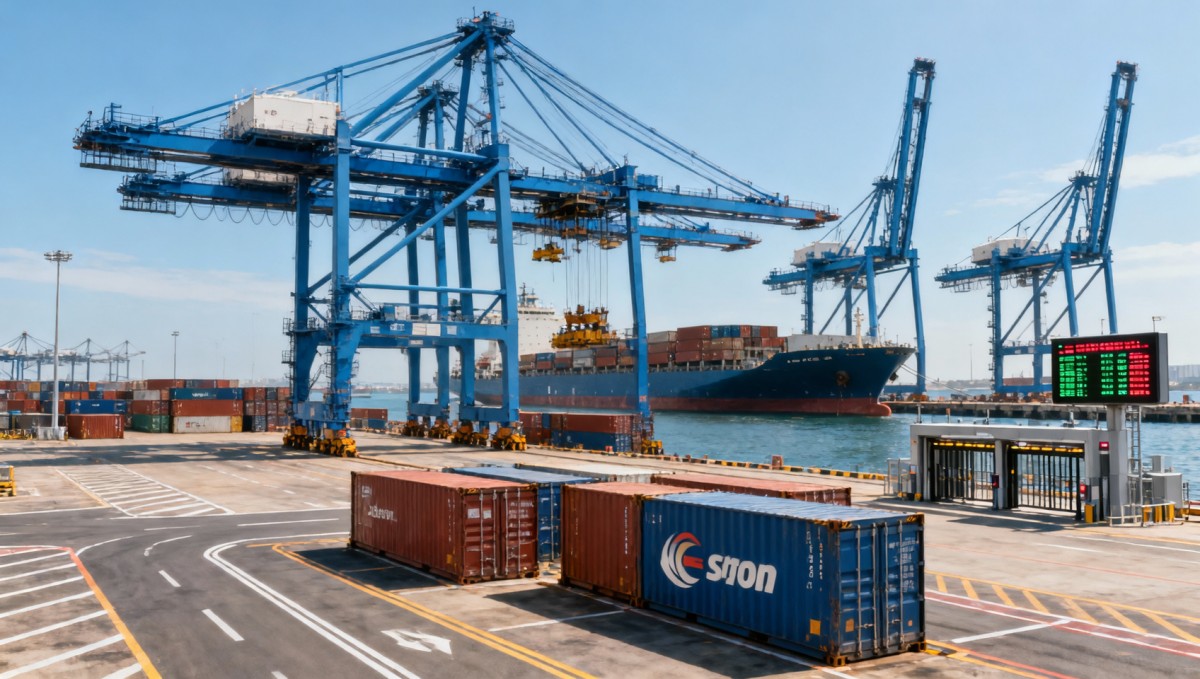
On April 30, 2026, the NDRC published official statistics showing that China’s Q1 2026 social logistics total amounted to RMB 96.4 trillion, representing a 6.2% year-on-year increase. Within international logistics, spot container freight rates on the US West Coast held steady at USD 1,850 per FEU (up 1.2% month-on-month), while European route rates declined to USD 2,120 per FEU (down 3.8% month-on-month). Air freight rates from East China to North America remained stable at USD 4.2 per kg. Average export customs clearance time improved to 21.3 hours, reflecting enhanced port operational efficiency.
Industries Affected
Direct Trading Enterprises
Exporters and importers engaged in direct bilateral trade are affected due to shifting freight rate differentials between trans-Pacific and Europe-bound routes. The US West Coast rate stability — contrasted with European route softening — may incentivize rerouting of certain shipments or renegotiation of Incoterms for new contracts signed in Q2 2026.
Raw Material Procurement Enterprises
Firms sourcing intermediate goods (e.g., semiconductors, specialty chemicals) from overseas face compressed lead-time buffers. While air freight pricing remains unchanged, the 21.3-hour average export clearance window suggests faster outbound movement — but does not directly ease inbound customs delays, which remain outside this dataset.
Manufacturing Enterprises (OEM/ODM)
Contract manufacturers serving global brands experience indirect pressure on landed cost predictability. Stable air rates support just-in-time replenishment for high-value components; however, the modest rise in US West Coast ocean rates (+1.2%) may slightly raise landed costs for finished goods shipped via FCL, especially where contracts lack fuel surcharge pass-through clauses.
Supply Chain Service Providers
Third-party logistics (3PL) and freight forwarders benefit operationally from shorter clearance times — reducing dwell time and documentation turnaround. Yet, the divergence in regional ocean rate trends (US vs. EU) requires more granular lane-by-lane margin tracking, particularly for multi-destination fulfillment models.
What Enterprises Should Monitor and Act On
Track NDRC and Customs updates on export clearance benchmarks
The 21.3-hour average is an aggregate metric; actual clearance time varies by commodity category and port. Enterprises should verify if their HS codes or origin ports are over- or under-performing relative to the national average — especially for regulated items (e.g., batteries, medical devices).
Review Q2 2026 contract renewals with freight forwarders on rate indexation
Given the +1.2% MoM uptick on US West Coast rates — albeit small — companies finalizing new ocean contracts should assess whether fixed-rate agreements through mid-2026 align with current trend stability, or whether indexed clauses better manage exposure to potential volatility later in the year.
Assess air-ocean substitution feasibility for time-sensitive SKUs
With air freight holding at USD 4.2/kg and US-bound ocean rates near USD 1,850/FEU (~USD 0.37/kg assuming 5,000 kg/FEU), shippers moving lightweight, high-value goods may find air increasingly competitive for urgent deliveries — particularly where inventory carrying costs outweigh incremental freight spend.
Monitor European route rate sustainability beyond Q1
The -3.8% MoM decline on Europe-bound rates reflects short-term demand softness or capacity adjustments. Since no volume or utilization data accompanied the NDRC release, enterprises should treat this as a near-term signal — not a structural shift — until Q2 data confirms continuity.
Editorial Perspective / Industry Observation
Observably, the Q1 2026 logistics data signals stabilization rather than acceleration: the 6.2% YoY growth reflects recovery momentum, but the flat-to-moderate freight rate movements suggest muted demand elasticity in key corridors. Analysis shows this is less a sign of robust global trade rebound and more evidence of recalibration — where carriers hold pricing power on resilient US lanes while yielding on softer European demand. From an industry perspective, the improved port clearance time is operationally meaningful, yet its impact remains constrained to outbound flows; it does not resolve inland logistics bottlenecks or import-side regulatory friction. This data point is best understood as a near-term operational benchmark — useful for tactical planning, but insufficient alone to revise full-year trade forecasts.
Conclusion: The Q1 2026 logistics figures reflect measurable progress in domestic port efficiency and freight market equilibrium — but do not indicate broad-based demand expansion. For businesses, the priority is not reacting to headline growth, but calibrating procurement, routing, and contracting decisions against lane-specific rate behavior and verified clearance performance. This update is most valuable as a reference point for operational benchmarking — not as evidence of systemic improvement in global supply chain conditions.
Source: National Development and Reform Commission (NDRC) of China, official data release dated April 30, 2026.
Notable observation: Ocean freight rate trends (US West Coast, Europe) and air freight pricing are reported as spot market averages; no underlying volume, vessel utilization, or carrier capacity data was disclosed. These metrics warrant continued monitoring in upcoming NDRC and Shanghai Shipping Exchange publications.
Recommended News
 China’s First Embodied AI Robot Export Liability Insurance Launched in GuangxiEmbodied AI Robot Export Liability Insurance — China’s first dedicated policy, 22% cheaper, covers EU/US/ASEAN markets. Secure compliance & boost exports now!
 China’s Q1 2026 Logistics Volume Rises 6.2%: Shipping Rates StabilizeChina’s Q1 2026 logistics volume rose 6.2% — shipping rates stabilize across US/EU lanes. Key insights for exporters, manufacturers & 3PLs.
 China to Include AI Quality Inspection, Remote IoT Maintenance in Export CertificationChina now certifies AI quality inspection & remote IoT maintenance for exports—unlock global market access, incentives, and trust. Act now to align with DS-EF.
 MIIT Releases 10G-PON Pilot Completion List, Boosting Global Export of Chinese Optical ModulesMIIT's 10G-PON pilot completion list unlocks global export opportunities for Chinese optical modules — gain 10G-IOA certification & win tenders in Spain, Brazil, Indonesia.
 Morocco Ranks 4th in EU Energy Aid to Africa; PV Mounting & BESS Export Pathways ExpandPV mounting & BESS exporters: Morocco’s ONEE white list unlocks EU-funded solar microgrid opportunities — faster clearance, stronger EU-Africa energy alignment.
 MIIT Introduces SGEER for Green Data Center ExportsSGEER for green data center exports is now a key tender requirement in Singapore, UAE & Chile—learn how MIIT’s new Space-Ground Energy Efficiency Ratio impacts servers, liquid cooling & intelligent PDUs.
 ADB Raises Vietnam’s 2026 GDP Forecast to 7.2% on Electronics & Solar Supply Chain GrowthADB raises Vietnam’s 2026 GDP forecast to 7.2%—driven by electronics & solar supply chain growth. Discover how PV bundling, 12-day deliveries, and Sino-Vietnamese integration reshape global procurement.
 First Batch of National SME Service Platforms AnnouncedNational SME Service Platforms launched: 30 demonstration hubs, including 16 for cross-border certification & green compliance—key for exporters in electronics, auto parts, and green energy.
 MIIT Approves 690 Industry Standards, Including AI Deep Synthesis Image SpecificationMIIT approves AI Deep Synthesis Image Specification amid 690 new industry standards—critical for AI visual inspection, industrial QA, and remote O&M exporters.
 EN 62368-1:2026 Mandatory in EU from May 2026 for Wearables & Smart HomeEN 62368-1:2026 mandates thermal runaway protection for wearables & smart home devices in the EU from May 2026 — ensure CE compliance now.
 China Accelerates Export Refunds for Cement, Glass FirmsChina accelerates export refunds for cement & glass firms—T+3 VAT rebates + 30% lower inspections for ISO 14067-certified exporters. Act now!
 MIIT Sets New Certification for Green Data Center ExportsMIIT Sets New Certification for Green Data Center Exports: LEO satellite sync, space-ground scheduling & liquid-cooling (PUE<1.15) now key for NEOM/G42 bids.
 China’s First Embodied AI Robot Insurance Launched in GuangxiChina’s first Embodied AI Robot Insurance launched in Guangxi—key for EU-bound service robot exporters, OEMs & compliance teams seeking faster market access.
 MIIT Releases List of Completed 10G-PON Pilot CitiesMIIT Releases List of Completed 10G-PON Pilot Cities — Discover how 800G optical modules, low-loss fiber patch cords & intelligent ODN cabinets are shaping global telecom procurement trends.
 Morocco: 4th Top African Recipient of EU Energy Aid, Boost for Chinese PV Mounting & BESS ExportsMorocco’s €1.2B EU energy aid boosts demand for Chinese PV mounting structures & containerized BESS — key export opportunity in North Africa.
 China’s 2026–2030 Service Trade Standardization PlanChina’s 2026–2030 Service Trade Standardization Plan officially recognizes AI inspection reports, cloud maintenance logs, and SaaS packages as certifiable digital exports—key for global SaaS, smart manufacturing & IT outsourcing firms.
 ADB Raises Vietnam’s 2026 GDP Forecast to 7.2% on Sino-Vietnam Electronics & Solar Supply Chain IntegrationADB raises Vietnam’s 2026 GDP forecast to 7.2% amid surging Sino-Vietnam electronics & solar supply chain integration—key insight for OEMs, EMS providers, and cross-border traders.
 China Launches Green Export Channel for High-Efficiency Motors & DrivesGreen export channel launched for high-efficiency motors & drives meeting GB 18613–2025 Level 1 — faster clearance, certification & global edge.
 EN 62368-1:2026 Mandatory in EU from May 2026 for Wearables & Smart Home DevicesEN 62368-1:2026 is mandatory for wearables & smart home devices in the EU from May 2026 — ensure CE compliance now with thermal, PCB, and flame-retardancy updates.
 WeChat Pay Connects QR Codes in 5 Countries for Cross-Border TradeWeChat Pay Connects QR Codes in 5 Countries for Cross-Border Trade — enabling seamless, wallet-to-wallet payments for SMEs importing from China. Faster settlement, no RMB top-up or cards needed.
 MIIT Releases First List of Completed 10G-PON Pilot ProjectsMIIT Releases First List of Completed 10G-PON Pilot Projects — discover how XGS-PON, 25G WDM-PON chips and China’s 10G optical network pilots impact global export opportunities.


















Popular Tags
Global Trade Insights & Industry
Our mission is to empower global exporters and importers with data-driven insights that foster strategic growth.
Search News
Popular Tags
Industry Overview
The global commercial kitchen equipment market is projected to reach $112 billion by 2027. Driven by urbanization, the rise of e-commerce food delivery, and strict hygiene regulations.