

EN 62368-1:2026 Mandatory in EU from May 2026 for Wearables & Smart Home Devices
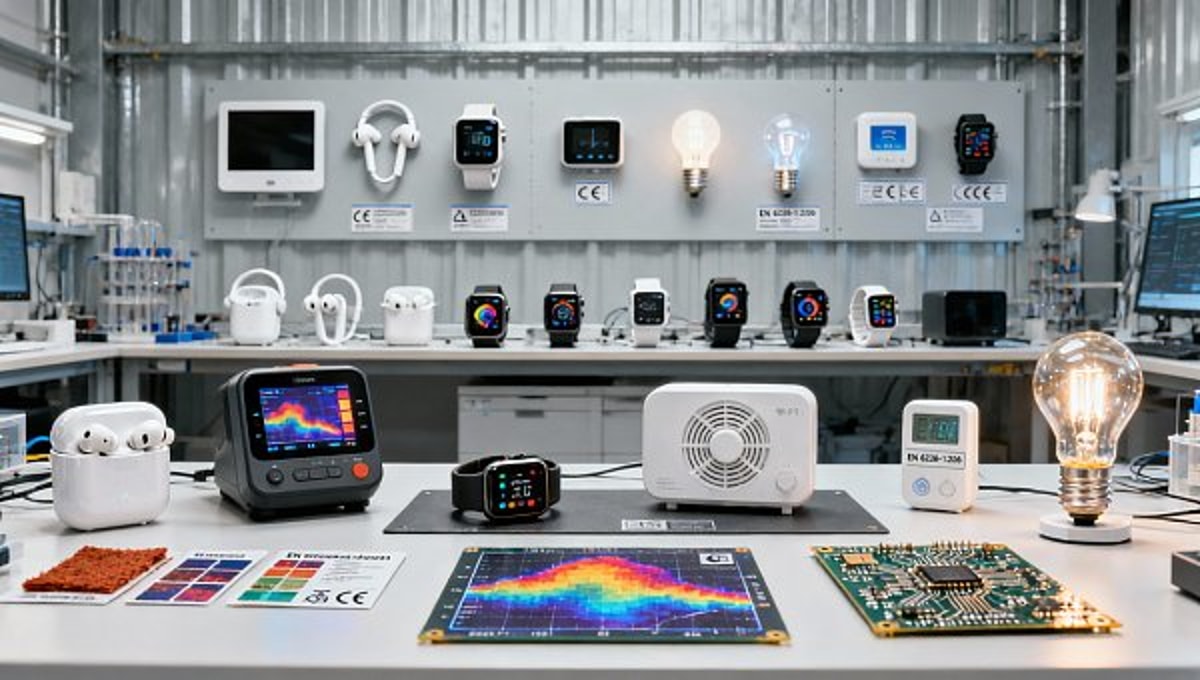
Effective 1 May 2026, the revised European safety standard EN 62368-1:2026 becomes mandatory for all audio/video, IT and communication technology equipment placed on the EU market — with particular implications for manufacturers and exporters of smart wearables (e.g., fitness trackers, wireless earbuds) and smart home devices (e.g., connected light bulbs, thermostats). This update introduces new, enforceable requirements for thermal runaway propagation mitigation, PCB high-temperature zone isolation, and enhanced enclosure flame retardancy. Non-compliant products will be ineligible for CE marking and thus prohibited from EU import and sale.
Event Overview
The European Official Journal confirmed that EN 62368-1:2026 enters into force as a harmonised standard under the EU Low Voltage Directive on 1 May 2026. The standard applies to all apparatus falling within its scope — specifically, audio/video equipment, information technology equipment, and telecommunications terminal equipment — including battery-powered smart wearables and smart home devices intended for consumer use. Certification to this version is required to support CE conformity assessment; previous editions (e.g., EN 62368-1:2019 or EN 62368-1:2020) will no longer suffice for new product introductions after the transition date.
Impact on Specific Industry Segments
Direct Exporters and Brand Owners
Exporters placing branded smart wearables or smart home devices on the EU market must obtain updated EN 62368-1:2026 certification before 1 May 2026. The impact manifests primarily in delayed time-to-market: retesting and redesign may be needed for existing models, especially those using lithium-based batteries without dedicated thermal propagation barriers or with insufficient PCB layout separation near heat-generating components.
OEM/ODM Manufacturing Partners
Contract manufacturers producing for EU-bound brands face revised design and documentation obligations. They must verify whether their current production lines meet the new thermal management and material flammability requirements — particularly for plastic enclosures (now requiring higher UL 94 V-0 or equivalent classification under Clause 6.5.2.2) and battery compartment construction (per Annex G.7 on thermal runaway containment).
Component Suppliers (Battery, PCB, Enclosure Materials)
Suppliers of lithium-ion cells, battery packs, printed circuit boards, and plastic housings will experience increased technical specification requests. Buyers are likely to require documented evidence of thermal propagation test results (e.g., UN 38.3 + additional cell-to-cell fire spread testing), PCB thermal simulation reports, and certified flame-retardant material data sheets aligned with EN 62368-1:2026 Annexes G and H.
Distribution and Import Agents
Importers and authorised representatives based in the EU bear legal responsibility for ensuring conformity. Under Article 6 of the EU Market Surveillance Regulation (EU) 2019/1020, they must retain technical documentation — now explicitly including EN 62368-1:2026-specific risk assessments and test reports — and make them available upon request by national authorities.
What Relevant Enterprises or Practitioners Should Focus On and How to Respond
Verify current certification status against the 2026 edition timeline
Confirm whether existing type approvals reference EN 62368-1:2026 or earlier versions. Note that while the standard was published in 2026, the mandatory application date is fixed at 1 May 2026 — no grace period is specified for legacy certifications. Early engagement with Notified Bodies is advised to secure test slots ahead of anticipated demand spikes.
Review thermal design and material specifications for priority product categories
Focus first on devices with integrated lithium batteries and compact enclosures — e.g., TWS earbuds, smart rings, and Wi-Fi-enabled thermostats — where thermal propagation risk and enclosure flammability compliance are most challenging. Cross-check PCB layout against Clause 6.4.3 (separation of high-temperature zones) and enclosure materials against Table 18 (flammability classification per IEC 60695-11-10).
Update technical documentation and supplier communication protocols
Revise internal technical files to include EN 62368-1:2026-specific clauses, especially Annex G (lithium battery safety) and Annex H (flammability evaluation). Require component suppliers to provide updated declarations of conformity referencing the 2026 edition — not just generic “complies with EN 62368-1” statements.
Monitor official updates from CENELEC and EU national market surveillance authorities
Although the standard’s entry into force is confirmed, interpretation guidance — such as accepted test methods for thermal runaway propagation or transitional arrangements for stock already in EU distribution channels — may be issued separately. Subscribing to CENELEC’s official notifications and national authority bulletins (e.g., Germany’s BAFA, Netherlands’ NVWA) is recommended.
Editorial Perspective / Industry Observation
Observably, EN 62368-1:2026 signals a structural shift toward performance-based safety verification — particularly for energy-dense portable electronics — rather than a mere incremental revision. Analysis shows the new thermal propagation requirements reflect growing regulatory attention to real-world failure modes, not just electrical insulation or mechanical strength. From an industry perspective, this is less a one-time compliance checkpoint and more an early indicator of tightening safety expectations across global markets, including potential alignment with upcoming IEC 62368-1 Ed. 4 and UKCA updates. Current enforcement focus remains on CE marking eligibility; however, post-market surveillance activity targeting thermal incidents is expected to increase following implementation.

In summary, EN 62368-1:2026 represents a defined, enforceable threshold for market access — not a voluntary upgrade. Its significance lies not in novelty alone, but in its binding nature and direct linkage to CE marking validity. It is best understood today not as a distant regulatory horizon, but as a concrete, date-bound operational requirement affecting product development, procurement, and documentation workflows across the smart device supply chain.
Source: Official Journal of the European Union (C 2026/05); CENELEC Standard EN 62368-1:2026 (published March 2026); EU Commission Communication on Harmonised Standards under Directive 2014/35/EU (OJ C 2025/112).
Observation note: Guidance on acceptable test methodologies for thermal runaway propagation (Annex G.7) and transitional provisions for products already placed on the market prior to 1 May 2026 remain pending official publication and are subject to ongoing monitoring.
Recommended News
 China Accelerates Export Refunds for Cement, Glass FirmsChina accelerates export refunds for cement & glass firms—T+3 VAT rebates + 30% lower inspections for ISO 14067-certified exporters. Act now!
 MIIT Sets New Certification for Green Data Center ExportsMIIT Sets New Certification for Green Data Center Exports: LEO satellite sync, space-ground scheduling & liquid-cooling (PUE<1.15) now key for NEOM/G42 bids.
 China’s First Embodied AI Robot Insurance Launched in GuangxiChina’s first Embodied AI Robot Insurance launched in Guangxi—key for EU-bound service robot exporters, OEMs & compliance teams seeking faster market access.
 MIIT Releases List of Completed 10G-PON Pilot CitiesMIIT Releases List of Completed 10G-PON Pilot Cities — Discover how 800G optical modules, low-loss fiber patch cords & intelligent ODN cabinets are shaping global telecom procurement trends.
 Morocco: 4th Top African Recipient of EU Energy Aid, Boost for Chinese PV Mounting & BESS ExportsMorocco’s €1.2B EU energy aid boosts demand for Chinese PV mounting structures & containerized BESS — key export opportunity in North Africa.
 China’s 2026–2030 Service Trade Standardization PlanChina’s 2026–2030 Service Trade Standardization Plan officially recognizes AI inspection reports, cloud maintenance logs, and SaaS packages as certifiable digital exports—key for global SaaS, smart manufacturing & IT outsourcing firms.
 ADB Raises Vietnam’s 2026 GDP Forecast to 7.2% on Sino-Vietnam Electronics & Solar Supply Chain IntegrationADB raises Vietnam’s 2026 GDP forecast to 7.2% amid surging Sino-Vietnam electronics & solar supply chain integration—key insight for OEMs, EMS providers, and cross-border traders.
 China Launches Green Export Channel for High-Efficiency Motors & DrivesGreen export channel launched for high-efficiency motors & drives meeting GB 18613–2025 Level 1 — faster clearance, certification & global edge.
 EN 62368-1:2026 Mandatory in EU from May 2026 for Wearables & Smart Home DevicesEN 62368-1:2026 is mandatory for wearables & smart home devices in the EU from May 2026 — ensure CE compliance now with thermal, PCB, and flame-retardancy updates.
 WeChat Pay Connects QR Codes in 5 Countries for Cross-Border TradeWeChat Pay Connects QR Codes in 5 Countries for Cross-Border Trade — enabling seamless, wallet-to-wallet payments for SMEs importing from China. Faster settlement, no RMB top-up or cards needed.
 MIIT Releases First List of Completed 10G-PON Pilot ProjectsMIIT Releases First List of Completed 10G-PON Pilot Projects — discover how XGS-PON, 25G WDM-PON chips and China’s 10G optical network pilots impact global export opportunities.
 Morocco: 4th Top African Recipient of EU Energy Aid, New Channel for Chinese PV & StorageMorocco: 4th top African recipient of EU energy aid (€4.1B) — unlocking new opportunities for Chinese PV modules, solar trackers, PV-storage cabinets & microgrid systems.
 MIIT Launches Space-Ground Computing Coordination PlanMIIT Launches Space-Ground Computing Coordination Plan — unlocking export opportunities for energy-efficient data center hardware in emerging markets.
 ADB Raises Vietnam’s 2026 GDP Forecast to 7.2% on China-Vietnam Supply Chain UpgradesADB raises Vietnam’s 2026 GDP forecast to 7.2% amid China-Vietnam supply chain upgrades in electronics, PV, and NEV sectors—key insight for global manufacturers and procurement teams.
 EN 62368-1:2026 Mandatory from Oct 2026: Thermal Runaway Protection for Wearables & Smart Home DevicesEN 62368-1:2026 mandates thermal runaway protection for wearables & smart home devices from Oct 2026 — act now to ensure EU market access, CB certification, and design compliance.
 UAE Emerges as Global AI Hub; Chinese AI Hardware Gains TractionUAE emerges as global AI hub—Chinese AI hardware from Shenzhen, Hangzhou & Suzhou gains traction in smart infrastructure, sandbox deployments & GCC market access.
 CMDE Adds 74 External Experts to Boost Med Device Export RegistrationCMDE Adds 74 External Experts to Boost Med Device Export Registration — accelerate FDA/EU/GCC submissions for medical equipment & rehab devices.
 MIIT Launches Space-Ground Compute & Power CoordinationMIIT Launches Space-Ground Compute & Power Coordination—unlocking export opportunities in liquid cooling, optical modules & high-efficiency servers for hot-humid markets.
 2026 Bio-based Raw Material Supplier Guide Released2026 Bio-based Raw Material Supplier Guide: Discover the official White List for PLA, PHA, bamboo fiber & more — boost EU/US compliance and procurement efficiency now.
 China Launches 'Model-Data Resonance' Initiative for AI+Manufacturing StandardsChina's 'Model-Data Resonance' initiative launches AI+Manufacturing standards — CESI/AI-MFG-2026 ensures plug-and-play interoperability for CNC, AGVs, MES & more across global smart factories.
 China’s First Embodied AI Robot Export Liability Insurance Launched in GuangxiChina’s first Embodied AI Robot Export Liability Insurance launched in Guangxi—key for robot exporters targeting EU, US & Saudi markets. Secure compliance-backed coverage now.
















Popular Tags
Global Trade Insights & Industry
Our mission is to empower global exporters and importers with data-driven insights that foster strategic growth.
Search News
Popular Tags
Industry Overview
The global commercial kitchen equipment market is projected to reach $112 billion by 2027. Driven by urbanization, the rise of e-commerce food delivery, and strict hygiene regulations.