

China Accelerates Export Refunds for Cement, Glass Firms
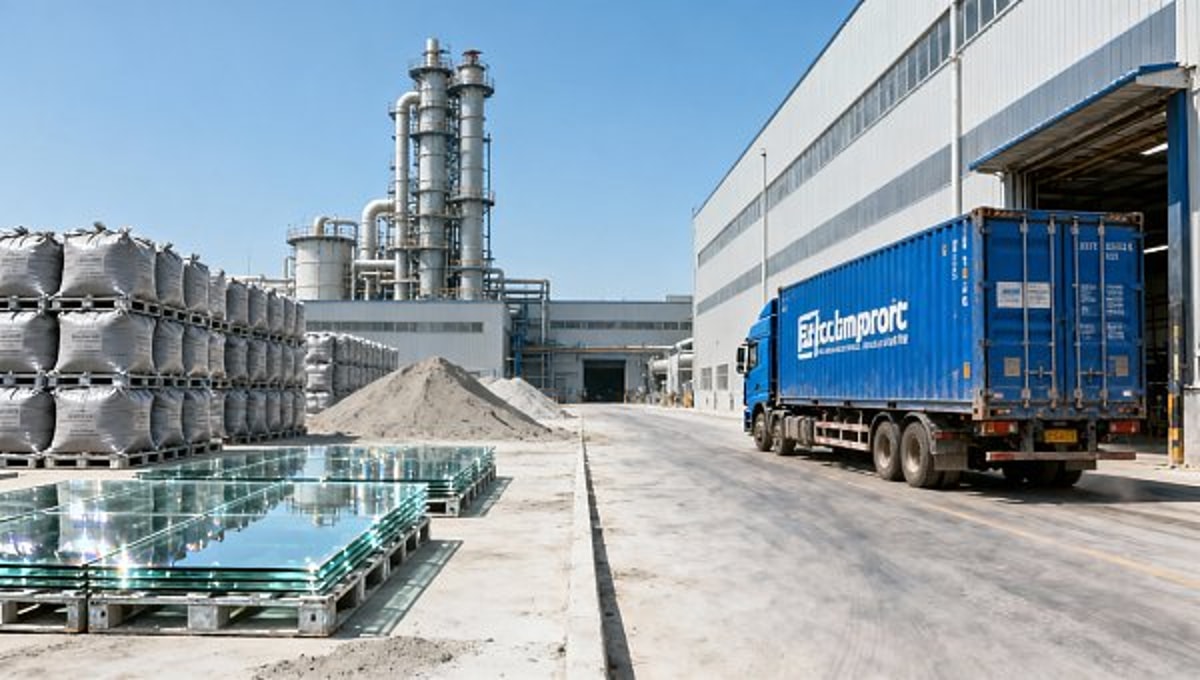
On April 24, 2026, six Chinese government departments jointly issued the Construction Materials Industry Stabilization and Growth Work Plan (2025–2026), introducing expedited export tax rebate processing and carbon footprint verification incentives for cement, glass, and downstream processed product exporters. The policy directly affects enterprises engaged in international trade of bulk and value-added building materials — particularly those exporting to markets with tightening environmental compliance requirements.
Event Overview
On April 24, 2026, China’s Ministry of Industry and Information Technology, Ministry of Finance, General Administration of Customs, State Taxation Administration, Ministry of Ecology and Environment, and General Administration of Market Regulation jointly released the Construction Materials Industry Stabilization and Growth Work Plan (2025–2026). The plan establishes a ‘T+3’ export VAT refund processing channel for enterprises exporting cement, flat glass, and deep-processed glass products. It also reduces export inspection sampling rates by 30% for enterprises certified under ISO 14067 for product-level carbon footprint. The plan took effect immediately. As of issuance, 217 construction materials export enterprises have completed system registration.
Which Subsectors Are Affected
Direct Export Trading Enterprises
These are companies that declare exports under their own name and claim VAT refunds. They benefit directly from the ‘T+3’ refund timeline — meaning refunds are processed within three working days after customs clearance. This improves cash flow predictability and reduces working capital pressure, especially for SMEs with narrow liquidity buffers.
Deep-Processing Manufacturers (e.g., tempered, laminated, coated glass producers)
Unlike basic flat glass or clinker producers, these firms add value through secondary manufacturing. Their eligibility for both the accelerated refund and the reduced inspection rate depends on whether their final exported goods fall under the defined scope of ‘deep-processed glass products’. Classification accuracy at customs declaration is therefore operationally critical.
Export-Oriented Raw Material Suppliers (e.g., specialty additives, refractory suppliers)
While not explicitly covered, these upstream suppliers may experience indirect effects: increased demand for low-carbon inputs (e.g., green electricity-backed melting, low-carbon fuels) as downstream processors seek ISO 14067 alignment. However, no direct policy benefit or obligation applies to them under current terms.
Third-Party Certification & Compliance Service Providers
Organizations offering ISO 14067 carbon footprint verification services face growing demand, particularly from exporters preparing for audits. The 30% sampling reduction serves as a tangible incentive for certification — but only for certified entities, not applicants in process.
What Relevant Enterprises or Practitioners Should Focus On — And How to Respond
Confirm eligibility and product classification ahead of first claim
Enterprises must verify whether their exported items qualify as ‘cement’, ‘flat glass’, or ‘deep-processed glass products’ per official HS code and technical definitions published by the General Administration of Customs. Misclassification risks disqualification from both the T+3 channel and sampling reduction benefits.
Align internal documentation with ISO 14067 reporting requirements — not just certification status
The 30% inspection relief applies only to enterprises holding valid ISO 14067 certification *and* maintaining traceable, auditable carbon data for the specific exported batch. Pre-submission of product-specific carbon reports to inspection authorities may be required to activate the benefit — though formal guidance remains pending.
Monitor implementation notices from provincial tax and customs bureaus
While the plan is national in scope, local tax offices manage VAT refund execution, and local customs branches conduct sampling. Variations in procedural interpretation or digital platform readiness across regions may affect actual turnaround time or sampling frequency. Early adopters should track announcements from key export hubs (e.g., Guangdong, Shandong, Hebei).
Prepare for potential phase-in of carbon data integration into export declarations
Although not yet mandated, the linkage between ISO 14067 certification and customs inspection suggests future alignment between carbon accounting systems and China’s Single Window export platform. Firms should assess whether their ERP or LCA tools can generate compliant, machine-readable carbon data for export batches.
Editor Perspective / Industry Observation
Observably, this policy is less a standalone stimulus and more an operational calibration — tightening alignment between trade facilitation and environmental governance in a high-exposure export segment. Analysis shows the dual focus on speed (T+3) and sustainability (ISO 14067 incentive) signals a shift toward conditionality: faster cash flow is now explicitly tied to verifiable decarbonization performance. From an industry perspective, it is better understood not as immediate revenue support, but as a structural nudge toward carbon-aware export operations — one that rewards early movers in data transparency and certification, while raising the baseline for market access in environmentally regulated destinations.
Current implementation remains narrow in scope (only cement, flat glass, and specified deep-processed glass), and no expansion to ceramics, refractories, or insulation materials is indicated. Therefore, its near-term impact is concentrated — not systemic — across the broader construction materials sector.
It is more accurately interpreted as a policy signal than a fully scaled intervention: the ‘T+3’ mechanism tests administrative capacity for rapid VAT processing, while the sampling reduction tests the feasibility of using third-party carbon verification as a proxy for regulatory trust. Sustained rollout will depend on performance metrics from the initial cohort of 217 registered enterprises.

Conclusion
This initiative marks a calibrated step toward integrating climate accountability into core trade infrastructure for select construction materials exporters. Its significance lies not in scale, but in precedent: it formally links export efficiency with carbon data credibility. For affected firms, the priority is operational precision — correct classification, timely certification, and system-readiness — rather than strategic repositioning. It is best understood as an administrative optimization with environmental conditions, not a broad-based growth lever.
Information Source:
Main source: Joint notice issued on April 24, 2026, by the Ministry of Industry and Information Technology, Ministry of Finance, General Administration of Customs, State Taxation Administration, Ministry of Ecology and Environment, and General Administration of Market Regulation — titled Construction Materials Industry Stabilization and Growth Work Plan (2025–2026).
Note: Implementation details (e.g., exact HS codes covered, definition of ‘deep-processed glass products’, technical specifications for ISO 14067 reporting) remain subject to further clarification by provincial authorities and are under ongoing observation.
Recommended News
 China Accelerates Export Refunds for Cement, Glass FirmsChina accelerates export refunds for cement & glass firms—T+3 VAT rebates + 30% lower inspections for ISO 14067-certified exporters. Act now!
 MIIT Sets New Certification for Green Data Center ExportsMIIT Sets New Certification for Green Data Center Exports: LEO satellite sync, space-ground scheduling & liquid-cooling (PUE<1.15) now key for NEOM/G42 bids.
 China’s First Embodied AI Robot Insurance Launched in GuangxiChina’s first Embodied AI Robot Insurance launched in Guangxi—key for EU-bound service robot exporters, OEMs & compliance teams seeking faster market access.
 MIIT Releases List of Completed 10G-PON Pilot CitiesMIIT Releases List of Completed 10G-PON Pilot Cities — Discover how 800G optical modules, low-loss fiber patch cords & intelligent ODN cabinets are shaping global telecom procurement trends.
 Morocco: 4th Top African Recipient of EU Energy Aid, Boost for Chinese PV Mounting & BESS ExportsMorocco’s €1.2B EU energy aid boosts demand for Chinese PV mounting structures & containerized BESS — key export opportunity in North Africa.
 China’s 2026–2030 Service Trade Standardization PlanChina’s 2026–2030 Service Trade Standardization Plan officially recognizes AI inspection reports, cloud maintenance logs, and SaaS packages as certifiable digital exports—key for global SaaS, smart manufacturing & IT outsourcing firms.
 ADB Raises Vietnam’s 2026 GDP Forecast to 7.2% on Sino-Vietnam Electronics & Solar Supply Chain IntegrationADB raises Vietnam’s 2026 GDP forecast to 7.2% amid surging Sino-Vietnam electronics & solar supply chain integration—key insight for OEMs, EMS providers, and cross-border traders.
 China Launches Green Export Channel for High-Efficiency Motors & DrivesGreen export channel launched for high-efficiency motors & drives meeting GB 18613–2025 Level 1 — faster clearance, certification & global edge.
 EN 62368-1:2026 Mandatory in EU from May 2026 for Wearables & Smart Home DevicesEN 62368-1:2026 is mandatory for wearables & smart home devices in the EU from May 2026 — ensure CE compliance now with thermal, PCB, and flame-retardancy updates.
 WeChat Pay Connects QR Codes in 5 Countries for Cross-Border TradeWeChat Pay Connects QR Codes in 5 Countries for Cross-Border Trade — enabling seamless, wallet-to-wallet payments for SMEs importing from China. Faster settlement, no RMB top-up or cards needed.
 MIIT Releases First List of Completed 10G-PON Pilot ProjectsMIIT Releases First List of Completed 10G-PON Pilot Projects — discover how XGS-PON, 25G WDM-PON chips and China’s 10G optical network pilots impact global export opportunities.
 Morocco: 4th Top African Recipient of EU Energy Aid, New Channel for Chinese PV & StorageMorocco: 4th top African recipient of EU energy aid (€4.1B) — unlocking new opportunities for Chinese PV modules, solar trackers, PV-storage cabinets & microgrid systems.
 MIIT Launches Space-Ground Computing Coordination PlanMIIT Launches Space-Ground Computing Coordination Plan — unlocking export opportunities for energy-efficient data center hardware in emerging markets.
 ADB Raises Vietnam’s 2026 GDP Forecast to 7.2% on China-Vietnam Supply Chain UpgradesADB raises Vietnam’s 2026 GDP forecast to 7.2% amid China-Vietnam supply chain upgrades in electronics, PV, and NEV sectors—key insight for global manufacturers and procurement teams.
 EN 62368-1:2026 Mandatory from Oct 2026: Thermal Runaway Protection for Wearables & Smart Home DevicesEN 62368-1:2026 mandates thermal runaway protection for wearables & smart home devices from Oct 2026 — act now to ensure EU market access, CB certification, and design compliance.
 UAE Emerges as Global AI Hub; Chinese AI Hardware Gains TractionUAE emerges as global AI hub—Chinese AI hardware from Shenzhen, Hangzhou & Suzhou gains traction in smart infrastructure, sandbox deployments & GCC market access.
 CMDE Adds 74 External Experts to Boost Med Device Export RegistrationCMDE Adds 74 External Experts to Boost Med Device Export Registration — accelerate FDA/EU/GCC submissions for medical equipment & rehab devices.
 MIIT Launches Space-Ground Compute & Power CoordinationMIIT Launches Space-Ground Compute & Power Coordination—unlocking export opportunities in liquid cooling, optical modules & high-efficiency servers for hot-humid markets.
 2026 Bio-based Raw Material Supplier Guide Released2026 Bio-based Raw Material Supplier Guide: Discover the official White List for PLA, PHA, bamboo fiber & more — boost EU/US compliance and procurement efficiency now.
 China Launches 'Model-Data Resonance' Initiative for AI+Manufacturing StandardsChina's 'Model-Data Resonance' initiative launches AI+Manufacturing standards — CESI/AI-MFG-2026 ensures plug-and-play interoperability for CNC, AGVs, MES & more across global smart factories.
 China’s First Embodied AI Robot Export Liability Insurance Launched in GuangxiChina’s first Embodied AI Robot Export Liability Insurance launched in Guangxi—key for robot exporters targeting EU, US & Saudi markets. Secure compliance-backed coverage now.



















Popular Tags
Global Trade Insights & Industry
Our mission is to empower global exporters and importers with data-driven insights that foster strategic growth.
Search News
Popular Tags
Industry Overview
The global commercial kitchen equipment market is projected to reach $112 billion by 2027. Driven by urbanization, the rise of e-commerce food delivery, and strict hygiene regulations.