

China Launches 'Model-Data Resonance' Initiative for AI+Manufacturing Standards
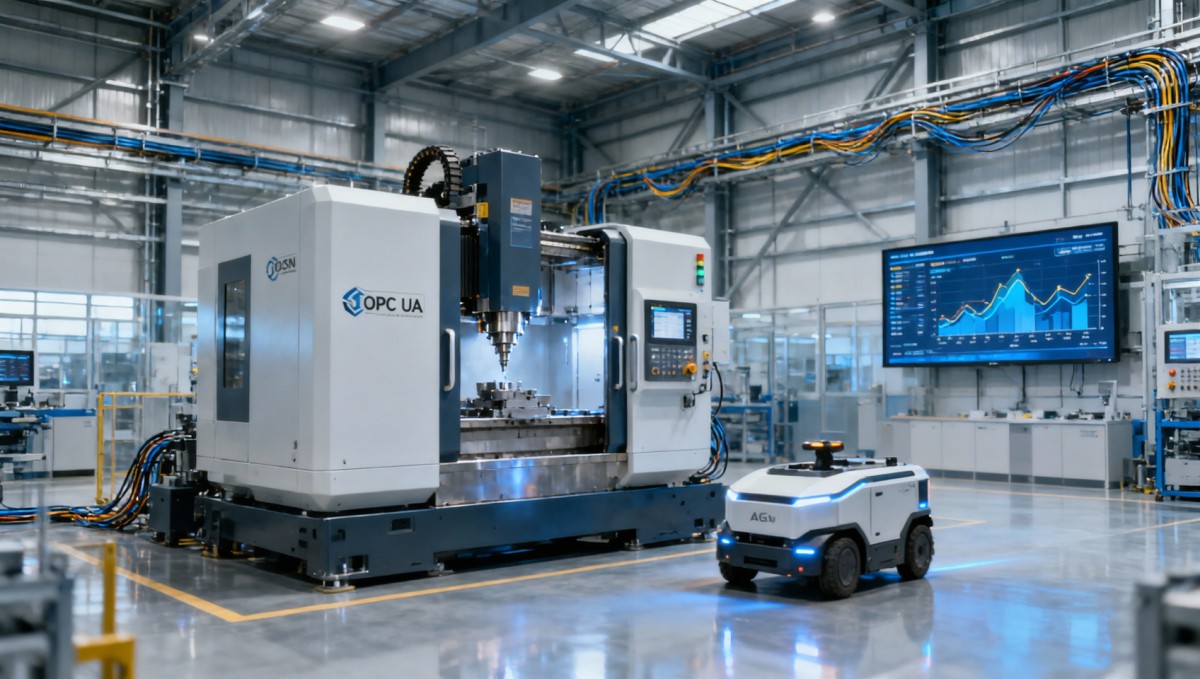
On April 29, 2026, China’s Ministry of Industry and Information Technology (MIIT) and the China Electronics Standardization Institute (CESI) jointly released the AI+Manufacturing Data Interoperability Interface Standard V1.0 (CESI/AI-MFG-2026). This marks the first national standard defining a unified OPC UA over TSN data model for CNC machine tools, injection molding machines, AGVs, and MES systems — with declared interoperability support for Germany’s VDMA 24582 and the U.S. MTConnect v2.3 specifications. The standard has already been adopted by industrial associations in Singapore, Mexico, and Turkey, offering Chinese smart factory equipment exporters a formal ‘plug-and-play’ data compatibility commitment to reduce overseas production line integration costs. Manufacturers, system integrators, and export-oriented OEMs in precision machinery, automation, and industrial software should closely monitor its technical scope and rollout implications.
Event Overview
On April 29, 2026, MIIT and CESI published the AI+Manufacturing Data Interoperability Interface Standard V1.0 (CESI/AI-MFG-2026). The standard specifies a common OPC UA over TSN data model for four core industrial components: CNC machine tools, injection molding machines, automated guided vehicles (AGVs), and manufacturing execution systems (MES). It explicitly declares alignment with two international interface frameworks: Germany’s VDMA 24582 and the U.S. MTConnect v2.3. As of publication, the standard has been formally adopted by national industrial associations in Singapore, Mexico, and Turkey.
Impact on Specific Subsectors
Export-Oriented Equipment Manufacturers
These companies supply CNC machines, injection molding units, or AGVs to overseas markets. The standard directly affects their product certification pathways and pre-delivery configuration requirements. Adoption means they must align firmware, data tagging, and metadata schemas with CESI/AI-MFG-2026 before shipment to participating countries — otherwise, local integration partners may reject data handshake attempts during commissioning.
Industrial Automation System Integrators
Integrators deploying end-to-end smart factory solutions abroad face revised interoperability expectations. Where clients in Singapore, Mexico, or Turkey specify compliance with CESI/AI-MFG-2026, integrators must verify that third-party devices — even those certified to MTConnect or VDMA — expose equivalent node structures and semantic definitions. Gaps may trigger custom adapter development, increasing project timelines and validation overhead.
MES and Industrial Software Vendors
Vendors whose platforms connect to shop-floor equipment must extend support for the CESI-defined object models and information models. Unlike MTConnect’s XML-based polling or VDMA’s fieldbus-centric profiles, CESI/AI-MFG-2026 mandates specific OPC UA Information Models with mandatory namespace identifiers and type definitions. This requires concrete SDK updates and conformance testing — not just protocol-level connectivity.
Global Procurement & Supply Chain Managers
Procurement teams sourcing industrial hardware for multinational facilities must now assess vendor documentation for CESI/AI-MFG-2026 compliance statements — especially when consolidating suppliers across ASEAN, LATAM, or EMEA regions. Non-compliant devices may introduce hidden integration friction during cross-regional plant rollouts, even if individually certified to other standards.
What Enterprises and Practitioners Should Monitor and Act On
Track official conformance test procedures and certification bodies
CESI has not yet published accredited testing labs or formal conformance test suites for CESI/AI-MFG-2026. Enterprises should monitor CESI’s official announcements and MIIT’s policy bulletins for authorized certification channels — as self-declared compliance carries no legal or contractual weight in adopting markets.
Verify implementation scope in key target markets
Adoption by industrial associations in Singapore, Mexico, and Turkey does not equate to national regulatory mandates. Enterprises should confirm whether local procurement policies, government-funded smart factory grants, or OEM tender requirements reference CESI/AI-MFG-2026 — and at what enforcement level (e.g., preferred, mandatory, or pilot-only).
Distinguish between protocol support and semantic interoperability
Supporting OPC UA over TSN is necessary but insufficient. The standard defines precise information models — including mandatory node IDs, data types, and update semantics. Enterprises should audit existing device drivers and MES connectors against the published CESI/AI-MFG-2026 specification annexes, not assume compatibility based on generic OPC UA capability.
Prepare internal documentation and training for cross-functional teams
Sales, engineering, and after-sales service teams need aligned terminology and test scenarios. For example, quoting ‘CESI/AI-MFG-2026 compliance’ without specifying supported object models or versioned conformance claims may lead to post-sale disputes. Internal SOPs should define how compliance statements are validated and communicated to customers.
Editor Perspective / Industry Observation
Observably, this initiative functions less as an immediate technical mandate and more as a strategic interoperability anchor — signaling China’s intent to co-define, rather than merely adopt, global industrial data standards. Analysis shows the timing aligns with parallel efforts by the International Electrotechnical Commission (IEC) to harmonize OPC UA companion specifications, suggesting CESI/AI-MFG-2026 may evolve into a candidate contribution for IEC/ISO standardization. From an industry perspective, it is currently best understood as a coordination mechanism for Chinese vendors entering markets where fragmented legacy protocols have raised integration risk — not as a replacement for MTConnect or VDMA, but as a complementary assurance layer for bilateral compatibility.
Consequently, the standard’s near-term value lies in reducing negotiation friction and lowering integration validation effort — particularly for repeat deployments across multiple jurisdictions. Its long-term significance depends on whether additional countries or multilateral frameworks grant it formal recognition beyond association-level endorsement.
Conclusion: The release of CESI/AI-MFG-2026 reflects a calibrated step toward structured data interoperability in AI-integrated manufacturing — one focused on practical integration assurance rather than technological prescription. It is neither a regulatory requirement nor a universal replacement for existing frameworks, but a targeted interface agreement with measurable utility for exporters, integrators, and software vendors operating in or serving Singapore, Mexico, and Turkey. Current adoption remains voluntary and association-led; enterprises should treat it as an emerging operational benchmark — not a compliance deadline.
Source: Ministry of Industry and Information Technology (MIIT) of the People’s Republic of China; China Electronics Standardization Institute (CESI); official adoption notices issued by the Singapore Industrial Automation Association (SIAA), Mexican Association of the Machine Tool Industry (AMIMT), and Turkish Machinery Exporters’ Association (MIB).
Note: Conformance testing procedures, certification body accreditation, and potential expansion to additional countries remain under observation and are not confirmed as of April 2026.
Recommended News
 CMDE Adds 74 External Experts to Boost Med Device Export RegistrationCMDE Adds 74 External Experts to Boost Med Device Export Registration — accelerate FDA/EU/GCC submissions for medical equipment & rehab devices.
 MIIT Launches Space-Ground Compute & Power CoordinationMIIT Launches Space-Ground Compute & Power Coordination—unlocking export opportunities in liquid cooling, optical modules & high-efficiency servers for hot-humid markets.
 2026 Bio-based Raw Material Supplier Guide Released2026 Bio-based Raw Material Supplier Guide: Discover the official White List for PLA, PHA, bamboo fiber & more — boost EU/US compliance and procurement efficiency now.
 China Launches 'Model-Data Resonance' Initiative for AI+Manufacturing StandardsChina's 'Model-Data Resonance' initiative launches AI+Manufacturing standards — CESI/AI-MFG-2026 ensures plug-and-play interoperability for CNC, AGVs, MES & more across global smart factories.
 China’s First Embodied AI Robot Export Liability Insurance Launched in GuangxiChina’s first Embodied AI Robot Export Liability Insurance launched in Guangxi—key for robot exporters targeting EU, US & Saudi markets. Secure compliance-backed coverage now.
 State Grid’s $680M Embodied AI Procurement Opens Export PathState Grid’s $680M embodied AI procurement sets global safety standards — IEC 62061 SIL2 & GB/T 38851 compliance unlocks EU/UK/NA export opportunities.
 WeChat Pay Cross-Border B2B QR Code Access in 5 ASEAN CountriesWeChat Pay Cross-Border B2B QR Code Access now live in 5 ASEAN countries — enabling real-time, local-currency settlements up to USD 50,000. Boost your hardware, garden & appliance exports today!
 RCEP Green Packaging Mutual Recognition Extended to AU, NZ, JP, KRRCEP Green Packaging Mutual Recognition now extends to AU, NZ, JP, KR — enabling customs-exempt clearance for certified Chinese food, infant & supplement packaging. Act now.
 IMDG Code 41-24 Enforces New UN3480 Lithium Battery Labels GloballyIMDG Code 41-24 mandates new UN3480 lithium battery labels globally from 1 May 2026—ensure compliance now to avoid shipment delays, rejections & penalties.
 CDE Adds 74 International Experts to Accelerate MedTech Export RegistrationCDE adds 74 international experts to accelerate MedTech export registration—key for IVD, imaging & rehab device exporters targeting FDA, EU MDR, Health Canada.
 MIIT Launches Space-Ground Computing & Green Data Center Export PlanMIIT's Space-Ground Computing & Green Data Center Export Plan unlocks global opportunities for liquid-cooled servers, PV direct-drive power, and satellite-ground scheduling—learn key impacts now.
 2026 Bio-based Raw Material Supplier Guide ReleasedBio-based raw material supplier guide 2026: Discover 47 ISO 16128-certified Chinese PLA, PBAT & PHA suppliers trusted by CBL, BPI & JIS.
 Q1 2026 Lithium Battery Export Prices Rise 11.3% YoYQ1 2026 Lithium Battery Export Prices Rise 11.3% YoY — discover why residential energy storage systems (RESS) drove the surge and what it means for exporters, suppliers & integrators.
 ‘Modular-Data Resonance’ Initiative Launches AI+Manufacturing Interface StandardModular-Data Resonance standard GB/T 45288-2026 launches AI+manufacturing interoperability—key for smart equipment exporters, MES/SCADA & AI model developers targeting EU/US markets.
 China's First Embodied AI Robot Export Liability Insurance Launched in GuangxiChina's first Embodied AI Robot Export Liability Insurance launched in Guangxi—key for robotics exporters targeting EU & SEA markets. Get compliant, certified, and covered.
 State Grid Launches $682M Embodied AI Inspection Equipment ProcurementState Grid’s $940M embodied AI inspection tender mandates IEC 62443-4-2 & ISO 13482 certs—key for robotics makers and global compliance teams. Act now.
 WeChat Pay Cross-Border B2B QR Code Live in 5 ASEAN CountriesWeChat Pay Cross-Border B2B QR Code is now live in 5 ASEAN countries — enabling fast, low-cost, local-currency settlements for SMEs and trade firms. Discover how it cuts costs by 47% and accelerates procurement.
 RCEP Green Packaging Mutual Recognition Extended to AU, NZ, JP, KRRCEP Green Packaging Mutual Recognition now extends to AU, NZ, JP, KR — unlock faster customs clearance & zero on-site inspection for compliant Chinese food packaging exports.
 IMDG Code 41-24 Enforces UN3480 Lithium Battery Labeling GloballyIMDG Code 41-24 enforces global UN3480 lithium battery labeling, packaging & e-CMR rules from 1 May 2026—act now to avoid port rejections and delays.
 Medical diagnostic equipment buying mistakes often start with workflowMedical diagnostic equipment buying mistakes often begin with workflow gaps. Learn how to compare systems, uncover hidden costs, and choose suppliers that fit real clinical operations.
 Interactive whiteboards are improving, but teacher adoption is unevenInteractive whiteboards are improving fast, but teacher adoption remains uneven. Explore what drives classroom success, ROI, and smarter edtech implementation.

















Popular Tags
Global Trade Insights & Industry
Our mission is to empower global exporters and importers with data-driven insights that foster strategic growth.
Search News
Popular Tags
Industry Overview
The global commercial kitchen equipment market is projected to reach $112 billion by 2027. Driven by urbanization, the rise of e-commerce food delivery, and strict hygiene regulations.