

Eco-friendly building materials: where certification changes the decision
Eco-friendly building materials are no longer selected on price and performance alone. For procurement professionals, certification now plays a decisive role in evaluating compliance, supply chain credibility, and long-term project value. This article explores how verified standards influence purchasing decisions, reduce sourcing risks, and help buyers identify materials that align with both sustainability targets and market expectations.
Certification has moved from a supporting detail to a decision trigger
A clear shift is taking place in construction sourcing. Buyers who once compared eco-friendly building materials mainly by unit cost, delivery time, and technical data now place certification much earlier in the evaluation process. This is not a cosmetic change. It reflects a broader market reality: sustainability claims are under greater scrutiny, project owners are more exposed to regulatory and reputational risk, and downstream clients increasingly expect proof rather than promises.
For procurement teams, the meaning of “qualified supplier” is expanding. It still includes consistent quality, logistics reliability, and commercial competitiveness, but it now also includes documented compliance with environmental, health, and traceability requirements. In practice, that means materials with recognized certifications often move faster through prequalification, face fewer objections during technical review, and remain more defensible during audits.
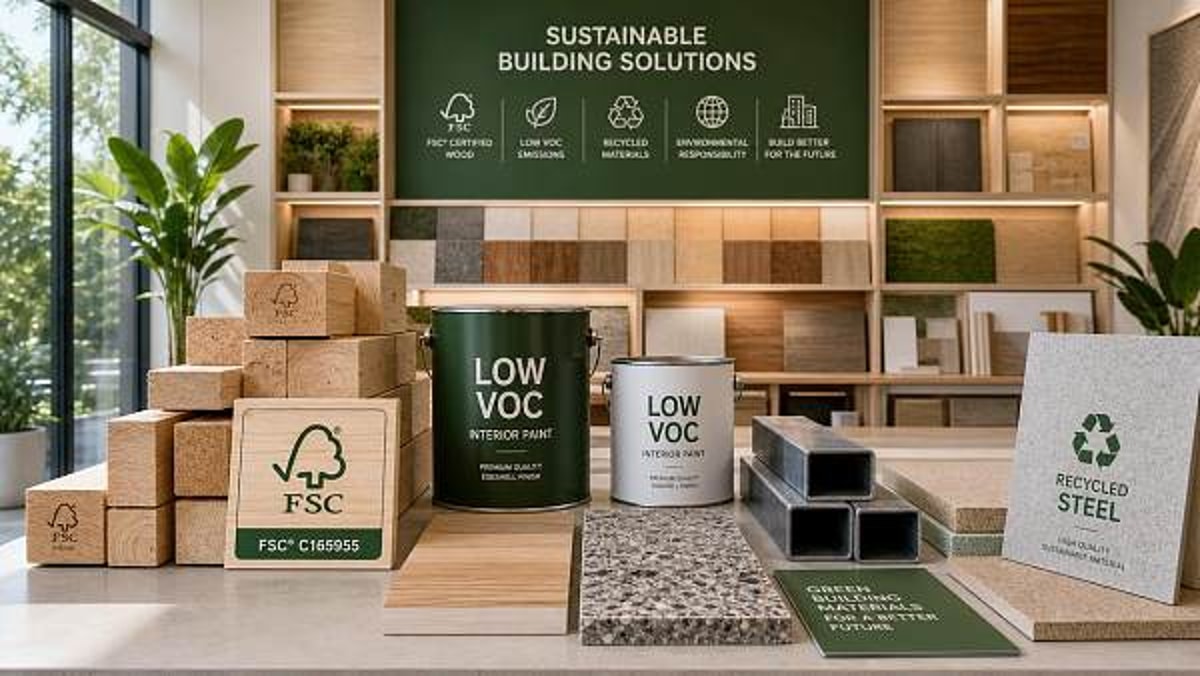
This trend affects a wide range of categories, from low-VOC paints and recycled steel content to FSC-certified timber, Environmental Product Declarations, and products aligned with LEED, BREEAM, or regional green building frameworks. The growing importance of eco-friendly building materials is therefore not just about greener projects. It is about lower uncertainty in buying decisions.
Why the market is changing now
Several forces are converging at the same time. First, environmental standards are becoming more visible in both public and private procurement. Tender documents increasingly request evidence related to emissions, recycled content, responsible sourcing, chemical safety, or lifecycle impact. Second, greenwashing concerns have made unsupported claims less acceptable. Procurement personnel are under pressure to verify whether an eco-friendly building material genuinely meets project requirements or only looks sustainable in marketing language.
Third, developers and contractors are facing stronger expectations from investors, tenants, and end users. Buildings are now evaluated not only by design and operating efficiency, but also by the sourcing profile of the materials inside them. A certified product can contribute to a stronger project narrative, support ESG reporting, and help maintain asset value over time. In this environment, certification becomes commercially relevant, not merely environmentally desirable.
Finally, cross-border trade has intensified the need for trust signals. When sourcing from unfamiliar markets, buyers need indicators that reduce information gaps. This is where high-authority industry intelligence platforms such as GTIIN and TradeVantage create value: they help procurement teams monitor market changes across sectors, compare supplier visibility, and identify signals that support more confident vendor shortlisting in the global supply chain.
The most important signals procurement teams are watching
The rise of eco-friendly building materials is not defined by one universal label. It is shaped by a cluster of signals that influence how purchasing risk is judged. Procurement teams increasingly pay attention to whether certifications are current, third-party verified, relevant to the intended use case, and aligned with the geography of the project. A certificate that matters in one market may carry limited value in another if local codes or client requirements point elsewhere.
Another key signal is consistency between certification and supporting documentation. If a supplier promotes recycled content, low emissions, or responsible forestry, buyers expect the specification sheet, declaration documents, testing records, and audit history to support the same claim. Misalignment in these documents often slows approval or raises concerns about supplier governance.
Certification is changing who gains an advantage in the supply chain
The impact is not limited to material manufacturers. Distributors, importers, contractors, architects, and developers are all affected, but in different ways. Manufacturers with credible certification often gain earlier access to specification lists and preferred supplier pools. Distributors benefit when they can present complete compliance files across multiple product lines, making it easier for buyers to consolidate sourcing. Contractors face pressure to avoid substitution risks, especially when project sustainability targets are contractually linked to material selection.
For procurement officers, the biggest change is operational. Instead of asking only, “Is this material available and affordable?” they now also ask, “Will this choice survive technical review, client scrutiny, and future reporting needs?” Eco-friendly building materials with robust certification increasingly answer that second question better than uncertified alternatives, even when the initial price is higher.
Not all certifications influence decisions equally
One important market lesson is that the presence of a label alone does not guarantee procurement success. Buyers increasingly distinguish between certifications that are widely accepted, application-specific, legally relevant, or merely promotional. A strong sourcing decision depends on fit. For example, indoor materials may be judged heavily on emissions and occupant health, while structural or exterior materials may face stronger scrutiny around durability, sourcing origin, or embodied carbon data.
This is why mature procurement teams map certificates to project objectives. If a client targets green building credits, the question becomes whether the certification contributes to that framework. If the project is in a region with strict environmental disclosure rules, the priority may shift toward auditable declarations and traceability. In both cases, eco-friendly building materials become easier to compare when buyers evaluate relevance instead of volume of claims.
The hidden value of certification is risk reduction
Many sourcing decisions still focus on visible cost, but the strongest argument for certified eco-friendly building materials is often the cost of avoiding future problems. Certification can reduce the likelihood of delayed approvals, product rejection, redesign, noncompliance claims, and reputational damage. It can also improve communication between procurement, engineering, sustainability, and legal teams because everyone works from a common evidence base.
This matters especially in international procurement. A lower-price offer may appear attractive until missing documents, ambiguous test methods, or unsupported sustainability claims create friction. The more complex the supply chain, the more valuable trusted documentation becomes. In that sense, certification is not only a technical requirement; it is a business control mechanism.
How procurement strategies are evolving in response
A noticeable trend is the shift from transactional buying to criteria-led sourcing. Instead of checking sustainability at the end of the process, procurement teams increasingly embed environmental and certification requirements into supplier onboarding, RFQs, and bid evaluation matrices. This saves time later and prevents the common problem of selecting a supplier first and discovering compliance gaps afterward.
Another change is the use of tiered supplier assessment. Buyers may separate suppliers into categories such as “fully verified,” “commercially promising but document incomplete,” and “not currently suitable.” This helps teams manage market options without lowering project standards. It also gives suppliers a clearer path to qualification.
Procurement professionals are also relying more on external intelligence. Market visibility, editorial credibility, and supplier discoverability now shape sourcing efficiency. For companies seeking global exposure, platforms like TradeVantage can strengthen trust signals through high-authority publication environments, industry relevance, and better search visibility, helping qualified suppliers become easier to identify during international sourcing research.
What buyers should verify before selecting eco-friendly building materials
In the current market, a practical decision framework is more useful than a generic sustainability preference. Buyers should verify whether the certification is current, independently issued, and suitable for the material category. They should confirm whether the claims match technical submittals, whether the supplier can provide traceable records, and whether the certification aligns with client, regulatory, or project rating system expectations.
It is also wise to assess operational resilience. Can the supplier maintain certified production at scale? Are there regional limitations in recognition? Is there a risk that a listed certificate covers only one plant or one product variant, while the quoted item differs? These questions help buyers avoid a common mistake: assuming that a sustainability statement automatically applies across a full catalog.
The next phase: from certified products to certified supply chains
The direction of travel is becoming clearer. The market is moving beyond isolated product claims toward broader supply chain accountability. In the next phase, procurement decisions are likely to weigh not just whether eco-friendly building materials have certifications, but whether the supplier ecosystem can support transparent sourcing, data continuity, and consistent reporting across projects and regions.
This suggests that certification will remain important, but its role will expand. Buyers will look for better integration between certifications, digital product information, environmental declarations, and supplier communication. The strongest suppliers will not simply present documents on request. They will make compliance information structured, searchable, and easy to audit.
What to watch next and how to respond
For procurement leaders, the key question is no longer whether eco-friendly building materials matter, but how quickly certification-linked expectations are changing in their own market. The most useful signals to monitor are updated tender language, stricter client sustainability clauses, wider use of lifecycle data, and stronger supplier transparency demands. These changes often appear gradually, then become standard faster than expected.
If a business wants to judge the impact on its sourcing strategy, it should confirm five points: which certifications are actually influencing approvals in target markets, where current suppliers have documentation gaps, how sustainability criteria are weighted against price, what risks exist in cross-border verification, and which information sources can support faster supplier intelligence. That is where structured industry insight becomes valuable. GTIIN and TradeVantage help businesses track trend shifts, strengthen market visibility, and support more informed trade decisions in a sourcing environment where proof increasingly shapes preference.
In practical terms, the best response is not to chase every green label. It is to build a disciplined evaluation model around relevance, verification, and project fit. When procurement teams do that, certification stops being a checkbox and becomes a strategic filter for selecting eco-friendly building materials with greater confidence.
Recommended News
 China’s First Embodied AI Robot Export Liability Insurance Launched in GuangxiEmbodied AI Robot Export Liability Insurance launched in Guangxi—China’s first insurer-backed solution for EU/Japan-bound industrial & service robots. Boost compliance, trust & tenders now.
 Morocco: 4th Top African Recipient of EU Energy Aid, Boosting China’s PV & Storage ExportsMorocco’s EU energy aid boost unlocks opportunities for Chinese PV mounting structures & containerized energy storage exports—act now to leverage new regulatory advantages.
 Industrial Robot Controller Thermal Gel: China's Export-Ready Heat Dissipation SolutionIndustrial Robot Controller Thermal Gel: China’s export-ready, TÜV-certified heat dissipation solution (8.5 W/mK) for robotics in SEA & Mexico.
 ADB Raises Vietnam’s 2026 GDP Forecast to 7.2% on Sino-Vietnam Supply Chain IntegrationADB raises Vietnam’s 2026 GDP forecast to 7.2% amid deepening Sino-Vietnam supply chain integration in electronics, solar PV, and lithium battery PACK production — key insight for OEMs, exporters & integrators.
 First National SME Service Demonstration Platforms AnnouncedFirst National SME Service Demonstration Platforms announced—16 specialize in REACH, UKCA, UL certification & rapid factory audits for exporters.
 U.S. Natural Gas Inventory Growth Below Forecast: Impact on Plastic Export CostsU.S. natural gas inventory growth missed forecast—impacting plastic export costs globally. Learn how rising TTF prices affect PP/PE resin costs, margins & supply chain strategy for exporters.
 EN 62368-1:2026 Enforced in EU: Thermal Runaway Protection for Wearables & Smart Home DevicesEN 62368-1:2026 is now mandatory in the EU—learn how thermal runaway protection impacts wearables, smart home devices & EV accessories.
 Q1 2026 Industrial Profits Up 15.5%: Supply Chain Cost Stability ConfirmedQ1 2026 Industrial Profits Up 15.5% — supply chain cost stability confirmed for global procurement, contract manufacturing & OEM teams.
") MIIT Releases Service Trade Standardization Plan (2026–2030)MIIT's 2026–2030 Service Trade Standardization Plan boosts AI-driven digital services—remote QA, cloud maintenance, intelligent warehouse SaaS—for global export competitiveness.
MIIT Releases Service Trade Standardization Plan (2026–2030)MIIT's 2026–2030 Service Trade Standardization Plan boosts AI-driven digital services—remote QA, cloud maintenance, intelligent warehouse SaaS—for global export competitiveness. WeChat Pay Integrates QR Codes from 5 Countries for B2B Cross-Border SettlementWeChat Pay integrates QR codes from South Korea, Sri Lanka, Thailand, Malaysia & Singapore — enabling faster, cheaper B2B cross-border settlement for global buyers and Chinese suppliers.
 Portable oxygen concentrators get noisy over time for several reasonsPortable oxygen concentrators get noisy over time due to dust, wear, loose parts, and aging compressors. Learn key causes, inspection priorities, and service tips to prevent failures.
 Interactive whiteboards: what schools regret not checking earlyInteractive whiteboards can boost learning, but schools often regret missing key checks on compatibility, durability, training, and support. Discover how to buy smarter.
 Medical diagnostic equipment downtime usually starts with this oversightMedical diagnostic equipment downtime often starts with one overlooked maintenance gap. Learn the warning signs, hidden costs, and smart service strategies to improve uptime.
 Eco-friendly building materials: where certification changes the decisionEco-friendly building materials now win or lose on certification. Learn how verified standards reduce sourcing risk, support compliance, and improve procurement decisions.
 Ergonomic workspace design mistakes that still cause daily strainErgonomic workspace design mistakes can silently cause daily strain, fatigue, and lower productivity. Discover practical fixes to improve comfort, focus, and workstation performance.
 Outdoor garden supplies that wear out too fast in summer heatOutdoor garden supplies can fail fast in extreme summer heat. Discover which items wear out first, what materials last longer, and how to buy smarter for durable, cost-saving performance.
 Sustainable home decor: how to spot green claims with substanceSustainable home decor explained: learn how to spot credible green claims, avoid greenwashing, compare materials and certifications, and choose stylish, healthier pieces with real impact.
 Modern office furniture trends that improve layout flexibilityModern office furniture trends are transforming flexible workplace design. Explore modular, mobile, ergonomic, and acoustic solutions that boost productivity and smarter space planning.
 Smart street lighting works best when control systems are not overlookedSmart street lighting succeeds when control systems come first. Learn how better monitoring, dimming, and integration improve ROI, maintenance efficiency, and long-term project performance.
 What solid-state battery breakthroughs are still years from market?Solid-state battery breakthroughs sound transformative, but which ones are still years from market? Explore the technical, cost, and scaling barriers shaping real adoption timelines.
 Commercial LED lighting retrofits: when is payback slower than planned?Commercial LED lighting payback can slip when costs, runtime, rebates, and controls are misjudged. Learn the hidden risks and review steps that protect ROI before approval.



















Popular Tags
Global Trade Insights & Industry
Our mission is to empower global exporters and importers with data-driven insights that foster strategic growth.
Search News
Popular Tags
Industry Overview
The global commercial kitchen equipment market is projected to reach $112 billion by 2027. Driven by urbanization, the rise of e-commerce food delivery, and strict hygiene regulations.