

RCEP Green Packaging Mutual Recognition Takes Effect
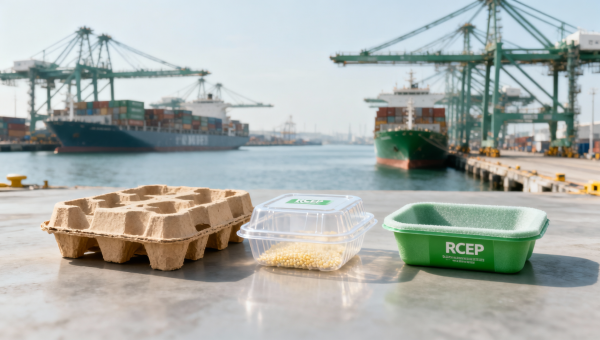
On April 21, 2026, RCEP green packaging mutual recognition officially entered into force, enabling Chinese eco-friendly packaging products—including compostable food packaging, recycled paper cartons, and bio-based labels—to clear customs without retesting in Australia, New Zealand, Japan, and South Korea. This development directly impacts exporters, packaging manufacturers, raw material suppliers, and logistics service providers operating across the RCEP region.
Event Overview
On April 21, 2026, the RCEP Secretariat confirmed that GB/T 37572–2025 General Principles for Evaluation of Green Packaging has been formally included in the RCEP Green Mutual Recognition List. As of that date, Chinese eco-friendly packaging products covered by this standard—such as biodegradable food packaging, environmentally certified paper boxes, and bio-based labels—may enter Australia, New Zealand, Japan, and South Korea using only third-party test reports issued in China, with no requirement for duplicate type testing in the importing countries.
Industries Affected
Direct Exporters (e.g., food, cosmetics, electronics brands shipping packaged goods)
These companies face reduced customs delays and lower compliance costs when exporting to the four RCEP markets. The elimination of redundant testing shortens time-to-market and lowers certification overhead—especially for SMEs with limited regulatory capacity.
Raw Material Suppliers (e.g., PLA resin producers, recycled fiber pulp mills)
Suppliers whose inputs feed into certified green packaging production may see increased demand for traceable, standards-aligned materials. However, downstream qualification remains contingent on final product conformity to GB/T 37572–2025—not upstream inputs alone.
Contract Packaging & Manufacturing Firms
Firms producing private-label or OEM eco-packaging must ensure their internal quality control and documentation align with GB/T 37572–2025’s evaluation criteria (e.g., recyclability, hazardous substance limits, life-cycle considerations). Non-conforming facilities risk losing eligibility for the mutual recognition benefit—even if clients hold valid test reports.
Distribution & Logistics Service Providers
Couriers, freight forwarders, and customs brokers handling green packaging shipments must verify that submitted documentation includes valid, accredited Chinese third-party test reports referencing GB/T 37572–2025. Misclassification or incomplete paperwork could trigger manual review despite mutual recognition status.
What Enterprises and Practitioners Should Monitor and Do Now
Track official implementation guidance from national authorities
The RCEP Secretariat’s confirmation is a framework-level decision. National customs or standards bodies in Australia, New Zealand, Japan, and South Korea may issue supplementary operational notices—e.g., acceptable lab accreditation scopes, report format requirements, or transitional arrangements. Enterprises should monitor updates from each country’s competent authority (e.g., Australia’s Department of Agriculture, Fisheries and Forestry; Japan’s METI).
Verify coverage for specific product categories and export destinations
Not all eco-friendly packaging automatically qualifies. Only products evaluated under GB/T 37572–2025—and falling within its defined scope (e.g., primary/secondary packaging for consumer goods)—are eligible. Companies must confirm whether their exact product types (e.g., laminated paper cups, multi-layer pouches) meet the standard’s structural and compositional criteria before assuming exemption applies.
Distinguish between policy signal and operational readiness
The inclusion of GB/T 37572–2025 in the RCEP list is a formal mutual recognition commitment—but actual border acceptance depends on frontline customs officials’ familiarity with the arrangement. Early adopters should pilot shipments with full documentation and document clearance outcomes to identify procedural gaps before scaling.
Prepare documentation and internal alignment ahead of first shipment
Third-party test reports must be issued by CNAS-accredited laboratories and explicitly reference GB/T 37572–2025. Internal quality records, material declarations, and process controls should be auditable against the standard’s evaluation indicators. Cross-functional alignment—between R&D, QA, logistics, and compliance teams—is critical to avoid inconsistencies at customs.
Editorial Perspective / Industry Observation
From an industry perspective, this development is best understood as an institutionalized facilitation mechanism—not an automatic market access guarantee. It reflects growing alignment among RCEP members on sustainability-linked trade infrastructure, but implementation fidelity will vary across jurisdictions and over time. Analysis来看, the move signals increasing convergence around lifecycle-informed packaging regulation, yet it does not replace national labeling, recycling, or EPR obligations. Observation来看, early uptake will likely concentrate among firms already certified to ISO 14040/44 or familiar with EU EN 13432—suggesting a ‘compliance spillover’ effect rather than a standalone simplification. Current more appropriate interpretation is that this is a procedural enabler, not a strategic differentiator—its value accrues incrementally through consistent application and cross-border feedback loops.
This milestone marks a step toward harmonized environmental trade protocols in the Asia-Pacific region—but its real-world impact remains contingent on execution consistency, documentation rigor, and ongoing inter-agency coordination. For now, it is better understood as a targeted operational improvement for compliant exporters, rather than a broad-based regulatory shift.
Source: RCEP Secretariat official notice (April 21, 2026); Standard GB/T 37572–2025 published by SAC (Standardization Administration of China).
Note: Implementation details from importing country authorities remain under observation and are subject to further notice.
Recommended News
 US CPSC Updates Child Sleep Sack Standard Effective July 2026US CPSC updates child sleep sack standard with new DSST test—mandatory for all U.S.-bound infant sleep sacks from July 2026. Act now to ensure compliance and market access.
 Red Sea Rerouting Pushes Asia-Europe Freight Premium to $1,850/TEURed Sea rerouting pushes Asia-Europe freight premium to $1,850/TEU—impacting importers, manufacturers & logistics providers. Act now to reassess costs, lead times & contracts.
 Mexico NOM-019-SCFI-2026 Effective May 1, 2026: EMC Certification Mandatory for Auto ElectronicsNOM-019-SCFI-2026 EMC certification is now mandatory for auto electronics in Mexico—effective May 1, 2026. Ensure compliance for infotainment, ADAS, OBD-II & more.
") TÜV Rheinland Updates CE Requirements for Servo Drives (PLd + EMC Class 3)TÜV Rheinland updates CE requirements for servo drives: PLd + EMC Class 3 joint validation mandatory from Q3 2026. Act now to avoid delays, rejections, or compliance risks.
TÜV Rheinland Updates CE Requirements for Servo Drives (PLd + EMC Class 3)TÜV Rheinland updates CE requirements for servo drives: PLd + EMC Class 3 joint validation mandatory from Q3 2026. Act now to avoid delays, rejections, or compliance risks. SABER Phase II Launch: Building Hardware Must Submit Digital e-CoC & UPISABER Phase II mandates digital e-CoC & UPI for building hardware imports to Saudi Arabia—act now to ensure customs clearance and market access.
 FDA AI Diagnostic Device Draft Rules: Bias Assessment for ImportsFDA AI diagnostic device draft rules mandate bias assessment for imports — discover how algorithmic fairness impacts 510(k)/De Novo submissions and what to do now.
 RCEP Green Packaging Mutual Recognition Starts June 1, 2026RCEP Green Packaging Mutual Recognition starts June 1, 2026 — unlock faster exports to Australia, NZ, Japan & Korea with GB/T 37572-2025 certification.
 Vietnam Suspends SASO Mutual Recognition for Chinese Irrigation EquipmentVietnam suspends SASO mutual recognition for Chinese irrigation equipment—impacting exporters, testers & suppliers. Act now to avoid 6–8 week delays & 35% cost hikes.
 IMDG Code 41-24 Enforces UN3480 Class 9 Labeling for Li-ion Battery Sea FreightIMDG Code 41-24 enforces UN3480 Class 9 labeling for Li-ion battery sea freight—learn mandatory QR labels, compliance actions & port enforcement risks.
 EU CBAM Enters Enforcement Phase on April 1, 2026EU CBAM enforcement starts April 1, 2026 — critical for Chinese battery materials, construction profiles & industrial coatings exporters. Act now to avoid customs delays.
 Mexico Enforces NOM-019-SCFI-2026 EMC Certification for Auto Electronics from May 2026Mexico enforces NOM-019-SCFI-2026 EMC certification for auto electronics from May 2026 — mandatory local testing, stricter standards, and urgent compliance action required.
 Global Port Congestion Eases, but Red Sea Rerouting PersistsRed Sea rerouting persists amid easing port congestion—Shanghai–Rotterdam freight rates surge 4.2% to $5,280/TEU. Critical insights for exporters, importers & logistics leaders.
 RCEP Green Packaging Mutual Recognition Starts June 2026RCEP Green Packaging Mutual Recognition starts June 2026 — streamline exports to Australia, NZ, Japan & SK with GB/T 37572-2025 certification. Save time & costs!
 FDA AI Diagnostic Device Rules: ABIA Required from Q3 2026FDA AI diagnostic device rules now require ABIA reports from Q3 2026 — essential for 510(k)/De Novo submissions. Stay compliant, avoid delays & secure U.S. market access.
 Vietnam Suspends SASO Mutual Recognition for Chinese Irrigation EquipmentVietnam suspends SASO mutual recognition for Chinese irrigation equipment—sprinkler systems, drip controllers & irrigation systems now require local QUATEST 3 testing. Act now to avoid 12-week delays & 35% cost hikes.
") TÜV Rheinland Updates CE Certification for Industrial Robot Drives (2026 Q3)TÜV Rheinland’s 2026 Q3 CE certification update for industrial robot drives mandates PLd safety + EN 61800-3 EMC — act now to avoid EU market delays.
TÜV Rheinland Updates CE Certification for Industrial Robot Drives (2026 Q3)TÜV Rheinland’s 2026 Q3 CE certification update for industrial robot drives mandates PLd safety + EN 61800-3 EMC — act now to avoid EU market delays. IMDG Code Amendment 41-24 Takes Effect for Lithium Battery Sea FreightIMDG Code Amendment 41-24 is live: New QR labels, bilingual handling tags & SOC disclosure required for UN3480 lithium battery sea freight—act now to avoid delays.
 SASO SABER Phase II: Digital Type Test Reports Required for Building Hardware from Jun 2026SASO SABER Phase II requires digital type test reports & unique product IDs for building hardware exports to Saudi Arabia — effective June 2026. Act now to ensure compliance and avoid customs delays.
 CPSC Updates 16 CFR Part 1236: New Suffocation Test for Children's Sleep Sacks Effective July 2026CPSC Updates 16 CFR Part 1236: New suffocation test for children's sleep sacks takes effect July 2026 — ensure compliance, avoid delays & protect your U.S. market access.
 EN IEC 62471-2:2026 Effective Oct 2026 for EU LED Lighting ExportsEN IEC 62471-2:2026 mandates full-spectrum photobiological safety testing (200–3000 nm) for all EU-bound LED lighting — effective 1 Oct 2026. Act now to secure CE marking & avoid market access delays.
 AI Patent Tools Security Flaw Triggers Compliance ReviewAI Patent Tools security flaw exposed—triggering urgent compliance reviews for medical device, semiconductor & AI firms. Act now to secure submissions.


















Popular Tags
Global Trade Insights & Industry
Our mission is to empower global exporters and importers with data-driven insights that foster strategic growth.
Search News
Popular Tags
Industry Overview
The global commercial kitchen equipment market is projected to reach $112 billion by 2027. Driven by urbanization, the rise of e-commerce food delivery, and strict hygiene regulations.