

TÜV Rheinland Updates CE Requirements for Servo Drives
On April 21, 2026, TÜV Rheinland announced a mandatory update to CE conformity requirements for servo drives exported to the EU — effective July 1, 2026. This change directly affects manufacturers and exporters serving CNC machining, smart factory automation, and industrial robotics sectors, introducing new compliance expectations that go beyond prior standalone certifications.
Event Overview
On April 21, 2026, German certification body TÜV Rheinland issued an official notice stating that, starting July 1, 2026, all servo drives placed on the EU market for applications including CNC machining, smart factories, and industrial robots must undergo combined validation for PLd-level functional safety (per ISO 13849-1) and EMC immunity (per EN 61800-3). Single-standard certification — whether for functional safety alone or EMC alone — will no longer be accepted. Chinese manufacturers are advised to allocate 6–8 weeks for testing lead time.
Which Subsectors Are Affected
Export-oriented manufacturing enterprises
These companies supply finished servo drives to EU customers under their own brand or OEM arrangements. They are directly responsible for CE marking and conformity documentation. The requirement means existing product lines may need retesting or redesign to meet the integrated assessment — potentially delaying shipments if not addressed before July 2026.
Industrial automation system integrators
Integrators embedding servo drives into larger machinery (e.g., CNC machine tools or robotic workcells) rely on supplier-provided CE declarations. Under the new rule, they must verify that drive suppliers have completed the joint PLd + EN 61800-3 test — otherwise, their own machinery’s CE declaration may become non-compliant.
Component procurement & supply chain management units
Procurement teams sourcing servo drives from Chinese or third-country suppliers must now include explicit contractual clauses requiring proof of combined PLd/EMC validation. Absence of such evidence risks incoming goods being held at EU customs or rejected by notified bodies during audits.
What Enterprises or Practitioners Should Focus On and How to Respond Now
Confirm current product certification status against the new requirement
Manufacturers should audit existing CE certificates for servo drives: check whether they reference both ISO 13849-1 (PLd) and EN 61800-3 (EMC immunity), and whether test reports were issued under a combined protocol — not separate assessments. If not, revalidation is required.
Reserve testing capacity with accredited labs well ahead of July 2026
TÜV Rheinland and other EU-notified bodies expect demand surges in Q2 2026. Chinese manufacturers are advised to book test slots by May 2026 at the latest, given the stated 6–8 week testing cycle — especially for drives with complex safety logic or variable-speed operation.
Update technical documentation and EU Declaration of Conformity templates
The EU DoC must now explicitly list both standards and reference the joint test report number. Internal technical files (Annex II of Directive 2014/35/EU) should reflect integration of safety and EMC design considerations — e.g., how EMC immunity measures support safe state transitions under fault conditions.
Communicate proactively with EU importers and authorized representatives
EU-based importers or authorized representatives listed on CE labels bear legal responsibility for conformity. Suppliers should share updated test reports and revised DoC drafts early — enabling them to verify alignment with EU Market Surveillance Authority expectations ahead of enforcement.
Editorial Perspective / Industry Observation
From an industry perspective, this update is better understood as a formalization of long-emerging expectations — rather than a sudden regulatory shift. Functional safety and EMC performance are interdependent in motion control systems; interference events can compromise safety-related stop functions. TÜV Rheinland’s move reflects growing scrutiny of real-world interaction between these domains. Analysis来看, it signals a broader trend toward integrated conformity assessment across multiple essential requirements — not just for drives, but potentially for other programmable industrial equipment in future updates. Current enforcement remains limited to TÜV Rheinland’s scope, but other notified bodies may adopt similar interpretations over time. Observation来看, this is less about new risk creation and more about closing a gap in verification rigor — making it a signal of maturity in EU regulatory oversight of intelligent drive systems.
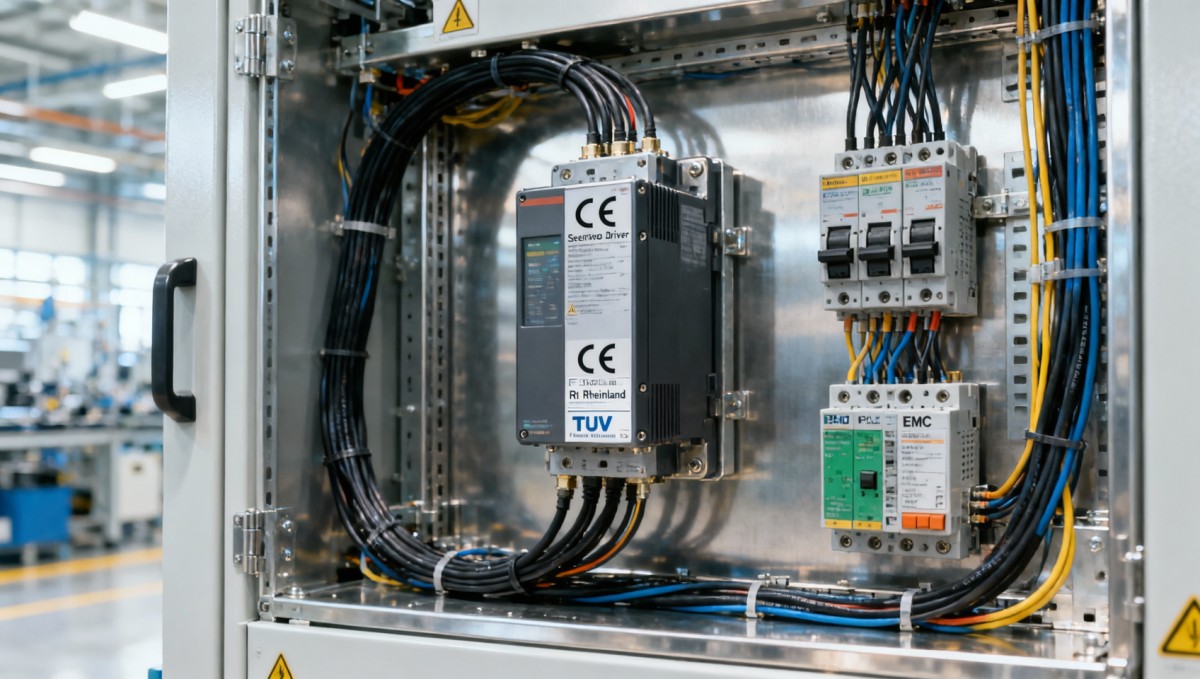
In summary, the TÜV Rheinland update marks a procedural tightening in CE conformity for servo drives — shifting from parallel compliance to integrated validation. It does not introduce new safety or EMC limits, but raises the evidentiary bar for demonstrating their coexistence in operational conditions. For stakeholders, the priority is not reinterpretation of standards, but timely alignment of testing, documentation, and supply chain communication with the new expectation.
Source: Official notice issued by TÜV Rheinland on April 21, 2026.
Note: Ongoing monitoring is recommended for potential adoption of similar requirements by other EU notified bodies beyond TÜV Rheinland.
Recommended News
 US CPSC Updates Child Sleep Sack Standard Effective July 2026US CPSC updates child sleep sack standard with new DSST test—mandatory for all U.S.-bound infant sleep sacks from July 2026. Act now to ensure compliance and market access.
 Red Sea Rerouting Pushes Asia-Europe Freight Premium to $1,850/TEURed Sea rerouting pushes Asia-Europe freight premium to $1,850/TEU—impacting importers, manufacturers & logistics providers. Act now to reassess costs, lead times & contracts.
 Mexico NOM-019-SCFI-2026 Effective May 1, 2026: EMC Certification Mandatory for Auto ElectronicsNOM-019-SCFI-2026 EMC certification is now mandatory for auto electronics in Mexico—effective May 1, 2026. Ensure compliance for infotainment, ADAS, OBD-II & more.
") TÜV Rheinland Updates CE Requirements for Servo Drives (PLd + EMC Class 3)TÜV Rheinland updates CE requirements for servo drives: PLd + EMC Class 3 joint validation mandatory from Q3 2026. Act now to avoid delays, rejections, or compliance risks.
TÜV Rheinland Updates CE Requirements for Servo Drives (PLd + EMC Class 3)TÜV Rheinland updates CE requirements for servo drives: PLd + EMC Class 3 joint validation mandatory from Q3 2026. Act now to avoid delays, rejections, or compliance risks. SABER Phase II Launch: Building Hardware Must Submit Digital e-CoC & UPISABER Phase II mandates digital e-CoC & UPI for building hardware imports to Saudi Arabia—act now to ensure customs clearance and market access.
 FDA AI Diagnostic Device Draft Rules: Bias Assessment for ImportsFDA AI diagnostic device draft rules mandate bias assessment for imports — discover how algorithmic fairness impacts 510(k)/De Novo submissions and what to do now.
 RCEP Green Packaging Mutual Recognition Starts June 1, 2026RCEP Green Packaging Mutual Recognition starts June 1, 2026 — unlock faster exports to Australia, NZ, Japan & Korea with GB/T 37572-2025 certification.
 Vietnam Suspends SASO Mutual Recognition for Chinese Irrigation EquipmentVietnam suspends SASO mutual recognition for Chinese irrigation equipment—impacting exporters, testers & suppliers. Act now to avoid 6–8 week delays & 35% cost hikes.
 IMDG Code 41-24 Enforces UN3480 Class 9 Labeling for Li-ion Battery Sea FreightIMDG Code 41-24 enforces UN3480 Class 9 labeling for Li-ion battery sea freight—learn mandatory QR labels, compliance actions & port enforcement risks.
 EU CBAM Enters Enforcement Phase on April 1, 2026EU CBAM enforcement starts April 1, 2026 — critical for Chinese battery materials, construction profiles & industrial coatings exporters. Act now to avoid customs delays.
 Mexico Enforces NOM-019-SCFI-2026 EMC Certification for Auto Electronics from May 2026Mexico enforces NOM-019-SCFI-2026 EMC certification for auto electronics from May 2026 — mandatory local testing, stricter standards, and urgent compliance action required.
 Global Port Congestion Eases, but Red Sea Rerouting PersistsRed Sea rerouting persists amid easing port congestion—Shanghai–Rotterdam freight rates surge 4.2% to $5,280/TEU. Critical insights for exporters, importers & logistics leaders.
 RCEP Green Packaging Mutual Recognition Starts June 2026RCEP Green Packaging Mutual Recognition starts June 2026 — streamline exports to Australia, NZ, Japan & SK with GB/T 37572-2025 certification. Save time & costs!
 FDA AI Diagnostic Device Rules: ABIA Required from Q3 2026FDA AI diagnostic device rules now require ABIA reports from Q3 2026 — essential for 510(k)/De Novo submissions. Stay compliant, avoid delays & secure U.S. market access.
 Vietnam Suspends SASO Mutual Recognition for Chinese Irrigation EquipmentVietnam suspends SASO mutual recognition for Chinese irrigation equipment—sprinkler systems, drip controllers & irrigation systems now require local QUATEST 3 testing. Act now to avoid 12-week delays & 35% cost hikes.
") TÜV Rheinland Updates CE Certification for Industrial Robot Drives (2026 Q3)TÜV Rheinland’s 2026 Q3 CE certification update for industrial robot drives mandates PLd safety + EN 61800-3 EMC — act now to avoid EU market delays.
TÜV Rheinland Updates CE Certification for Industrial Robot Drives (2026 Q3)TÜV Rheinland’s 2026 Q3 CE certification update for industrial robot drives mandates PLd safety + EN 61800-3 EMC — act now to avoid EU market delays. IMDG Code Amendment 41-24 Takes Effect for Lithium Battery Sea FreightIMDG Code Amendment 41-24 is live: New QR labels, bilingual handling tags & SOC disclosure required for UN3480 lithium battery sea freight—act now to avoid delays.
 SASO SABER Phase II: Digital Type Test Reports Required for Building Hardware from Jun 2026SASO SABER Phase II requires digital type test reports & unique product IDs for building hardware exports to Saudi Arabia — effective June 2026. Act now to ensure compliance and avoid customs delays.
 CPSC Updates 16 CFR Part 1236: New Suffocation Test for Children's Sleep Sacks Effective July 2026CPSC Updates 16 CFR Part 1236: New suffocation test for children's sleep sacks takes effect July 2026 — ensure compliance, avoid delays & protect your U.S. market access.
 EN IEC 62471-2:2026 Effective Oct 2026 for EU LED Lighting ExportsEN IEC 62471-2:2026 mandates full-spectrum photobiological safety testing (200–3000 nm) for all EU-bound LED lighting — effective 1 Oct 2026. Act now to secure CE marking & avoid market access delays.
 AI Patent Tools Security Flaw Triggers Compliance ReviewAI Patent Tools security flaw exposed—triggering urgent compliance reviews for medical device, semiconductor & AI firms. Act now to secure submissions.















Popular Tags
Global Trade Insights & Industry
Our mission is to empower global exporters and importers with data-driven insights that foster strategic growth.
Search News
Popular Tags
Industry Overview
The global commercial kitchen equipment market is projected to reach $112 billion by 2027. Driven by urbanization, the rise of e-commerce food delivery, and strict hygiene regulations.