

RCEP Green Packaging Mutual Recognition Extended to AU, NZ, JP, KR
Effective 1 May 2026, the RCEP Green Packaging Mutual Recognition Mechanism has expanded to Australia, New Zealand, Japan, and South Korea — enabling customs-exempt clearance for certified Chinese food packaging exports. This development directly impacts food manufacturers, infant product suppliers, and health supplement exporters engaging with these four markets.
Event Overview
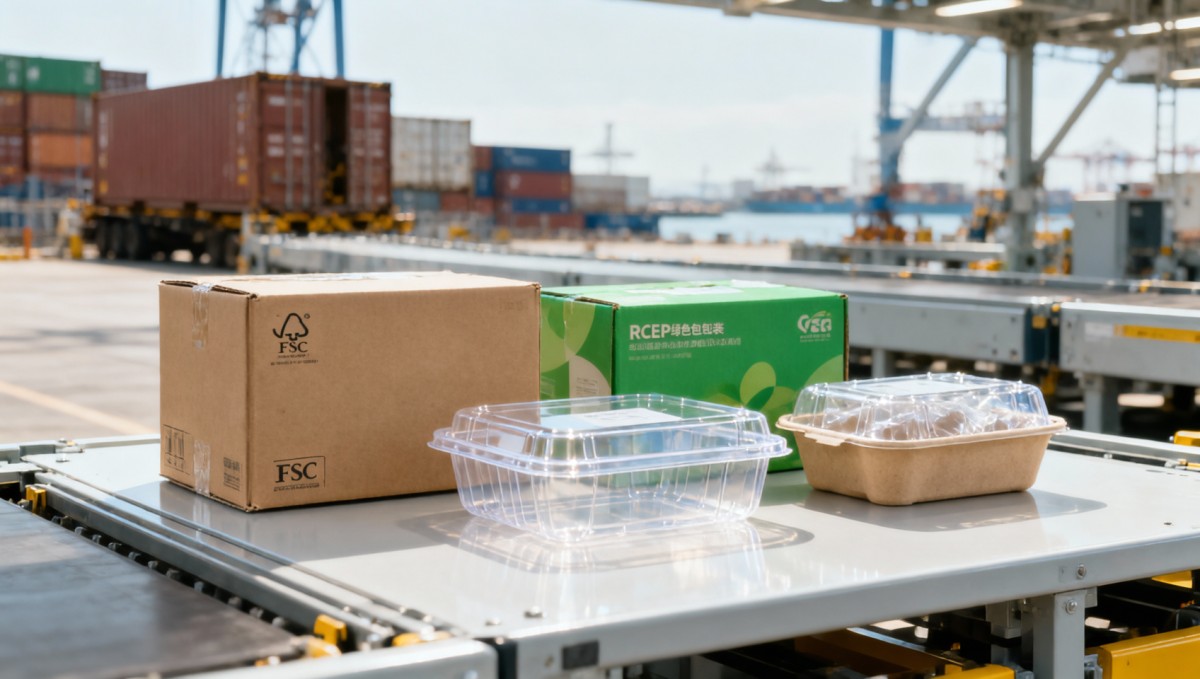
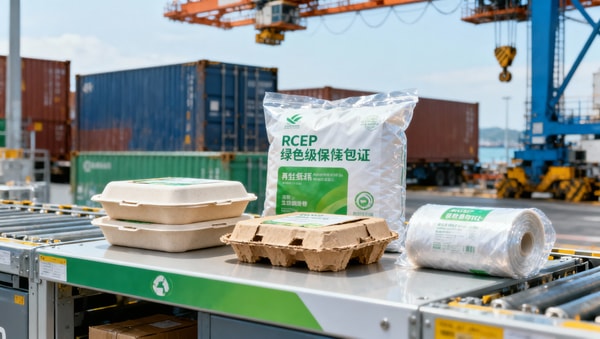
According to the latest announcement by the RCEP Joint Committee, the Green Packaging Mutual Recognition Mechanism officially extends to Australia, New Zealand, Japan, and South Korea as of 1 May 2026. The scope covers 12 categories of environmentally compliant packaging materials, including FSC/PEFC-certified corrugated boxes, compostable PLA trays, and recycled PET inner linings. Chinese packaging suppliers holding SGS or Intertek green packaging certification may issue a China-issued Green Packaging Conformity Statement; when exporting food, infant products, or health supplements to the four countries, such declarations qualify for port-of-entry exemption from inspection.
Which Subsectors Are Affected
Direct Exporters (Food, Infant Products, Health Supplements)
These enterprises face immediate operational implications: reduced border delays and lower third-party testing costs at destination ports. The exemption applies only to shipments where both the packaging and the final product category fall within the defined scope — meaning eligibility is conditional on correct classification and documentation alignment.
Packaging Manufacturers & Suppliers
Suppliers certified by SGS or Intertek now hold a functional advantage in cross-border tenders targeting AU/NZ/JP/KR distribution channels. However, certification alone does not guarantee automatic acceptance — conformity statements must reference specific material types (e.g., PLA tray grade, PET recycling content %) listed in the RCEP annex, requiring traceability-ready documentation systems.
Raw Material Sourcing & Conversion Firms
Firms supplying base materials (e.g., PLA resin, post-consumer PET flake, FSC-sourced kraft linerboard) may see increased demand visibility — but only if downstream converters maintain full chain-of-custody records. Without verifiable upstream certifications, finished packaging cannot meet the declared conformity criteria.
Distribution & Import Agents in AU/NZ/JP/KR
Local importers and logistics providers handling food-related consignments must update internal compliance checklists to recognize Chinese-issued conformity statements as valid pre-clearance documents. Their verification responsibility shifts from physical inspection to document authenticity and scope alignment — necessitating staff training on acceptable statement formats and material classifications.
What Enterprises and Practitioners Should Focus On Now
Monitor official implementation guidance from national customs authorities
While the RCEP Joint Committee announced the extension, each participating country retains discretion over operational procedures — e.g., whether electronic submission of conformity statements is accepted, or whether paper originals must accompany shipments. Enterprises should track announcements from the Australian Department of Home Affairs, New Zealand Customs Service, Japan Customs, and Korea Customs Service through mid-2026.
Verify coverage of current packaging SKUs against the 12 approved categories
The mechanism applies only to the 12 specified material types. Companies must cross-check existing packaging specifications (e.g., exact PLA polymer grade, PET recycled content percentage, FSC claim type) against the official RCEP annex — generic ‘eco-friendly’ labels or non-listed bioplastics do not qualify.
Distinguish between policy signal and enforceable procedure
This expansion represents an agreed framework, not yet a fully harmonized regulatory regime. Until national customs publish formal notices confirming enforcement timelines and documentary requirements, companies should treat the exemption as conditional — maintaining contingency plans for standard inspection protocols during early rollout phases.
Prepare documentation workflows for conformity statement issuance and validation
Exporters must ensure their certified packaging suppliers can generate statements referencing precise material standards and batch-level traceability. Internal SOPs should assign clear ownership for statement review, translation (where required), and digital archiving — as discrepancies between statement content and actual shipment composition will invalidate the exemption.
Editorial Perspective / Industry Observation
Observably, this extension functions primarily as a procedural signal rather than an immediately executable outcome. It confirms political alignment among RCEP members on green trade facilitation but delegates technical implementation to national authorities. From an industry perspective, the real impact hinges less on the agreement itself and more on how consistently and transparently each country’s customs service interprets and enforces the mutual recognition criteria. Analysis shows that early adopters will likely be those with integrated packaging compliance teams — capable of synchronizing material certification, declaration drafting, and importer-facing documentation support across multiple jurisdictions.
Current observation suggests this is best understood as a targeted efficiency lever for specific export corridors — not a broad deregulatory shift. Its value emerges incrementally, as documentation systems mature and cross-border trust builds through consistent application.
Concluding, this development marks a calibrated step toward greener supply chain interoperability under RCEP — one that rewards precision in certification, documentation, and scope adherence. It is neither a blanket simplification nor a distant aspiration, but a conditionally actionable opportunity requiring focused operational readiness.
Information Source: RCEP Joint Committee Official Announcement (May 2026). Note: National implementation details from Australia, New Zealand, Japan, and South Korea remain pending formal publication and are subject to ongoing monitoring.
Recommended News
 CMDE Adds 74 External Experts to Boost Med Device Export RegistrationCMDE Adds 74 External Experts to Boost Med Device Export Registration — accelerate FDA/EU/GCC submissions for medical equipment & rehab devices.
 MIIT Launches Space-Ground Compute & Power CoordinationMIIT Launches Space-Ground Compute & Power Coordination—unlocking export opportunities in liquid cooling, optical modules & high-efficiency servers for hot-humid markets.
 2026 Bio-based Raw Material Supplier Guide Released2026 Bio-based Raw Material Supplier Guide: Discover the official White List for PLA, PHA, bamboo fiber & more — boost EU/US compliance and procurement efficiency now.
 China Launches 'Model-Data Resonance' Initiative for AI+Manufacturing StandardsChina's 'Model-Data Resonance' initiative launches AI+Manufacturing standards — CESI/AI-MFG-2026 ensures plug-and-play interoperability for CNC, AGVs, MES & more across global smart factories.
 China’s First Embodied AI Robot Export Liability Insurance Launched in GuangxiChina’s first Embodied AI Robot Export Liability Insurance launched in Guangxi—key for robot exporters targeting EU, US & Saudi markets. Secure compliance-backed coverage now.
 State Grid’s $680M Embodied AI Procurement Opens Export PathState Grid’s $680M embodied AI procurement sets global safety standards — IEC 62061 SIL2 & GB/T 38851 compliance unlocks EU/UK/NA export opportunities.
 WeChat Pay Cross-Border B2B QR Code Access in 5 ASEAN CountriesWeChat Pay Cross-Border B2B QR Code Access now live in 5 ASEAN countries — enabling real-time, local-currency settlements up to USD 50,000. Boost your hardware, garden & appliance exports today!
 RCEP Green Packaging Mutual Recognition Extended to AU, NZ, JP, KRRCEP Green Packaging Mutual Recognition now extends to AU, NZ, JP, KR — enabling customs-exempt clearance for certified Chinese food, infant & supplement packaging. Act now.
 IMDG Code 41-24 Enforces New UN3480 Lithium Battery Labels GloballyIMDG Code 41-24 mandates new UN3480 lithium battery labels globally from 1 May 2026—ensure compliance now to avoid shipment delays, rejections & penalties.
 CDE Adds 74 International Experts to Accelerate MedTech Export RegistrationCDE adds 74 international experts to accelerate MedTech export registration—key for IVD, imaging & rehab device exporters targeting FDA, EU MDR, Health Canada.
 MIIT Launches Space-Ground Computing & Green Data Center Export PlanMIIT's Space-Ground Computing & Green Data Center Export Plan unlocks global opportunities for liquid-cooled servers, PV direct-drive power, and satellite-ground scheduling—learn key impacts now.
 2026 Bio-based Raw Material Supplier Guide ReleasedBio-based raw material supplier guide 2026: Discover 47 ISO 16128-certified Chinese PLA, PBAT & PHA suppliers trusted by CBL, BPI & JIS.
 Q1 2026 Lithium Battery Export Prices Rise 11.3% YoYQ1 2026 Lithium Battery Export Prices Rise 11.3% YoY — discover why residential energy storage systems (RESS) drove the surge and what it means for exporters, suppliers & integrators.
 ‘Modular-Data Resonance’ Initiative Launches AI+Manufacturing Interface StandardModular-Data Resonance standard GB/T 45288-2026 launches AI+manufacturing interoperability—key for smart equipment exporters, MES/SCADA & AI model developers targeting EU/US markets.
 China's First Embodied AI Robot Export Liability Insurance Launched in GuangxiChina's first Embodied AI Robot Export Liability Insurance launched in Guangxi—key for robotics exporters targeting EU & SEA markets. Get compliant, certified, and covered.
 State Grid Launches $682M Embodied AI Inspection Equipment ProcurementState Grid’s $940M embodied AI inspection tender mandates IEC 62443-4-2 & ISO 13482 certs—key for robotics makers and global compliance teams. Act now.
 WeChat Pay Cross-Border B2B QR Code Live in 5 ASEAN CountriesWeChat Pay Cross-Border B2B QR Code is now live in 5 ASEAN countries — enabling fast, low-cost, local-currency settlements for SMEs and trade firms. Discover how it cuts costs by 47% and accelerates procurement.
 RCEP Green Packaging Mutual Recognition Extended to AU, NZ, JP, KRRCEP Green Packaging Mutual Recognition now extends to AU, NZ, JP, KR — unlock faster customs clearance & zero on-site inspection for compliant Chinese food packaging exports.
 IMDG Code 41-24 Enforces UN3480 Lithium Battery Labeling GloballyIMDG Code 41-24 enforces global UN3480 lithium battery labeling, packaging & e-CMR rules from 1 May 2026—act now to avoid port rejections and delays.
 Medical diagnostic equipment buying mistakes often start with workflowMedical diagnostic equipment buying mistakes often begin with workflow gaps. Learn how to compare systems, uncover hidden costs, and choose suppliers that fit real clinical operations.
 Interactive whiteboards are improving, but teacher adoption is unevenInteractive whiteboards are improving fast, but teacher adoption remains uneven. Explore what drives classroom success, ROI, and smarter edtech implementation.












Popular Tags
Global Trade Insights & Industry
Our mission is to empower global exporters and importers with data-driven insights that foster strategic growth.
Search News
Popular Tags
Industry Overview
The global commercial kitchen equipment market is projected to reach $112 billion by 2027. Driven by urbanization, the rise of e-commerce food delivery, and strict hygiene regulations.