

Next-gen wireless charging sounds convenient, but how efficient is it?
Next-gen wireless charging promises a cable-free future, but convenience alone does not guarantee performance. For information researchers tracking consumer tech, supply chain shifts, and energy efficiency trends, understanding how Next-gen wireless charging actually performs is essential. From power transfer losses to heat management and adoption barriers, this topic reveals where innovation is creating value—and where practical limitations still remain.
The market signal is changing: convenience is no longer the only selling point
The conversation around Next-gen wireless charging has shifted noticeably. A few years ago, the main attraction was simple: remove the cable, reduce clutter, and make charging feel effortless. Today, that promise still matters, but market attention has broadened. Device brands, component suppliers, retailers, and industrial buyers are asking a harder question: how efficient is wireless power transfer when measured against wired alternatives, especially under real-world conditions?
This change in focus is important because charging technology now sits at the intersection of user experience, energy consumption, thermal design, battery life, and product differentiation. In other words, Next-gen wireless charging is no longer judged only as a feature. It is increasingly evaluated as part of a broader performance system that affects operating cost, sustainability claims, and product trust.
For information researchers, this makes the topic strategically relevant. Wireless charging adoption reflects more than consumer taste. It reveals where standards are maturing, where materials demand may rise, how OEM priorities are changing, and where energy efficiency concerns may slow adoption or redirect investment.
What is driving the new interest in wireless charging efficiency
Several trend signals explain why Next-gen wireless charging is under closer scrutiny. First, charging power is increasing. As systems aim to deliver faster charging, efficiency losses become harder to ignore. A small loss at low power may be acceptable; the same percentage loss at higher power means more heat, more design complexity, and potentially more user frustration.
Second, device ecosystems are expanding. Smartphones, earbuds, smartwatches, industrial handhelds, medical wearables, and even electric vehicles are all tied to charging design decisions. As more categories seek cable-free operation, efficiency becomes a cross-sector issue rather than a niche consumer electronics topic.
Third, sustainability expectations are becoming more practical. Buyers and regulators increasingly look beyond marketing language. If Next-gen wireless charging wastes significantly more power than wired charging, that gap matters in large installed bases such as offices, hotels, logistics environments, and public infrastructure.
Fourth, the rise of magnetic alignment, better coils, smarter power management chips, and evolving interoperability standards has created genuine technical progress. That progress keeps the market interested, but it also raises the standard for proof. Stakeholders want evidence that the next generation is not just more elegant, but measurably better.
How efficient is Next-gen wireless charging in practice?
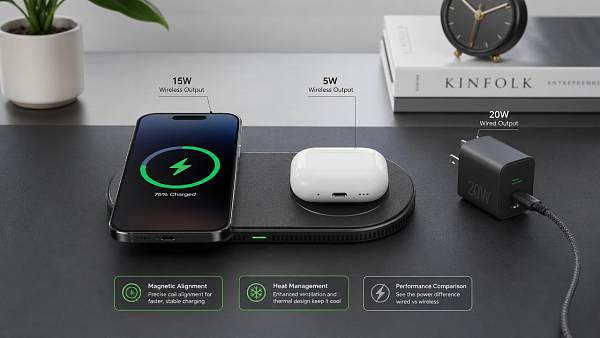
In ideal conditions, Next-gen wireless charging can be reasonably efficient, especially when alignment is precise, the charger and receiver are well matched, and thermal management is well engineered. However, “reasonably efficient” is not the same as “equal to wired charging.” Wired systems still tend to deliver stronger end-to-end efficiency because energy travels through direct electrical contact rather than through an air gap using electromagnetic induction or resonance.
The real-world efficiency gap often comes from four sources: coil misalignment, heat generation, standby energy draw, and conversion losses in both the charging pad and the receiving device. Even advanced systems can lose performance when the phone is slightly off-center, when a protective case interferes with coupling, or when foreign object detection limits power transfer for safety.
This is why efficiency should be seen as conditional rather than absolute. Next-gen wireless charging may perform well in tightly controlled ecosystems, such as branded accessories designed around a specific device family. It may perform less impressively in fragmented environments where chargers, cases, and devices come from different suppliers and are used under inconsistent conditions.
A practical view of the current trend
The hidden constraint: heat is shaping the future of adoption
If one factor best explains the current limits of Next-gen wireless charging, it is heat. Heat is not just a user comfort issue. It directly affects charging speed control, component durability, battery health, and safety management. As more energy is lost in the transfer process, more thermal regulation is required. That often means charging speed is reduced dynamically, especially once the battery enters higher state-of-charge ranges.
This creates a market perception gap. Consumers may see high advertised wireless charging wattage and assume equal or better performance than wired options. In practice, thermal throttling may reduce sustained charging speed. For product teams, that means headline power specifications do not always translate into superior daily experience.
For researchers and industry watchers, the signal is clear: the future winners in Next-gen wireless charging are likely to be those who solve thermal constraints through materials, software control, mechanical alignment, and smarter charging profiles, not just those who announce higher power numbers.
Who is most affected by this efficiency debate?
The impact of Next-gen wireless charging efficiency extends beyond end users. It shapes decision-making across multiple layers of the supply chain and across industries where charging design influences product value.
The effect is especially strong in products used repeatedly throughout the day. In such cases, even modest efficiency differences can accumulate into visible energy cost, heat stress, or replacement planning issues. That is why the efficiency question around Next-gen wireless charging matters far more in scaled environments than in isolated consumer use.
Why the technology still keeps gaining momentum
Despite its efficiency challenges, Next-gen wireless charging continues to gain traction because it solves problems wired systems do not solve as elegantly. It reduces mechanical wear on ports, supports sealed device design, improves water and dust resistance strategies, and simplifies casual charging behavior. In public or shared environments, it can also lower cable clutter and reduce connector damage.
More importantly, user behavior is changing. Many people no longer think of charging as a single scheduled event. They top up devices throughout the day: at a desk, in a car, on a nightstand, or in transit hubs. In that usage pattern, friction reduction matters. Next-gen wireless charging fits this distributed charging model well, even if it remains less efficient than wired charging on a pure energy-transfer basis.
This suggests an important market direction: the technology may not need to replace wired charging completely to succeed. Instead, it may expand as a complementary layer, with wired charging retained for maximum speed and efficiency, while wireless charging serves convenience-heavy moments and premium ecosystem integration.
The next competitive shift is from charging speed to charging quality
A notable trend is that market competition is slowly moving beyond raw charging speed. The emerging battleground is charging quality: stable performance, lower heat, better foreign object detection, broader compatibility, and improved efficiency under real-life use. This is where Next-gen wireless charging will either prove its maturity or remain a feature with limited operational credibility.
Charging quality also aligns more closely with enterprise procurement logic. Business buyers are rarely impressed by peak wattage alone. They care about failure rates, user complaints, replacement intervals, and consistent charging outcomes across fleets of devices. As a result, suppliers that can document performance stability may be better positioned than those focused mainly on promotional speed metrics.
What signals should researchers and businesses watch next?
To assess where Next-gen wireless charging is heading, it helps to monitor signals that reveal whether the technology is becoming operationally stronger rather than merely more visible.
- Improvement in alignment systems that reduce user placement error
- Better thermal materials and smarter charging algorithms
- Lower standby power draw in charging pads and docks
- More transparent efficiency communication from brands and suppliers
- Expansion into verticals where connector wear or hygiene concerns make wireless charging more attractive
- Standardization progress that reduces compatibility friction across ecosystems
These signals matter because they indicate whether the industry is solving structural weaknesses. If the market continues to prioritize ecosystem convenience while improving alignment and heat control, Next-gen wireless charging may achieve broader acceptance even without matching wired efficiency perfectly.
A practical judgment framework for evaluating Next-gen wireless charging
For businesses, analysts, and sourcing teams, the right question is not simply whether wireless charging is efficient or inefficient. The better question is efficient for what scenario, under what conditions, and against which alternatives? A realistic evaluation framework can prevent overestimating the technology or dismissing it too early.
What this means for future strategy across the supply chain
The broader strategic takeaway is that Next-gen wireless charging is advancing, but its growth path will likely be selective rather than universal. The strongest opportunities may emerge where convenience, sealing, durability, or shared-use simplicity outweigh pure energy efficiency concerns. Sectors that value reduced connector failure, cleaner industrial design, or automated docking behavior may adopt faster than segments focused mainly on peak power efficiency.
For exporters, importers, and market intelligence teams, this creates a useful lens for identifying opportunity. The most promising suppliers may not be those making the loudest consumer claims, but those building practical performance around coils, power ICs, thermal interfaces, magnetic structures, and standards-based interoperability. These are the areas where technical improvement can translate into durable commercial relevance.
For B2B decision-makers, the implication is equally clear: treat Next-gen wireless charging as a category that requires scenario-based validation. It should be measured not only by convenience messaging, but also by efficiency behavior, thermal stability, lifecycle impact, and deployment fit.
Final takeaway and action guide
Next-gen wireless charging is becoming more capable, more visible, and more commercially relevant. Yet the efficiency question remains central because it shapes cost, sustainability, user experience, and adoption confidence. The current trend is not a simple story of replacement. It is a story of specialization, technical refinement, and better alignment between charging method and usage context.
If businesses want to judge how Next-gen wireless charging may affect their products, sourcing plans, or market positioning, they should confirm several issues first: where convenience creates measurable value, how much heat can be tolerated, whether compatibility is controlled, and whether energy losses are acceptable at scale. Those answers will reveal whether wireless charging is a premium feature, an operational advantage, or an efficiency compromise that still needs further improvement.
For information researchers, that is the key signal to follow next: not whether the technology sounds convenient, but whether the latest generation can prove its value under real usage conditions that matter to business, industry, and long-term adoption.
Recommended News
 Portable oxygen concentrators vary more in noise than spec sheets suggestPortable oxygen concentrators may share similar specs, yet real-world noise can vary widely. Learn what decibel ratings miss and choose a quieter, more comfortable model with confidence.
 Interactive whiteboards are easier to buy than to integrate wellInteractive whiteboards are easy to buy, but hard to integrate. Discover how to align workflows, IT, training, and ROI for smarter deployment.
![]() Medical diagnostic equipment upgrades should start with workflow bottlenecksMedical diagnostic equipment upgrades should start with workflow bottlenecks. Discover how targeted investments improve throughput, integration, ROI, and diagnostic efficiency.
Medical diagnostic equipment upgrades should start with workflow bottlenecksMedical diagnostic equipment upgrades should start with workflow bottlenecks. Discover how targeted investments improve throughput, integration, ROI, and diagnostic efficiency.![]() Eco-friendly building materials can raise budgets before they lower themEco-friendly building materials may raise upfront budgets, but they can cut long-term costs, improve compliance, and strengthen asset value. Learn when the premium truly pays off.
Eco-friendly building materials can raise budgets before they lower themEco-friendly building materials may raise upfront budgets, but they can cut long-term costs, improve compliance, and strengthen asset value. Learn when the premium truly pays off. Ergonomic workspace design fixes discomfort, but not every layout problemErgonomic workspace design improves comfort, focus, and buying decisions—but not every layout issue. Learn what upgrades work, what room limits remain, and how to choose smarter.
![]() Outdoor garden supplies demand shifts earlier than many sellers plan forOutdoor garden supplies demand is starting earlier than many sellers expect. Learn what drives the shift and how distributors, wholesalers, and agents can plan smarter to win more sales.
Outdoor garden supplies demand shifts earlier than many sellers plan forOutdoor garden supplies demand is starting earlier than many sellers expect. Learn what drives the shift and how distributors, wholesalers, and agents can plan smarter to win more sales. Sustainable home decor sells better when materials are easy to verifySustainable home decor sells better when material claims are easy to verify. Discover how traceable data, certifications, and clear sourcing build trust and boost B2B sales.
 Modern office furniture trends are changing around hybrid work needsModern office furniture trends are redefining hybrid workplaces with flexible layouts, ergonomic design, and smart tech integration. Discover what drives demand and smarter buying decisions.
 Smart street lighting projects often miss the maintenance sideSmart street lighting projects often overlook maintenance. Learn how diagnostics, spare parts, and scenario-based support improve reliability, reduce downtime, and protect long-term value.
 Solid-state battery breakthroughs are real, but mass rollout is still difficultSolid-state battery breakthroughs are real, but scaling remains difficult. Explore what’s driving progress, what blocks mass rollout, and where commercialization may happen first.
![]() Commercial LED lighting retrofits save money, but not at the same paceCommercial LED lighting can cut costs, but payback varies by warehouse, office, retail, and industrial scenario. Discover how to identify the fastest-return retrofit opportunities.
Commercial LED lighting retrofits save money, but not at the same paceCommercial LED lighting can cut costs, but payback varies by warehouse, office, retail, and industrial scenario. Discover how to identify the fastest-return retrofit opportunities. Lithium battery storage projects fail early when thermal planning is weakLithium battery storage projects fail early when thermal planning is weak. Learn the key checks to improve safety, uptime, compliance, and long-term project returns.
 Photovoltaic solar panels: when higher efficiency is not the better dealPhotovoltaic solar panels are not always best when efficiency is highest. Discover how lifecycle cost, payback, and site conditions can deliver smarter ROI and better sourcing decisions.
 Plant-based protein processing depends more on texture than many expectPlant-based protein processing relies heavily on texture to improve quality, control risk, and boost consistency. Learn how better texture management strengthens compliance and competitiveness.
 Foldable screen technology keeps improving, yet repair costs remain a problemFoldable screen technology is getting stronger and smarter, but repair costs still worry buyers. Discover who should buy, key ownership risks, and how to choose wisely.
 Next-gen wireless charging sounds convenient, but how efficient is it?Next-gen wireless charging sounds effortless, but how efficient is it in real use? Explore heat, power loss, alignment, and the market factors shaping adoption.
![]() Wearable technology is improving fast, but comfort still decides adoptionWearable technology is evolving fast, but comfort still drives real adoption. Explore how design, fit, battery life, and daily usability shape the wearables consumers truly keep using.
Wearable technology is improving fast, but comfort still decides adoptionWearable technology is evolving fast, but comfort still drives real adoption. Explore how design, fit, battery life, and daily usability shape the wearables consumers truly keep using. Smart home devices wholesale margins shrink faster than many expectSmart home devices wholesale margins are shrinking fast. Learn what causes profit erosion, which categories face price wars, and how distributors can protect growth and improve sourcing decisions.
 Agri-PV systems make sense only when land use goals are clearAgri-PV systems create business value only when land use goals are clearly defined. Discover how aligned energy, farming, and ESG priorities reduce risk and improve returns.
 Organic fertilizers vs synthetic inputs: where does the payoff change?Organic fertilizers vs synthetic inputs: discover where costs, compliance, soil health, and market premiums shift the payoff—and how to choose the smartest long-term strategy.
 Smart classroom solutions often underdeliver without teacher-side usabilitySmart classroom solutions often fail when teacher-side usability is ignored. Discover scenario-based insights to improve adoption, reduce friction, and maximize classroom ROI.











Popular Tags
Global Trade Insights & Industry
Our mission is to empower global exporters and importers with data-driven insights that foster strategic growth.
Search News
Popular Tags
Industry Overview
The global commercial kitchen equipment market is projected to reach $112 billion by 2027. Driven by urbanization, the rise of e-commerce food delivery, and strict hygiene regulations.