

Interactive whiteboards are easier to buy than to integrate well
Interactive whiteboards are often simple to purchase, but far harder to integrate into real project workflows, IT systems, and team collaboration habits. For project managers and engineering leaders, the real challenge is not the hardware itself, but aligning deployment, training, compatibility, and long-term value. This article explores why successful integration demands more planning than procurement.
The market signal has changed: buying Interactive whiteboards is no longer the hard part
Across education, engineering, manufacturing, corporate training, and multi-site operations, the conversation around Interactive whiteboards has shifted. A few years ago, the core decision was whether an organization should adopt them at all. Today, the question is more practical and more demanding: how can teams make Interactive whiteboards work inside existing systems, meeting habits, security policies, and project delivery models?
This change matters because digital collaboration tools are no longer judged mainly by hardware specifications. Project leaders now evaluate operational fit, adoption speed, software interoperability, remote collaboration readiness, and lifecycle support. In many organizations, a whiteboard that looks advanced in the showroom can become an underused display once it meets fragmented networks, mixed user skill levels, legacy conference platforms, or unclear ownership between IT and operations.
For project management teams, this is a trend worth watching. Procurement has become easier due to wider vendor availability and stronger channel distribution. Integration, however, has become more complex because workplaces themselves are more hybrid, more software-driven, and more dependent on measurable productivity outcomes. That is why Interactive whiteboards now sit at the intersection of AV infrastructure, collaboration software, cybersecurity, user training, and change management.
Why integration challenges are growing even as products become easier to source
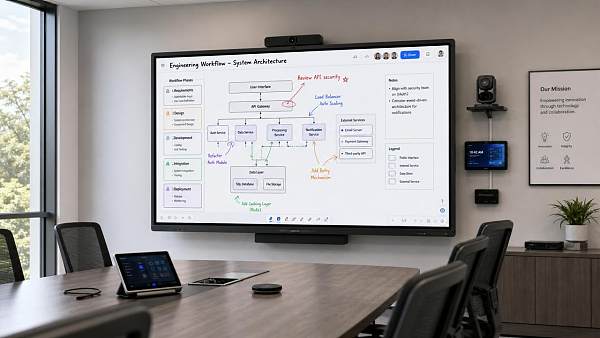
The first driver is the rising complexity of work environments. Project teams rarely operate in one room, on one platform, or with one standard device setup. A board may need to connect with cloud storage, video conferencing tools, design review systems, document management platforms, and permission-controlled enterprise networks. The hardware may be ready on day one, but the workflow is not.
The second driver is the shift from presentation use to collaboration use. Traditional display equipment served mainly as a visual output device. Interactive whiteboards, by contrast, are expected to support annotation, co-creation, instant content sharing, meeting capture, and cross-location participation. This expands their value, but it also raises the integration threshold. A tool built for participation cannot succeed if users still treat meetings as one-way presentations.
The third driver is accountability. Budget owners increasingly want evidence that digital workplace investments improve coordination, shorten feedback cycles, reduce meeting friction, or support training quality. That means engineering managers and project sponsors must think beyond installation. They need a deployment model that supports usage consistency, measurable outcomes, and maintainable support processes.
Key drivers behind the new integration reality
The biggest impact is not technical failure, but workflow misalignment
In practice, most integration problems with Interactive whiteboards do not begin with a broken screen. They begin with a mismatch between the board and the way teams actually work. Engineering review sessions may require markups linked to CAD exports. Construction planning teams may need quick sharing across site offices. Corporate trainers may need session recording and content reuse. If those workflow requirements are not mapped early, the device may still function, but the business case weakens.
This is why project managers should treat Interactive whiteboards as part of a collaboration process, not merely as room equipment. A successful rollout depends on who uses the board, what software they rely on, how often sessions involve remote stakeholders, how content is stored after meetings, and who provides ongoing support when problems appear.
Another important trend is that organizations increasingly expect one deployment model to serve many use cases. A board selected for executive meetings may later be requested for design workshops, onboarding sessions, technical troubleshooting, or customer presentations. That cross-functional demand is positive, but it increases the need for scalable governance and standard operating practices.
Who feels the integration pressure most strongly
The impact of Interactive whiteboards is not distributed evenly. Some roles experience the integration challenge more directly because they carry responsibility for continuity, usability, and measurable project performance.
A clear trend: the decision is moving from product comparison to ecosystem judgment
One of the strongest market signals is that buyers are becoming less impressed by isolated feature lists and more focused on ecosystem fit. In earlier procurement cycles, screen size, touch points, brightness, and built-in apps often dominated evaluations. Those factors still matter, but they no longer decide long-term success on their own. Today, project teams are asking sharper questions: Will this device work across our meeting platforms? Can files move cleanly between users and systems? Can the board be managed centrally? How much retraining will be required?
This trend is especially relevant in global trade and multi-sector environments where organizations operate across regions, vendors, and collaboration standards. A premium product in one room does not automatically create value across a distributed organization. For foreign trade enterprises and industrial teams seeking scalable digital visibility and operational efficiency, the lesson is familiar: tools create impact only when they align with real usage patterns and broader system architecture.
From procurement stage to integration stage
What project leaders should evaluate before scaling Interactive whiteboards
The most useful shift in mindset is to stop asking whether Interactive whiteboards are valuable in general and start asking under what conditions they create measurable value for a specific team. That means evaluating readiness across several dimensions.
First, confirm use-case clarity. Boards used for design review, training, sprint planning, factory coordination, and customer presentation do not require exactly the same setup. Second, assess software dependency. If teams live inside one conferencing stack but the device favors another, friction will appear immediately. Third, define governance. Someone must own updates, permissions, troubleshooting, and usage guidance. Fourth, budget for adoption, not just acquisition. Short onboarding sessions and usage templates often deliver more value than another hardware upgrade.
For engineering project environments, another practical question is whether the board supports traceability after the meeting ends. Notes, drawings, action items, and revisions need to move into project systems. If collaboration happens on the screen but not in the workflow, the efficiency gain stays superficial.
Signals worth monitoring over the next deployment cycle
Several signals can help organizations judge whether their Interactive whiteboards strategy is moving in the right direction. One signal is repeat usage across departments. If only one champion uses the tool, adoption is fragile. Another is reduced meeting friction, such as faster annotation sharing or fewer delays in connecting remote participants. A third signal is lower shadow-tool behavior. When teams stop bypassing room systems in favor of personal laptops and ad hoc apps, integration is improving.
It is also wise to watch vendor responsiveness and software update consistency. In a fast-changing collaboration environment, the quality of ongoing support can matter more than initial setup. Devices that fit today but fail to keep pace with platform changes can create hidden costs later. This is why long-term compatibility should be treated as a strategic criterion, not a technical footnote.
How to respond: practical judgment before large-scale rollout
A strong response starts with a controlled pilot, but not a cosmetic one. The pilot should mirror real project pressure, real users, real network constraints, and real collaboration tasks. Test Interactive whiteboards in the exact settings where they are expected to create value: cross-functional design review, client coordination, training delivery, or site planning. Observe not only whether the board works, but whether people naturally choose to use it.
Next, create a lightweight integration checklist covering device provisioning, account access, content storage, conferencing compatibility, room support, and user onboarding. This reduces the common problem of fragmented responsibility. Finally, define success in operational terms. Better outcomes might include shorter review cycles, cleaner meeting records, improved remote participation, or stronger consistency across project sites.
For businesses building international visibility and trust across industrial sectors, the wider lesson is clear: technology decisions increasingly succeed when they are treated as ecosystem decisions. The same principle applies whether evaluating collaboration equipment, digital publishing infrastructure, or cross-border information platforms. Integration quality shapes long-term performance more than purchase speed.
Final judgment: focus on fit, not just features
Interactive whiteboards are becoming easier to source, compare, and install, but the real competitive difference now lies in how well organizations integrate them into everyday execution. For project managers and engineering leaders, the important trend is not hardware maturity alone. It is the rising importance of workflow fit, platform compatibility, user adoption, and lifecycle governance.
If your organization wants to judge the likely impact of Interactive whiteboards on its own operations, start with a few direct questions: Which meetings actually need shared visual interaction? Which software environments must the board support without friction? Who owns post-deployment support? How will usage and value be measured after installation? The answers to those questions will reveal whether the next purchase is simply another device order or a meaningful step toward better collaboration.
Recommended News
 Portable oxygen concentrators vary more in noise than spec sheets suggestPortable oxygen concentrators may share similar specs, yet real-world noise can vary widely. Learn what decibel ratings miss and choose a quieter, more comfortable model with confidence.
 Interactive whiteboards are easier to buy than to integrate wellInteractive whiteboards are easy to buy, but hard to integrate. Discover how to align workflows, IT, training, and ROI for smarter deployment.
![]() Medical diagnostic equipment upgrades should start with workflow bottlenecksMedical diagnostic equipment upgrades should start with workflow bottlenecks. Discover how targeted investments improve throughput, integration, ROI, and diagnostic efficiency.
Medical diagnostic equipment upgrades should start with workflow bottlenecksMedical diagnostic equipment upgrades should start with workflow bottlenecks. Discover how targeted investments improve throughput, integration, ROI, and diagnostic efficiency.![]() Eco-friendly building materials can raise budgets before they lower themEco-friendly building materials may raise upfront budgets, but they can cut long-term costs, improve compliance, and strengthen asset value. Learn when the premium truly pays off.
Eco-friendly building materials can raise budgets before they lower themEco-friendly building materials may raise upfront budgets, but they can cut long-term costs, improve compliance, and strengthen asset value. Learn when the premium truly pays off. Ergonomic workspace design fixes discomfort, but not every layout problemErgonomic workspace design improves comfort, focus, and buying decisions—but not every layout issue. Learn what upgrades work, what room limits remain, and how to choose smarter.
![]() Outdoor garden supplies demand shifts earlier than many sellers plan forOutdoor garden supplies demand is starting earlier than many sellers expect. Learn what drives the shift and how distributors, wholesalers, and agents can plan smarter to win more sales.
Outdoor garden supplies demand shifts earlier than many sellers plan forOutdoor garden supplies demand is starting earlier than many sellers expect. Learn what drives the shift and how distributors, wholesalers, and agents can plan smarter to win more sales. Sustainable home decor sells better when materials are easy to verifySustainable home decor sells better when material claims are easy to verify. Discover how traceable data, certifications, and clear sourcing build trust and boost B2B sales.
 Modern office furniture trends are changing around hybrid work needsModern office furniture trends are redefining hybrid workplaces with flexible layouts, ergonomic design, and smart tech integration. Discover what drives demand and smarter buying decisions.
 Smart street lighting projects often miss the maintenance sideSmart street lighting projects often overlook maintenance. Learn how diagnostics, spare parts, and scenario-based support improve reliability, reduce downtime, and protect long-term value.
 Solid-state battery breakthroughs are real, but mass rollout is still difficultSolid-state battery breakthroughs are real, but scaling remains difficult. Explore what’s driving progress, what blocks mass rollout, and where commercialization may happen first.
![]() Commercial LED lighting retrofits save money, but not at the same paceCommercial LED lighting can cut costs, but payback varies by warehouse, office, retail, and industrial scenario. Discover how to identify the fastest-return retrofit opportunities.
Commercial LED lighting retrofits save money, but not at the same paceCommercial LED lighting can cut costs, but payback varies by warehouse, office, retail, and industrial scenario. Discover how to identify the fastest-return retrofit opportunities. Lithium battery storage projects fail early when thermal planning is weakLithium battery storage projects fail early when thermal planning is weak. Learn the key checks to improve safety, uptime, compliance, and long-term project returns.
 Photovoltaic solar panels: when higher efficiency is not the better dealPhotovoltaic solar panels are not always best when efficiency is highest. Discover how lifecycle cost, payback, and site conditions can deliver smarter ROI and better sourcing decisions.
 Plant-based protein processing depends more on texture than many expectPlant-based protein processing relies heavily on texture to improve quality, control risk, and boost consistency. Learn how better texture management strengthens compliance and competitiveness.
 Foldable screen technology keeps improving, yet repair costs remain a problemFoldable screen technology is getting stronger and smarter, but repair costs still worry buyers. Discover who should buy, key ownership risks, and how to choose wisely.
 Next-gen wireless charging sounds convenient, but how efficient is it?Next-gen wireless charging sounds effortless, but how efficient is it in real use? Explore heat, power loss, alignment, and the market factors shaping adoption.
![]() Wearable technology is improving fast, but comfort still decides adoptionWearable technology is evolving fast, but comfort still drives real adoption. Explore how design, fit, battery life, and daily usability shape the wearables consumers truly keep using.
Wearable technology is improving fast, but comfort still decides adoptionWearable technology is evolving fast, but comfort still drives real adoption. Explore how design, fit, battery life, and daily usability shape the wearables consumers truly keep using. Smart home devices wholesale margins shrink faster than many expectSmart home devices wholesale margins are shrinking fast. Learn what causes profit erosion, which categories face price wars, and how distributors can protect growth and improve sourcing decisions.
 Agri-PV systems make sense only when land use goals are clearAgri-PV systems create business value only when land use goals are clearly defined. Discover how aligned energy, farming, and ESG priorities reduce risk and improve returns.
 Organic fertilizers vs synthetic inputs: where does the payoff change?Organic fertilizers vs synthetic inputs: discover where costs, compliance, soil health, and market premiums shift the payoff—and how to choose the smartest long-term strategy.
 Smart classroom solutions often underdeliver without teacher-side usabilitySmart classroom solutions often fail when teacher-side usability is ignored. Discover scenario-based insights to improve adoption, reduce friction, and maximize classroom ROI.













Popular Tags
Global Trade Insights & Industry
Our mission is to empower global exporters and importers with data-driven insights that foster strategic growth.
Search News
Popular Tags
Industry Overview
The global commercial kitchen equipment market is projected to reach $112 billion by 2027. Driven by urbanization, the rise of e-commerce food delivery, and strict hygiene regulations.