

RCEP Green Packaging Mutual Recognition: China Food Packaging Exempt from Testing in AU/NZ/JP/KR
Starting 1 April 2026, the RCEP Green Packaging Mutual Recognition Mechanism has been extended to cover food contact packaging. Chinese food packaging products exported to Australia, New Zealand, Japan, and South Korea — including food packaging and eco-friendly packaging — are now eligible for customs clearance without retesting, provided they are accompanied by a certification report issued by the China National Accreditation Service for Conformity Assessment (CNAS). This development is especially relevant for exporters in the baked goods, snack, and dietary supplement sectors, where frequent small-batch shipments are common.
Event Overview
Effective 1 April 2026, the Regional Comprehensive Economic Partnership (RCEP) Green Packaging Mutual Recognition Mechanism has expanded its scope to include food contact packaging. Under this update, Chinese food packaging exports to Australia, New Zealand, Japan, and South Korea may clear customs without undergoing duplicate conformity testing at destination, as long as they carry a valid CNAS-issued accreditation report. The measure reduces average customs processing time by 5–7 working days and lowers testing-related costs by approximately 30%.
Impact on Specific Industry Segments
Direct Exporters (Food Brand Owners & OEMs)
These enterprises directly ship finished packaged food products overseas. They benefit most directly from the exemption, as reduced testing requirements lower both lead time and cost per shipment. For brands relying on agile, small-batch export cycles — such as premium snack startups or functional food labels — faster clearance supports just-in-time inventory management and seasonal campaign responsiveness.
Food Packaging Manufacturers
Manufacturers supplying packaging to food exporters must ensure their production processes and quality documentation align with CNAS accreditation criteria for food contact materials. While no new international standard is introduced, compliance verification now hinges more tightly on domestic CNAS reporting — meaning tighter alignment between factory QA systems and accredited lab protocols is required.
Raw Material Suppliers (e.g., Bioplastics, Coating Providers)
Suppliers of substrates, inks, adhesives, or barrier coatings used in certified packaging may face increased downstream demand for traceable, test-backed material declarations. Though not directly subject to CNAS reporting, their technical data sheets and migration test reports may be reviewed during CNAS audits of packaging producers.
Logistics & Compliance Service Providers
Freight forwarders and regulatory consultants handling RCEP-region shipments must update documentation checklists to verify CNAS report validity (e.g., scope coverage, issue date, signatory accreditation status). Misclassification of packaging type — e.g., labeling non-food-contact items as food-grade — could trigger retesting despite report presence.
What Relevant Enterprises Should Focus On Now
Monitor official implementation guidance from CNAS and RCEP national authorities
The current announcement confirms eligibility criteria but does not yet detail procedural safeguards — such as report format requirements, validity windows, or dispute resolution mechanisms. Enterprises should track updates from CNAS and respective national food safety or customs agencies (e.g., Australia’s Department of Agriculture, Fisheries and Forestry; Japan’s MHLW).
Verify CNAS report scope against target market regulations
CNAS accreditation covers specific test parameters (e.g., overall migration, specific migration of regulated substances). Not all CNAS reports automatically satisfy all destination-country requirements — for example, Japan’s Positive List system or Australia’s FSANZ Standard 1.1.1. Exporters must confirm that their report explicitly addresses applicable local limits.
Distinguish policy intent from operational readiness
While the mutual recognition framework is now active, port-level enforcement may vary during early rollout. Early adopters should pilot shipments with full documentation and request written feedback from customs agents to identify process gaps before scaling.
Align internal procurement and QA workflows with CNAS-linked traceability
Brands and manufacturers should review supplier agreements to ensure raw material certifications feed into final packaging CNAS reports. Where batch-level migration testing is part of CNAS validation, procurement records must support full traceability from resin lot to finished package.
Editorial Observation / Industry Perspective
Observably, this extension signals a maturing phase in RCEP’s regulatory cooperation — moving beyond tariff reduction toward harmonized conformity assessment in high-trust product categories. Analysis shows it functions less as an immediate operational overhaul and more as a targeted efficiency lever: its value is concentrated among exporters already operating within formal quality frameworks, rather than serving as a broad-based entry enabler. From an industry perspective, its significance lies not in novelty but in precedent — it sets a template for future mutual recognition expansions, potentially into other regulated packaging categories (e.g., pharmaceutical or infant formula packaging) if cross-border verification proves robust over the next 12–18 months.
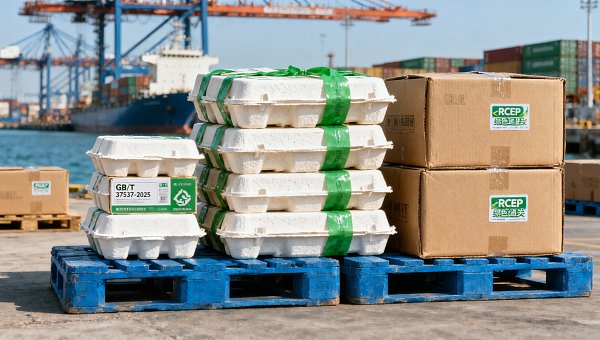
[[IMG:img_01]]
Conclusion
This development represents a concrete step in streamlining regulatory friction for compliant food packaging trade across key RCEP markets. It does not eliminate technical compliance obligations but shifts verification upstream — reinforcing the strategic importance of domestic accreditation infrastructure. Currently, it is best understood not as a universal simplification tool, but as an efficiency multiplier for enterprises already aligned with CNAS-recognized quality systems.
Information Sources
Main source: Official notice issued by the China National Accreditation Service for Conformity Assessment (CNAS), effective 1 April 2026.
Note: Implementation details — including port-level acceptance consistency and potential scope adjustments — remain under observation and will require monitoring through Q2 2026.
Recommended News
 China-France Nuclear Cooperation Advances at Beijing ExpoChina-France nuclear cooperation advances: mutual recognition for nuclear-grade seals, cables & radiation monitors boosts export readiness for suppliers targeting EU and BRI projects.
 Vietnam’s 4 Provinces Seek AI Tourism Tech in NanningAI tourism tech in demand: Vietnam’s 4 provinces seek AI-guided terminals, multilingual interpretation, AI-CCTV & smart ticketing in Nanning—key opportunity for B2G exporters.
 Q1 2026 China Power Market Trading Up 25.6%: Smart Meters, Storage Export Demand RisesSmart meters, energy storage exports surge as China’s Q1 2026 power market trading jumps 25.6% — key signal for global manufacturers & channel partners.
 China First Country with 5M+ Active Invention PatentsChina first country with 5M+ active invention patents—key for buyers in AI, solar, lithium battery & energy storage. Discover IP implications for sourcing, compliance & supplier vetting.
![]() RCEP Green Packaging Mutual Recognition: China Food Packaging Exempt from Testing in AU/NZ/JP/KRRCEP Green Packaging Mutual Recognition now exempts China's food packaging from retesting in AU/NZ/JP/KR — faster clearance, 30% cost savings, and streamlined exports for brands & manufacturers.
RCEP Green Packaging Mutual Recognition: China Food Packaging Exempt from Testing in AU/NZ/JP/KRRCEP Green Packaging Mutual Recognition now exempts China's food packaging from retesting in AU/NZ/JP/KR — faster clearance, 30% cost savings, and streamlined exports for brands & manufacturers. Shenneng Etorkeqi Green Ammonia Project: Deionized Water Station OperationalShenneng Etorkeqi Green Ammonia Project’s deionized water station is now operational—ISO 8502-3 compliant, fully integrated, and a key milestone for global green hydrogen developers and exporters.
 China Launches 'Model-Data Resonance' Initiative for AI+Manufacturing InteroperabilityModel-Data Resonance initiative boosts AI+manufacturing interoperability—learn how GB/T XXXX–2026 aligns with VDI 2182 & ISA-95 for smoother global factory deployments.
 China’s First Embodied AI Robot Insurance Launched in GuangxiChina’s first embodied AI robot insurance launched in Guangxi—key for robotics exporters, AI hardware makers & global compliance teams. CE-recognized, EU/UK/AU-ready.
 IMDG Code 41-24 Enforced: UN3480 Lithium Battery Labeling Now MandatoryIMDG Code 41-24 is now mandatory: UN3480 lithium battery labeling, documentation & packaging rules are enforced globally as of 28 April 2026 — avoid port rejections!
 State Grid’s $680M Embodied AI Procurement Signals Export OpportunityEmbodied AI, IEC 61850 & IEC 62443: State Grid’s $680M procurement unlocks export opportunities for compliant industrial robots and smart vision systems in emerging markets.
 IMDG Code 41-24 Enforces UN3480 Class 9 Labeling for Lithium Battery Sea FreightIMDG Code 41-24 mandates UN3480 lithium battery sea freight to display durable Class 9 labels from April 27, 2026—avoid delays & port rejections.
 ESS Key Component Prices Drop ~80%: Quality & Compliance RiseESS key component prices dropped ~80%—but quality & compliance demands surged. Discover how UL 9540A, AS/NZS 5139, and certified BMS/inverters now define market access.
 Mexico NOM-019-SCFI-2026 Effective July 2026: EMC Certification Mandatory for Auto ElectronicsMexico NOM-019-SCFI-2026 mandates EMC certification for auto electronics from July 2026 — ensure compliance now to avoid supply chain disruption & customs delays.
 Red Sea Rerouting Normalized, ECA Surcharge Hits $1,850/TEURed Sea rerouting normalized: ECA surcharge hits $1,850/TEU — 47% of total freight cost. Impacting hand tools, building materials & furniture exporters to Europe. Act now.
 RCEP Green Packaging Mutual Recognition Takes EffectRCEP Green Packaging Mutual Recognition is live—GB/T 37537-2025–certified packaging now enjoys fast-track clearance in Australia, NZ, Japan & Korea. Save time, cut costs, and boost export efficiency.
 Vietnam Suspends SASO Mutual Recognition for Chinese Irrigation EquipmentVietnam suspends SASO mutual recognition for Chinese irrigation equipment—drip tapes, PE fittings, auto valves now require VINAQ-IR certification. Act now to avoid delays & customs hold.
 Key Energy Storage Equipment Prices Drop ~80% in ChinaKey energy storage equipment prices in China dropped ~80% — PCS, BMS & liquid cooling units. Discover implications for compliance, margins & standards enforcement.
") China Releases Green Design Guidelines for Industrial Products (2026)China's 2026 Green Design Guidelines for industrial products—covering PV modules, lithium batteries & smart appliances—link eco-design to green factory certification and export tax rebates starting 2027.
China Releases Green Design Guidelines for Industrial Products (2026)China's 2026 Green Design Guidelines for industrial products—covering PV modules, lithium batteries & smart appliances—link eco-design to green factory certification and export tax rebates starting 2027. Mexico NOM-019-SCFI-2026 Effective: Automotive Electronics Require New EMC CertificationMexico NOM-019-SCFI-2026 is live: Automotive electronics (infotainment, ADAS, domain controllers) now require mandatory EMC certification by July 31, 2026 — act now to avoid customs delays.
 Red Sea Detour Premium Rises to $1,850/TEU Amid Port Congestion ReliefRed Sea Detour Premium hits $1,850/TEU — now 43% of FE–NE freight rates. Discover why this structural surcharge demands urgent supply chain action.
 TÜV Rheinland Updates PLd Certification: EMC Immunity Now Mandatory for Servo DrivesTÜV Rheinland now mandates EN IEC 61000-6-2:2024 EMC immunity testing for PLd certification of servo drives—act before May 26, 2026 to avoid EU market delays.



















Popular Tags
Global Trade Insights & Industry
Our mission is to empower global exporters and importers with data-driven insights that foster strategic growth.
Search News
Popular Tags
Industry Overview
The global commercial kitchen equipment market is projected to reach $112 billion by 2027. Driven by urbanization, the rise of e-commerce food delivery, and strict hygiene regulations.