

Next-gen wireless charging still faces a heat management problem
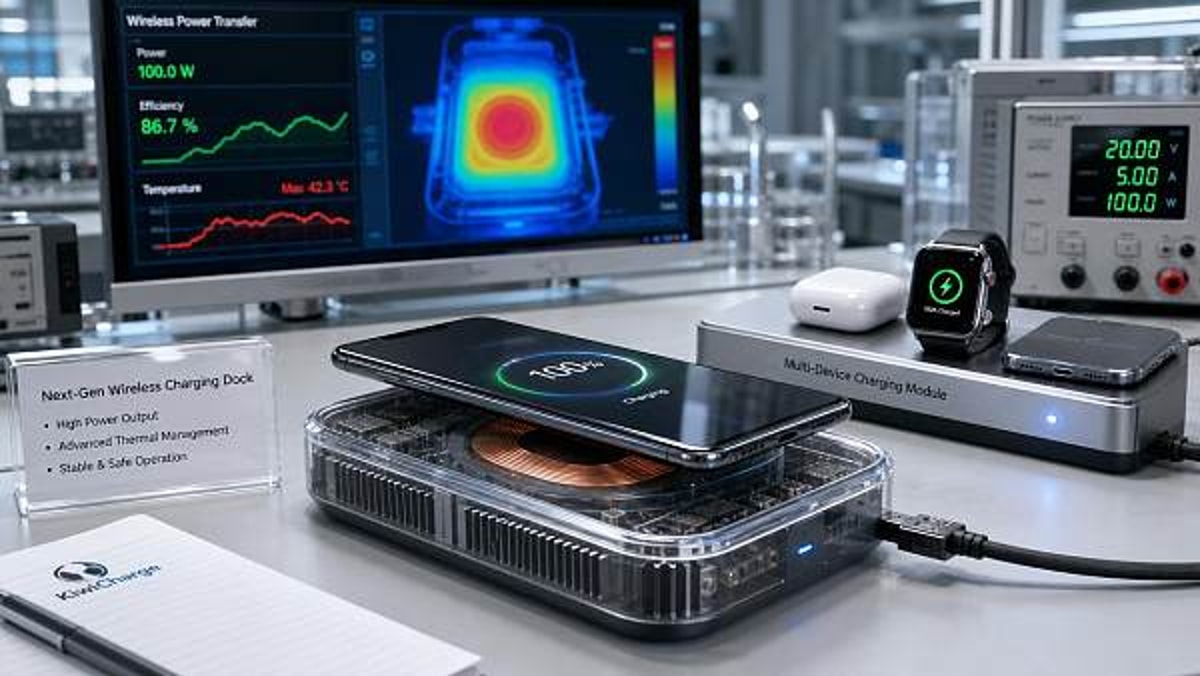
Next-gen wireless charging promises greater convenience, higher power transfer, and new design flexibility, yet heat management remains a critical barrier to large-scale adoption. For technical evaluators, understanding how thermal buildup affects efficiency, safety, component lifespan, and system reliability is essential when assessing this evolving technology and its commercial readiness.
Thermal limits are becoming the main signal in the Next-gen wireless charging market
The industry conversation around Next-gen wireless charging has clearly shifted. A few years ago, most attention centered on charging speed, user convenience, and industrial design freedom. Today, the more important signal is different: as power levels rise and use cases expand, heat is no longer a secondary engineering issue. It has become a first-order constraint that shapes certification, product architecture, component sourcing, and go-to-market timing.
This change matters because the technology is moving beyond basic smartphone pads into multi-device docks, automotive cabins, wearables, medical accessories, industrial handhelds, and embedded furniture or retail surfaces. In all of these environments, charging systems must perform consistently across alignment conditions, enclosure materials, ambient temperatures, and usage patterns. As soon as thermal margins narrow, efficiency drops, foreign object detection becomes more difficult, battery stress increases, and user trust declines.
For technical assessment teams, this means the commercial question is no longer simply whether Next-gen wireless charging works in a demo. The real question is whether it can maintain acceptable thermal behavior in uncontrolled, real-world operating conditions. That is the point at which many promising concepts encounter friction.
Why the heat problem is becoming more visible now
Several converging trends are exposing thermal weaknesses that were easier to tolerate at lower power levels. First, market expectations have changed. Users increasingly compare wireless charging with wired fast charging, which creates pressure to deliver more power without sacrificing compactness. Higher power transfer, however, amplifies losses across coils, shielding materials, rectification stages, and battery interfaces.
Second, device design is becoming thinner, denser, and more sealed. That improves aesthetics and ingress protection, but often reduces passive cooling paths. In compact devices, the charging coil must share thermal budget with application processors, camera modules, radios, and batteries. A thermal issue in the charging path can therefore cascade into broader system throttling.
Third, charging scenarios are becoming less controlled. Misalignment, non-ideal surfaces, case thickness, metallic accessories, and variable ambient temperatures all influence coupling efficiency. Even if a lab prototype performs well under optimized alignment, field deployment may produce hotspots that challenge safety thresholds or degrade user experience.
Fourth, standards evolution and ecosystem scaling are increasing interoperability demands. Broader compatibility is commercially attractive, but it also requires systems to perform across a wider range of receivers and operating states. That places more emphasis on robust thermal management rather than narrow optimization for a single device pair.
Trend signals technical evaluators should read carefully
The heat issue is not only about safety; it is about system economics
A common mistake in evaluating Next-gen wireless charging is to view thermal management only as a compliance requirement. In reality, heat directly affects business viability. Excessive heat lowers effective charging efficiency, which raises energy loss and may require larger power budgets or longer charging times. It also increases the burden on materials selection, mechanical design, firmware control, and post-sale support.
When thermal performance is weak, companies often compensate with conservative firmware limits. That can help pass validation, but it may reduce the user-visible advantage that justified wireless integration in the first place. In other words, a design can be technically compliant yet commercially underwhelming. For B2B decision-makers, this distinction is important because the return on integration depends on delivered experience, not only nominal specification.
Battery longevity is another economic factor. Even moderate but repeated thermal stress can accelerate degradation, especially in compact electronics that already operate near tight internal thermal envelopes. For sectors with warranty exposure or long service cycles, such as automotive and industrial devices, this risk deserves more attention than headline charging speed.
Where the thermal bottlenecks are shifting in the value chain
The burden of solving the heat problem is spreading across the value chain rather than staying with one component supplier. Coil design, magnetic shielding, power electronics, control firmware, thermal interface materials, enclosure engineering, and battery management all contribute. This is why Next-gen wireless charging evaluations increasingly require cross-functional review rather than isolated component benchmarking.
On the transmitter side, inefficiencies can emerge from coil geometry, driving frequency strategy, and poor adaptation to load variation. On the receiver side, compact layouts can cause thermal accumulation near the battery or other heat-sensitive components. At the system level, foreign object detection and thermal derating logic may protect the product, but frequent intervention can make charging behavior inconsistent or frustrating.
As a result, supplier discussions are changing. Technical evaluators are asking not only for peak power claims, but also for thermal maps, derating curves, misalignment behavior, enclosure impact data, and performance across ambient ranges. This is a healthy sign of market maturity.
Who is most affected by the thermal challenge
The market is moving from peak performance claims to stable operating windows
One of the clearest directional changes is how sophisticated buyers define performance. Peak wattage remains useful for marketing, but technical evaluators increasingly care about stable operating windows: how long a system sustains useful charging before derating, how often it recovers from thermal limits, and how it behaves when alignment shifts during normal use.
This shift favors vendors that can demonstrate balanced system engineering instead of isolated fast-charge achievements. It also benefits suppliers that provide transparent test methodologies. In practical terms, Next-gen wireless charging will likely see stronger adoption first in applications where moderate power, predictable placement, and manageable ambient conditions allow thermal control to remain robust. More demanding use cases may scale later as materials, control algorithms, and thermal architectures improve.
That does not mean innovation is slowing. On the contrary, thermal constraints are forcing better design discipline. Improvements in coil alignment assistance, adaptive power control, thermal spreaders, magnetic materials, and firmware intelligence are all becoming more valuable. The key trend is that competitive advantage is moving from raw ambition to reliable execution.
How technical evaluators should adjust their assessment criteria
For technical assessment personnel, the most important response is to expand the qualification framework. Next-gen wireless charging should be reviewed as a system behavior problem, not just a power transfer feature. A credible evaluation process should include thermal behavior under ideal and non-ideal alignment, various case materials, elevated ambient conditions, repeated charging cycles, and simultaneous system load where relevant.
It is also useful to distinguish between thermal events that are acceptable and those that indicate structural weakness. Brief temperature increases during ramp-up may be manageable if the system quickly stabilizes. Repeated oscillation between boosting and throttling, however, usually signals insufficient thermal margin or poor control tuning. Such behavior can undermine both customer perception and long-term reliability.
Another practical adjustment is to request evidence from deployment-like scenarios rather than only reference-board results. For example, if the intended product uses metal framing, thick protective surfaces, or shared thermal zones with other components, those conditions should be represented early in validation. This can prevent expensive redesigns later in the program.
A practical evaluation checklist for the current phase
What this means for near-term adoption and sourcing decisions
In the near term, adoption of Next-gen wireless charging is likely to remain selective rather than uniform. Segments with strong design value and manageable thermal environments will continue to move first. Sectors demanding high reliability, heavy usage cycles, or difficult ambient conditions will adopt more cautiously unless suppliers can provide stronger thermal evidence.
For sourcing teams, the implication is clear: comparing solutions only by protocol support and maximum power is no longer enough. Thermal management capability should be treated as a sourcing discriminator. Vendors that can share integration guidance, validated material stacks, thermal simulation support, and field-tested derating strategies may deliver lower total risk even if their headline specifications appear less aggressive.
For exporters and global supply chain participants, this trend also affects market positioning. Products associated with stable and safe Next-gen wireless charging behavior can build stronger trust signals in international channels, especially where buyers prioritize durability, compliance, and after-sales performance over promotional speed claims.
The next decision point: judge readiness by thermal resilience, not by excitement
The broader direction is promising. Next-gen wireless charging still has strong momentum because it aligns with convenience, sealed-device design, and multi-surface user experiences. Yet the current stage of market development makes one lesson unavoidable: thermal resilience is now the key filter between impressive prototypes and scalable products.
If enterprises want to judge how this trend affects their own roadmap, they should focus on a few practical questions. Can the intended use case tolerate moderate charging speeds in exchange for stable thermal behavior? Is the product architecture able to dissipate heat without compromising other functions? Does the supplier provide realistic data for non-ideal conditions? And will the resulting user experience remain competitive after all thermal safeguards are applied?
For technical evaluators, these questions provide a more reliable basis for action than market hype. In the current cycle, the winners in Next-gen wireless charging will not be the teams that promise the most, but the ones that can prove controlled heat, stable efficiency, and dependable operation at scale.
Recommended News
 Portable oxygen concentrators are quieter now, but not always lighterPortable oxygen concentrators are getting quieter, but not always lighter. Explore the trade-offs in weight, battery life, comfort, and daily usability before you compare today’s top options.
 Interactive whiteboards are improving, but software still decides valueInteractive whiteboards deliver real value when software matches the scenario. Explore how usability, integration, security, and updates shape smarter buying decisions.
 Medical diagnostic equipment downtime often starts with calibration neglectMedical diagnostic equipment downtime often starts with missed calibration. Learn the warning signs, checklist priorities, and practical steps to prevent failures and keep healthcare operations reliable.
 Eco-friendly building materials are easier to specify than to sourceEco-friendly building materials are easier to specify than source. Learn how procurement teams can verify claims, reduce risk, and find reliable suppliers faster.
 Ergonomic workspace design can fail if chair fit comes lastErgonomic workspace design starts with chair fit. Learn how the right seat improves posture, comfort, and focus—and why fixing it first can transform your workspace.
 Outdoor garden supplies demand shifts faster than many expectOutdoor garden supplies demand is shifting faster than expected. Discover key B2B trends, smarter sourcing insights, and practical strategies to stay competitive and capture growth.
 Sustainable home decor sells better when materials are clearly disclosedSustainable home decor sells better when brands clearly disclose materials, finishes, and sourcing. Discover why transparency builds trust, justifies price, and drives more confident buying.
 Modern office furniture trends now favor modular over fixed layoutsModern office furniture is shifting to modular layouts for flexibility, lower lifecycle costs, and better hybrid work performance. See why enterprises are moving away from fixed office design.
 Smart street lighting projects stall when controls are overcomplicatedSmart street lighting projects often stall when controls become too complex. Learn how to simplify deployment, reduce risk, and scale citywide with practical, maintainable systems.
 Solid-state battery breakthroughs look promising, but scale is harderSolid-state battery breakthroughs promise safer, higher-density energy storage, but scaling remains the real challenge. Explore what this means for supply chains, investment, and market advantage.
 Commercial LED lighting upgrades often save less than expectedCommercial LED lighting upgrades can underdeliver when baseline data, controls, and installation costs are misjudged. Learn how to assess real savings, reduce ROI risk, and make smarter investment decisions.
 Lithium battery storage payback can change with one policy updateLithium battery storage payback can shift fast after one policy update. See how tariffs, tax credits, grid pricing, and incentives change ROI—and how finance teams can approve smarter.
 Photovoltaic solar panels now compete on output in low lightPhotovoltaic solar panels now compete on low-light output. Discover how buyers can compare yield, risk, and supplier value to source smarter and boost project returns.
 Plant-based protein processing changes texture more than many expectPlant-based protein processing reshapes texture, stability, and safety more than expected. Explore key risks, QC checkpoints, and smarter sourcing insights for consistent results.
 Foldable screen technology is improving, but crease concerns remainFoldable screen technology is evolving fast with slimmer designs and stronger hinges, but crease concerns still shape buying decisions. Explore where it matters most.
 Next-gen wireless charging still faces a heat management problemNext-gen wireless charging promises faster, more flexible power delivery, but heat remains the key barrier. Discover how thermal limits impact safety, efficiency, and market readiness.
 Wearable technology adoption drops when comfort gets overlookedWearable technology adoption falls fast when comfort is ignored. Discover how fit, materials, weight, and battery life shape long-term use and smarter buying decisions.
 Smart home devices wholesale is no longer just about low pricingSmart home devices wholesale now goes beyond low pricing. Discover how reliability, compatibility, and supply chain confidence help distributors choose profitable, trusted partners.
 Agri-PV systems make sense only when land use is planned wellAgri-PV systems deliver real value only when land use is planned well. Discover how smart site, crop, grid, and compliance decisions turn dual-use solar into a bankable, sustainable project.
 Organic fertilizers may improve soil slower, but results last longerOrganic fertilizers improve soil slowly but deliver longer-lasting results. Learn how they boost soil health, support safer growing, and help you choose the right option for sustainable planting success.
 Smart classroom solutions fail when teachers need too many appsSmart classroom solutions fail when teachers juggle too many apps. Discover why integrated, easy-to-use platforms drive adoption, ROI, and scalable learning success.













Popular Tags
Global Trade Insights & Industry
Our mission is to empower global exporters and importers with data-driven insights that foster strategic growth.
Search News
Popular Tags
Industry Overview
The global commercial kitchen equipment market is projected to reach $112 billion by 2027. Driven by urbanization, the rise of e-commerce food delivery, and strict hygiene regulations.