

Eco-friendly building materials are easier to specify than to source
Eco-friendly building materials are increasingly easy to specify on paper, yet far harder to source at scale, on budget, and with verified performance. For procurement professionals, this gap creates delays, compliance risks, and supplier uncertainty. This article explores why sourcing remains the real challenge and how buyers can identify reliable partners, validate claims, and build more resilient procurement strategies.
Why scenario differences matter more than material labels
For procurement teams, the phrase Eco-friendly building materials sounds straightforward until project reality intervenes. A commercial fit-out, a public infrastructure package, a modular housing line, and a premium green-certified office tower may all request “sustainable materials,” but their buying logic is completely different. One project may prioritize recycled content, another low embodied carbon, another indoor air quality, and another long-term durability in humid or coastal conditions.
That is why sourcing is more difficult than specification. Designers can list desired attributes in tender documents, but buyers must translate those attributes into available stock, credible certifications, stable lead times, acceptable cost structures, and supplier accountability. In practice, procurement professionals are not just buying materials. They are buying traceability, consistency, compliance evidence, and delivery confidence across multiple markets and timelines.
For global trade participants, this is where market intelligence becomes critical. A material category that appears mature in one region may still have fragmented suppliers in another. A product marketed as low-carbon may comply with one standard but fail another client requirement. The result is a sourcing environment where choosing the right partner often matters more than choosing the right product family.
Where procurement teams usually encounter sourcing pressure
The sourcing challenge for Eco-friendly building materials usually emerges in a few recurring business scenarios. Understanding these scenarios helps buyers avoid one-size-fits-all decisions.
Scenario 1: Commercial interiors need proof, not promises
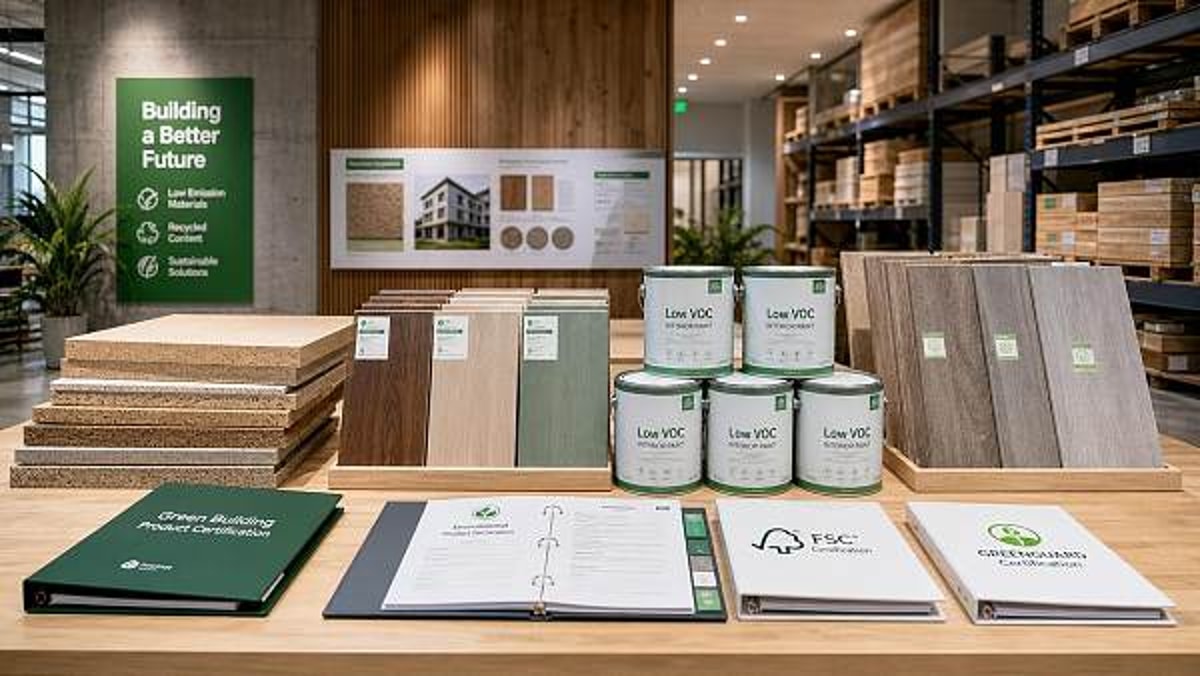
Commercial interiors are one of the most common environments where Eco-friendly building materials are specified. Developers, landlords, and occupiers often want low-emission paints, recycled-content ceiling systems, sustainable flooring, and low-impact partition materials. On paper, these requirements look easy to satisfy because many suppliers use similar sustainability language.
The problem is that interiors are highly sensitive to product consistency and indoor environmental quality. Procurement teams must pay attention to VOC emissions, adhesives, coatings, fire performance, installation compatibility, and lot-to-lot uniformity. A supplier may present a broad sustainability brochure, but unless the exact product variant has current test reports, the buying team faces risk.
In this scenario, the best sourcing approach is evidence-led. Ask for third-party emissions testing, recycled content declarations, installation guidance, maintenance data, and references from comparable projects. For fit-out programs with aggressive schedules, procurement should also confirm buffer stock policies and local distributor support. Sustainable claims mean little if replacement materials cannot be delivered quickly during site execution.
Scenario 2: Public projects reward documentation discipline
In schools, hospitals, transport hubs, and government buildings, Eco-friendly building materials are often tied to formal procurement rules. The challenge here is not only whether a material is sustainable, but whether every claim can withstand audit, tender review, and contractual scrutiny. Public projects usually have less tolerance for ambiguous labels, expired reports, or partial technical files.
Buyers in this scenario should expect documentation-heavy sourcing. Environmental Product Declarations, chain-of-custody certificates, origin records, product safety sheets, and compliance mapping to local standards may all be required. The supplier’s internal responsiveness also becomes a procurement criterion. A technically sound supplier that cannot organize paperwork on time can still become a project bottleneck.
A practical strategy is to introduce supplier pre-qualification before final tender award. This allows procurement teams to compare not only price and product attributes but also documentation maturity, export readiness, and past performance on regulated projects. In high-stakes public procurement, the lowest price for sustainable materials is rarely the lowest total risk.
Scenario 3: Volume housing demands scale and supply resilience
Residential developers and large contractors increasingly want Eco-friendly building materials in insulation, wall systems, roofing, windows, boards, and finishing products. However, the economics of volume housing are unforgiving. Even if the sustainability target is clear, procurement must ensure that unit costs stay within budget and that deliveries can support repetitive construction cycles.
This is where many sourcing plans fail. A supplier may offer an attractive sustainable product for a pilot phase but lack the production depth to support thousands of units over multiple quarters. Another frequent issue is price volatility linked to recycled feedstock, regional energy costs, or transportation constraints. For buyers, this means capacity verification is just as important as technical qualification.
In this scenario, procurement should assess monthly output, raw material dependency, geographic manufacturing spread, and contingency sourcing options. It is wise to dual-source critical categories where specification allows. Buyers should also ask whether the supplier can maintain the same sustainability profile when output increases. Sometimes a product is “green” only under limited sourcing conditions, which creates hidden risk once demand scales up.
Scenario 4: Modular construction needs precision and repeatability
Modular and prefabricated construction brings a different sourcing logic. Here, Eco-friendly building materials must fit tightly controlled manufacturing workflows. Boards, panels, insulation, fasteners, sealants, and finishes are selected not only for sustainability performance but also for dimensional tolerances, assembly speed, transport endurance, and compatibility with automated processes.
A material that works well on a traditional construction site may cause serious problems in a factory setting if thickness variation, cure time, or moisture behavior is inconsistent. Procurement teams should therefore involve production, engineering, and quality teams much earlier than usual. The sourcing question becomes: can this material perform repeatedly under factory conditions without disrupting throughput?
For this scenario, pilot orders and controlled trials are essential. Buyers should request tolerance data, packaging protection standards, and evidence from similar modular applications. Sustainable sourcing in modular construction is successful when it reduces lifecycle impact without adding manufacturing instability.
How priorities differ by buyer type
Not every procurement organization evaluates Eco-friendly building materials in the same way. The decision criteria change depending on where the buyer sits in the supply chain.
What reliable sourcing looks like in practice
Reliable sourcing of Eco-friendly building materials depends on moving beyond product marketing and into verifiable supply intelligence. A strong sourcing process usually includes five checkpoints. First, define the exact sustainability requirement in operational terms: recycled content, carbon threshold, indoor air quality, responsible forestry, durability, or circularity. Second, identify which standards matter in the target market, because different geographies recognize different proof systems.
Third, qualify the supplier as carefully as the product. Review factory capacity, quality control, export history, claim substantiation, and responsiveness. Fourth, test the commercial resilience of the offer. Check pricing triggers, lead times, minimum order quantities, currency exposure, and substitution policies. Fifth, create an approval path for ongoing verification, especially if the project spans many months and multiple shipments.
For international buyers, this is where trusted B2B intelligence platforms add value. Procurement teams benefit from updated market signals on supply shifts, regional production growth, regulatory trends, and supplier visibility. Better information shortens the gap between what can be specified and what can actually be purchased with confidence.
Common sourcing mistakes across scenarios
Several recurring mistakes make Eco-friendly building materials harder to source than they should be. One is treating all sustainable claims as equivalent. “Recycled,” “natural,” “low-carbon,” and “non-toxic” are not interchangeable procurement criteria. Another is waiting too long to involve procurement. If buyers enter after the design team has locked in narrow material assumptions, sourcing options become constrained and expensive.
A third mistake is ignoring logistics. Heavy low-carbon products may lose their environmental and cost advantage if shipped inefficiently across long distances. A fourth is overreliance on a single supplier without understanding raw material inputs or backup production routes. Finally, many teams fail to distinguish between certification presence and certification relevance. A certificate may exist, but it may not address the project’s actual risk or compliance need.
FAQ for procurement teams evaluating sustainable materials
How can buyers compare suppliers offering similar Eco-friendly building materials?
Compare them on verified documentation, production capacity, quality consistency, delivery history, and destination-market compliance, not just headline sustainability claims.
Which projects should be most cautious when switching to new materials?
Public projects, modular construction, and high-volume housing should be especially cautious because documentation gaps, tolerance variation, or supply interruptions can create major downstream costs.
Is local sourcing always better for sustainable procurement?
Not always. Local sourcing may reduce transport exposure, but imported options can still be competitive if they provide better traceability, stronger certifications, or more stable performance.
A smarter next step for buyers
The real procurement challenge is not finding companies that mention Eco-friendly building materials. It is finding partners that can support the exact project scenario you are managing. A fit-out buyer needs proof of emissions and finish reliability. A public buyer needs audit-ready compliance. A housing buyer needs scale. A modular buyer needs precision. Once procurement teams define the scenario clearly, sourcing becomes less about chasing claims and more about matching requirements to credible supply capability.
For organizations operating across borders, consistent market visibility is a competitive advantage. Trade intelligence platforms such as GTIIN and TradeVantage help buyers monitor supplier landscapes, industry shifts, and documentation expectations across sectors and regions. That broader view strengthens supplier selection, reduces sourcing surprises, and helps businesses turn sustainability goals into practical procurement outcomes.
Before your next RFQ, map your application scenario, rank your non-negotiables, and verify which suppliers can deliver both performance and proof. That is the difference between specifying sustainable materials and actually sourcing them well.
Recommended News
 Portable oxygen concentrators are quieter now, but not always lighterPortable oxygen concentrators are getting quieter, but not always lighter. Explore the trade-offs in weight, battery life, comfort, and daily usability before you compare today’s top options.
 Interactive whiteboards are improving, but software still decides valueInteractive whiteboards deliver real value when software matches the scenario. Explore how usability, integration, security, and updates shape smarter buying decisions.
 Medical diagnostic equipment downtime often starts with calibration neglectMedical diagnostic equipment downtime often starts with missed calibration. Learn the warning signs, checklist priorities, and practical steps to prevent failures and keep healthcare operations reliable.
 Eco-friendly building materials are easier to specify than to sourceEco-friendly building materials are easier to specify than source. Learn how procurement teams can verify claims, reduce risk, and find reliable suppliers faster.
 Ergonomic workspace design can fail if chair fit comes lastErgonomic workspace design starts with chair fit. Learn how the right seat improves posture, comfort, and focus—and why fixing it first can transform your workspace.
 Outdoor garden supplies demand shifts faster than many expectOutdoor garden supplies demand is shifting faster than expected. Discover key B2B trends, smarter sourcing insights, and practical strategies to stay competitive and capture growth.
 Sustainable home decor sells better when materials are clearly disclosedSustainable home decor sells better when brands clearly disclose materials, finishes, and sourcing. Discover why transparency builds trust, justifies price, and drives more confident buying.
 Modern office furniture trends now favor modular over fixed layoutsModern office furniture is shifting to modular layouts for flexibility, lower lifecycle costs, and better hybrid work performance. See why enterprises are moving away from fixed office design.
 Smart street lighting projects stall when controls are overcomplicatedSmart street lighting projects often stall when controls become too complex. Learn how to simplify deployment, reduce risk, and scale citywide with practical, maintainable systems.
 Solid-state battery breakthroughs look promising, but scale is harderSolid-state battery breakthroughs promise safer, higher-density energy storage, but scaling remains the real challenge. Explore what this means for supply chains, investment, and market advantage.
 Commercial LED lighting upgrades often save less than expectedCommercial LED lighting upgrades can underdeliver when baseline data, controls, and installation costs are misjudged. Learn how to assess real savings, reduce ROI risk, and make smarter investment decisions.
 Lithium battery storage payback can change with one policy updateLithium battery storage payback can shift fast after one policy update. See how tariffs, tax credits, grid pricing, and incentives change ROI—and how finance teams can approve smarter.
 Photovoltaic solar panels now compete on output in low lightPhotovoltaic solar panels now compete on low-light output. Discover how buyers can compare yield, risk, and supplier value to source smarter and boost project returns.
 Plant-based protein processing changes texture more than many expectPlant-based protein processing reshapes texture, stability, and safety more than expected. Explore key risks, QC checkpoints, and smarter sourcing insights for consistent results.
 Foldable screen technology is improving, but crease concerns remainFoldable screen technology is evolving fast with slimmer designs and stronger hinges, but crease concerns still shape buying decisions. Explore where it matters most.
 Next-gen wireless charging still faces a heat management problemNext-gen wireless charging promises faster, more flexible power delivery, but heat remains the key barrier. Discover how thermal limits impact safety, efficiency, and market readiness.
 Wearable technology adoption drops when comfort gets overlookedWearable technology adoption falls fast when comfort is ignored. Discover how fit, materials, weight, and battery life shape long-term use and smarter buying decisions.
 Smart home devices wholesale is no longer just about low pricingSmart home devices wholesale now goes beyond low pricing. Discover how reliability, compatibility, and supply chain confidence help distributors choose profitable, trusted partners.
 Agri-PV systems make sense only when land use is planned wellAgri-PV systems deliver real value only when land use is planned well. Discover how smart site, crop, grid, and compliance decisions turn dual-use solar into a bankable, sustainable project.
 Organic fertilizers may improve soil slower, but results last longerOrganic fertilizers improve soil slowly but deliver longer-lasting results. Learn how they boost soil health, support safer growing, and help you choose the right option for sustainable planting success.
 Smart classroom solutions fail when teachers need too many appsSmart classroom solutions fail when teachers juggle too many apps. Discover why integrated, easy-to-use platforms drive adoption, ROI, and scalable learning success.
















Popular Tags
Global Trade Insights & Industry
Our mission is to empower global exporters and importers with data-driven insights that foster strategic growth.
Search News
Popular Tags
Industry Overview
The global commercial kitchen equipment market is projected to reach $112 billion by 2027. Driven by urbanization, the rise of e-commerce food delivery, and strict hygiene regulations.