

Plant-based protein processing costs more where texture matters most
Plant-based protein processing often becomes significantly more expensive in applications where texture is the key purchase driver. For business evaluators, understanding how extrusion intensity, ingredient functionality, and process control affect cost is essential to assessing product viability, supplier competitiveness, and long-term margin potential in this fast-evolving market.
Why a checklist approach is the fastest way to evaluate texture-driven cost pressure
For commercial assessment teams, the biggest mistake in reviewing plant-based protein processing is to treat cost as a simple raw-material issue. In reality, costs rise sharply when buyers expect fibrous bite, juiciness, chew resistance, and visual similarity to meat or seafood. Texture is not a decorative feature; in many categories it is the product. That means processing intensity, formulation precision, and quality consistency become direct cost drivers.
A checklist-based review helps decision makers quickly identify whether a supplier’s price premium comes from genuine technical requirements or from inefficient operations. It also makes cross-supplier comparisons more objective. Instead of asking whether a product is “high quality,” evaluators can ask which texture-related steps add cost, whether those steps are necessary, and how reliably they translate into market value.
First-screen checklist: what to confirm before comparing suppliers
Before analyzing quotations, contracts, or production claims, business evaluators should confirm the following priority items in plant-based protein processing:
- Target application: burger, nugget, shredded meat alternative, dairy analog, ready meal inclusion, or high-moisture whole-cut substitute. Texture demands differ widely by format.
- Required textural outcome: softness, fibrous pull, elasticity, layered structure, bite recovery, or crispness after cooking.
- Processing route: dry texturization, high-moisture extrusion, shear-cell processing, fermentation-assisted structuring, or hybrid processing.
- Protein base: soy, pea, wheat gluten, fava, chickpea, canola, mycoprotein, or blended systems.
- Yield sensitivity: how much water uptake, oil retention, and cooking loss affect final unit economics.
- Scale assumptions: pilot, regional commercial run, or global industrial supply.
- Tolerance for variation: premium retail and foodservice chains usually demand tighter texture consistency than value-tier or ingredient applications.
If these points are unclear, cost benchmarking becomes unreliable. Two products may both be labeled as plant-based protein processing solutions while requiring very different capital load, energy intensity, and operator skill.
Core cost checklist: where texture makes plant-based protein processing more expensive
1. Ingredient functionality costs more than ingredient weight
Texture-focused products often require protein ingredients with narrow particle size distribution, higher purity, stronger gel behavior, or better water-binding performance. These functional specifications usually cost more than commodity-grade protein. A lower-cost protein may appear attractive on paper, but if it creates poor fiber formation or unstable bite, the processor may need more binders, more flavor masking, or stricter process controls later.
2. Extrusion intensity raises energy and wear costs
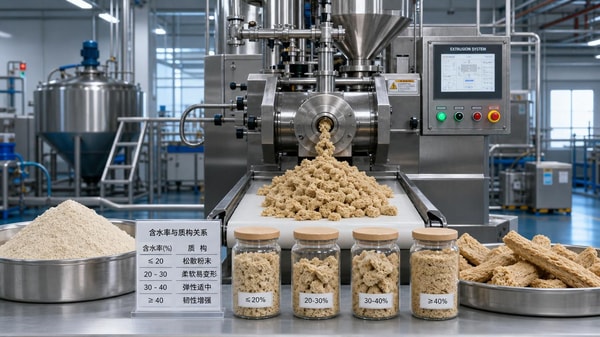
In plant-based protein processing, texture often depends on pressure, heat, shear, residence time, and moisture control inside the extruder. High-moisture systems designed to create layered, meat-like fibers consume more energy and place greater stress on screws, barrels, and cooling dies. Maintenance cycles shorten, spare parts become more important, and downtime risk increases. These hidden costs are easy to miss in supplier presentations.
3. Formulation complexity increases rework risk
Texture is rarely created by protein alone. Oils, hydrocolloids, starches, fibers, salts, and natural flavors may all influence the final bite. Each added component introduces compatibility questions. The more complex the recipe, the greater the risk of batch variation, process drift, and reformulation cost when raw-material quality changes. Evaluators should ask whether texture performance relies on a robust system or a fragile balance.
4. Process control systems add value but also cost
Where texture matters most, manual control is rarely enough. Suppliers may need in-line moisture monitoring, temperature mapping, feed-rate synchronization, and post-extrusion cooling management. These systems improve consistency, but they increase capital expenditure, calibration requirements, and operator training needs. Strong process control can justify premium pricing if it reduces rejects and protects brand quality.
5. Yield losses can erase apparent savings
A lower quoted processing cost means little if the product loses mass during hydration, freezing, frying, or reheating. In texture-sensitive categories, yield is part of the texture equation. Excess moisture release, oil separation, or structural collapse can increase effective cost per serving. Business evaluators should always compare costs on a finished-use basis, not only on dry input or ex-factory kilogram price.
Decision table: what to check when comparing plant-based protein processing options
Scenario guide: which applications justify higher processing cost
Not every category needs premium texture engineering. Evaluators should separate applications where advanced plant-based protein processing creates measurable commercial value from those where simpler systems are enough.
- High justification: whole-cut chicken alternatives, pulled meat analogs, steak-like formats, premium foodservice items, and chilled retail products where bite and structure shape repurchase.
- Moderate justification: burgers, meatballs, nuggets, dumpling fillings, and blended applications where texture matters but can be supported by coating, sauce, or cooking method.
- Lower justification: powdered nutrition, bakery enrichment, soups, sauces, and processed foods where protein delivery matters more than fibrous structure.
This distinction is important because some suppliers apply high-cost texturization logic to categories that do not reward it. Others underinvest in structure for premium formats and then struggle with customer retention. Good evaluation means matching process cost to market expectations, not chasing the most technical solution by default.
Commonly overlooked risks that distort cost analysis
Several risks are frequently missed during commercial review of plant-based protein processing:
- Pilot success does not guarantee industrial consistency. Texture windows often narrow as throughput rises.
- Alternative proteins may need different screw configurations or moisture profiles, making “drop-in replacement” claims unrealistic.
- Texture can degrade during downstream steps such as marination, freezing, retorting, or pan-frying.
- A visually convincing texture may still fail sensory expectations under real foodservice preparation conditions.
- Labor intensity matters. If product quality depends heavily on operator experience, cost scalability is weaker than advertised.
- Sustainability claims should be checked against energy use and waste rates. A premium processing route may weaken the environmental story if efficiency is poor.
Practical evaluation steps for business reviewers
To assess whether texture-driven plant-based protein processing cost is justified, use a structured review sequence:
- Define the target eating experience in measurable terms, not marketing language.
- Map every cost layer from protein input to final cooked yield.
- Request evidence of batch consistency, reject rates, and downtime history.
- Compare performance after downstream handling, not just immediately after processing.
- Test the economics at expected commercial scale, including maintenance and labor assumptions.
- Check whether the texture premium improves pricing power, repeat purchase, or customer acceptance enough to protect margin.
This process aligns well with the information-driven evaluation standards used by global B2B intelligence platforms. For exporters, importers, and sourcing teams tracking sector trends across multiple markets, the ability to compare processing logic rather than just headline prices is increasingly important.
FAQ for commercial teams reviewing plant-based protein processing
Does higher texture quality always mean better profitability?
No. It only improves profitability when the market segment values that texture enough to support pricing, conversion, or repeat purchase. In value-oriented categories, extra processing may compress margin instead.
Which cost factor is most often underestimated?
Yield-adjusted economics are often underestimated. Many teams compare ingredient and processing cost without fully accounting for hydration behavior, cooking loss, and finished portion performance.
What is the clearest sign that a supplier has real processing capability?
Reliable commercial consistency. A supplier that can show stable texture outcomes across batches, scales, and end-use conditions is usually stronger than one with only impressive pilot samples.
Action guide: what to ask before moving to the next stage
If your team is evaluating suppliers, partnerships, or investment opportunities related to plant-based protein processing, the next discussion should focus on operational proof rather than broad claims. Ask for target application data, texture specifications, commercial-scale processing parameters, reject and maintenance records, downstream performance results, and cost breakdowns tied to finished-use yield.
For business evaluators operating in international trade and industrial intelligence environments, these questions help determine whether a premium processing model is truly defensible. The most competitive suppliers are not simply those with advanced equipment, but those able to convert texture complexity into repeatable product performance, scalable economics, and credible market differentiation.
Recommended News
 Portable oxygen concentrators are quieter now, but not always lighterPortable oxygen concentrators are getting quieter, but not always lighter. Explore the trade-offs in weight, battery life, comfort, and daily usability before you compare today’s top options.
 Interactive whiteboards are improving, but software still decides valueInteractive whiteboards deliver real value when software matches the scenario. Explore how usability, integration, security, and updates shape smarter buying decisions.
 Medical diagnostic equipment downtime often starts with calibration neglectMedical diagnostic equipment downtime often starts with missed calibration. Learn the warning signs, checklist priorities, and practical steps to prevent failures and keep healthcare operations reliable.
 Eco-friendly building materials are easier to specify than to sourceEco-friendly building materials are easier to specify than source. Learn how procurement teams can verify claims, reduce risk, and find reliable suppliers faster.
 Ergonomic workspace design can fail if chair fit comes lastErgonomic workspace design starts with chair fit. Learn how the right seat improves posture, comfort, and focus—and why fixing it first can transform your workspace.
 Outdoor garden supplies demand shifts faster than many expectOutdoor garden supplies demand is shifting faster than expected. Discover key B2B trends, smarter sourcing insights, and practical strategies to stay competitive and capture growth.
 Sustainable home decor sells better when materials are clearly disclosedSustainable home decor sells better when brands clearly disclose materials, finishes, and sourcing. Discover why transparency builds trust, justifies price, and drives more confident buying.
 Modern office furniture trends now favor modular over fixed layoutsModern office furniture is shifting to modular layouts for flexibility, lower lifecycle costs, and better hybrid work performance. See why enterprises are moving away from fixed office design.
 Smart street lighting projects stall when controls are overcomplicatedSmart street lighting projects often stall when controls become too complex. Learn how to simplify deployment, reduce risk, and scale citywide with practical, maintainable systems.
 Solid-state battery breakthroughs look promising, but scale is harderSolid-state battery breakthroughs promise safer, higher-density energy storage, but scaling remains the real challenge. Explore what this means for supply chains, investment, and market advantage.
 Commercial LED lighting upgrades often save less than expectedCommercial LED lighting upgrades can underdeliver when baseline data, controls, and installation costs are misjudged. Learn how to assess real savings, reduce ROI risk, and make smarter investment decisions.
 Lithium battery storage payback can change with one policy updateLithium battery storage payback can shift fast after one policy update. See how tariffs, tax credits, grid pricing, and incentives change ROI—and how finance teams can approve smarter.
 Photovoltaic solar panels now compete on output in low lightPhotovoltaic solar panels now compete on low-light output. Discover how buyers can compare yield, risk, and supplier value to source smarter and boost project returns.
 Plant-based protein processing changes texture more than many expectPlant-based protein processing reshapes texture, stability, and safety more than expected. Explore key risks, QC checkpoints, and smarter sourcing insights for consistent results.
 Foldable screen technology is improving, but crease concerns remainFoldable screen technology is evolving fast with slimmer designs and stronger hinges, but crease concerns still shape buying decisions. Explore where it matters most.
 Next-gen wireless charging still faces a heat management problemNext-gen wireless charging promises faster, more flexible power delivery, but heat remains the key barrier. Discover how thermal limits impact safety, efficiency, and market readiness.
 Wearable technology adoption drops when comfort gets overlookedWearable technology adoption falls fast when comfort is ignored. Discover how fit, materials, weight, and battery life shape long-term use and smarter buying decisions.
 Smart home devices wholesale is no longer just about low pricingSmart home devices wholesale now goes beyond low pricing. Discover how reliability, compatibility, and supply chain confidence help distributors choose profitable, trusted partners.
 Agri-PV systems make sense only when land use is planned wellAgri-PV systems deliver real value only when land use is planned well. Discover how smart site, crop, grid, and compliance decisions turn dual-use solar into a bankable, sustainable project.
 Organic fertilizers may improve soil slower, but results last longerOrganic fertilizers improve soil slowly but deliver longer-lasting results. Learn how they boost soil health, support safer growing, and help you choose the right option for sustainable planting success.
 Smart classroom solutions fail when teachers need too many appsSmart classroom solutions fail when teachers juggle too many apps. Discover why integrated, easy-to-use platforms drive adoption, ROI, and scalable learning success.













Popular Tags
Global Trade Insights & Industry
Our mission is to empower global exporters and importers with data-driven insights that foster strategic growth.
Search News
Popular Tags
Industry Overview
The global commercial kitchen equipment market is projected to reach $112 billion by 2027. Driven by urbanization, the rise of e-commerce food delivery, and strict hygiene regulations.