

Solid-state battery breakthroughs are real, but timelines keep slipping
Solid-state battery breakthroughs are no longer just lab-stage talking points. Major automakers, battery startups, and materials suppliers have all demonstrated meaningful progress in energy density, charging speed, and safety performance. Yet the commercial timelines attached to those advances keep moving outward. For information researchers, that is the real story: the science is advancing, but industrialization remains constrained by manufacturing complexity, material availability, quality control, and long-cycle validation. The key question is no longer whether solid-state batteries can work, but when they can be produced reliably, at cost, and at automotive scale.
That distinction matters for anyone tracking global supply chains, industrial investment, and technology commercialization. The gap between breakthrough announcements and market deployment reveals which companies are solving practical bottlenecks, which regions may capture strategic value, and where expectations have run ahead of execution. In other words, the most useful lens is not hype versus skepticism. It is readiness versus scalability.
Why do solid-state battery breakthroughs sound so close, yet mass adoption still feels far away?
The short answer is that a working prototype and a scalable product are two very different achievements. Many of the recent solid-state battery breakthroughs are technically real. Companies have shown improved cell performance, better thermal stability, and promising laboratory cycle life. However, moving from a controlled test environment to consistent high-volume manufacturing is one of the hardest transitions in the battery industry.
In batteries, small defects can create major performance losses or safety risks. Solid-state designs often rely on new electrolytes, unfamiliar interfaces between materials, and manufacturing methods that have not yet reached the process maturity of conventional lithium-ion production. That means every gain in one area can expose weakness in another. A cell may offer strong energy density, for example, but still struggle with dendrite formation, brittleness, interface degradation, or poor yield during fabrication.
This is why launch schedules keep slipping. Timelines are not only delayed because the chemistry is difficult. They are delayed because carmakers and battery suppliers must validate product durability across years of use, under varied climates, charging patterns, and accident scenarios. In transportation, performance claims are only valuable when they survive industrial qualification.
What are the biggest barriers preventing commercialization at scale?
For researchers evaluating this sector, four barriers deserve the most attention: manufacturing scalability, cost structure, safety validation, and supply chain readiness. These are more important than headline performance metrics alone because they determine whether a breakthrough can become a business.
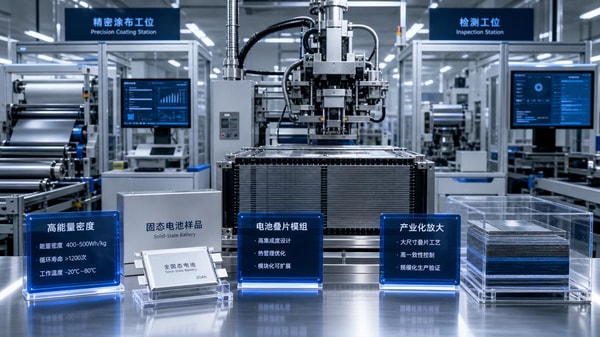
Manufacturing scalability remains the first major challenge. Solid-state batteries often require tighter moisture control, more precise layer handling, and highly consistent interfaces between cathode, electrolyte, and anode materials. Even if a company can make excellent samples, reproducing them at high yield on a large production line is a separate hurdle. A promising chemistry without a manufacturable process can stay trapped in pilot mode for years.
Cost structure is the second barrier. Many solid-state pathways depend on advanced ceramics, sulfides, or specialized polymers, as well as novel equipment and process steps. Those factors can raise capital expenditure and operating costs. If the battery delivers meaningful range, charging, or safety benefits, premium segments may absorb some of that cost. But broad market adoption requires a cost curve that can compete with increasingly efficient lithium-ion technologies.
Safety validation is also more complicated than many headlines imply. Solid-state batteries are often promoted as safer than liquid-electrolyte cells, and in principle they can reduce certain flammability risks. But safer does not mean automatically approved. Regulators, automakers, and industrial buyers still need extensive proof under abuse testing, temperature stress, long-term cycling, fast charging, and mechanical impact conditions.
Supply chain readiness may be the most underestimated issue. Even a strong cell architecture depends on reliable sourcing of precursor materials, processing tools, coatings, separators or solid electrolyte components, and quality inspection systems. If a region lacks one or two critical supply chain links, commercialization slows regardless of laboratory progress.
Which solid-state battery breakthroughs actually matter most to the market?
Not every breakthrough has equal strategic value. For market observers, the most important advances are those that reduce commercialization risk, not just those that set laboratory records. A new energy density benchmark may attract attention, but it matters less than a development that improves manufacturability, extends cycle life under realistic conditions, or supports high-yield production.
The breakthroughs that matter most usually fall into five categories. First are interface stability improvements, because stable contact between solid electrolyte and electrodes is essential for long-term performance. Second are higher-yield fabrication methods, which show whether companies can produce cells consistently rather than occasionally. Third are fast-charging results under practical temperature ranges, which indicate consumer relevance. Fourth are durability gains at automotive-grade cycle counts, because vehicle applications demand far more than a short successful demonstration. Fifth are pilot-line validation milestones, which often say more about readiness than press releases about prototype cells.
For information researchers, this means the best signals are usually hidden in technical updates, production announcements, capital expenditure plans, equipment partnerships, and qualification timelines. A company discussing yield rates, pilot throughput, and validation phases often provides more useful evidence than one emphasizing only energy density figures.
Why are automakers and battery firms still investing heavily despite repeated delays?
Because the potential rewards are still large enough to justify patience. If successfully commercialized, solid-state batteries could unlock advantages in vehicle range, charging speed, packaging efficiency, and safety. Those benefits are strategically important in electric vehicles, premium mobility, aerospace, defense, and potentially high-performance consumer applications.
Automakers are especially motivated because battery architecture shapes both product competitiveness and supply chain control. A company that secures early access to a workable solid-state platform could differentiate on range, weight, charging time, or safety branding. Just as importantly, it could reduce long-term dependence on current battery configurations that are already facing intense competition and margin pressure.
Battery firms and materials suppliers are investing for similar reasons. Even if first-generation solid-state products enter only premium niches, early participation can establish intellectual property, customer relationships, process expertise, and downstream scale advantages. In emerging technologies, the first commercial wave does not have to dominate total volume to reshape market position.
That said, the investment logic is evolving. The industry is becoming more selective. Capital now tends to favor companies that can show not only chemistry potential, but also manufacturability pathways, strategic partnerships, and staged commercialization plans. Investors and industrial partners are increasingly asking a practical question: can this company cross the valley between prototype excellence and factory discipline?
What should information researchers watch to separate genuine progress from hype?
This is where search intent becomes highly practical. Most readers looking into solid-state battery breakthroughs are not simply asking whether the technology is exciting. They want to know how to assess credibility. The best approach is to track commercialization indicators instead of relying on isolated announcements.
Start with production stage. Is the company still in laboratory testing, operating a pilot line, or preparing mass production? Terms like “sample shipped,” “prototype validated,” and “pilot facility expanded” signal very different levels of maturity. Researchers should map each company to a clear readiness stage.
Next, examine partnership structure. When an automaker, cell maker, materials supplier, and equipment partner are aligned, the probability of industrial progress improves. Solid-state battery development is too complex for most firms to solve alone. Strong ecosystems often indicate stronger execution potential.
Then look at validation language. Credible companies usually discuss cycle life, temperature performance, safety testing, yield targets, or qualification milestones with some specificity. Vague claims about “revolutionary performance” without production detail should be treated cautiously.
Another important signal is capital allocation. A company building pilot infrastructure, hiring process engineers, or signing equipment deals is making a more serious industrial commitment than one issuing broad future plans. Follow the money, not just the messaging.
Finally, compare the company’s timeline history. Repeated delays are not necessarily proof of failure; this is a difficult field. But researchers should ask whether milestones have become more concrete over time or whether the language remains permanently aspirational. Real progress tends to narrow uncertainty, even if schedules move.
How will slipping timelines affect the global supply chain and trade landscape?
Delays do not mean the opportunity disappears. They change where value accrues first. When commercialization takes longer, upstream suppliers, testing specialists, advanced materials firms, and pilot-line equipment makers can benefit before mass-market battery volumes arrive. This shifts attention from end products to enabling infrastructure.
For global trade participants, that means the solid-state story is not only about future EV batteries. It is also about present demand for ceramic processing, dry-room systems, precision coating, material purification, quality inspection, and intellectual property licensing. These adjacent segments may see measurable commercial activity earlier than finished battery packs.
Regional competition is another factor. Countries and industrial clusters with strong battery ecosystems, process engineering talent, and supportive industrial policy are better positioned to absorb timeline delays and still capture long-term value. Firms operating in Asia, Europe, and North America are all racing to secure pieces of the stack, from materials to cell integration to automotive qualification.
For exporters and importers, slipping launch dates can alter procurement cycles, partnership timing, and capital planning. Companies expecting rapid market rollout may need to adjust assumptions around customer demand, equipment orders, or cross-border sourcing. In fast-moving sectors, timing risk is often as important as technology risk.
What is the most realistic market outlook over the next several years?
The most realistic outlook is gradual commercialization, not sudden disruption. Solid-state battery breakthroughs will likely reach the market first in limited or premium applications where higher costs can be justified and production volumes remain manageable. Automotive deployment may begin in select models or hybrid architectures before expanding into broader vehicle categories.
Conventional lithium-ion technology will not be displaced overnight. In fact, it will continue improving while solid-state systems mature. That means the competition is dynamic, not static. Every year that solid-state timelines slip, incumbent battery technologies gain more time to reduce cost, improve safety, and increase energy density. This raises the commercialization bar for new entrants.
Still, gradual does not mean insignificant. Even a narrow launch window can validate supply chains, unlock follow-on investment, and create a pathway for larger-scale adoption later. The first meaningful market entry may matter less for immediate volume and more for proving that industrial execution is finally catching up with the science.
How should decision-makers interpret today’s solid-state battery narrative?
The right interpretation is balanced and evidence-based. Solid-state battery breakthroughs are real, but they are not self-executing. The market should neither dismiss the technology because of delays nor accept aggressive timelines without scrutiny. The companies most likely to lead are those translating chemistry advances into repeatable manufacturing systems.
For information researchers, the practical takeaway is to focus on readiness indicators: pilot output, validation progress, equipment partnerships, capital deployment, and supply chain integration. These reveal much more than headline claims alone. The central question is not whether a breakthrough happened. It is whether the breakthrough can survive industrial reality.
That is why slipping timelines are not just disappointments. They are data. They show where complexity remains, where bottlenecks are concentrated, and which firms are learning how to solve them. For anyone tracking technology markets, trade flows, or strategic investment, that is where the most valuable insight lies.
In summary, solid-state battery breakthroughs deserve serious attention, but commercialization should be evaluated through the lens of manufacturability, cost, validation, and supply chain readiness. The future is still promising, yet the pace will be shaped less by laboratory milestones than by factory performance. Readers who understand that distinction will be better equipped to judge market claims, identify credible players, and anticipate where the next phase of industrial value will emerge.
Recommended News
 Portable oxygen concentrators are quieter now, but not always lighterPortable oxygen concentrators are getting quieter, but not always lighter. Explore the trade-offs in weight, battery life, comfort, and daily usability before you compare today’s top options.
 Interactive whiteboards are improving, but software still decides valueInteractive whiteboards deliver real value when software matches the scenario. Explore how usability, integration, security, and updates shape smarter buying decisions.
 Medical diagnostic equipment downtime often starts with calibration neglectMedical diagnostic equipment downtime often starts with missed calibration. Learn the warning signs, checklist priorities, and practical steps to prevent failures and keep healthcare operations reliable.
 Eco-friendly building materials are easier to specify than to sourceEco-friendly building materials are easier to specify than source. Learn how procurement teams can verify claims, reduce risk, and find reliable suppliers faster.
 Ergonomic workspace design can fail if chair fit comes lastErgonomic workspace design starts with chair fit. Learn how the right seat improves posture, comfort, and focus—and why fixing it first can transform your workspace.
 Outdoor garden supplies demand shifts faster than many expectOutdoor garden supplies demand is shifting faster than expected. Discover key B2B trends, smarter sourcing insights, and practical strategies to stay competitive and capture growth.
 Sustainable home decor sells better when materials are clearly disclosedSustainable home decor sells better when brands clearly disclose materials, finishes, and sourcing. Discover why transparency builds trust, justifies price, and drives more confident buying.
 Modern office furniture trends now favor modular over fixed layoutsModern office furniture is shifting to modular layouts for flexibility, lower lifecycle costs, and better hybrid work performance. See why enterprises are moving away from fixed office design.
 Smart street lighting projects stall when controls are overcomplicatedSmart street lighting projects often stall when controls become too complex. Learn how to simplify deployment, reduce risk, and scale citywide with practical, maintainable systems.
 Solid-state battery breakthroughs look promising, but scale is harderSolid-state battery breakthroughs promise safer, higher-density energy storage, but scaling remains the real challenge. Explore what this means for supply chains, investment, and market advantage.
 Commercial LED lighting upgrades often save less than expectedCommercial LED lighting upgrades can underdeliver when baseline data, controls, and installation costs are misjudged. Learn how to assess real savings, reduce ROI risk, and make smarter investment decisions.
 Lithium battery storage payback can change with one policy updateLithium battery storage payback can shift fast after one policy update. See how tariffs, tax credits, grid pricing, and incentives change ROI—and how finance teams can approve smarter.
 Photovoltaic solar panels now compete on output in low lightPhotovoltaic solar panels now compete on low-light output. Discover how buyers can compare yield, risk, and supplier value to source smarter and boost project returns.
 Plant-based protein processing changes texture more than many expectPlant-based protein processing reshapes texture, stability, and safety more than expected. Explore key risks, QC checkpoints, and smarter sourcing insights for consistent results.
 Foldable screen technology is improving, but crease concerns remainFoldable screen technology is evolving fast with slimmer designs and stronger hinges, but crease concerns still shape buying decisions. Explore where it matters most.
 Next-gen wireless charging still faces a heat management problemNext-gen wireless charging promises faster, more flexible power delivery, but heat remains the key barrier. Discover how thermal limits impact safety, efficiency, and market readiness.
 Wearable technology adoption drops when comfort gets overlookedWearable technology adoption falls fast when comfort is ignored. Discover how fit, materials, weight, and battery life shape long-term use and smarter buying decisions.
 Smart home devices wholesale is no longer just about low pricingSmart home devices wholesale now goes beyond low pricing. Discover how reliability, compatibility, and supply chain confidence help distributors choose profitable, trusted partners.
 Agri-PV systems make sense only when land use is planned wellAgri-PV systems deliver real value only when land use is planned well. Discover how smart site, crop, grid, and compliance decisions turn dual-use solar into a bankable, sustainable project.
 Organic fertilizers may improve soil slower, but results last longerOrganic fertilizers improve soil slowly but deliver longer-lasting results. Learn how they boost soil health, support safer growing, and help you choose the right option for sustainable planting success.
 Smart classroom solutions fail when teachers need too many appsSmart classroom solutions fail when teachers juggle too many apps. Discover why integrated, easy-to-use platforms drive adoption, ROI, and scalable learning success.













Popular Tags
Global Trade Insights & Industry
Our mission is to empower global exporters and importers with data-driven insights that foster strategic growth.
Search News
Popular Tags
Industry Overview
The global commercial kitchen equipment market is projected to reach $112 billion by 2027. Driven by urbanization, the rise of e-commerce food delivery, and strict hygiene regulations.