

FDA Finalizes AI Diagnostic Device Rules for Importers
FDA issued its final regulatory framework for AI/ML-based medical devices on April 22, 2026 — a development with direct implications for manufacturers and exporters of AI-enabled diagnostic equipment, including portable ultrasound systems, glucose analyzers, and dermatoscopes. This requirement signals a new compliance threshold for global suppliers seeking U.S. market access.
Event Overview
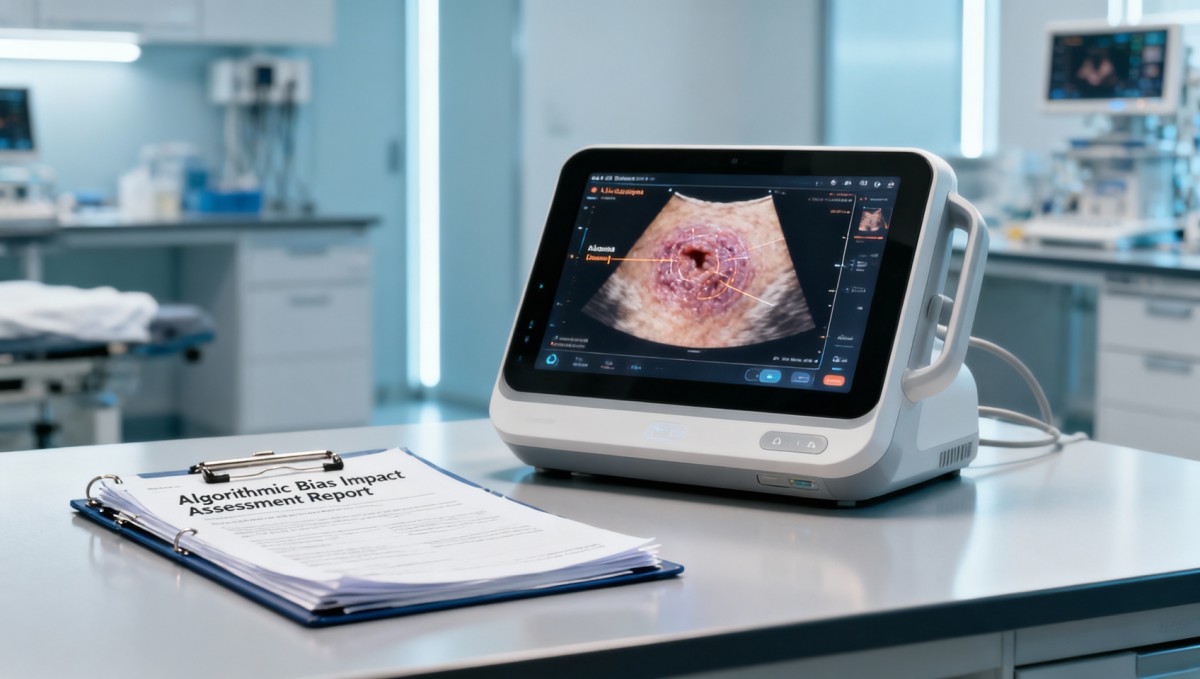
On April 22, 2026, the U.S. Food and Drug Administration (FDA) released the final version of its AI/ML-Based Software as a Medical Device (SaMD) Regulatory Framework. Under this rule, all imported medical devices incorporating AI-based diagnostic functions must submit a third-party-validated ‘Algorithmic Bias Impact Assessment Report’ as part of their 510(k) or De Novo premarket submission. The report must be based on evaluation across datasets representing at least three racial groups, two genders, and multiple age cohorts. Absence of this report will result in denial of FDA clearance for affected devices.
Industries Affected
Direct Exporters of AI-Enabled Medical Devices
Companies exporting AI-integrated diagnostic devices — such as portable ultrasound units, point-of-care glucose analyzers, and dermatoscopes — are directly subject to the new requirement. Because the rule applies specifically to imported devices undergoing 510(k) or De Novo review, these exporters must now integrate bias assessment into their premarket strategy. Failure to provide the validated report will halt FDA clearance, delaying or blocking U.S. market entry.
OEM/ODM Manufacturers Serving U.S.-Bound Brands
Contract manufacturers and original design manufacturers producing AI-diagnostic hardware or embedded software for U.S.-registered brands face upstream compliance pressure. Their customers (i.e., U.S.-based sponsors) will require documented evidence that algorithmic bias assessments were conducted during development — meaning OEM/ODM partners must either perform or enable such evaluations, including data collection protocols and documentation traceability.
Regulatory Affairs & Clinical Validation Service Providers
Third-party validation bodies and regulatory consultancies specializing in SaMD submissions are now positioned as essential collaborators. The mandate for third-party validation of bias impact reports creates a defined service scope: providers must demonstrate capability in demographic dataset curation, fairness metric application (e.g., predictive parity, equalized odds), and audit-ready reporting aligned with FDA expectations.
What Relevant Enterprises or Practitioners Should Focus On — And How to Respond
Monitor official FDA guidance documents and Q&A updates
The final framework outlines requirements but defers detailed methodology to future guidance. Enterprises should track upcoming FDA publications — especially those clarifying acceptable bias metrics, minimum sample size thresholds per demographic subgroup, and criteria for third-party validator qualification.
Prioritize high-risk product categories for immediate gap assessment
Devices classified under 510(k) or De Novo pathways — particularly those with image-based or physiological pattern recognition (e.g., skin lesion classification, ECG arrhythmia detection) — are most likely to trigger bias scrutiny. Exporters should map current product portfolios against these categories and initiate internal readiness reviews for applicable items.
Distinguish policy signal from operational implementation timelines
The rule takes effect upon publication (April 22, 2026), but FDA has indicated a phased enforcement approach. Sponsors submitting after October 2026 will be expected to comply fully; earlier submissions may be reviewed under prior expectations. Companies should verify submission dates against this timeline rather than assume blanket retroactivity.
Begin preparing data infrastructure and vendor engagement now
Assembling representative demographic datasets and securing qualified third-party validators takes time. Exporters should assess existing clinical data repositories for diversity gaps, initiate dialogue with potential validation partners, and document data provenance practices — especially where training data originates from non-U.S. populations.
Editorial Perspective / Industry Observation
From an industry perspective, this rule is best understood not as an isolated technical update, but as a formalization of long-emerging regulatory expectation: that AI-driven health tools must demonstrate equitable performance across population subgroups. Analysis来看, the requirement reflects FDA’s shift from evaluating ‘what the algorithm does’ to ‘how fairly it does it’ — elevating bias assessment from optional best practice to mandatory submission component. Current more appropriate interpretation is that this is both a signal and an operational milestone: while full ecosystem alignment (e.g., standardized metrics, harmonized international expectations) remains underway, the rule itself is enforceable and binding for new submissions. Ongoing attention is warranted because subsequent FDA actions — such as enforcement discretion notices or international alignment efforts (e.g., with EU MDR or IMDRF) — will shape how strictly and broadly this requirement is applied in practice.
This marks a structural inflection point in AI medical device regulation — one that redefines premarket readiness beyond accuracy and safety to include representativeness and fairness. For exporters, it transforms bias assessment from a research or ethics consideration into a core regulatory deliverable. The most pragmatic stance is to treat the rule not as a barrier, but as a specification: one requiring cross-functional coordination among engineering, clinical affairs, regulatory, and data governance teams — and one that begins with verified, documented, and externally validated evidence.
Source: U.S. Food and Drug Administration (FDA), Final Guidance: Artificial Intelligence/Machine Learning (AI/ML)-Based Software as a Medical Device (SaMD) Regulatory Framework, published April 22, 2026. Pending further clarification on implementation details, including validator qualification criteria and transitional provisions, remains under observation.
Recommended News
 China’s 10-Dept AI Export Ethics Review Rule Takes EffectChina’s new 10-dept AI export ethics rule mandates algorithmic bias review for AI hardware bound for the EU, US, Canada, Japan & SK—key for smart cameras, voice assistants & industrial vision exporters.
 Red Sea Detour Now Standard: $1,850 TEU Premium on Asia-Europe RoutesRed Sea detour premium now standard: $1,850/TEU surcharge embedded in Asia-Europe freight rates — vital intel for exporters, importers & logistics teams.
 RCEP Green Packaging Mutual Recognition Takes EffectRCEP Green Packaging Mutual Recognition takes effect Apr 22, 2026—streamline exports to AU, NZ, JP, KR with GB/T 37629–2019 certified molded fiber & PLA packaging.
 Mexico NOM-019-SCFI-2026 Effective: EMC Certification Required for Auto Electronics ExportsEMC certification is now mandatory for auto electronics exports to Mexico under NOM-019-SCFI-2026. Ensure compliance for rearview mirrors, radar sensors & T-Box units—avoid shipment delays and order cancellations.
") TÜV Rheinland Updates CE Requirements for Servo Drives (PLd + EMC Joint Validation)TÜV Rheinland now mandates joint PLd + EMC validation for servo drives under CE marking—learn how this impacts certification timelines, lab selection, and EU market access.
TÜV Rheinland Updates CE Requirements for Servo Drives (PLd + EMC Joint Validation)TÜV Rheinland now mandates joint PLd + EMC validation for servo drives under CE marking—learn how this impacts certification timelines, lab selection, and EU market access. Vietnam Suspends SASO Mutual Recognition for Chinese Irrigation EquipmentVietnam suspends SASO mutual recognition for Chinese irrigation equipment—urgent compliance updates for drip tapes & PE pipes (HS 8424.89/3917.39). Act now to avoid delays.
 FDA Finalizes AI Diagnostic Device Rules for ImportersFDA finalizes AI diagnostic device rules for importers: New bias assessment mandate impacts ultrasound, glucose analyzers & dermatoscopes. Act now to ensure U.S. market access.
 SABER Phase II Live: Saudi Building Hardware Requires Digital Type Test Reports & PIDSABER Phase II is live: Building hardware exports to Saudi Arabia now require digital type test reports & a mandatory, immutable Product ID (PID). Act now to avoid customs delays!
 IMDG Code 41-24 Enforced: UN3480 Lithium Battery Labeling Mandatory from Apr 2026IMDG Code 41-24 enforcement starts Apr 2026: UN3480 lithium battery labeling & ISO 17363 docs are now mandatory—avoid port rejections!
 CBAM Carbon Tax Launch: Low CBAM Reporting Rate Among Chinese ExportersCBAM Carbon Tax is live—only 36.8% of Chinese exporters reported. Discover why, which industries are at risk, and how to secure EU market access now.
 China’s 10 Agencies Issue AI Export Ethics Review RulesChina’s 10 agencies launch AI export ethics rules—mandating bias reviews for visual inspection, warehouse AI & defect detection systems. Stay compliant & competitive.
 RCEP Green Packaging Mutual Recognition Takes EffectRCEP Green Packaging Mutual Recognition is now in effect—unlock faster customs clearance in Australia, NZ, Japan & Korea for GB/T 37659–2019-certified eco-packaging.
 Mexico NOM-019-SCFI-2026 Effective Apr 10, 2026: EMC Certification Required for Automotive ElectronicsNOM-019-SCFI-2026 EMC certification is now mandatory for automotive electronics entering Mexico — act before the July 1, 2026 customs ban.
 Red Sea Rerouting Normalized, EBA at $1,850/TEURed Sea rerouting normalized with EBA fixed at $1,850/TEU—learn how this structural shift impacts Asia-Europe freight costs, lead times & supply chain strategy.
 FDA AI Diagnostic Device Draft Rules: Bias Assessment for ImportsFDA AI diagnostic device draft rules require bias assessment for imports—learn how portable ultrasound, glucose, and dermatoscopic AI devices are affected & what to do next.
") TÜV Rheinland Updates CE Requirements for Servo Drives (PLd + EMC)TÜV Rheinland updates CE requirements for servo drives: PLd (ISO 13849-1) + EMC immunity (IEC 61000-6-2 Ed.4) now mandatory together — act now to avoid EU market delays!
TÜV Rheinland Updates CE Requirements for Servo Drives (PLd + EMC)TÜV Rheinland updates CE requirements for servo drives: PLd (ISO 13849-1) + EMC immunity (IEC 61000-6-2 Ed.4) now mandatory together — act now to avoid EU market delays! SABER Phase II Launch: Building Hardware Must Submit Digital Type Test Reports & Unique Product IDSABER Phase II now mandates digital type test reports & unique product IDs for building hardware—fasteners, scaffolding, door/window components. Ensure compliance to avoid customs rejection & SCOC delays.
 Vietnam Suspends SASO Mutual Recognition for Chinese Irrigation EquipmentVietnam suspends SASO mutual recognition for Chinese irrigation equipment—TCVN testing now mandatory. Act now to avoid 8–12 week delays and customs holdups.
 IMDG Code 41-24 Enforced: UN3480 Lithium Battery Labeling UpdateIMDG Code 41-24 enforcement starts April 2026: UN3480 lithium battery labeling updates are mandatory for global maritime shipments — avoid port delays, detention & penalties.
 EU CBAM Enters Full Enforcement on Jan 1, 2026EU CBAM full enforcement starts Jan 1, 2026 — mandatory quarterly reporting & certificate purchases for batteries, steel, cement, aluminum, fertilizers & chemicals. Act now to ensure EU market access.
 EU CBAM Carbon Tariff Starts Oct 2026 for Chinese Battery, Cement, Chemical ExportsEU CBAM carbon tariff hits Chinese battery, cement & chemical exports from Oct 2026 — mandatory emissions reporting starts now. Avoid €98/t default fees.

















Popular Tags
Global Trade Insights & Industry
Our mission is to empower global exporters and importers with data-driven insights that foster strategic growth.
Search News
Popular Tags
Industry Overview
The global commercial kitchen equipment market is projected to reach $112 billion by 2027. Driven by urbanization, the rise of e-commerce food delivery, and strict hygiene regulations.