

Eco-friendly building materials can raise compliance questions early
Eco-friendly building materials are reshaping project planning, but they can also trigger compliance questions long before procurement begins. For project managers and engineering leads, understanding how sustainability goals intersect with codes, certifications, and supplier documentation is essential to avoiding delays, cost overruns, and approval risks. This article explores where early compliance issues emerge and how teams can address them with greater confidence.
Why scenario differences matter before selecting eco-friendly building materials
For project leaders, the biggest mistake is treating eco-friendly building materials as a uniform category. In reality, a recycled insulation board, a low-VOC coating, a mass timber system, and a rapidly renewable flooring product can face very different approval pathways. The compliance burden changes according to building type, jurisdiction, procurement model, certification target, fire and structural requirements, and even the client’s public sustainability commitments.
This is why early-stage review matters. A material that appears attractive in concept design may later raise questions about code equivalency, emissions testing, embodied carbon claims, chain-of-custody proof, or regional product acceptance. For engineering project leads, these issues rarely stay technical. They affect schedule certainty, tender language, supplier qualification, insurance reviews, and final sign-off.
In cross-border and multi-stakeholder projects, the risk increases further. Global supply chains can deliver innovative eco-friendly building materials, but documentation standards may vary from one market to another. A product accepted in one region may require additional testing, translation, or third-party verification in another. That gap is where many compliance questions begin.
Common project scenarios where compliance questions emerge early
Project managers usually encounter compliance concerns in a few repeatable scenarios. Understanding them helps teams screen risk before design freeze or supplier nomination.
1. Public infrastructure and government-funded projects
These projects often include strict procurement rules, transparent tendering requirements, and detailed environmental criteria. Eco-friendly building materials may be preferred, but only if they meet approved standards and traceability rules. Teams must often prove not just product performance, but also the credibility of sustainability claims. Missing declarations, incomplete environmental product documentation, or weak certification evidence can quickly disqualify a bid.
2. Commercial office and mixed-use developments
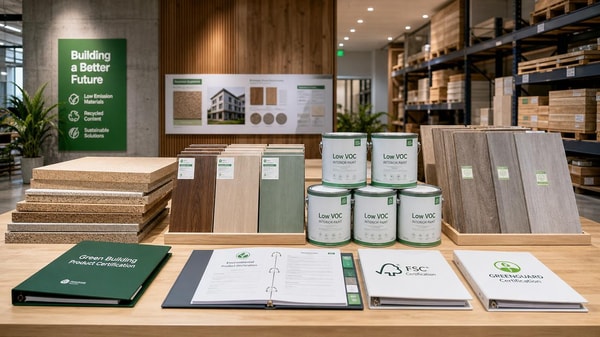
In this scenario, the pressure usually comes from investor expectations, tenant wellness goals, and certification systems such as LEED, BREEAM, or WELL-related material strategies. Compliance questions often focus on indoor air quality, volatile organic compounds, recycled content, and responsible sourcing. Here, eco-friendly building materials are not just technical components; they are part of a market positioning strategy. If the selected products fail documentation review, the project may lose certification points and commercial value.
3. Industrial and logistics facilities
For factories, warehouses, and distribution centers, operational durability tends to outweigh marketing narratives. Project teams need eco-friendly building materials that still satisfy fire resistance, chemical exposure, loading demands, and maintenance expectations. Compliance questions arise when sustainable alternatives do not align neatly with established industrial specifications. The issue is less about whether a material is green and more about whether it can survive operating conditions without creating regulatory exposure.
4. Healthcare and education facilities
These environments often demand strict safety, hygiene, acoustic, and emissions performance. Eco-friendly building materials may support healthy indoor environments, but they also invite closer scrutiny. A hospital or school cannot rely on vague claims about sustainability. Teams need reliable test reports, low-emission evidence, cleaning compatibility information, and confirmation that the material meets occupancy-specific regulations.
5. Renovation, retrofit, and adaptive reuse projects
This is one of the most complex scenarios. Existing structures may have legacy conditions, hidden constraints, and unclear documentation. Eco-friendly building materials can support carbon reduction goals in retrofits, but they may create approval concerns when installed into older assemblies. Compatibility with historic elements, moisture behavior, fire separation upgrades, and local refurbishment codes all become critical. What works well in new build projects may require a different review path in retrofits.
Scenario comparison: what project teams should check first
The table below highlights how compliance priorities shift by application scenario. This helps decision-makers avoid using the same screening checklist for every project.
How compliance priorities change by stakeholder and business need
The same eco-friendly building materials can be assessed very differently depending on who is reviewing them. Project managers should map stakeholder expectations early instead of waiting for approval comments late in the process.
Design teams focus on technical fit
Architects and engineers often ask whether the material can meet design intent, thermal targets, acoustic goals, and system integration requirements. If eco-friendly building materials require substitutions, custom details, or unfamiliar installation methods, those changes should be documented at concept stage rather than after tender.
Procurement teams focus on supplier readiness
Buyers and sourcing managers typically need stable supply, document completeness, and contractual clarity. A promising sustainable product becomes risky if lead times are uncertain or if the supplier cannot provide consistent certification packages across batches or regions.
Owners and investors focus on reputational and reporting value
Clients may select eco-friendly building materials to support ESG reporting, green financing, or tenant communications. In this setting, compliance includes claim defensibility. If environmental performance statements cannot survive an external audit, the material can create governance risk rather than brand value.
Authorities and certifiers focus on evidence quality
Reviewing bodies rarely approve intentions; they approve evidence. Test standards, product listings, local acceptance criteria, and correct labeling matter more than marketing language. Teams should assume that any unsupported sustainability claim will be challenged.
Practical screening steps for choosing eco-friendly building materials by scenario
A useful approach is to build a scenario-based filter before materials are shortlisted. This keeps the conversation grounded in actual project risk.
- Define the compliance pathway first: local code approval, voluntary certification, client ESG target, or all three.
- Match the material to the occupancy and use case: facade, interior finish, structural component, insulation, or flooring each raises different questions.
- Verify whether the supplier documentation aligns with the project jurisdiction, not just the supplier’s home market.
- Check whether claimed environmental benefits are measured, certified, and current rather than promotional.
- Review installation dependencies, because some eco-friendly building materials require specific adhesives, substrates, or moisture controls that also affect compliance.
- Ask for case references in similar project scenarios, especially in retrofit, healthcare, and industrial settings.
Frequent misjudgments in real projects
Several recurring assumptions cause avoidable delays when eco-friendly building materials are introduced too casually.
Assuming green claims equal code acceptance
A product may have a strong sustainability profile yet still lack the fire, structural, or emissions evidence required for the intended use. Environmental value does not replace regulatory proof.
Assuming one certification solves every requirement
Many teams overestimate what a single label means. An EPD, for example, can support transparency but does not automatically confirm fitness for every application. Project managers should separate environmental disclosure from safety and performance compliance.
Assuming supplier documents are globally transferable
International sourcing is valuable, but technical submissions may need local translation, formatting, updated testing, or regional equivalency review. This is especially relevant in global trade environments where eco-friendly building materials move across multiple regulatory systems.
Assuming substitutions are low-risk late in the schedule
When a sustainable alternative is introduced after tender or during construction, review time often expands. Late substitutions can trigger redesign, consultant review, and new authority approvals. The earlier the material is checked, the lower the disruption risk.
A simple decision framework for project managers and engineering leads
If your team is evaluating eco-friendly building materials, use a four-part decision framework. First, identify the scenario: new build, retrofit, industrial, public sector, or high-occupancy facility. Second, identify the governing requirement set: code, certification, procurement rule, or client reporting objective. Third, test supplier readiness: documents, test validity, production consistency, and local support. Fourth, assess schedule exposure: how much review time, substitution risk, and authority engagement will be required?
This method helps teams move beyond broad sustainability ambition and into controlled delivery planning. It also creates a stronger internal basis for deciding when a material is suitable, when more evidence is needed, and when a lower-risk alternative is more practical.
FAQ: early compliance questions about eco-friendly building materials
When should compliance review begin?
Ideally during concept or schematic design. If eco-friendly building materials are only reviewed during procurement, teams often discover documentation gaps too late to avoid cost or schedule impacts.
Which projects require the most caution?
Retrofits, public projects, healthcare facilities, and industrial plants usually require the most careful evaluation because they combine technical constraints with stricter approval expectations.
What documents are most commonly missing?
Teams often find missing local test reports, incomplete emissions data, outdated certificates, unclear chain-of-custody records, or insufficient installation guidance for the exact application scenario.
How can global sourcing teams reduce risk?
They should standardize supplier prequalification, verify regional acceptance early, and compare documentation quality across multiple vendors instead of relying on sustainability claims alone.
Turning sustainability goals into approval-ready project decisions
Eco-friendly building materials can absolutely strengthen project value, resilience, and market appeal, but only when they are matched to the right scenario and supported by credible evidence. For project managers and engineering leads, the key is not simply asking whether a material is sustainable. The better question is whether it is sustainable, compliant, documented, and practical for this specific project context.
Teams that evaluate eco-friendly building materials through a scenario-based lens are better positioned to protect timelines, satisfy stakeholders, and make smarter procurement decisions. In a global construction environment shaped by evolving standards and cross-border sourcing, early intelligence is a competitive advantage. The more clearly you define your project scenario, compliance pathway, and evidence threshold, the more confidently you can move from sustainability intent to successful delivery.
Recommended News
 Portable oxygen concentrators are quieter now, but not always lighterPortable oxygen concentrators are getting quieter, but not always lighter. Explore the trade-offs in weight, battery life, comfort, and daily usability before you compare today’s top options.
 Interactive whiteboards are improving, but software still decides valueInteractive whiteboards deliver real value when software matches the scenario. Explore how usability, integration, security, and updates shape smarter buying decisions.
 Medical diagnostic equipment downtime often starts with calibration neglectMedical diagnostic equipment downtime often starts with missed calibration. Learn the warning signs, checklist priorities, and practical steps to prevent failures and keep healthcare operations reliable.
 Eco-friendly building materials are easier to specify than to sourceEco-friendly building materials are easier to specify than source. Learn how procurement teams can verify claims, reduce risk, and find reliable suppliers faster.
 Ergonomic workspace design can fail if chair fit comes lastErgonomic workspace design starts with chair fit. Learn how the right seat improves posture, comfort, and focus—and why fixing it first can transform your workspace.
 Outdoor garden supplies demand shifts faster than many expectOutdoor garden supplies demand is shifting faster than expected. Discover key B2B trends, smarter sourcing insights, and practical strategies to stay competitive and capture growth.
 Sustainable home decor sells better when materials are clearly disclosedSustainable home decor sells better when brands clearly disclose materials, finishes, and sourcing. Discover why transparency builds trust, justifies price, and drives more confident buying.
 Modern office furniture trends now favor modular over fixed layoutsModern office furniture is shifting to modular layouts for flexibility, lower lifecycle costs, and better hybrid work performance. See why enterprises are moving away from fixed office design.
 Smart street lighting projects stall when controls are overcomplicatedSmart street lighting projects often stall when controls become too complex. Learn how to simplify deployment, reduce risk, and scale citywide with practical, maintainable systems.
 Solid-state battery breakthroughs look promising, but scale is harderSolid-state battery breakthroughs promise safer, higher-density energy storage, but scaling remains the real challenge. Explore what this means for supply chains, investment, and market advantage.
 Commercial LED lighting upgrades often save less than expectedCommercial LED lighting upgrades can underdeliver when baseline data, controls, and installation costs are misjudged. Learn how to assess real savings, reduce ROI risk, and make smarter investment decisions.
 Lithium battery storage payback can change with one policy updateLithium battery storage payback can shift fast after one policy update. See how tariffs, tax credits, grid pricing, and incentives change ROI—and how finance teams can approve smarter.
 Photovoltaic solar panels now compete on output in low lightPhotovoltaic solar panels now compete on low-light output. Discover how buyers can compare yield, risk, and supplier value to source smarter and boost project returns.
 Plant-based protein processing changes texture more than many expectPlant-based protein processing reshapes texture, stability, and safety more than expected. Explore key risks, QC checkpoints, and smarter sourcing insights for consistent results.
 Foldable screen technology is improving, but crease concerns remainFoldable screen technology is evolving fast with slimmer designs and stronger hinges, but crease concerns still shape buying decisions. Explore where it matters most.
 Next-gen wireless charging still faces a heat management problemNext-gen wireless charging promises faster, more flexible power delivery, but heat remains the key barrier. Discover how thermal limits impact safety, efficiency, and market readiness.
 Wearable technology adoption drops when comfort gets overlookedWearable technology adoption falls fast when comfort is ignored. Discover how fit, materials, weight, and battery life shape long-term use and smarter buying decisions.
 Smart home devices wholesale is no longer just about low pricingSmart home devices wholesale now goes beyond low pricing. Discover how reliability, compatibility, and supply chain confidence help distributors choose profitable, trusted partners.
 Agri-PV systems make sense only when land use is planned wellAgri-PV systems deliver real value only when land use is planned well. Discover how smart site, crop, grid, and compliance decisions turn dual-use solar into a bankable, sustainable project.
 Organic fertilizers may improve soil slower, but results last longerOrganic fertilizers improve soil slowly but deliver longer-lasting results. Learn how they boost soil health, support safer growing, and help you choose the right option for sustainable planting success.
 Smart classroom solutions fail when teachers need too many appsSmart classroom solutions fail when teachers juggle too many apps. Discover why integrated, easy-to-use platforms drive adoption, ROI, and scalable learning success.
















Popular Tags
Global Trade Insights & Industry
Our mission is to empower global exporters and importers with data-driven insights that foster strategic growth.
Search News
Popular Tags
Industry Overview
The global commercial kitchen equipment market is projected to reach $112 billion by 2027. Driven by urbanization, the rise of e-commerce food delivery, and strict hygiene regulations.