

Eco-Friendly Building Materials: Which Claims Deserve Verification?
Eco-friendly building materials are gaining traction across global construction and supply chains, but not every sustainability claim stands up to scrutiny. For quality control and safety managers, verifying certifications, emissions data, and performance standards is essential to reducing compliance risks and protecting long-term project value. This article explores which green claims deserve closer examination and how evidence-based evaluation supports smarter sourcing decisions.
Why Verification Is Becoming a Central Market Signal
The market for eco-friendly building materials is no longer driven only by brand storytelling or niche green architecture. A broader shift is underway across construction, industrial procurement, export compliance, and commercial real estate. Buyers increasingly want materials that not only sound sustainable, but also hold up under regulatory review, safety inspections, and lifecycle scrutiny. This change matters because environmental claims now affect tender qualification, insurance conversations, project approvals, and even reputational risk across the supply chain.
For quality control and safety managers, the practical challenge is clear: many products are marketed with terms such as low-carbon, non-toxic, recycled, renewable, natural, or net-zero aligned, yet the evidence behind those labels varies widely. Some claims are backed by Environmental Product Declarations, chain-of-custody records, fire performance data, and VOC emissions testing. Others rely on vague language or incomplete documentation. The trend is moving away from accepting green positioning at face value and toward structured verification of what the material is, how it performs, and whether it remains compliant in the destination market.
This is especially relevant in global trade. As more importers and contractors compare suppliers across regions, eco-friendly building materials are being evaluated not just for price and availability, but for claim credibility. The result is a more disciplined sourcing environment in which proof becomes a competitive advantage.
What Has Changed in the Evaluation of Eco-Friendly Building Materials
Several notable shifts are redefining how eco-friendly building materials are judged in the market. First, attention has expanded from single attributes to whole-material impact. A product made from recycled content may still face questions about chemical additives, durability, end-of-life disposal, or manufacturing emissions. Second, project teams are becoming more aware that environmental performance cannot be separated from safety performance. Low emissions, moisture resistance, fire behavior, structural integrity, and indoor air quality are now reviewed together rather than in isolation.
Third, green procurement is becoming more documentation-heavy. Importers, developers, and large contractors often request third-party certifications, material safety data, test reports, and traceability information earlier in the procurement cycle. Fourth, the burden of proof is shifting toward suppliers. General promises are losing value if they cannot be tied to recognized standards or current lab results. In short, the market is moving from narrative-based sustainability to evidence-based sustainability.
Which Claims Deserve the Closest Verification
Not all sustainability claims carry the same level of risk. Some are relatively straightforward to validate, while others require deeper investigation. For eco-friendly building materials, quality control teams should pay particular attention to claims that can influence compliance, indoor safety, and asset performance over time.
Low VOC or Non-Toxic Claims
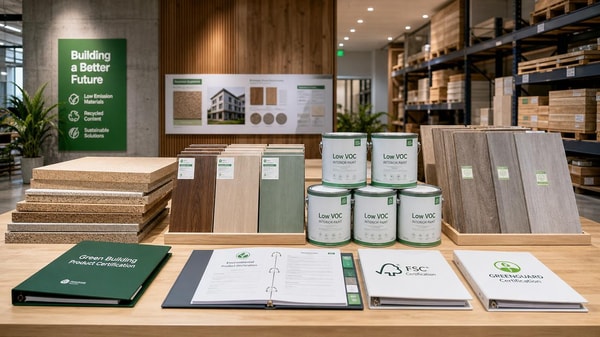
These claims are common in paints, adhesives, flooring, insulation, sealants, and composite panels. They deserve close review because indoor air quality affects occupant health, handover acceptance, and building certification outcomes. Ask whether the product has been tested to recognized emissions standards, whether the test is recent, and whether the tested formulation matches the imported product version. A non-toxic claim without laboratory emissions data should be treated cautiously.
Recycled Content Claims
Recycled content can support sustainability goals, but the percentage, source, and consistency matter. Post-consumer and pre-consumer content are not the same. Neither is recycled content equivalent to low-impact performance in all cases. Verification should include supporting calculations, supplier declarations, and ideally third-party confirmation. QC personnel should also review whether higher recycled content changes mechanical properties, dimensional stability, or contamination risk.
Renewable or Bio-Based Claims
Materials marketed as bamboo-based, cork-based, wood fiber-based, or plant-derived often appeal to buyers seeking eco-friendly building materials. However, renewable feedstock alone does not guarantee good environmental or safety outcomes. The adhesive system, treatment chemicals, moisture behavior, mold resistance, and fire performance may be more decisive than the origin story. Verification should therefore go beyond renewable sourcing and include end-use suitability.
Carbon Reduction or Carbon Neutral Claims
These claims are increasingly influential, especially in public projects and large commercial developments. They also carry a higher risk of misunderstanding. Teams should distinguish between reduced embodied carbon, offset-supported neutrality, and future decarbonization targets. If a supplier claims lower carbon impact, ask for a product-specific declaration, system boundary details, and the basis of comparison. Broad statements without methodology should not guide procurement decisions.
Natural, Plastic-Free, or Chemical-Free Claims
These terms are often attractive in marketing, but they are among the least precise. “Natural” does not automatically mean low-emission, durable, or safe in fire conditions. “Chemical-free” is usually not a technically sound description. These claims deserve verification because they can create false confidence. Safety managers should require actual composition data, hazard classifications, and relevant performance reports rather than relying on simplified eco language.
What Is Driving This Tightening of Standards
The stronger emphasis on verifying eco-friendly building materials comes from several converging forces. One is regulation. While requirements differ across regions, there is a clear pattern toward greater transparency on chemical content, emissions, product labeling, and environmental reporting. Another driver is investor and customer pressure. Developers, manufacturers, and importers increasingly need defensible sustainability data to satisfy ESG expectations and supply chain audits.
A third factor is technical maturity. Testing methods, digital product documentation, and lifecycle assessment tools are more widely available than before. That makes unsupported claims easier to challenge. Finally, reputational risk has grown. If a marketed green material later causes indoor air complaints, premature failure, or certification disputes, the downstream cost can exceed the initial material savings. As a result, buyers are becoming more cautious and more selective.
How the Trend Affects Different Roles in the Supply Chain
The verification trend does not affect all stakeholders in the same way. For procurement managers, it raises the bar for supplier screening. For QC teams, it expands the checklist beyond physical inspection into document validation and claim consistency. For safety managers, it reinforces the need to connect environmental marketing claims with real exposure and hazard profiles. For exporters, it means that documentation quality can directly influence conversion rates and long-term buyer trust.
What Evidence Should Carry the Most Weight
As eco-friendly building materials become more mainstream, the quality of supporting evidence becomes a key differentiator. The most useful documents are those that are current, product-specific, and issued by credible third parties where appropriate. Environmental Product Declarations can be valuable for embodied impact discussions, but they should not be mistaken for proof of low toxicity or superior durability. VOC test reports matter for indoor materials, but they should be read alongside application conditions and curing behavior. Chain-of-custody certifications can support responsible sourcing claims, yet they do not replace technical performance validation.
In practice, the strongest verification approach combines three layers: environmental proof, safety proof, and performance proof. When those three align, sourcing decisions are more resilient. When one layer is missing, the risk of later dispute rises.
Signals That a Green Claim May Need Extra Scrutiny
Certain patterns should prompt more careful review. Be cautious if the supplier uses broad eco language without naming a test method or certification basis. Watch for expired reports, reports issued for a similar but not identical model, or declarations that do not match the destination market’s compliance expectations. Another warning sign is when a product is promoted heavily for sustainability while little is said about installation conditions, service life, fire classification, or maintenance requirements.
QC and safety teams should also examine consistency across documents. If product data sheets, safety data sheets, marketing brochures, and certification records use conflicting terminology, the claim may be overstated or poorly controlled. In international sourcing, translation gaps and version control issues can create additional risk. A disciplined document review process is therefore as important as laboratory validation.
How to Respond Without Slowing Down Procurement
The goal is not to reject eco-friendly building materials, but to evaluate them with enough rigor to avoid hidden liabilities. A practical response starts with categorizing claims by risk. Claims tied to occupant exposure, regulatory reporting, or critical structural use should receive the highest level of scrutiny. Lower-risk decorative applications may allow a simpler review path. This risk-based model helps teams preserve procurement speed while still protecting compliance and safety outcomes.
It also helps to standardize supplier questions. Ask what specific sustainability claim is being made, what standard or protocol supports it, whether the claim applies to the exact shipped product, and whether any recent formulation changes have occurred. For export-oriented sourcing, request documents in a format that can be readily reviewed by downstream customers, auditors, or certifiers. This reduces friction later in the project cycle.
A Practical Decision Framework for the Next 12 Months
Looking ahead, the most useful approach is not to chase every new green label, but to strengthen internal judgment criteria. Over the next 12 months, quality and safety leaders should expect more requests for documented sustainability performance, more supplier competition around eco positioning, and more overlap between environmental review and technical compliance review. Eco-friendly building materials will continue to expand in use, but the winners in sourcing decisions will be those that can prove both environmental value and reliable real-world performance.
For companies that want to respond effectively, the next step is to confirm a short list of questions: Which claims are most common in your inbound material categories? Which of those claims affect safety, emissions, or regulatory exposure? Which documents are currently missing or inconsistent across suppliers? And which verification points should become mandatory before approval? Answering those questions turns market noise into a workable sourcing strategy and helps organizations judge eco-friendly building materials with confidence rather than assumption.
Recommended News
 Portable oxygen concentrators are quieter now, but not always lighterPortable oxygen concentrators are getting quieter, but not always lighter. Explore the trade-offs in weight, battery life, comfort, and daily usability before you compare today’s top options.
 Interactive whiteboards are improving, but software still decides valueInteractive whiteboards deliver real value when software matches the scenario. Explore how usability, integration, security, and updates shape smarter buying decisions.
 Medical diagnostic equipment downtime often starts with calibration neglectMedical diagnostic equipment downtime often starts with missed calibration. Learn the warning signs, checklist priorities, and practical steps to prevent failures and keep healthcare operations reliable.
 Eco-friendly building materials are easier to specify than to sourceEco-friendly building materials are easier to specify than source. Learn how procurement teams can verify claims, reduce risk, and find reliable suppliers faster.
 Ergonomic workspace design can fail if chair fit comes lastErgonomic workspace design starts with chair fit. Learn how the right seat improves posture, comfort, and focus—and why fixing it first can transform your workspace.
 Outdoor garden supplies demand shifts faster than many expectOutdoor garden supplies demand is shifting faster than expected. Discover key B2B trends, smarter sourcing insights, and practical strategies to stay competitive and capture growth.
 Sustainable home decor sells better when materials are clearly disclosedSustainable home decor sells better when brands clearly disclose materials, finishes, and sourcing. Discover why transparency builds trust, justifies price, and drives more confident buying.
 Modern office furniture trends now favor modular over fixed layoutsModern office furniture is shifting to modular layouts for flexibility, lower lifecycle costs, and better hybrid work performance. See why enterprises are moving away from fixed office design.
 Smart street lighting projects stall when controls are overcomplicatedSmart street lighting projects often stall when controls become too complex. Learn how to simplify deployment, reduce risk, and scale citywide with practical, maintainable systems.
 Solid-state battery breakthroughs look promising, but scale is harderSolid-state battery breakthroughs promise safer, higher-density energy storage, but scaling remains the real challenge. Explore what this means for supply chains, investment, and market advantage.
 Commercial LED lighting upgrades often save less than expectedCommercial LED lighting upgrades can underdeliver when baseline data, controls, and installation costs are misjudged. Learn how to assess real savings, reduce ROI risk, and make smarter investment decisions.
 Lithium battery storage payback can change with one policy updateLithium battery storage payback can shift fast after one policy update. See how tariffs, tax credits, grid pricing, and incentives change ROI—and how finance teams can approve smarter.
 Photovoltaic solar panels now compete on output in low lightPhotovoltaic solar panels now compete on low-light output. Discover how buyers can compare yield, risk, and supplier value to source smarter and boost project returns.
 Plant-based protein processing changes texture more than many expectPlant-based protein processing reshapes texture, stability, and safety more than expected. Explore key risks, QC checkpoints, and smarter sourcing insights for consistent results.
 Foldable screen technology is improving, but crease concerns remainFoldable screen technology is evolving fast with slimmer designs and stronger hinges, but crease concerns still shape buying decisions. Explore where it matters most.
 Next-gen wireless charging still faces a heat management problemNext-gen wireless charging promises faster, more flexible power delivery, but heat remains the key barrier. Discover how thermal limits impact safety, efficiency, and market readiness.
 Wearable technology adoption drops when comfort gets overlookedWearable technology adoption falls fast when comfort is ignored. Discover how fit, materials, weight, and battery life shape long-term use and smarter buying decisions.
 Smart home devices wholesale is no longer just about low pricingSmart home devices wholesale now goes beyond low pricing. Discover how reliability, compatibility, and supply chain confidence help distributors choose profitable, trusted partners.
 Agri-PV systems make sense only when land use is planned wellAgri-PV systems deliver real value only when land use is planned well. Discover how smart site, crop, grid, and compliance decisions turn dual-use solar into a bankable, sustainable project.
 Organic fertilizers may improve soil slower, but results last longerOrganic fertilizers improve soil slowly but deliver longer-lasting results. Learn how they boost soil health, support safer growing, and help you choose the right option for sustainable planting success.
 Smart classroom solutions fail when teachers need too many appsSmart classroom solutions fail when teachers juggle too many apps. Discover why integrated, easy-to-use platforms drive adoption, ROI, and scalable learning success.

















Popular Tags
Global Trade Insights & Industry
Our mission is to empower global exporters and importers with data-driven insights that foster strategic growth.
Search News
Popular Tags
Industry Overview
The global commercial kitchen equipment market is projected to reach $112 billion by 2027. Driven by urbanization, the rise of e-commerce food delivery, and strict hygiene regulations.