

Interactive whiteboards promise engagement, but usage often drops later
Interactive whiteboards are often introduced with high expectations for collaboration, productivity, and classroom or meeting-room engagement, yet many organizations see usage decline after the initial rollout. For business decision-makers, this gap between investment and sustained adoption raises important questions about training, workflow integration, and measurable ROI. Understanding why enthusiasm fades is essential to turning digital board deployments into long-term operational value.
The market signal is shifting from purchase excitement to adoption accountability
Across education, corporate offices, training centers, healthcare meeting environments, and public-sector organizations, the conversation around Interactive whiteboards is changing. The early phase of adoption was driven by visible modernization: replacing static whiteboards with connected touchscreens looked like a clear step toward digital transformation. Today, however, the more important signal is not how many boards are installed, but how often they are used in daily workflows and whether they improve outcomes that leaders actually track.
This change matters because enterprise technology budgets are under greater scrutiny. Decision-makers no longer evaluate collaboration hardware only by feature lists such as multi-touch capability, annotation tools, wireless casting, or video conferencing compatibility. They want evidence that Interactive whiteboards support meeting efficiency, training retention, hybrid collaboration, or cross-site coordination. When usage drops after the launch period, the issue is rarely the screen alone. It usually reflects a broader mismatch between tools, habits, incentives, and business processes.
For a platform like GTIIN and TradeVantage, which tracks industrial and commercial change across sectors, this pattern reflects a wider trend in business technology adoption: implementation is no longer enough. Buyers are moving from hardware acquisition to operational proof. That shift affects procurement strategy, vendor selection, user enablement, and how global suppliers position digital collaboration products in competitive markets.
Why Interactive whiteboards often lose momentum after rollout
The decline in usage is usually gradual, not immediate. During launch, teams are curious, pilot sessions are well attended, and internal champions demonstrate the capabilities. Several months later, people often return to familiar methods such as laptops, printed documents, standard displays, or basic conferencing tools. This does not mean Interactive whiteboards lack value. It means sustained adoption depends on organizational conditions that are often underestimated during procurement.
One major factor is workflow friction. If a board requires extra steps to connect devices, switch inputs, save content, or launch remote collaboration apps, users quickly choose simpler alternatives. In fast-moving business settings, even small delays can reduce participation. Another issue is role-specific relevance. An Interactive whiteboard may be highly useful for project planning, design review, onboarding, or operational briefings, but much less useful for routine status meetings where participants mostly need a shared dashboard or slide deck.
Training gaps also play a central role. Many organizations provide installation support but limited behavior change support. Users learn basic touch functions yet never progress to high-value use cases such as live annotation during hybrid workshops, integrated brainstorming, or collaborative markups tied to cloud content. Without repeated reinforcement, the technology remains impressive but optional.
A fourth issue is ownership ambiguity. If no department is responsible for governance, content standards, support escalation, and usage review, Interactive whiteboards become a shared asset with weak accountability. In many organizations, IT manages the device, facilities manages the room, and business units run the meetings. That fragmentation can leave adoption unmanaged after deployment.
The trend is less about hardware quality and more about fit with hybrid work patterns
A notable change in the market is that hybrid work has altered how collaboration tools are judged. In the past, an Interactive whiteboard could be evaluated mainly by what happened inside a room. Now, value depends on whether remote participants can contribute equally, whether board content syncs into cloud platforms, and whether outputs can be captured without manual rework. If the in-room experience is strong but remote inclusion is weak, adoption tends to fall in organizations with distributed teams.
This is why enterprise buyers increasingly compare Interactive whiteboards not only with older boards or projectors, but with digital collaboration ecosystems. Shared documents, virtual whiteboarding platforms, project management tools, and embedded meeting software all compete for the same collaboration budget. The board must justify its place within that stack. It must make work faster, clearer, or more participatory than software-only alternatives.
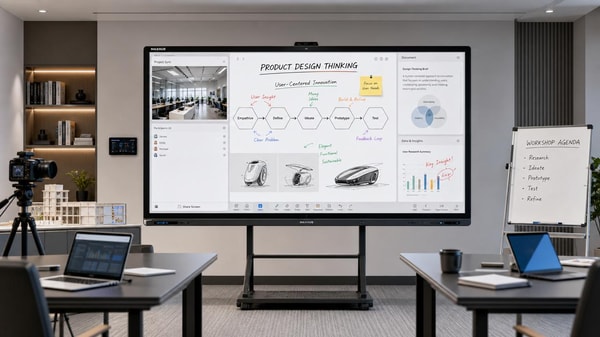
In practical terms, the winning use cases are becoming narrower but more strategic. Interactive whiteboards perform best where teams need visual collaboration, rapid input, spatial thinking, training engagement, or real-time group problem-solving. They perform less well when used as expensive display replacements without process redesign. This distinction is increasingly shaping procurement decisions across sectors.
Key drivers behind the adoption dip
Who feels the impact most
The usage decline of Interactive whiteboards does not affect every function equally. For procurement leaders, the concern is asset utilization and lifecycle value. For IT teams, it becomes a support and integration issue. For HR and learning teams, it may reduce the effectiveness of training spaces that were designed to be more participatory. For operations and sales leadership, low usage can signal that collaboration infrastructure is not aligned with how teams now make decisions.
A three-stage pattern is becoming easier to recognize
Many deployments of Interactive whiteboards follow a similar pattern. Recognizing this cycle helps leaders intervene before underuse becomes permanent.
What this means for sourcing, vendors, and international trade visibility
For manufacturers, exporters, distributors, and solution providers, the market trend around Interactive whiteboards is significant. Buyers are becoming more selective, and product messaging based only on screen size, resolution, and touch responsiveness is less persuasive than before. Global B2B demand increasingly favors suppliers that can speak to integration, support models, software compatibility, analytics, and deployment success over time.
This is where high-authority industrial information platforms create strategic value. Through sector visibility, search-optimized publishing, and trust-building editorial placement, companies can move beyond feature-driven promotion and communicate the operational impact of their solutions. For foreign trade enterprises seeking stronger international reach, thought leadership around Interactive whiteboards can improve both market credibility and digital discoverability. Buyers want suppliers that understand adoption challenges, not just equipment specifications.
TradeVantage and GTIIN sit at this intersection of information, visibility, and market intelligence. As decision cycles become more evidence-driven, vendors who publish insights on deployment models, user behavior, sector-specific needs, and post-installation support will be better positioned to attract qualified global buyers and higher-value backlinks that strengthen long-term search performance.
What business decision-makers should evaluate now
Organizations considering new purchases or reviewing existing Interactive whiteboards should shift from a technology-first evaluation to an adoption-first framework. The first question is not whether the hardware is advanced. It is whether the intended users have recurring collaboration scenarios that genuinely benefit from shared visual interaction. If that answer is unclear, underuse is likely.
Second, leaders should assess integration maturity. Can the board connect cleanly to the platforms teams already use? Can notes, screenshots, annotations, or workshop outputs move directly into document systems or project spaces? If not, the board may remain outside the real workflow. Third, organizations should define ownership. Someone must monitor usage, gather feedback, refresh training, and identify the departments where Interactive whiteboards are delivering strong value or weak value.
Finally, success metrics should be practical. Instead of relying only on room booking data, organizations can examine whether meetings are shortened, workshops become more participatory, training completion improves, or distributed teams produce clearer outputs. These signals are more meaningful than installation counts.
A realistic response strategy for the next phase
The next phase of the Interactive whiteboards market will likely reward realism over hype. Decision-makers should avoid treating every room as a candidate for advanced collaboration hardware. Instead, they should identify high-impact environments such as innovation workshops, technical reviews, customer briefing spaces, training rooms, and cross-functional planning sessions. In those settings, the board can become a workflow anchor rather than a decorative upgrade.
For existing deployments, a focused reset is often more effective than broad replacement. This may include retraining facilitators, simplifying room setup, standardizing collaboration templates, or integrating the board more tightly with video conferencing and cloud documentation. For new buyers, pilot programs should be measured over several months, not only during the first weeks of enthusiasm.
The broader lesson is clear: Interactive whiteboards still have strategic potential, but only when supported by behavioral change, process fit, and clear ownership. The trend is moving away from one-time installation wins and toward durable, measurable adoption.
Questions to confirm before making the next move
If enterprises want to judge how this trend affects their own business, they should confirm several points. Which teams use Interactive whiteboards repeatedly without being prompted? Which meeting types genuinely improve when the board is present? Where does setup friction still interrupt adoption? Are remote participants benefiting equally? Are suppliers offering deployment guidance that extends beyond installation? The answers to these questions can help organizations decide whether to expand, redesign, or narrow their investment strategy.
For companies selling into global markets, the same questions also shape commercial positioning. Buyers increasingly favor partners that can explain not only what Interactive whiteboards do, but why usage rises or falls over time. In a market where visibility, trust signals, and informed decision support matter more each year, businesses that align product value with adoption reality will be better prepared for sustainable growth.
Recommended News
 Portable oxygen concentrators are quieter now, but not always lighterPortable oxygen concentrators are getting quieter, but not always lighter. Explore the trade-offs in weight, battery life, comfort, and daily usability before you compare today’s top options.
 Interactive whiteboards are improving, but software still decides valueInteractive whiteboards deliver real value when software matches the scenario. Explore how usability, integration, security, and updates shape smarter buying decisions.
 Medical diagnostic equipment downtime often starts with calibration neglectMedical diagnostic equipment downtime often starts with missed calibration. Learn the warning signs, checklist priorities, and practical steps to prevent failures and keep healthcare operations reliable.
 Eco-friendly building materials are easier to specify than to sourceEco-friendly building materials are easier to specify than source. Learn how procurement teams can verify claims, reduce risk, and find reliable suppliers faster.
 Ergonomic workspace design can fail if chair fit comes lastErgonomic workspace design starts with chair fit. Learn how the right seat improves posture, comfort, and focus—and why fixing it first can transform your workspace.
 Outdoor garden supplies demand shifts faster than many expectOutdoor garden supplies demand is shifting faster than expected. Discover key B2B trends, smarter sourcing insights, and practical strategies to stay competitive and capture growth.
 Sustainable home decor sells better when materials are clearly disclosedSustainable home decor sells better when brands clearly disclose materials, finishes, and sourcing. Discover why transparency builds trust, justifies price, and drives more confident buying.
 Modern office furniture trends now favor modular over fixed layoutsModern office furniture is shifting to modular layouts for flexibility, lower lifecycle costs, and better hybrid work performance. See why enterprises are moving away from fixed office design.
 Smart street lighting projects stall when controls are overcomplicatedSmart street lighting projects often stall when controls become too complex. Learn how to simplify deployment, reduce risk, and scale citywide with practical, maintainable systems.
 Solid-state battery breakthroughs look promising, but scale is harderSolid-state battery breakthroughs promise safer, higher-density energy storage, but scaling remains the real challenge. Explore what this means for supply chains, investment, and market advantage.
 Commercial LED lighting upgrades often save less than expectedCommercial LED lighting upgrades can underdeliver when baseline data, controls, and installation costs are misjudged. Learn how to assess real savings, reduce ROI risk, and make smarter investment decisions.
 Lithium battery storage payback can change with one policy updateLithium battery storage payback can shift fast after one policy update. See how tariffs, tax credits, grid pricing, and incentives change ROI—and how finance teams can approve smarter.
 Photovoltaic solar panels now compete on output in low lightPhotovoltaic solar panels now compete on low-light output. Discover how buyers can compare yield, risk, and supplier value to source smarter and boost project returns.
 Plant-based protein processing changes texture more than many expectPlant-based protein processing reshapes texture, stability, and safety more than expected. Explore key risks, QC checkpoints, and smarter sourcing insights for consistent results.
 Foldable screen technology is improving, but crease concerns remainFoldable screen technology is evolving fast with slimmer designs and stronger hinges, but crease concerns still shape buying decisions. Explore where it matters most.
 Next-gen wireless charging still faces a heat management problemNext-gen wireless charging promises faster, more flexible power delivery, but heat remains the key barrier. Discover how thermal limits impact safety, efficiency, and market readiness.
 Wearable technology adoption drops when comfort gets overlookedWearable technology adoption falls fast when comfort is ignored. Discover how fit, materials, weight, and battery life shape long-term use and smarter buying decisions.
 Smart home devices wholesale is no longer just about low pricingSmart home devices wholesale now goes beyond low pricing. Discover how reliability, compatibility, and supply chain confidence help distributors choose profitable, trusted partners.
 Agri-PV systems make sense only when land use is planned wellAgri-PV systems deliver real value only when land use is planned well. Discover how smart site, crop, grid, and compliance decisions turn dual-use solar into a bankable, sustainable project.
 Organic fertilizers may improve soil slower, but results last longerOrganic fertilizers improve soil slowly but deliver longer-lasting results. Learn how they boost soil health, support safer growing, and help you choose the right option for sustainable planting success.
 Smart classroom solutions fail when teachers need too many appsSmart classroom solutions fail when teachers juggle too many apps. Discover why integrated, easy-to-use platforms drive adoption, ROI, and scalable learning success.

















Popular Tags
Global Trade Insights & Industry
Our mission is to empower global exporters and importers with data-driven insights that foster strategic growth.
Search News
Popular Tags
Industry Overview
The global commercial kitchen equipment market is projected to reach $112 billion by 2027. Driven by urbanization, the rise of e-commerce food delivery, and strict hygiene regulations.