

Car electronics failures often start with power instability
Car electronics failures rarely happen without warning—power instability is often the hidden trigger behind sensor errors, module resets, and intermittent faults. For aftermarket maintenance professionals, identifying voltage irregularities early can reduce misdiagnosis, cut repair time, and prevent repeat issues. This article explores how unstable power affects modern vehicle systems and what practical checks can improve diagnostic accuracy.
In today’s service environment, Car electronics are no longer limited to lighting, audio, or basic control modules. A typical passenger vehicle may contain 30 to 100 electronic control units, depending on trim level and platform complexity. That density means even a brief voltage drop, a weak ground, or a charging ripple outside normal range can create symptoms that appear unrelated, from false ABS alerts to unstable infotainment behavior.
For aftermarket maintenance teams, the business impact is direct. Intermittent electrical faults often consume 2 to 4 times more labor hours than straightforward mechanical repairs, especially when modules are replaced before root cause validation. In fleet, workshop, and cross-border parts support contexts, better power-system diagnostics also improve parts selection, reduce warranty exposure, and strengthen service credibility.
Why power instability is the starting point for many Car electronics faults
Modern Car electronics depend on stable supply voltage within a relatively narrow operating window. In many 12 V systems, resting battery voltage should generally remain near 12.4 V to 12.7 V, while charging voltage commonly falls between 13.5 V and 14.8 V depending on temperature, load strategy, and smart charging logic. When actual values drift below or above these ranges, control units may remain operational but begin producing misleading symptoms.
The challenge for technicians is that electronic modules do not always fail in a clean on/off pattern. A 0.3 V to 0.8 V drop across a corroded ground point may be enough to trigger random resets under load. Likewise, excessive AC ripple from a weak alternator diode can disturb communication lines, confuse sensors, and create low-confidence fault codes that look like component failure rather than power instability.
This is especially relevant in vehicles equipped with ADAS features, start-stop systems, electric steering, telematics, and battery management modules. These systems are more sensitive to transient voltage events during engine cranking, high accessory demand, or post-repair reconnection. In workshops handling multi-brand service, understanding these baseline electrical relationships is often more valuable than relying on one scan tool result.
Common triggers behind unstable supply conditions
The most frequent causes are not always catastrophic failures. Aging batteries, poor terminal contact, loose engine grounds, alternator output variation, water intrusion in connectors, and aftermarket accessory overloading are among the most common contributors. In vehicles older than 5 to 7 years, resistance-related issues become more common as oxidation builds at crimp points and grounding studs.
- Battery state of charge below functional threshold during repeated short trips
- Charging system output outside normal loaded range during idle or cold start
- Ground path resistance caused by corrosion, paint contamination, or poor repair practice
- High-current aftermarket devices such as amplifiers, trackers, or lighting kits sharing unstable supply lines
A disciplined maintenance process should always separate primary power issues from secondary module complaints. That approach lowers parts waste and improves first-time fix rate, particularly for workshops serving export markets where replacement lead times can extend from 7 days to 21 days.
How unstable voltage appears in real service scenarios
Not all Car electronics failures announce themselves as battery or charging faults. In practice, unstable voltage often shows up as communication errors, memory loss, false sensor readings, or modules that recover after ignition cycling. This is why many intermittent complaints return after an apparently successful repair. The original fault may have been masked rather than eliminated.
For example, a vehicle with low cranking voltage may log steering angle, radar, camera, and transmission-related faults at the same time. A technician focusing on the fault list alone could suspect multiple components. However, if cranking voltage drops below 9.6 V for more than 1 to 2 seconds, several modules may initialize incorrectly, producing a chain of non-primary codes.
Similarly, charging ripple can affect signal integrity. Sensors that operate correctly at a steady 13.8 V may become erratic when ripple rises beyond acceptable limits. In CAN-based systems, unstable supply does not always break communication completely. Instead, it may increase noise, reduce module confidence, and generate sporadic network faults that disappear during stationary testing.
Symptom patterns technicians should treat as power-related first
The table below summarizes typical workshop symptoms and the power issues that often sit behind them. It can be used as a fast triage reference before module replacement or software escalation.
The key takeaway is simple: when symptoms affect more than one electronic subsystem, power quality should move to the top of the diagnostic list. This reduces the risk of replacing expensive components such as body modules, cameras, or instrument clusters without solving the underlying cause.
A frequent workshop mistake
A common error is testing voltage only at rest. A battery can show 12.5 V after charging and still collapse under a 200 A to 400 A starting load. Likewise, a charging system may appear normal at idle with minimal electrical demand but drift out of range once headlights, blower, heated glass, and seat circuits are active together. Dynamic testing is essential for reliable Car electronics diagnosis.
A practical diagnostic workflow for aftermarket maintenance professionals
Efficient diagnosis depends on a repeatable sequence. When technicians jump directly from code reading to parts replacement, intermittent Car electronics faults often return. A structured 5-step workflow improves consistency across brands, service bays, and technician skill levels, while making job reports clearer for workshop managers and parts decision-makers.
Step-by-step inspection logic
- Record customer complaint conditions, including ambient temperature, startup behavior, and whether faults occur after parking for 12 to 24 hours.
- Measure battery resting voltage and, where possible, battery conductance or load performance before connecting support equipment.
- Monitor minimum cranking voltage and charging output at idle and under added electrical load for at least 3 to 5 minutes.
- Perform voltage drop tests on positive feed and main grounds, especially between battery negative, engine block, chassis, and module grounds.
- Only after power integrity is confirmed should technicians prioritize code interpretation, network tracing, or module-level replacement decisions.
This process can often cut diagnostic time by 20% to 40% in cases involving repeat electrical complaints. It also creates stronger documentation for parts suppliers and service partners when warranty or return discussions arise. For B2B maintenance networks, standardization matters as much as technical accuracy.
A useful rule is to test under the same conditions that trigger the complaint. If resets happen on first start, test on first start. If infotainment reboots only when the blower is on level 4 and defogger is active, recreate that load. Static bay testing alone may miss the real instability event.
Reference values that help narrow the fault path
The following ranges are not brand-specific specifications, but they are practical reference points for workshop screening. They help determine whether a fault path should move toward power supply repair, charging system evaluation, or module-level investigation.
These values should always be interpreted alongside vehicle design, battery chemistry, and operating state. However, even general thresholds provide a stronger starting point than code-based guesswork. In many service cases, one reliable meter capture prevents one unnecessary control unit replacement.
Tools, parts decisions, and service standards that improve first-time fix rate
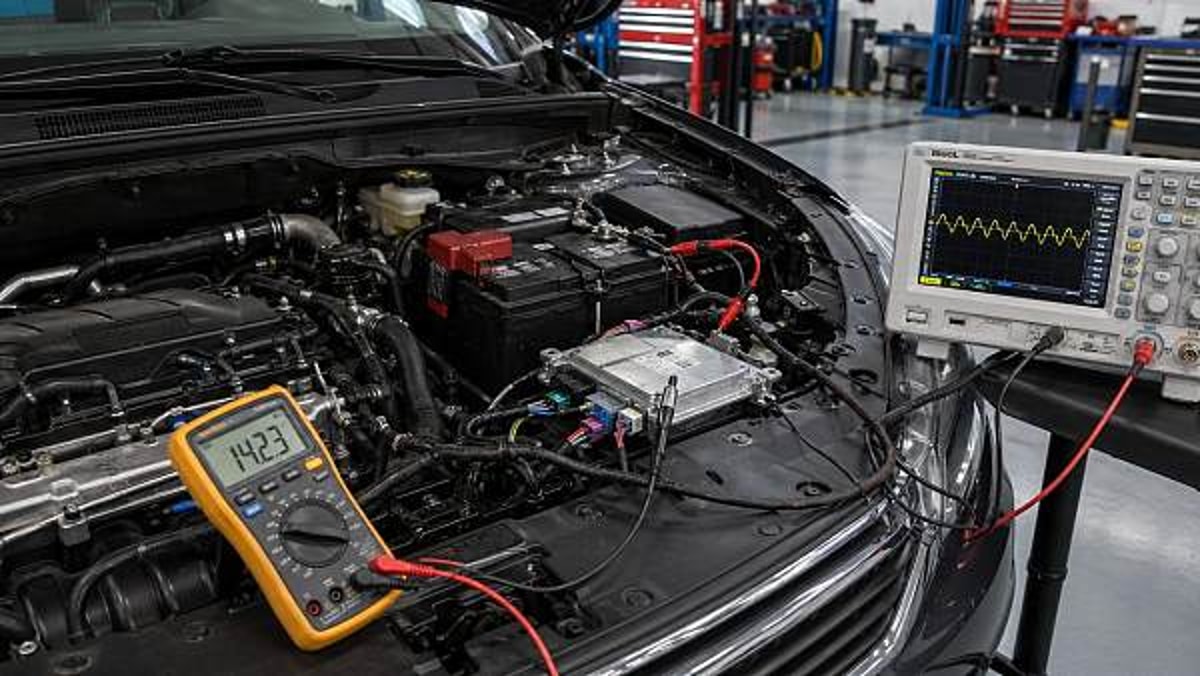
The reliability of Car electronics diagnostics depends not just on technician skill, but on tool capability and parts discipline. Basic multimeters remain essential, yet they are often insufficient for capturing transient events. In workshops dealing with repeat faults, adding a current clamp, oscilloscope, battery tester, and stable power support unit can produce measurable gains in diagnostic certainty.
A practical issue in aftermarket environments is parts escalation. If power instability is not verified first, modules, sensors, or wiring sections may be replaced in sequence, extending downtime from 1 day to 5 days or more. For fleet customers or export-service chains, that delay affects vehicle utilization, customer satisfaction, and inventory planning.
Selecting the right diagnostic support tools
The table below outlines common tools and where they add the most value during electrical troubleshooting. It also helps workshop managers align investment with service volume and fault complexity.
For workshops with medium to high electronic repair volume, a staged upgrade plan is often more effective than buying equipment without process changes. Start with battery validation and voltage drop discipline, then add waveform analysis where intermittent failures are common. This approach balances cost control with service capability.
Parts handling and replacement caution
- Do not replace sensors or modules before confirming supply and ground integrity under actual load.
- When installing used or remanufactured electronics, verify system voltage stability first to avoid repeat failure claims.
- After battery replacement, complete required registration or adaptation procedures where applicable, especially on newer platforms.
- During programming or coding, maintain stable support voltage because a drop of even 1 V to 2 V can interrupt write procedures.
In B2B service networks, these practices are also procurement issues. Better process control reduces unnecessary parts consumption, lowers return disputes, and supports cleaner communication between workshop teams, distributors, and technical support desks.
Risk control, preventive maintenance, and sourcing considerations
Power instability should not be treated only as a repair topic. It is also a preventive maintenance and sourcing issue. As Car electronics become more integrated, workshops and service buyers need standards for batteries, charging components, connectors, and diagnostic support practices. This is particularly important for businesses managing fleets, export-ready maintenance operations, or regional parts supply channels.
A preventive check every 6 to 12 months can catch many hidden electrical risks before they create customer complaints. The highest-value checks are battery state, charging stability under load, visible connector condition, and main ground integrity. Vehicles used for urban delivery, cold starts, or accessory-heavy operation should be inspected more frequently because repeated short cycles accelerate electrical stress.
Preventive maintenance priorities for aftermarket teams
- Inspect and clean battery terminals during routine service intervals rather than only after no-start incidents.
- Measure loaded charging voltage when vehicles have high accessory use, not just at idle without consumers switched on.
- Review aftermarket add-ons for shared power feeds, poor splice quality, and inadequate fuse strategy.
- Record baseline voltage and fault history so intermittent trends can be compared over 2 or 3 service visits.
For purchasing teams supporting maintenance operations, low-cost components may increase long-term service cost if terminal fit, conductor quality, or regulator consistency is poor. Decision-makers should evaluate not only price, but also return rate, compatibility, delivery cycle, and technical support responsiveness.
FAQ for technicians and sourcing managers
How can I tell whether a module fault is actually a power issue?
If multiple unrelated systems report faults together, if symptoms change with engine start or heavy load, or if the complaint disappears after battery charging, power integrity should be checked first. Minimum cranking voltage, charging stability, and ground drop testing usually provide the quickest answer in under 15 minutes.
Which vehicles are most likely to show power-related Car electronics problems?
Vehicles with start-stop systems, many comfort modules, ADAS features, or frequent short-trip use are more vulnerable. Older vehicles with 5+ years of exposure also face higher risk from connector corrosion and ground degradation.
What should buyers look for when sourcing electrical service parts?
Focus on compatibility data, terminal and housing quality, voltage regulation consistency, packaging protection, and after-sales support. In cross-border sourcing, lead time of 7 to 15 days versus 20+ days can affect workshop scheduling as much as unit price.
Is a scan tool enough for electrical diagnosis?
No. A scan tool identifies symptom records, but it does not prove power quality. Reliable diagnosis of Car electronics usually requires at least voltage measurement, load observation, and voltage drop or waveform analysis.
For maintenance professionals, the most cost-effective way to reduce repeat Car electronics faults is to treat power stability as a primary diagnostic layer, not a final check. Stable voltage, clean grounds, and controlled charging behavior directly influence module reliability, communication quality, and sensor accuracy across the vehicle.
For B2B service operators, distributors, and global trade participants, this topic also affects sourcing quality, parts turnover, and service reputation. Better electrical troubleshooting means fewer unnecessary replacements, faster turnaround, and stronger customer trust. To explore more industry-focused maintenance insights, sourcing intelligence, and practical technical content, contact GTIIN or TradeVantage to get tailored solutions and learn more about the right support strategy for your market.
Recommended News
 Medical diagnostic equipment buying mistakes often start with workflowMedical diagnostic equipment buying mistakes often begin with workflow gaps. Learn how to compare systems, uncover hidden costs, and choose suppliers that fit real clinical operations.
 Interactive whiteboards are improving, but teacher adoption is unevenInteractive whiteboards are improving fast, but teacher adoption remains uneven. Explore what drives classroom success, ROI, and smarter edtech implementation.
 Portable oxygen concentrators: what noise levels feel acceptable?Portable oxygen concentrators: discover what noise levels feel acceptable for sleep, travel, work, and home use, with practical guidance to choose a quieter, more comfortable model.
 Car electronics failures often start with power instabilityCar electronics issues often begin with hidden power instability. Learn how voltage drops, ripple, and weak grounds cause faults—and how smarter diagnostics cut repair time and repeat failures.
 Telemedicine hardware works best when setup friction is lowTelemedicine hardware works best with low setup friction. Discover how faster deployment, easier operation, and scenario-based selection improve care efficiency and service quality.
 Are light-weighting vehicle materials worth the repair tradeoff?Light-weighting vehicle materials: Are efficiency gains worth higher repair costs? Explore lifecycle impact, EV value, downtime risks, and smarter sourcing decisions.
 Educational robots in class: novelty or lasting value?Educational robots are moving beyond classroom novelty. Discover how they create lasting value through STEM learning, scalability, and smarter school purchasing decisions.
 Biodegradable plastics fail when disposal assumptions are wrongBiodegradable plastics can fail when real disposal systems do not match design assumptions. Learn the compliance, contamination, and claim risks before they damage trust.
 Office stationery wholesale margins depend on boring detailsOffice stationery wholesale margins are won in the details—packaging, MOQ, freight, and SKU rotation. Learn how distributors protect profit and reduce hidden cost leakage.
 Carbon capture materials are improving, but durability still mattersCarbon capture materials are improving, but durability still decides ROI. Explore cycle stability, regeneration resilience, and supplier evaluation factors for reliable industrial deployment.
 Which graphene applications in industry are moving beyond pilots?Graphene applications in industry are moving beyond pilots fastest in coatings, composites, thermal management, sensors, and energy storage. See where commercialization is gaining traction.
 Precision farming drones need better data, not just better flight timePrecision farming drones deliver more value through accurate maps, crop insights, and faster decisions than longer flight time alone. See how better data improves farm efficiency.
 Smart classroom solutions often disappoint for one simple reasonSmart classroom solutions often fail when complexity is ignored. Discover how project leaders can improve adoption, scalability, ROI, and long-term classroom performance.
 Organic fertilizers: when higher cost brings better soil resultsOrganic fertilizers may cost more, but they can improve soil structure, moisture retention, and long-term plant health. Learn when the higher price delivers better garden results.
 Agri-PV systems can raise land efficiency, but not everywhereAgri-PV systems can improve land efficiency, but only in the right conditions. Explore where they work, key risks, and how to evaluate profitable deployment.
 Smart home devices wholesale gets risky when standards do not matchSmart home devices wholesale becomes risky when standards, protocols, and certifications do not align. Learn how to reduce sourcing errors, control costs, and protect buyer trust.
 Wearable technology users quit when comfort is overlookedWearable technology users quit when comfort is ignored. Discover the checklist for fit, weight, skin safety, and long-term wear to choose devices that improve adoption and user satisfaction.
 Next-gen wireless charging still faces a heat management gapNext-gen wireless charging still faces a critical heat management gap. Explore how thermal risks affect efficiency, safety, lifecycle, and product readiness.
 Foldable screen technology looks mature until repair costs appearFoldable screen technology looks premium and practical, but are repair costs too high? Discover the real tradeoff between innovation, durability, and long-term value before you buy.
 Plant-based protein processing bottlenecks start after extractionPlant-based protein processing bottlenecks often begin after extraction. Discover downstream risks, supplier evaluation tips, and cost-saving insights for better sourcing decisions.
 Photovoltaic solar panels lose value when degradation is underestimatedPhotovoltaic solar panels can lose value fast when degradation is underestimated. Learn how realistic modeling protects ROI, asset valuation, and smarter solar investment decisions.















Popular Tags
Global Trade Insights & Industry
Our mission is to empower global exporters and importers with data-driven insights that foster strategic growth.
Search News
Popular Tags
Industry Overview
The global commercial kitchen equipment market is projected to reach $112 billion by 2027. Driven by urbanization, the rise of e-commerce food delivery, and strict hygiene regulations.