

Which graphene applications in industry are moving beyond pilots?
Graphene applications in industry are steadily moving beyond pilots as manufacturers and material innovators validate performance, scale production, and target clearer commercial returns. From coatings and composites to energy storage and electronics, the key question is no longer where graphene could fit, but which use cases are proving viable in real markets. This article examines where adoption is gaining traction, what is driving commercialization, and which sectors merit close attention.
For information researchers tracking industrial materials, the short answer is this: graphene is moving beyond pilots fastest in applications where it delivers an incremental but measurable performance gain without forcing an entire production system to change. In practice, that means anti-corrosion coatings, thermally conductive materials, polymer composites, certain sensor platforms, and selected energy-storage components are showing the clearest signs of commercialization.
By contrast, areas that depend on graphene replacing incumbent materials at scale in highly regulated or capital-intensive environments—such as mass-market semiconductors or broad structural substitution—are advancing more slowly. The difference is not about scientific promise. It is about manufacturability, cost discipline, integration into existing supply chains, qualification cycles, and whether buyers can calculate a credible return on adoption.
That distinction matters because the industrial market no longer evaluates graphene purely as a breakthrough material. Buyers increasingly assess it as a business case. Which applications reduce maintenance costs? Which improve heat dissipation enough to justify reformulation? Which can be added to existing production lines with limited disruption? These are the questions shaping which graphene applications in industry are becoming commercially relevant.
What the market is really asking about graphene now
Search interest around graphene applications in industry is usually not driven by curiosity alone. Most readers want to know whether graphene has crossed from laboratory promise into revenue-generating products, and if so, where. They are looking for evidence of adoption, practical use cases, and signals that help separate near-term industrial opportunities from long-term technical speculation.
For business and market intelligence audiences, the core concerns are consistent. First, which segments already have paying customers? Second, what problem does graphene solve better than incumbent materials? Third, is supply stable enough for industrial procurement? Fourth, can manufacturers scale production while maintaining quality consistency? Finally, are performance claims strong enough to survive real-world operating conditions rather than controlled pilot environments?
That means the most useful analysis is not a broad catalog of every possible graphene use. It is a prioritization of where commercialization friction is lowest and value capture is clearest. In other words, the most important task is identifying applications where graphene works as an enhancer inside existing systems, not only as a disruptive replacement that requires an entire market to retool around it.
Why some graphene applications are moving beyond pilots faster than others
The commercial path for graphene depends heavily on product form, performance consistency, and how easily the material fits into existing manufacturing workflows. In industrial adoption, “graphene” is not one uniform offering. Buyers may encounter graphene nanoplatelets, graphene oxide, reduced graphene oxide, dispersions, films, inks, and hybrid formulations. Each has different cost profiles, handling requirements, and performance characteristics.
Applications move faster when graphene can be used in low loading levels to improve a familiar material. If a small graphene addition strengthens a coating, increases conductivity, or improves thermal management, the value proposition is easier to communicate and test. The buyer does not need to redesign an entire product architecture. They need to verify whether the additive improves performance enough to justify the cost.
By comparison, adoption slows when the application requires ultra-high purity, complex transfer processes, regulatory validation, or entirely new fabrication infrastructure. This is why the commercialization curve is uneven. Markets with shorter qualification cycles and clear cost-of-failure metrics are more likely to adopt graphene first, while sectors with heavier technical and regulatory burdens often stay in advanced pilot stages longer.
Coatings are among the strongest examples of graphene commercialization
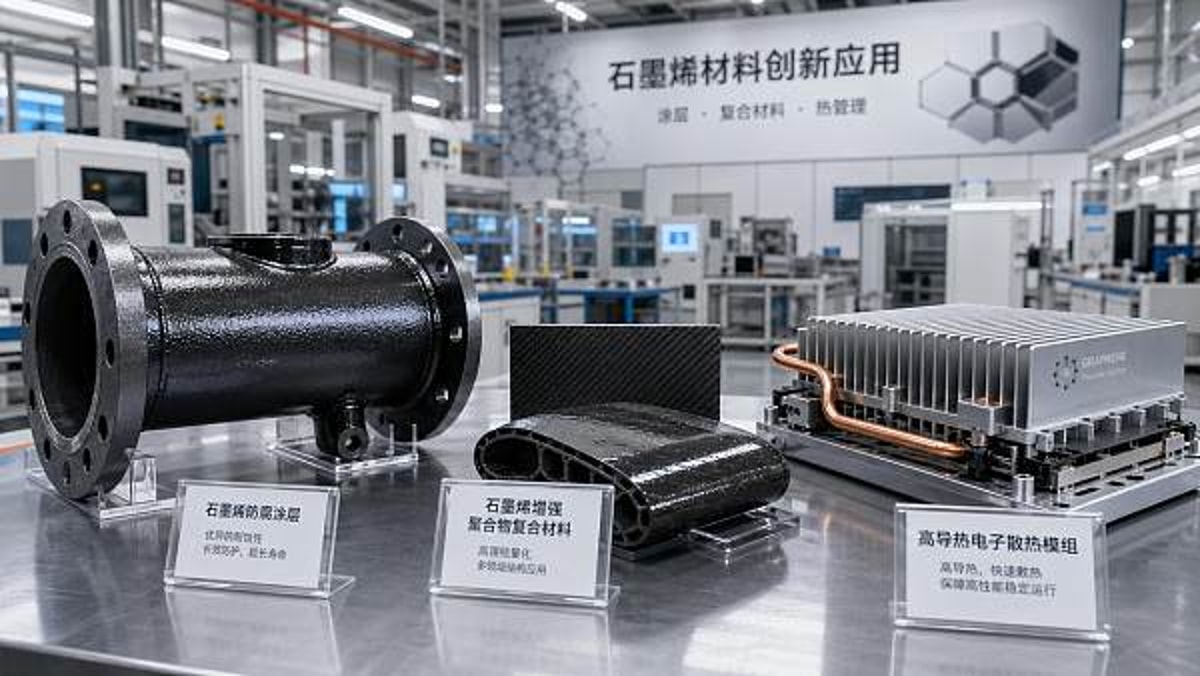
If one category best illustrates graphene applications in industry moving beyond pilots, it is coatings. Anti-corrosion and protective coatings have become one of the most credible commercial pathways because the problem they address is expensive, measurable, and persistent across sectors such as marine, oil and gas, infrastructure, automotive, and heavy equipment.
Graphene-enhanced coatings can improve barrier performance, reduce permeability, and help extend service life in harsh operating environments. For industrial buyers, the attraction is not only better technical performance. It is the potential to reduce maintenance intervals, lower downtime, and cut lifecycle costs for assets exposed to moisture, chemicals, salt, or abrasion.
Another reason coatings are advancing is that graphene can often be incorporated into established formulation and application systems. Producers still face dispersion, compatibility, and repeatability challenges, but these are more manageable than the hurdles involved in creating entirely new end-use product platforms. As a result, coatings have become a practical route for suppliers to prove industrial value and for end users to evaluate return on investment.
Commercial traction is especially visible where graphene serves as one component in a broader formulation rather than the sole innovation claim. Buyers are generally more receptive when suppliers position graphene as a performance enabler inside a validated coating system, supported by corrosion testing, field data, and third-party certification where relevant.
Polymer composites are gaining traction where lightweighting and conductivity matter
Polymer composites are another area where graphene is moving from pilot activity to selective market adoption. The strongest opportunities tend to be in thermoplastics, elastomers, and resin systems where graphene improves mechanical strength, stiffness, electrical conductivity, thermal conductivity, or barrier properties without requiring high additive loads.
Industrial sectors interested in these gains include automotive, aerospace-adjacent manufacturing, consumer electronics housings, packaging, sporting goods, and industrial components. In many of these markets, graphene is not competing to replace carbon fiber or conventional fillers across the board. Instead, it is being evaluated for targeted performance enhancements in products where a small change in material behavior can deliver a meaningful commercial advantage.
For example, manufacturers may use graphene-enhanced polymers to improve static dissipation, reduce weight while maintaining strength, or improve heat spreading in compact assemblies. These are narrower but more practical use cases than the once-common vision of graphene transforming every structural material. The applications that are progressing share a common trait: they address specific engineering constraints tied to customer requirements.
That said, composite adoption still depends on formulation expertise and quality control. Graphene must disperse well, interact predictably with the polymer matrix, and perform consistently batch to batch. Where suppliers can demonstrate that reliability and support compounders with application data, the path beyond pilot becomes much more credible.
Thermal management is emerging as a serious near-term opportunity
As devices become smaller and power densities rise, thermal management has become a strategic bottleneck across electronics, batteries, LEDs, telecom equipment, and industrial machinery. This has created a practical opening for graphene-based materials in thermal interface materials, heat spreaders, and conductive compounds designed to manage heat more effectively.
The appeal here is straightforward. Many industries do not need graphene because it is novel; they need better ways to move heat without adding excessive weight or sacrificing form factor. Graphene’s thermal properties make it attractive in formulations where conventional materials struggle to balance conductivity, processability, and thickness constraints.
Commercial movement is strongest in products where graphene is blended into hybrid systems rather than deployed as a standalone miracle material. Suppliers that combine graphene with other thermally conductive fillers can tailor performance for specific applications and price targets. This hybridization also helps bridge the gap between laboratory potential and manufacturable products.
For researchers, thermal management is worth watching because it aligns with clear market demand and ongoing electronics miniaturization. It also benefits from the fact that buyers can often validate performance using familiar metrics such as thermal conductivity, operating temperature reduction, reliability improvement, and component lifespan extension.
Energy storage is advancing, but not evenly across the value chain
Energy storage remains one of the most discussed graphene applications in industry, but it is important to distinguish between marketing visibility and actual commercial maturity. The most realistic near-term opportunities are in enabling roles: conductive additives, electrode enhancements, supercapacitor components, and performance optimization in selected battery chemistries.
Graphene’s conductivity and surface-area-related properties make it useful in efforts to improve charge transfer, power density, cycle stability, and material utilization. In practice, however, widespread adoption depends on whether graphene adds enough performance to justify its cost compared with carbon black, graphite, carbon nanotubes, or other established conductive materials.
This is why commercialization has been selective. In premium or performance-driven energy storage products, graphene can make economic sense. In highly cost-sensitive, high-volume battery manufacturing, the threshold for adoption is much higher. Even when technical benefits are real, manufacturers need predictable material quality, tight process compatibility, and strong evidence that the additive improves economics at pack or system level rather than only at lab scale.
Supercapacitors and specialized storage devices may continue to offer more agile routes to commercialization than mainstream mass-market batteries. These segments often value power performance and differentiation more strongly, making them more receptive to advanced materials when the performance gains are validated.
Sensors and printed electronics show promise because they solve defined problems
Graphene has long attracted attention in electronics, but the broad dream of graphene as a direct silicon replacement remains distant for most commercial markets. A more realistic picture is emerging in sensors, conductive inks, flexible electronics, and printed components, where graphene can offer useful combinations of conductivity, flexibility, transparency, or chemical sensitivity.
These application areas are moving beyond pilots when they are tied to specific detection or performance needs—for example, biosensing, environmental monitoring, strain sensing, wearable systems, or smart packaging. In such cases, the value proposition is not that graphene changes electronics as a whole. It is that it enables a particular sensor format or manufacturing method that incumbent materials address less effectively.
Printed electronics also benefit from a broader industry trend toward low-cost, scalable, and flexible manufacturing methods. If graphene inks or coatings can be integrated into existing printing and deposition processes, suppliers gain a viable commercial route. The challenge is still consistency, especially where electrical performance, adhesion, and environmental stability are critical.
For industrial observers, this segment deserves attention not because it is the largest today, but because it can create highly differentiated niche markets. In many advanced materials markets, commercially meaningful growth starts in narrow, high-value use cases before expanding outward.
Which sectors are still mostly in pilot mode
Some of the most publicized graphene narratives remain commercially early despite impressive technical milestones. High-performance logic electronics, broad semiconductor substitution, large-area transparent conductive films for mainstream use, and sweeping structural replacement applications are still constrained by scale-up, defect control, transfer methods, manufacturing cost, and market qualification timelines.
This does not mean these sectors lack potential. It means they require a different time horizon. Investors, suppliers, and market researchers should be careful not to interpret technical validation as proof of near-term market penetration. Many advanced materials show excellent experimental results long before they achieve production economics or procurement confidence.
In addition, heavily regulated sectors such as medical devices, aerospace-critical components, and certain food-contact applications may move slowly even when graphene offers compelling performance advantages. Regulatory review, safety documentation, and long qualification cycles can delay revenue realization far beyond the pilot stage.
How to judge whether a graphene use case is truly commercial
For information researchers and procurement-oriented readers, one of the most valuable skills is distinguishing a real industrial application from a promotional case study. Several indicators help. The first is whether the supplier names a specific end-use market and performance requirement rather than making broad claims about “revolutionizing industry.” Precision usually signals maturity.
The second is evidence of repeatable manufacturing. Commercially serious suppliers discuss material grade, dispersion behavior, production capacity, quality assurance, and compatibility with customer processes. They may also present comparative testing against incumbent solutions. Vague claims without process context are often a sign that the application is still exploratory.
The third indicator is customer logic. Ask whether the benefit maps directly to a business outcome: lower corrosion maintenance, better thermal reliability, lighter components, improved conductivity, longer product life, or reduced system cost. If the value proposition cannot be translated into procurement logic or operational savings, moving beyond pilots will be difficult.
Finally, watch for ecosystem development. Applications gain momentum when material producers, compounders, formulators, manufacturers, and testing bodies all participate in the value chain. Graphene commercialization is rarely a one-company story. It usually requires coordinated progress across production, application engineering, and market qualification.
What is driving commercialization right now
Several market forces are helping graphene applications in industry advance. One is the growing pressure on manufacturers to deliver performance improvements without major design overhauls. Graphene fits this need when it can function as a drop-in or near-drop-in enhancement to an existing material platform.
Another driver is the maturing supply base. Although quality and standardization challenges remain, graphene production capabilities have improved significantly in recent years. More suppliers can now offer differentiated grades tailored to coatings, composites, energy, or electronics applications, making commercialization more practical than it was during the first wave of graphene hype.
Sustainability and durability pressures also matter. In sectors where longer product life, reduced material usage, lighter weight, or lower maintenance support environmental goals, graphene can align with broader corporate priorities. This does not guarantee adoption, but it strengthens the business case when performance and sustainability benefits reinforce each other.
At the same time, commercialization is being driven by more disciplined market behavior. Buyers increasingly demand application-specific evidence, and suppliers are responding by narrowing their focus. That shift from broad promises to targeted industrial solutions is one of the clearest signs that the market is evolving beyond the pilot narrative.
Bottom line: where the strongest commercial signals are appearing
The industrial graphene story is no longer defined by whether the material has promise. It is defined by where that promise is translating into repeatable, economically viable use. Today, the strongest commercial signals are appearing in protective coatings, targeted polymer composites, thermal management materials, selected energy-storage components, and niche sensor or printed-electronics platforms.
These are not the loudest or most futuristic use cases, but they are the ones most aligned with how industrial adoption actually happens. They solve specific problems, fit more easily into existing manufacturing systems, and offer benefits that buyers can test and quantify. That combination is what allows graphene applications in industry to move beyond pilots.
For researchers, the most useful mindset is pragmatic rather than promotional. Track applications where graphene acts as a measurable performance enhancer, where supply and formulation capabilities are improving, and where customers can justify adoption on operational or financial grounds. Those are the segments most likely to define the next phase of commercial growth.
In short, graphene is becoming real not where it promises to remake industry overnight, but where it quietly helps manufacturers improve products already in demand. That is where the market is moving now, and where informed observers should focus their attention.
Recommended News
 Medical diagnostic equipment buying mistakes often start with workflowMedical diagnostic equipment buying mistakes often begin with workflow gaps. Learn how to compare systems, uncover hidden costs, and choose suppliers that fit real clinical operations.
 Interactive whiteboards are improving, but teacher adoption is unevenInteractive whiteboards are improving fast, but teacher adoption remains uneven. Explore what drives classroom success, ROI, and smarter edtech implementation.
 Portable oxygen concentrators: what noise levels feel acceptable?Portable oxygen concentrators: discover what noise levels feel acceptable for sleep, travel, work, and home use, with practical guidance to choose a quieter, more comfortable model.
 Car electronics failures often start with power instabilityCar electronics issues often begin with hidden power instability. Learn how voltage drops, ripple, and weak grounds cause faults—and how smarter diagnostics cut repair time and repeat failures.
 Telemedicine hardware works best when setup friction is lowTelemedicine hardware works best with low setup friction. Discover how faster deployment, easier operation, and scenario-based selection improve care efficiency and service quality.
 Are light-weighting vehicle materials worth the repair tradeoff?Light-weighting vehicle materials: Are efficiency gains worth higher repair costs? Explore lifecycle impact, EV value, downtime risks, and smarter sourcing decisions.
 Educational robots in class: novelty or lasting value?Educational robots are moving beyond classroom novelty. Discover how they create lasting value through STEM learning, scalability, and smarter school purchasing decisions.
 Biodegradable plastics fail when disposal assumptions are wrongBiodegradable plastics can fail when real disposal systems do not match design assumptions. Learn the compliance, contamination, and claim risks before they damage trust.
 Office stationery wholesale margins depend on boring detailsOffice stationery wholesale margins are won in the details—packaging, MOQ, freight, and SKU rotation. Learn how distributors protect profit and reduce hidden cost leakage.
 Carbon capture materials are improving, but durability still mattersCarbon capture materials are improving, but durability still decides ROI. Explore cycle stability, regeneration resilience, and supplier evaluation factors for reliable industrial deployment.
 Which graphene applications in industry are moving beyond pilots?Graphene applications in industry are moving beyond pilots fastest in coatings, composites, thermal management, sensors, and energy storage. See where commercialization is gaining traction.
 Precision farming drones need better data, not just better flight timePrecision farming drones deliver more value through accurate maps, crop insights, and faster decisions than longer flight time alone. See how better data improves farm efficiency.
 Smart classroom solutions often disappoint for one simple reasonSmart classroom solutions often fail when complexity is ignored. Discover how project leaders can improve adoption, scalability, ROI, and long-term classroom performance.
 Organic fertilizers: when higher cost brings better soil resultsOrganic fertilizers may cost more, but they can improve soil structure, moisture retention, and long-term plant health. Learn when the higher price delivers better garden results.
 Agri-PV systems can raise land efficiency, but not everywhereAgri-PV systems can improve land efficiency, but only in the right conditions. Explore where they work, key risks, and how to evaluate profitable deployment.
 Smart home devices wholesale gets risky when standards do not matchSmart home devices wholesale becomes risky when standards, protocols, and certifications do not align. Learn how to reduce sourcing errors, control costs, and protect buyer trust.
 Wearable technology users quit when comfort is overlookedWearable technology users quit when comfort is ignored. Discover the checklist for fit, weight, skin safety, and long-term wear to choose devices that improve adoption and user satisfaction.
 Next-gen wireless charging still faces a heat management gapNext-gen wireless charging still faces a critical heat management gap. Explore how thermal risks affect efficiency, safety, lifecycle, and product readiness.
 Foldable screen technology looks mature until repair costs appearFoldable screen technology looks premium and practical, but are repair costs too high? Discover the real tradeoff between innovation, durability, and long-term value before you buy.
 Plant-based protein processing bottlenecks start after extractionPlant-based protein processing bottlenecks often begin after extraction. Discover downstream risks, supplier evaluation tips, and cost-saving insights for better sourcing decisions.
 Photovoltaic solar panels lose value when degradation is underestimatedPhotovoltaic solar panels can lose value fast when degradation is underestimated. Learn how realistic modeling protects ROI, asset valuation, and smarter solar investment decisions.















Popular Tags
Global Trade Insights & Industry
Our mission is to empower global exporters and importers with data-driven insights that foster strategic growth.
Search News
Popular Tags
Industry Overview
The global commercial kitchen equipment market is projected to reach $112 billion by 2027. Driven by urbanization, the rise of e-commerce food delivery, and strict hygiene regulations.