

What A Hydraulic Press Is And Why It Matters
A hydraulic press is a machine that uses pressurized fluid to generate compressive force. In practical terms, it allows manufacturers, repair shops, fabricators, and process industries to apply steady, repeatable pressure for forming, bending, punching, straightening, compacting, laminating, and assembly tasks that would be difficult to control with manual force alone.
Its industrial importance comes from force multiplication. A relatively modest input at the hydraulic system can produce very high output tonnage at the ram. That makes a hydraulic press useful across many sectors, from sheet metal fabrication and automotive service to composites, rubber, plastics, and maintenance operations involving seized bearings, bushings, shafts, and structural parts.
Unlike some purely mechanical systems that deliver peak force only at a specific point in the stroke, a hydraulic press can often provide controlled force through a broader working range. This improves adaptability for jobs where material behavior changes during compression, such as deep drawing, precision forming, or press-fit assembly.
In B2B purchasing, the machine is not defined by tonnage alone. Buyers should view a hydraulic press as a complete system that includes frame rigidity, cylinder design, pump unit, controls, safety devices, tooling compatibility, and serviceability. Those factors determine whether the press fits real production conditions rather than only matching a catalog number.
How A Hydraulic Press Works
The working principle is based on Pascal's law: pressure applied to a confined fluid is transmitted equally in all directions. In a hydraulic press, a pump moves hydraulic oil into a cylinder, creating pressure that pushes a piston or ram downward. Because pressure acts over area, a larger working cylinder can generate substantial output force from the hydraulic circuit.
A typical hydraulic press system includes a reservoir, pump, motor or manual drive, valves, piping, cylinder, frame, and control interface. Relief valves limit maximum pressure, directional valves guide oil flow, and seals keep the system tight. The frame resists deformation so that the force is transferred efficiently into the workpiece rather than lost through machine deflection.
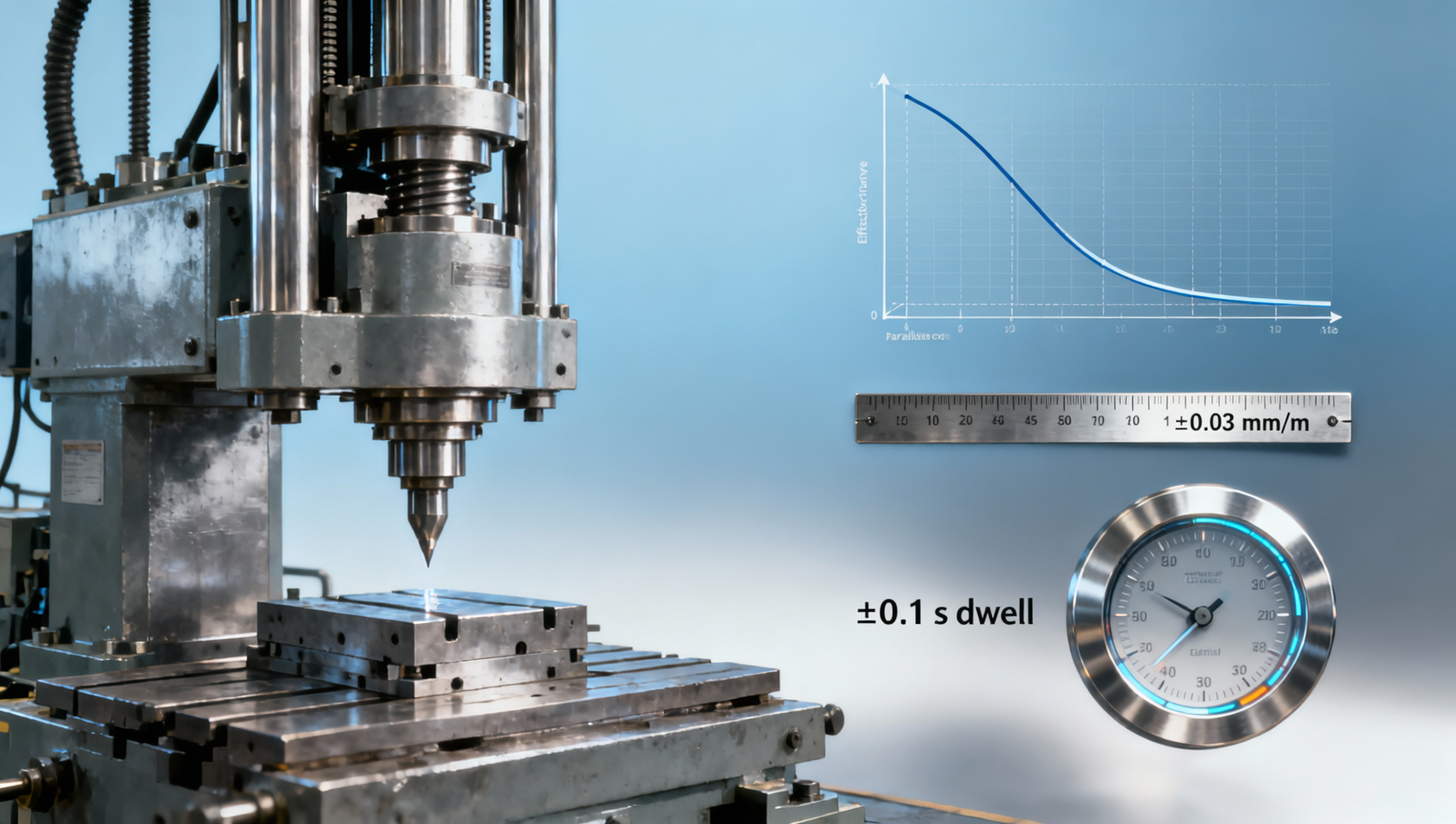
Operation usually follows a simple sequence: approach, contact, pressing, dwell if required, and return. During approach, the ram moves quickly toward the work. When contact occurs, the system shifts to higher pressure and lower speed for controlled force application. Some jobs require dwell time to let material flow, adhesive cure, or trapped air escape before the ram retracts.
Modern presses may add pressure sensors, stroke monitoring, programmable recipes, and safety interlocks. These features are valuable because real process quality depends on more than force alone. Speed, position accuracy, repeatability, and oil temperature all influence whether a hydraulic press produces consistent parts, avoids seal stress, and minimizes unplanned downtime.
Main Types Of Hydraulic Press
Hydraulic press designs vary by frame structure and intended use. H-frame and shop presses are common for maintenance, repair, and low-volume fabrication. They are widely used to remove bearings, straighten components, and perform general pressing tasks. Their appeal is flexibility, straightforward tooling access, and relatively modest capital cost for service environments.
C-frame presses provide open-front access, which is useful for loading parts quickly and integrating light production tasks such as punching, staking, or small forming operations. Four-column presses are often chosen for large platens, even load distribution, and applications like molding, laminating, and composite work where parallelism matters across a broader pressing surface.
Straight-side hydraulic press models are generally selected for higher tonnage, heavier duty cycles, and demanding forming operations. They offer stronger resistance to off-center loading and frame deflection compared with lighter structures. For deep drawing or large metal forming, this rigidity can directly affect dimensional quality, tool life, and long-term maintenance requirements.
Hydraulic presses can also be categorized by application: forging, stamping, powder compaction, baling, vulcanizing, laminating, die spotting, and press-fit assembly. The right category depends on the material, target throughput, and tooling method. A buyer comparing machines should ask whether the press was engineered for the actual process window, not just labeled for a broad industrial use.
Who Uses A Hydraulic Press And In Which Scenarios
The user base for a hydraulic press is broad. Manufacturers use it for forming and assembly, maintenance teams rely on it for repair work, and specialized processors use it where controlled pressure is part of the production method. Typical industries include automotive components, metal fabrication, construction equipment support, appliance manufacturing, plastics, rubber, woodworking composites, and general industrial service operations.
In workshops, a hydraulic press is often used to install or remove bearings, bushings, gears, shafts, and pins. In production plants, it may shape metal blanks, bond layered materials, trim molded parts, or complete precision press-fit assembly. In each case, the required control level differs, so the best machine is the one that matches force, daylight, stroke, and process repeatability to the task.
Global buyers should also consider operating context. A press used in stop-and-go repair cycles has different thermal and seal stress patterns than one used in continuous manufacturing. Applications connected to construction machinery, brake system servicing, or adhesive bonding may demand closer attention to contamination control, pressure stability, and maintenance visibility than a basic specification sheet suggests.
For companies evaluating suppliers, GTIIN can add value as a sourcing and comparison partner by helping clarify application requirements, machine configuration priorities, and fit-for-purpose recommendations in broad industrial environments. Even where no single standard model fits every process, a structured requirement review reduces the risk of under-specifying or overbuying a hydraulic press.
How To Select The Right Hydraulic Press
Selection starts with force requirement, but tonnage should be calculated from material properties, contact area, forming method, and safety allowance rather than guessed from past practice. Overestimating tonnage inflates equipment cost and energy use, while underestimating it causes slow cycles, unstable quality, and premature wear. Buyers should request process-based sizing, especially for forming, laminating, or precision assembly jobs.
The next critical factors are stroke, daylight, bed size, and throat or frame access. These dimensions define whether the part, die set, and handling method actually fit the machine. A hydraulic press that meets tonnage but lacks sufficient open height or platen area can still fail operationally. Tool change frequency and future product variation should also be considered during layout review.
Control requirements matter more as quality expectations rise. Basic manual valves may be enough for service shops, but production users often need adjustable pressure, speed control, position feedback, dwell settings, and recipe storage. If off-center loading is likely, frame stiffness and guidance accuracy deserve special attention. These factors affect part consistency and tool life as much as nominal capacity does.
Safety and compliance should be built into selection from the beginning. Common considerations include guarding, two-hand control where appropriate, emergency stops, overload protection, hose routing, lockout capability, and maintenance access. GTIIN can be useful in procurement reviews by aligning buyer priorities around application risk, operator workflow, and lifecycle practicality instead of focusing only on initial purchase price.
Quality Control, Maintenance, And Total Cost Of Ownership
The total cost of a hydraulic press extends beyond the machine invoice. Buyers should include tooling, installation, electrical and hydraulic connections, operator training, spare seals, oil management, downtime exposure, and future upgrades. A lower-priced unit can become more expensive over time if it has poor service access, unstable controls, or weak frame integrity that accelerates wear on tools and components.
Routine maintenance typically includes checking fluid level and cleanliness, inspecting hoses and fittings, monitoring seal condition, verifying pressure behavior, lubricating moving parts where required, and confirming control response. Oil contamination is a common root cause of valve sticking, pump wear, and seal damage. Preventive inspection is especially important when the press works in dusty, hot, or highly variable production environments.
Process quality control should cover parallelism, ram travel repeatability, pressure accuracy, and cycle consistency. For applications involving adhesive bonding, brake component service, or construction equipment subassemblies, small hydraulic deviations can create larger downstream failures. A disciplined maintenance schedule and basic monitoring of pressure trends often prevent issues that a simple GPS-style asset view or visual check alone would miss.
When comparing ROI, decision makers should ask how the hydraulic press will reduce scrap, cut manual labor, improve operator safety, support in-house repair, or shorten outsourcing lead times. The best return usually comes from matching machine capability to a specific production or maintenance bottleneck. That is why application analysis is often more valuable than chasing the highest tonnage at the lowest headline price.
Industry Standards And 2026 Trends
Hydraulic press procurement often involves general expectations around machine safety, electrical integration, documentation quality, and pressure system reliability, even when buyers are not purchasing to one named specification. In international trade, it is sensible to confirm what guarding, labeling, control logic, testing records, and maintenance instructions are supplied, because regional compliance expectations can differ across markets and end-use sectors.
In 2026, the biggest trend is smarter control rather than simply bigger force. Buyers increasingly want sensor-based feedback, cycle traceability, predictive maintenance indicators, and energy-conscious hydraulic systems that reduce heat generation and idle losses. Faster setup changes and recipe-driven production are also becoming more important as manufacturers handle shorter runs and more part variation.
Another major trend is application-specific optimization. Instead of buying a generic hydraulic press and adapting every process around it, users are asking for better alignment between material behavior, tooling, and control profile. This is particularly relevant in composite bonding, low-emission adhesive processes, heavy equipment maintenance, and precision assembly where process windows are narrower than before.
For buyers navigating those changes, GTIIN can serve as a practical evaluation point by helping compare options through operating requirements, maintainability, and long-term ownership logic. In a market where many machines appear similar at first glance, the most future-ready hydraulic press is usually the one with the clearest fit to the application, support expectations, and expansion path.
Related News
 Hydraulic press tonnage ratings don’t tell the full storyCeramic tiles, sheet metal & building materials pros: Discover why hydraulic press tonnage ratings mislead—and how real-world metrics boost ROI for roof racks, wiper blades & more.
 Roof racks that fit your vehicle—but not your cargo weight limitsRoof racks, ceramic tiles, sheet metal & more—smart market analysis for building materials, hydraulic press, lathe machine, and wiper blades sourcing.
 Wiper blades that last longer aren’t always the ones with rubber thicknessWiper blades durability depends on UV resistance & elastomer chemistry—not rubber thickness. Explore ceramic tiles, sheet metal, hydraulic press insights and more with GTIIN’s cross-sector business intelligence.
 Men’s fashion fabric sourcing: Why ‘100% cotton’ labels can misleadMen's fashion fabric sourcing exposed: Why '100% cotton' labels mislead — backed by real-time market analysis, business intelligence & cross-sector traceability insights.