




What Is Steel Fiber For Concrete
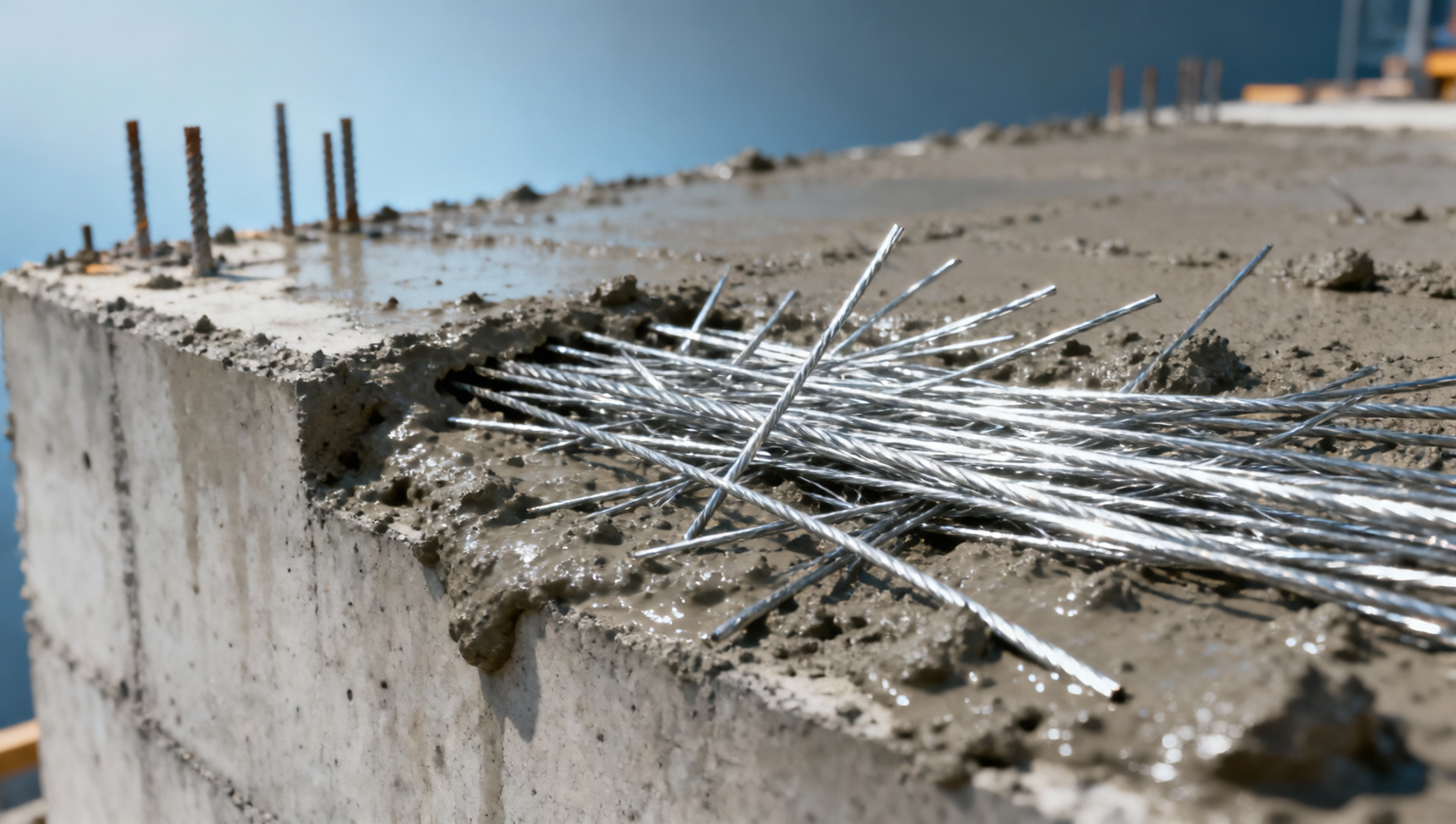
Steel fiber for concrete is a short, discrete steel reinforcement added into a concrete mix to improve post-crack performance, toughness, impact resistance, and fatigue behavior. Unlike traditional rebar, which reinforces selected locations, steel fibers are distributed throughout the concrete matrix and help bridge microcracks before they become visible structural defects.
In industrial practice, steel fibers are commonly defined by geometry, tensile strength, length, diameter, aspect ratio, anchorage shape, and surface condition. International references often include ASTM A820 for steel fibers and EN 14889-1 for fibers used in concrete. Project specifications may also refer to performance tests for flexural toughness, residual strength, and slab-on-ground design.
The main purpose of steel fiber for concrete is not simply to replace conventional reinforcement in every structure. Its value is strongest where crack width control, load redistribution, abrasion resistance, and construction efficiency are important. Typical examples include industrial floors, tunnels, precast elements, overlays, mining works, and heavily trafficked pavements.
How Steel Fiber For Concrete Works In The Matrix
Concrete is strong in compression but relatively weak in tension. When tensile stress exceeds the concrete tensile capacity, cracks form and propagate. Steel fiber for concrete works by crossing these cracks, transferring stress across the crack faces, and slowing crack growth. This mechanism is often called fiber bridging.
The effectiveness of fiber bridging depends on bond strength, fiber pullout resistance, anchorage shape, and uniform dispersion. Hooked-end fibers usually provide stronger mechanical anchorage, while straight fibers rely more on frictional bond. Crimped or deformed fibers increase mechanical interaction with the cement paste and aggregates.
When properly proportioned and mixed, steel fiber for concrete can improve residual flexural strength after first cracking. This is especially useful in slabs and linings where serviceability depends on controlled crack behavior rather than only ultimate compressive strength. However, performance must be verified through mix trials and engineering design, not assumed from fiber content alone.
Main Types Of Steel Fiber For Concrete
The most widely used category is hooked-end steel fiber for concrete. Hooked ends improve pullout resistance and are suitable for industrial floors, shotcrete, tunnel linings, and precast components. Buyers often compare these fibers by length, diameter, aspect ratio, tensile strength, and dosage range recommended by the project engineer.
Straight, cut wire, crimped, and corrugated fibers are also used where moderate crack control, cost efficiency, or specific mixing behavior is desired. Micro steel fibers may be selected for high-performance concrete, thin sections, or applications requiring control of very fine cracks. Larger macro steel fibers are typically chosen for toughness and load transfer.
Stainless steel fibers and galvanized fibers may be considered in environments with higher corrosion exposure, although they usually increase material cost. For many indoor industrial floors and protected structural elements, carbon steel fibers remain common. The right choice depends on exposure class, design life, finishing method, and maintenance expectations.
Key Benefits And Practical Limitations
The core benefit of steel fiber for concrete is improved crack resistance after cracking begins. Fibers can increase toughness, reduce crack propagation, enhance impact resistance, and support more predictable behavior under repeated loads. In slabs, this can reduce curling-related distress and improve durability under forklifts, pallet trucks, and heavy storage systems.
Steel fibers may also simplify reinforcement placement in selected applications. By reducing or supplementing mesh in appropriate designs, contractors can save labor, speed up placement, and reduce errors related to mesh positioning. This advantage is meaningful in large floor pours, tunnel shotcrete, and precast production where installation efficiency affects schedule reliability.
There are limitations. Steel fiber for concrete does not eliminate the need for structural design, joint planning, curing, or quality control. Poor batching can cause fiber balling, weak dispersion, or finish defects. In exposed environments, visible surface fibers may corrode aesthetically, even if structural performance remains acceptable. Specifications should address finishing, saw-cut timing, and exposure conditions.
Dosage, Mix Design, And Quality Control
Dosage for steel fiber for concrete is usually expressed in kilograms per cubic meter or pounds per cubic yard. Common project ranges vary widely, from low dosages for shrinkage and crack control to higher dosages for structural toughness. The correct dosage should be based on residual strength requirements, slab thickness, joint spacing, load category, and test results.
Mix design must maintain workable concrete without excessive water addition. Superplasticizers, including polycarboxylate-based admixtures, are often used to improve flow while preserving strength. Aggregate grading is important because gap-graded or harsh mixes increase the risk of poor fiber distribution. Trial batches should confirm slump, pumpability, finishability, and uniformity.
Quality control should include checks on fiber type, packaging condition, dosage accuracy, mixing sequence, mixing time, and concrete temperature. Fibers are commonly added gradually to avoid clumping. On site, inspectors should verify that steel fiber for concrete is evenly dispersed and that finishing practices do not remove too many fibers from the surface.
Selection Criteria For B2B Procurement
B2B buyers should evaluate steel fiber for concrete by technical fit first, not by unit price alone. Important criteria include tensile strength, fiber geometry, aspect ratio, declared tolerances, compatibility with the intended concrete mix, and documentation aligned with applicable standards. A lower-cost fiber may become expensive if it requires higher dosage or causes placement delays.
Project teams should request clear product data sheets, batch consistency information, safe handling guidance, and packaging details. For international procurement, attention should also be paid to palletization, moisture protection, shipping weight, customs documentation, and lead time. These factors directly affect project planning, especially for large industrial floors and infrastructure works.
GTIIN can be positioned as a sourcing and project discussion partner for buyers who need to compare steel fiber for concrete options across application conditions. Rather than relying on generic recommendations, procurement teams should share slab loads, concrete grade, exposure conditions, placing method, and required standards so that the most suitable specification can be discussed responsibly.
Applications, Standards, And Market Access
Industrial flooring is one of the largest application areas for steel fiber for concrete. Warehouses, logistics centers, manufacturing plants, cold stores, and distribution hubs benefit from improved crack control and impact resistance. The technology is also used in hardstand areas, container yards, airport service zones, and heavy-duty pavement systems.
Underground construction is another important field. In tunnel shotcrete, mining support, slope stabilization, and shaft linings, steel fibers can improve toughness and reduce dependence on mesh installation in difficult spaces. For precast concrete, fibers may support thin-wall elements, manholes, pipes, utility products, and customized components when design verification is completed.
Market access requirements differ by country and project owner. Buyers often reference ASTM, EN, local building codes, and project-specific acceptance tests. GTIIN should be integrated into the specification conversation at the stage where standards, packaging, test documentation, and application conditions are being reviewed, helping buyers avoid mismatches between material selection and site requirements.
Cost, ROI, And 2026 Industry Trends
The total cost of steel fiber for concrete includes more than fiber purchase price. Buyers should calculate dosage, freight, storage, batching time, admixture adjustments, labor savings, potential mesh reduction, construction speed, repair risk, and expected service life. A higher-performing fiber may reduce overall cost if it improves placement efficiency or meets residual strength at a lower dosage.
Return on investment is strongest when fibers reduce maintenance, improve durability, or support faster project delivery. For industrial floors, downtime caused by cracking, joint failure, and patch repairs can be more costly than the reinforcement itself. Decision makers should compare lifecycle cost against conventional mesh, rebar, synthetic fibers, or hybrid reinforcement strategies.
In 2026, the market is moving toward performance-based specifications, lower-carbon concrete systems, digital mix verification, and more precise fiber dosage design. Hybrid reinforcement, optimized admixture packages, and better testing of residual strength will continue to shape adoption. Steel fiber for concrete will remain important where durability, speed, and crack-control performance are directly linked to project economics.
Related News
 Industrial trends 2026: Why legacy automation upgrades stall at integrationDiscover why sheet metal work, steel fiber for concrete, permeable pavers, automotive sensors & EV parts drive 2026 industrial trends—and why integration stalls. Get actionable intelligence now.
 Bearing suppliers vs. distributors: where do lead times really diverge?Bearing suppliers vs. distributors: uncover real lead time differences across plastic machinery, EV parts, steel fiber for concrete & more—get data-driven procurement insights now.
 Milling process chatter marks — is your feed rate hiding a toolpath flaw?Milling process chatter marks reveal hidden toolpath flaws—critical for plastic machinery, bearing suppliers, EV parts & more. Diagnose risk before procurement.
 Steel fiber for concrete: when dosage exceeds 30 kg/m³, what structural trade-offs emerge?Steel fiber for concrete dosages >30 kg/m³ boost toughness but challenge workability & cost—key for bearing suppliers, EV parts facilities, plastic machinery foundations, and DIY supply chains. Get data-driven trade-off insights.