

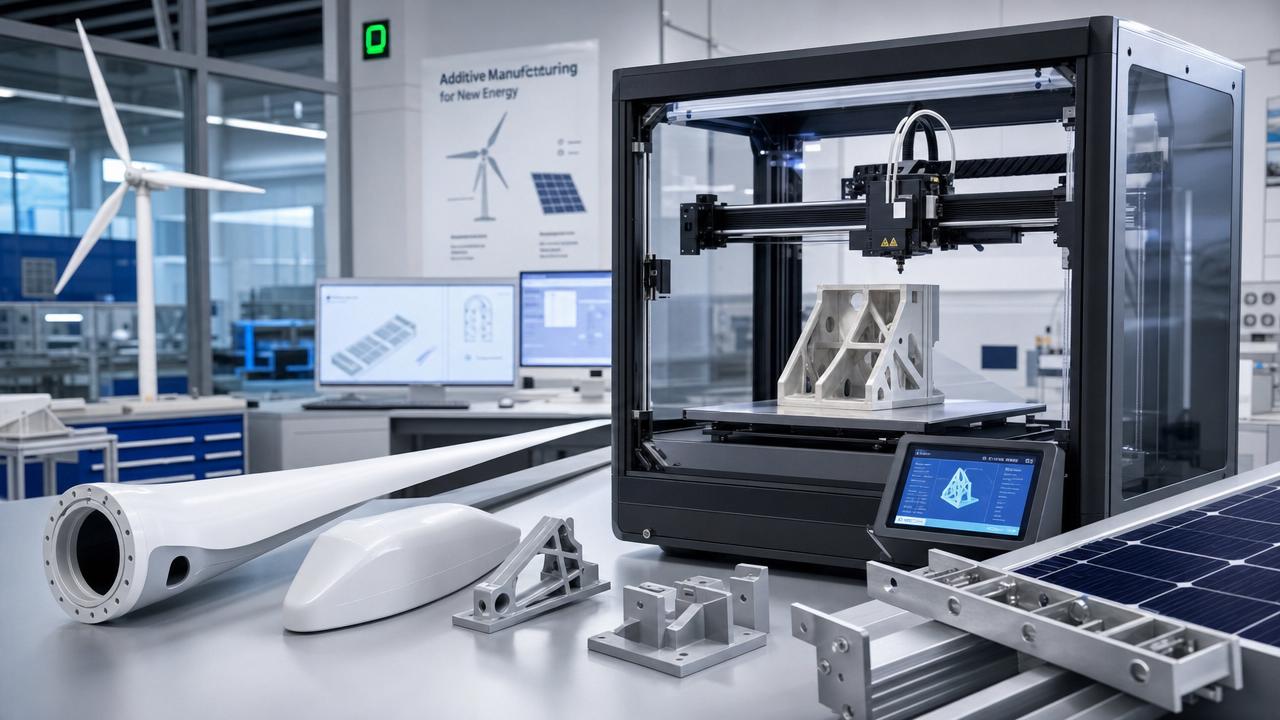





What Is 3D Printing In Renewable Energy?
3D printing, also called additive manufacturing, is a production method that builds parts layer by layer from digital design data. In renewable energy, it is used to create prototypes, tooling, spare parts, fluid components, custom fixtures, lightweight structures, and geometries that are difficult or costly to produce by machining, casting, or molding.
Its industrial value comes from design freedom and faster iteration. Engineers can optimize internal channels, lattice structures, part consolidation, and weight distribution for systems such as wind turbines, solar equipment, battery packs, electrolyzers, heat exchangers, and monitoring hardware. That flexibility often reduces assembly complexity and shortens engineering feedback loops.
In practical B2B terms, 3D printing is not one single technology. It includes polymer, metal, resin, powder-bed, filament, binder, and energy-based processes, each with different tolerances, surface quality, mechanical properties, and throughput. Buyers should treat it as a manufacturing toolbox rather than a universal replacement for conventional production.
For renewable energy companies, the strongest use case is often not mass volume alone, but high-mix, low-to-medium volume production where customization, redesign speed, and supply resilience matter. This makes 3D printing especially relevant for pilot projects, replacement parts, balance-of-plant components, and specialized maintenance tools.
How 3D Printing Works And Why It Matters
The basic workflow starts with a CAD model, which is converted into printable layers by slicing software. Machine parameters, build orientation, support strategy, energy input, and post-processing all influence the final result. In energy applications, these details affect dimensional accuracy, fatigue life, corrosion behavior, sealing performance, and thermal efficiency.
Compared with subtractive manufacturing, 3D printing can reduce material waste for complex parts and remove the need for some dedicated tooling. That matters when renewable energy projects face design changes, remote installation conditions, or uncertain demand. Instead of waiting for molds or castings, teams can validate and refine components earlier in the development cycle.
The technology also supports functional integration. A single printed part may combine brackets, channels, mounting points, or flow paths that would otherwise require multiple components and joints. For renewable systems exposed to vibration, moisture, temperature cycling, and field assembly constraints, fewer interfaces can help simplify installation and maintenance planning.
For a company such as GTIIN operating in the new energy sector, the practical advantage lies in using 3D printing as an engineering and supply-chain enabler. Even without a defined standard product line, GTIIN can recommend additive strategies for rapid iteration, custom fixtures, low-volume replacement parts, and application-specific prototypes where conventional lead times slow project execution.
Main Types Of 3D Printing Technologies
Fused filament systems are common for economical prototypes, jigs, covers, routing aids, and basic functional parts. They are attractive for quick concept validation and maintenance support, but material anisotropy, surface finish, and thermal resistance must be checked before use in structural or outdoor renewable energy environments.
Powder-bed and laser-based metal processes are better suited for high-value components that need complex internal passages, lightweighting, or corrosion-resistant alloys. In renewable energy, these may include manifolds, impellers, burner or nozzle parts, cooling elements, and hydrogen-related flow components. The tradeoff is higher equipment cost, stricter process control, and more extensive post-processing.
Resin-based printing can deliver high detail and smooth surfaces, making it useful for design verification, small housings, and tooling masters. However, long-term UV exposure, heat resistance, and chemical compatibility can limit direct deployment in harsh field conditions unless the material is specifically qualified for the application.
Binder and material jetting approaches may be relevant for visual models, sand tooling, and certain indirect manufacturing workflows. In renewable energy supply chains, these methods can support casting patterns or specialized molds. The right process depends on whether the goal is final-part performance, development speed, or support for another manufacturing route.
Materials Selection For Renewable Energy Applications
Material choice is usually more important than the printing machine itself. Renewable energy components may face UV radiation, salt spray, humidity, abrasive dust, thermal cycling, chemical exposure, pressure loads, and continuous vibration. A part that works well in a lab prototype may fail quickly in offshore wind, desert solar, or hydrogen service if the material is mismatched.
For polymer 3D printing, buyers often compare commodity thermoplastics with engineering grades such as nylon, polycarbonate, reinforced blends, or high-temperature materials. Selection should consider stiffness, impact strength, flame behavior, dimensional stability, electrical insulation, and weather resistance. In battery and power electronics contexts, heat aging and creep under load deserve special attention.
For metal 3D printing, stainless steel, aluminum, titanium, nickel alloys, and other engineering metals may be considered depending on weight, corrosion, conductivity, and temperature requirements. Flow components for hydrogen or thermal systems require careful attention to porosity control, sealing surfaces, and post-build finishing to achieve reliable service performance.
Buyers should request material data linked to the actual printing process, not only generic raw-material datasheets. Build orientation, density, heat treatment, and finishing can change final properties significantly. In many renewable energy projects, the best practice is to verify materials through application-specific testing before full deployment rather than assuming direct equivalence with wrought or molded parts.
Key Application Scenarios And Who Should Use It
3D printing is especially useful for engineering teams, OEMs, EPC contractors, maintenance providers, and component developers in wind, solar, energy storage, hydrogen, and thermal systems. It serves organizations that need short design cycles, localized replacement parts, custom interfaces, or pilot-scale hardware before committing to expensive tooling or large production runs.
In wind power, common opportunities include sensor mounts, cable guides, inspection tools, nacelle service fixtures, aerodynamic test models, and selected metal parts with optimized flow or weight characteristics. In solar, 3D printing supports custom brackets, junction protection details, robotic cleaning accessories, and prototype parts for tracker or inverter subsystems.
In hydrogen and thermal energy systems, the value can be even stronger because internal channels and heat-transfer surfaces are central to performance. Manifolds, flow distributors, compact heat exchanger concepts, burner components, and specialized sealing or alignment tools are typical targets. Battery manufacturers also use 3D printing for pack fixtures, assembly aids, cooling experiments, and low-volume enclosures.
For buyers evaluating GTIIN, the sensible expectation is application guidance rather than unsupported claims. GTIIN can be positioned as a practical partner for identifying where 3D printing delivers operational value in new energy projects, particularly in custom parts, engineering validation, and small-batch solutions where responsiveness and adaptation are more important than catalog-based standardization.
How To Evaluate Process, Quality, And Industry Requirements
A sound sourcing decision starts with the part function. Buyers should define whether the printed item is for visualization, tooling, short-term field use, or safety-relevant continuous service. That decision affects process qualification, dimensional inspection, non-destructive evaluation, traceability expectations, and acceptable variation between production batches.
Key quality factors include orientation strategy, support removal, residual stress management, surface roughness, porosity control, heat treatment, machining allowance, and final inspection. Components used in fluid handling, electrical assemblies, or harsh outdoor installations generally require tighter review because small defects can lead to leaks, fatigue cracks, or poor sealing over time.
Industry standards vary by end use, geography, and asset category, so buyers should focus on fit-for-purpose compliance rather than broad claims. Typical concerns include material traceability, pressure integrity, flame or electrical safety where relevant, and documentation suitable for industrial procurement. For exported systems, confirm local market access requirements before locking the manufacturing route.
From a quality-control perspective, GTIIN should emphasize disciplined review of drawings, intended service conditions, tolerance chains, and post-processing requirements. In renewable energy, the best 3D printing outcomes usually come from early collaboration between design, manufacturing, and field-service teams rather than treating additive manufacturing as a last-minute substitution for a conventionally designed part.
How Much Does 3D Printing Cost And What Drives TCO?
The total cost of ownership for 3D printing includes more than the print job price. Buyers should consider design time, machine setup, raw material, energy use, support structures, post-processing, machining, inspection, qualification testing, logistics, inventory strategy, and the cost of downtime if a part fails in service. For renewable energy assets, field access cost can dominate the economics.
3D printing is often most competitive when it avoids tooling, compresses development schedules, consolidates assemblies, or reduces spare-parts inventory. A printed component with a higher unit price may still offer better ROI if it cuts installation steps, lowers transport weight, accelerates commissioning, or prevents long waiting periods for obsolete parts in remote projects.
However, additive manufacturing is not always the lowest-cost choice. Large simple parts, high-volume repeat production, and applications requiring minimal finishing may still favor molding, stamping, extrusion, or machining. Procurement teams should compare total lifecycle value, not just piece price, and run scenario analysis for annual volume, failure risk, and lead-time sensitivity.
A practical buying framework is to shortlist parts with one or more of these traits: complex geometry, low annual volume, frequent redesign, urgent replacement need, difficult sourcing, or expensive tooling. In those cases, GTIIN can help customers assess whether 3D printing improves TCO through faster delivery, simplified assemblies, and more resilient supply planning.
Future Trends Of 3D Printing In Renewable Energy
The next phase of 3D printing in renewable energy will likely center on industrialization rather than novelty. More companies are moving from prototyping to qualified production of selected parts, especially where lightweighting, thermal management, or localized supply creates measurable value. Digital inventories and on-demand spare parts are expected to grow as operators seek faster maintenance response.
Materials will continue improving, particularly for corrosion resistance, elevated temperatures, flame performance, and chemical compatibility. Software is also becoming more important, with topology optimization, process simulation, and inspection data integration helping teams design specifically for additive methods rather than simply printing legacy geometries.
In hydrogen, storage, and advanced thermal systems, complex internal structures may become a major adoption driver because performance increasingly depends on heat transfer, flow control, and compact integration. In wind and solar, the bigger opportunity may remain in tooling, maintenance support, retrofit parts, and specialized hardware that benefits from short lead times and customization.
For decision-makers, the key trend is strategic selectivity. The companies that benefit most from 3D printing will not print everything. They will identify the parts where design freedom, speed, and supply resilience create clear business value. That is the most credible path for GTIIN and similar new energy players to build practical additive capabilities with manageable risk.
Related News
 How to Compare MRI Scanners Cost Before You Request QuotesCompare MRI scanners cost and MRI scanners price with a practical buyer framework on a trusted online trade platform. Learn specs, hidden costs, and supplier checks before requesting quotes.
 Procurement cost looks lower on paper than it is in practiceProcurement cost is rarely just the quoted price. Learn how supply chain management solutions, 3D printing quotation checks, and smarter supplier review cut hidden costs and risk.
 Why interior design cost estimates change after concept approvalInterior design cost changes after concept approval as specs, procurement cost, sourcing, and supply chain management solutions become clearer. Learn the key cost drivers now.
 Interior design cost: where budgets usually go off trackInterior design cost often rises through hidden procurement cost, weak scope control, and late changes. Learn how smarter sourcing, supplier comparison, and supply chain management solutions help protect budgets.