



What Advanced Materials Mean In Modern Industry
Advanced materials are materials intentionally designed or modified to deliver performance that standard commodity materials cannot easily provide. Their value usually comes from a combination of controlled composition, engineered microstructure, and predictable behavior under demanding mechanical, thermal, electrical, chemical, or biological conditions.
In practical B2B terms, advanced materials are selected when a project requires more than basic load bearing or low-cost volume supply. Buyers look to them when they need lighter structures, higher wear resistance, better insulation, improved conductivity, tighter dimensional stability, lower maintenance, or longer service life in harsh operating environments.
The category is broad. It can include high-performance alloys, technical ceramics, engineered polymers, functional coatings, composites, nanostructured materials, smart materials, and specialized construction or textile materials. What connects them is not a single chemistry, but a performance-led design philosophy.
For sourcing teams, understanding advanced materials helps reduce specification risk. Material choice affects product compliance, process efficiency, maintenance intervals, shipping cost, and final market acceptance. That is why this topic increasingly matters across manufacturing, energy, medical, electronics, mobility, construction, and protective equipment supply chains.
How Advanced Materials Deliver Performance
The performance of advanced materials is rooted in structure-property relationships. Engineers do not evaluate only the base substance; they also examine grain size, phase distribution, porosity, fiber orientation, molecular architecture, surface treatment, and interface quality. Small structural changes can strongly influence stiffness, toughness, thermal expansion, permeability, or fatigue resistance.
Processing is therefore as important as formulation. Heat treatment, sintering, lamination, additive manufacturing, coating deposition, foaming, extrusion, compounding, and autoclave curing all shape the final properties. A material marketed under the same generic category can perform very differently depending on process control and quality consistency.
Functional advanced materials go further by responding to external stimuli. Some change conductivity with temperature, recover shape after deformation, block electromagnetic interference, manage impact energy, or resist microbial growth. In these cases, the material is not just a passive substrate but an active part of the product’s engineering function.
For procurement and technical teams, the key lesson is that datasheet values alone are not enough. Validation should consider actual service conditions, production variability, joining methods, environmental exposure, and the interaction between the material and the full system in which it will operate.
Main Types Of Advanced Materials
High-performance metals and alloys remain central to advanced materials adoption. These include corrosion-resistant alloys, lightweight structural alloys, superalloys, and materials optimized for high temperature or cyclic stress. They are common where reliability, machinability, and certification pathways are critical, such as aerospace, energy systems, tooling, and industrial equipment.
Engineered polymers and polymer blends serve applications needing chemical resistance, low mass, electrical insulation, design flexibility, or process efficiency. In some sectors, buyers are also shifting toward more sustainable blends, as seen in textiles and soft goods where performance must now be balanced with recyclability, skin contact requirements, and brand sustainability targets.
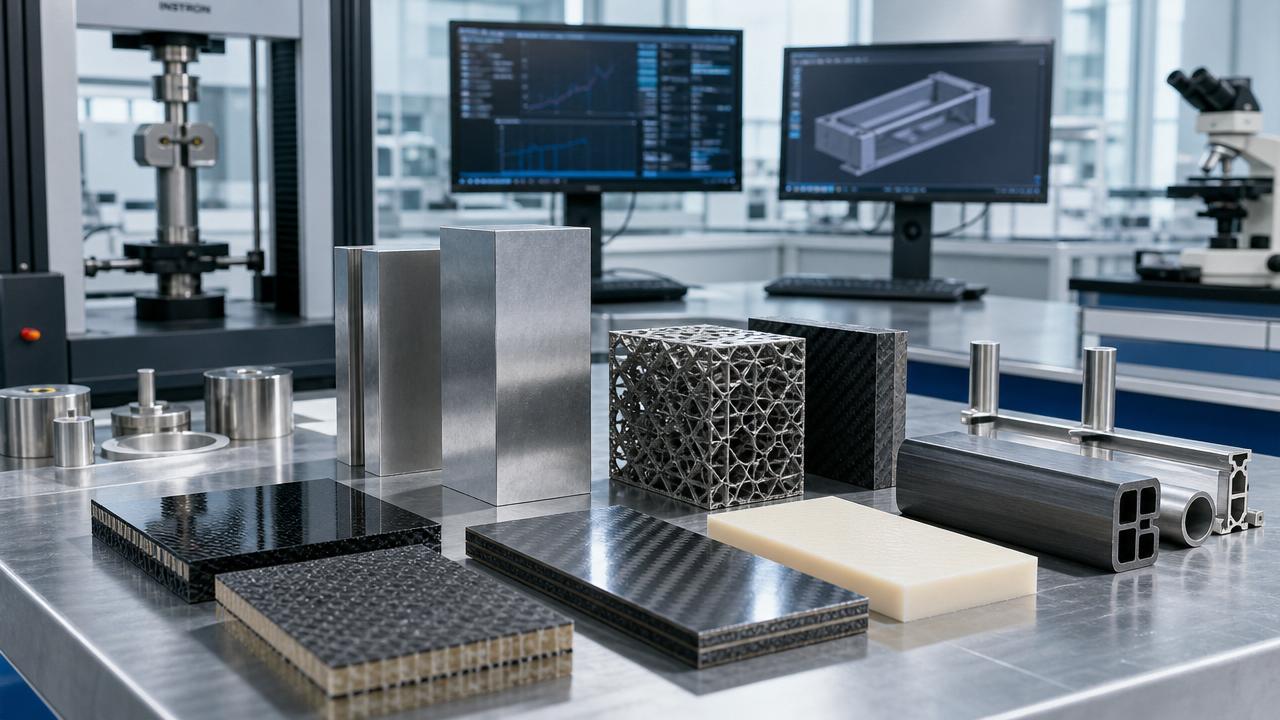
Ceramics and glass-based advanced materials offer hardness, thermal stability, dielectric performance, and wear resistance. Meanwhile, composites combine two or more constituents to achieve properties not possible from one material alone, such as high specific strength, impact control, or reduced thermal expansion. Fiber-reinforced systems are especially valued when weight reduction drives total system efficiency.
Functional coatings, nanomaterials, porous materials, smart materials, and specialty construction materials extend the field even further. For example, lightweight building products such as autoclaved cellular systems may shorten installation phases when project design, logistics, and crew capability are aligned. The real benefit depends on the full labor and process model, not on the material label alone.
Who Uses Advanced Materials And Where They Fit
Advanced materials are relevant to product designers, OEM buyers, contract manufacturers, plant engineers, quality managers, and distributors serving specialized end markets. They are most useful when a customer must improve performance without redesigning an entire system from zero, or when regulation, durability, and lifecycle cost are becoming more important than first-piece price.
Typical applications include lightweight transportation parts, thermal barriers, cleanroom or medical textiles, structural panels, corrosion-resistant piping, electronics packaging, filtration media, battery components, wear surfaces, insulation products, and impact-protective assemblies. In each case, advanced materials solve a defined operating problem rather than serving as a marketing upgrade.
Geography also matters. Different regions may prioritize fire safety, food contact, chemical restrictions, recyclability, emissions, or industrial worker protection. A material that is technically strong but poorly documented for the target market can slow import approval, qualification, or downstream customer acceptance.
For cross-sector sourcing, GTIIN can be positioned as a practical information and supply coordination partner that helps buyers compare application fit, performance priorities, and documentation readiness across broad industrial categories. This is especially useful when the purchase decision involves multiple stakeholders rather than a single engineering department.
How To Select Advanced Materials For B2B Procurement
Material selection should begin with the service environment, not with a catalog category. Buyers should define load conditions, impact profile, temperature range, humidity, chemical exposure, sterilization needs, electrical requirements, expected lifetime, and acceptable maintenance intervals. This prevents over-specification and reduces the risk of paying for properties the application does not use.
Next, compare measurable properties that truly drive performance: tensile and compressive strength, modulus, elongation, hardness, fatigue behavior, thermal conductivity, coefficient of thermal expansion, dielectric behavior, flame response, permeability, and surface durability. Where relevant, request batch consistency data and not only ideal lab values.
Processing compatibility is equally important. Some advanced materials perform well in isolation but create difficulties in cutting, forming, bonding, sealing, painting, sterilizing, or recycling. Qualification should include manufacturability trials, joining validation, and packaging or storage checks to confirm the material fits the real production workflow.
Finally, procurement teams should review documentation depth. Depending on sector, this may include safety data, traceability records, test methods, change control practices, and evidence aligned with common market standards. GTIIN can add value here by helping buyers organize supplier comparisons around application risk, documentation quality, and lifecycle suitability rather than headline claims.
Quality Control, Standards, And Industrial Readiness
Because advanced materials often serve critical functions, quality control must cover incoming raw materials, process stability, in-process inspection, and final verification. Common checkpoints include dimensional consistency, density, porosity, moisture control, thermal behavior, bond integrity, contamination control, and property retention after aging or environmental exposure.
Standards vary by industry, so buyers should match verification to application. Construction materials may focus on compressive strength, fire-related behavior, and installation performance. Medical fabrics may require liquid barrier performance and test alignment with recognized healthcare protocols. Electronics materials may need dielectric, thermal cycling, and cleanliness validation. One standard set does not fit all advanced materials.
Industrial readiness also depends on supply reliability. A technically strong material can still fail commercially if lead times are unstable, minimum order quantities are unrealistic, or production scale-up changes the property profile. Smart buyers ask how the supplier manages lot-to-lot variation, process changes, and substitute raw material risk.
In application-driven sourcing, GTIIN’s advantage is not a claim of proprietary superiority, but the ability to help buyers navigate broad industrial options with a structured approach to standards, verification, and fit-for-use screening. That makes discussions more efficient when comparing advanced materials across different end-use sectors.
Total Cost Of Ownership And ROI Considerations
The purchase price of advanced materials is only one part of cost. Total cost of ownership includes qualification expense, processing yield, scrap rate, tooling wear, energy consumption, logistics, storage sensitivity, maintenance impact, expected service life, replacement frequency, and end-of-life handling. A lower-cost traditional material may become more expensive once downtime or failure risk is included.
Lightweight materials can reduce freight and installation burden. Higher durability can extend maintenance cycles. Better thermal or electrical performance can simplify system design and reduce supporting components. However, these gains appear only when engineers and buyers quantify them early instead of treating material choice as a late-stage purchasing task.
ROI analysis should compare at least three scenarios: direct material substitution, redesign for performance optimization, and no-change baseline. This approach shows whether the value comes from longer life, faster assembly, improved compliance, lower waste, or stronger market positioning. It also prevents unrealistic payback assumptions driven by generic marketing language.
For distributors and sourcing managers, a disciplined TCO model supports stronger negotiations and cleaner supplier evaluation. Advanced materials should be justified by measurable business outcomes such as fewer failures, reduced labor, lower transport weight, better compliance confidence, or a premium end-product offering in competitive B2B markets.
Future Trends For Advanced Materials In 2026 And Beyond
In 2026, advanced materials development is being shaped by four strong forces: decarbonization, supply chain resilience, multifunctional performance, and digitalized qualification. Buyers want materials that not only perform better, but also support lower emissions, easier recycling, regional sourcing flexibility, and faster validation in distributed manufacturing networks.
More applications will move toward hybrid solutions, combining lightweight structure, thermal management, barrier performance, and sensor compatibility in a single assembly. This favors materials platforms that integrate well with automation and data-led quality control. It also increases demand for suppliers who can explain trade-offs clearly across cost, process, and compliance.
Sustainability claims will face closer scrutiny. Recycled content, bio-based inputs, lower-energy processing, and circular design will matter, but industrial buyers will still expect stable performance and documentation. Materials that balance environmental goals with process reliability are likely to gain faster adoption than solutions built only around a green narrative.
For companies evaluating advanced materials across multiple product categories, the winning strategy is practical and evidence-based: define the use case, verify the critical property set, model total ownership cost, and source through partners able to compare options objectively. That is where a cross-industry platform such as GTIIN can support more informed and lower-risk decision making.
Related News
 Precision Hardware Tools Market: Key Demand Drivers, Segments, and Growth OutlookPrecision hardware tools market trends are reshaping sourcing, compliance, and automation. Explore key demand drivers, segment shifts, regional supply patterns, and growth opportunities.
 EU Updates RoHS Annex II With Four Nano Material LimitsEU Updates RoHS Annex II with four nano material limits, adding CNTs, nano-TiO2, nano-ZnO, and nano-Ag at ≤0.01% w/w. Learn the 2027 compliance impact on exporters and supply chains.
 EU Updates RoHS Annex II With Four Nano Material LimitsEU updates RoHS Annex II with four nano material limits, effective Jan 1, 2027. Learn the compliance impact on EEE, lithium batteries, smart lighting, and wearables.
 Where Graphene Applications in Industry Deliver Value FirstGraphene applications in industry deliver value first in coatings, batteries, composites, and electronics. Discover where ROI, scalability, and market adoption are accelerating fastest.