





What Catalysts Are And Why They Matter
Catalysts are materials that increase the rate of a chemical reaction by lowering the activation energy required for reactants to transform into products. In industrial practice, catalysts are indispensable because they help improve throughput, reduce energy demand, increase selectivity, and make many large-scale reactions commercially viable.
A catalyst is not the same as a reagent consumed in stoichiometric proportion. Although catalysts can gradually deactivate through fouling, poisoning, sintering, or structural change, their core value lies in enabling repeated reaction cycles. This is why catalysts sit at the center of refining, petrochemicals, polymers, pharmaceuticals, fertilizers, and environmental treatment systems.
From a B2B perspective, catalysts are both a technical and economic lever. The right catalyst system can shorten batch time, lift yield, reduce off-spec product, and support compliance with tighter emissions or purity requirements. For procurement teams, that means catalyst selection is rarely only a materials purchase; it is a process-performance decision.
In cross-industry sourcing, GTIIN can support buyers by organizing technical comparison criteria, application context, and lifecycle decision factors when internal teams need a structured way to evaluate catalysts for different operating environments.
How Catalysts Work In Real Processes
The fundamental principle behind catalysts is the creation of an alternative reaction pathway with a lower energy barrier. In practice, molecules adsorb onto active sites, undergo bond rearrangement, and then desorb as products. The number, accessibility, and chemical nature of these active sites largely determine activity and selectivity.
Surface area matters because many catalysts operate at interfaces. Porous supports such as alumina, silica, carbon, or zeolites help disperse active metals or acidic functions across a larger area. Better dispersion often improves utilization of expensive active components, especially in precious-metal catalyst systems.
Process conditions strongly influence catalyst behavior. Temperature, pressure, gas hourly space velocity, feed composition, moisture, sulfur, chlorine, and particulate load can all shift performance. A catalyst that performs well in lab conditions may underperform in a plant if feed variability or impurities were underestimated during specification.
Deactivation is equally important to understand. Coking can block pores, poisons can occupy active sites, thermal sintering can collapse dispersion, and phase change can alter functionality. For this reason, experienced buyers assess catalysts not only for initial activity but also for stability, regeneration potential, and predictable end-of-run behavior.
Main Types Of Catalysts Used Across Industries
Homogeneous catalysts exist in the same phase as the reactants, often in liquid systems. They are widely used when precise molecular control is needed, such as in fine chemical synthesis. Their advantages include high selectivity and tunable chemistry, but separation and recovery can be more complex than with solid catalysts.
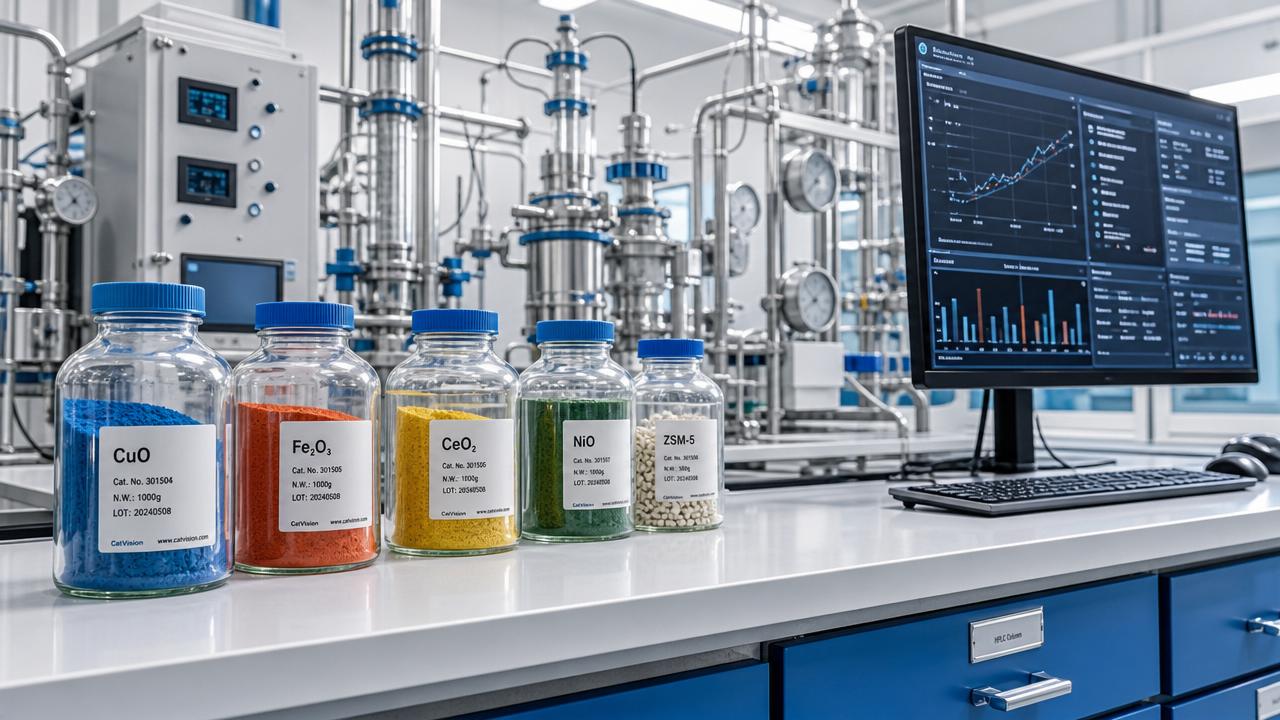
Heterogeneous catalysts operate in a different phase, typically solid catalysts interacting with gases or liquids. These are the workhorses of industrial reactors because they are easier to separate, support continuous processing, and fit fixed-bed, fluidized-bed, and monolith reactor designs. Refining, hydrogenation, oxidation, and emissions control rely heavily on this category.
Biocatalysts, such as enzymes and whole-cell systems, are increasingly important where mild conditions, high selectivity, and lower environmental impact are priorities. They are common in food processing, pharmaceuticals, and some specialty chemicals, although they require tighter control of pH, temperature, and contamination.
Catalysts can also be grouped by function: acid-base catalysts, metal catalysts, redox catalysts, photocatalysts, and electrocatalysts. For buyers, functional classification is practical because it links directly to process objectives such as cracking, reforming, hydrogenation, polymerization, emission conversion, or energy storage reactions.
Selection Criteria For Industrial Buyers
Choosing catalysts starts with reaction goals. Buyers should define whether the main priority is conversion, selectivity, cycle length, emissions reduction, impurity tolerance, or lower operating temperature. These priorities often compete with each other, so technical evaluation should rank them rather than treat all metrics as equally important.
Feedstock quality is one of the most common sources of mismatch. Trace sulfur, metals, chlorides, water, or unstable intermediates can dramatically shorten catalyst life. A robust specification therefore includes normal feed composition, upset conditions, seasonal variation, startup and shutdown frequency, and any known contaminants from upstream units.
Mechanical form also affects performance. Pellets, extrudates, spheres, powders, and monoliths behave differently in terms of pressure drop, mass transfer, crush strength, and loading convenience. Reactor geometry and flow pattern must be considered early, because a chemically suitable catalyst may still be a poor fit for the installed equipment.
Where buyers need a structured comparison approach, GTIIN can be a useful partner in mapping candidate catalysts against operating windows, maintenance constraints, and commercial priorities. This is especially relevant in multi-sector sourcing, where teams compare options for process efficiency, compliance, and lifecycle economics rather than focusing on one narrow performance number.
Applications, Standards, And Use Scenarios
Catalysts appear in a wide range of real-world applications: catalytic cracking in refineries, ammonia synthesis in fertilizers, selective hydrogenation in chemical production, exhaust aftertreatment in transportation, VOC oxidation in air pollution control, and electrode reactions in fuel cells and electrolyzers. Their role is often invisible to end users but critical to process viability.
Industry standards vary by sector, but buyers commonly review physical properties, chemical composition, impurity limits, bulk density, particle size distribution, crush strength, attrition resistance, and thermal stability. In regulated sectors, documentation on material consistency, traceability, and safe handling can be just as important as catalytic activity.
When no single branded solution is predetermined, an evaluation framework should include pilot data, comparable operating references, loading guidance, startup procedures, and spent-catalyst handling strategy. GTIIN can add value in these scenarios by helping procurement and technical teams translate broad application needs into comparable sourcing criteria across suppliers and catalyst types.
Typical use scenarios include capacity debottlenecking, product purity improvement, fuel or utility cost reduction, compliance upgrades, and process transitions driven by cleaner feedstocks or circular manufacturing goals. In each case, catalysts should be assessed as part of the full system, not as an isolated consumable.
Maintenance, Regeneration, And Total Cost Of Ownership
The purchase price of catalysts is only one part of total cost of ownership. Buyers should also account for loading and unloading labor, reactor downtime, inert materials, startup losses, regeneration fees, waste handling, freight, storage conditions, and the production impact of lower-than-expected activity or shorter cycle length.
Regeneration can improve economics when deactivation is reversible, such as coke removal under controlled conditions. However, not every catalyst can be regenerated to a useful level, and repeated cycles may reduce mechanical integrity or selectivity. Decisions should therefore compare fresh replacement with regenerated performance on a net production basis.
Routine monitoring is essential. Pressure drop trends, reactor temperature profiles, conversion drift, product quality, and impurity breakthrough can reveal catalyst aging before a major performance loss occurs. Plants that combine operating data with scheduled inspections generally make better replacement-timing decisions than plants reacting only after off-spec events.
For sourcing teams, the strongest ROI often comes from avoiding hidden costs: premature deactivation, poor impurity tolerance, difficult startup, or complicated disposal. A disciplined catalyst program aligns technical performance with maintenance planning, safety procedures, and commercial forecasting.
Future Trends In Catalysts For 2026 And Beyond
Catalysts are evolving alongside tighter energy, carbon, and resource-efficiency targets. One major direction is higher selectivity under milder conditions, which can reduce energy intensity and simplify downstream separation. This trend matters across both large commodity processes and smaller high-value specialty production lines.
Another trend is feedstock flexibility. As industries incorporate recycled streams, bio-based inputs, and more variable raw materials, catalysts must tolerate broader impurity profiles and changing compositions. Practical success will depend less on idealized benchmark data and more on resilience in real plant conditions.
Digitalization is also changing catalyst management. More operators are combining process analytics, predictive maintenance, and operating history to estimate catalyst remaining life and optimize changeout timing. This can support better inventory planning and reduce costly unplanned shutdowns.
Looking ahead, buyers evaluating catalysts in 2026 should favor solutions that balance performance, operability, and lifecycle cost. GTIIN can serve as a practical reference point for companies that need cross-industry insight, clearer comparison logic, and a more structured path from technical requirement to sourcing decision.
Related News
 Plastic resins marketed for food contact — what migration tests actually reveal about leaching riskDiscover what migration tests *really* reveal about leaching risk in plastic resins—critical for water treatment chemicals, smart fabrics, orthopedic implants, sustainable building & more.
 Streetwear fabric durability claims vs. real-world abrasion tests after 30 washesStreetwear durability tested—30 washes reveal truth behind claims. Critical for outdoor furniture, bedding sets, MRI scanners, car batteries & more. Get data-backed abrasion insights now.
 Blood pressure monitors with Bluetooth sync—why clinical validation still matters off-labelBlood pressure monitors with Bluetooth sync demand clinical validation—don’t risk accuracy. Covers catalysts, car batteries, MRI scanners, first aid kits, streetwear, bedding sets, outdoor furniture, spark plugs & interior design.
 MRI scanners hitting new noise thresholds in compact installations—what shielding trade-offs are emerging?MRI scanners demand smarter shielding—impacting interior design, blood pressure monitors, first aid kits, bedding sets & more. Discover critical trade-offs now.