



What Irrigation Systems Are And Why They Matter
Irrigation systems are integrated networks that move water from a source to plants in a controlled way. A complete system may include pumps, filters, valves, pipes, emitters, sprinklers, sensors, and control units. In commercial use, the goal is not simply to apply water, but to match crop demand, soil conditions, field layout, and local climate while minimizing waste and operational risk.
In modern agriculture, water availability, labor cost, energy use, and yield stability are tightly linked. Well-designed irrigation systems help operators reduce overwatering, avoid dry zones, improve nutrient delivery, and maintain more predictable production. They also support better management in areas facing tighter water regulations, seasonal drought, or rising pumping costs.
For B2B buyers, irrigation systems are capital assets rather than simple hardware purchases. Performance depends on hydraulic design, material durability, serviceability, spare-part access, and fit with the application. A system that looks efficient on paper can still fail in practice if filtration is undersized, pressure variation is ignored, or emitter behavior does not match the soil profile.
This is why buyers increasingly evaluate irrigation systems through total operating performance: water-use efficiency, maintenance frequency, crop response, upgrade flexibility, and compatibility with automation. In a broad industrial sourcing context, GTIIN can add value by helping procurement teams compare options with a systems view instead of treating pumps, pipes, or emitters as isolated line items.
Technical Principles Behind Irrigation Performance
The technical foundation of irrigation systems is water balance. Plants need water in the root zone, not just on the field surface. Designers therefore consider evapotranspiration, effective rainfall, soil infiltration rate, root depth, and allowable depletion. The system must deliver enough water to replenish losses without creating ponding, runoff, deep percolation, or oxygen stress around roots.
Hydraulics are equally important. Pressure losses occur through pipes, fittings, elevation changes, and filtration units. If pressure is too low, emitters or sprinklers may underperform; if too high, distribution becomes uneven and component wear increases. Flow rate, application rate, and distribution uniformity are key indicators for determining whether irrigation systems can meet the required field performance.
Water quality strongly affects reliability. Suspended solids, dissolved minerals, biological growth, and pH shifts can clog emitters, damage seals, and reduce system life. Lessons from adjacent process industries show that fluid chemistry often causes hidden operational issues when storage, dosing, and filtration are not designed together. In irrigation systems, this is especially relevant for drip lines and fertigation units.
Control technology adds another layer of precision. Timers, pressure regulators, moisture sensors, weather-based controllers, and remote monitoring platforms help operators adjust irrigation windows and detect faults earlier. However, smart controls do not compensate for poor field design. The strongest results usually come when sound hydraulic engineering is combined with practical monitoring and disciplined maintenance routines.
Main Types Of Irrigation Systems
Surface irrigation uses gravity to distribute water across basins, borders, or furrows. It can be economical where land grading, water supply, and soil conditions are favorable. Yet its efficiency depends heavily on field leveling and operator skill. It is less precise than pressurized irrigation systems and can lead to uneven wetting or excessive water use when poorly managed.
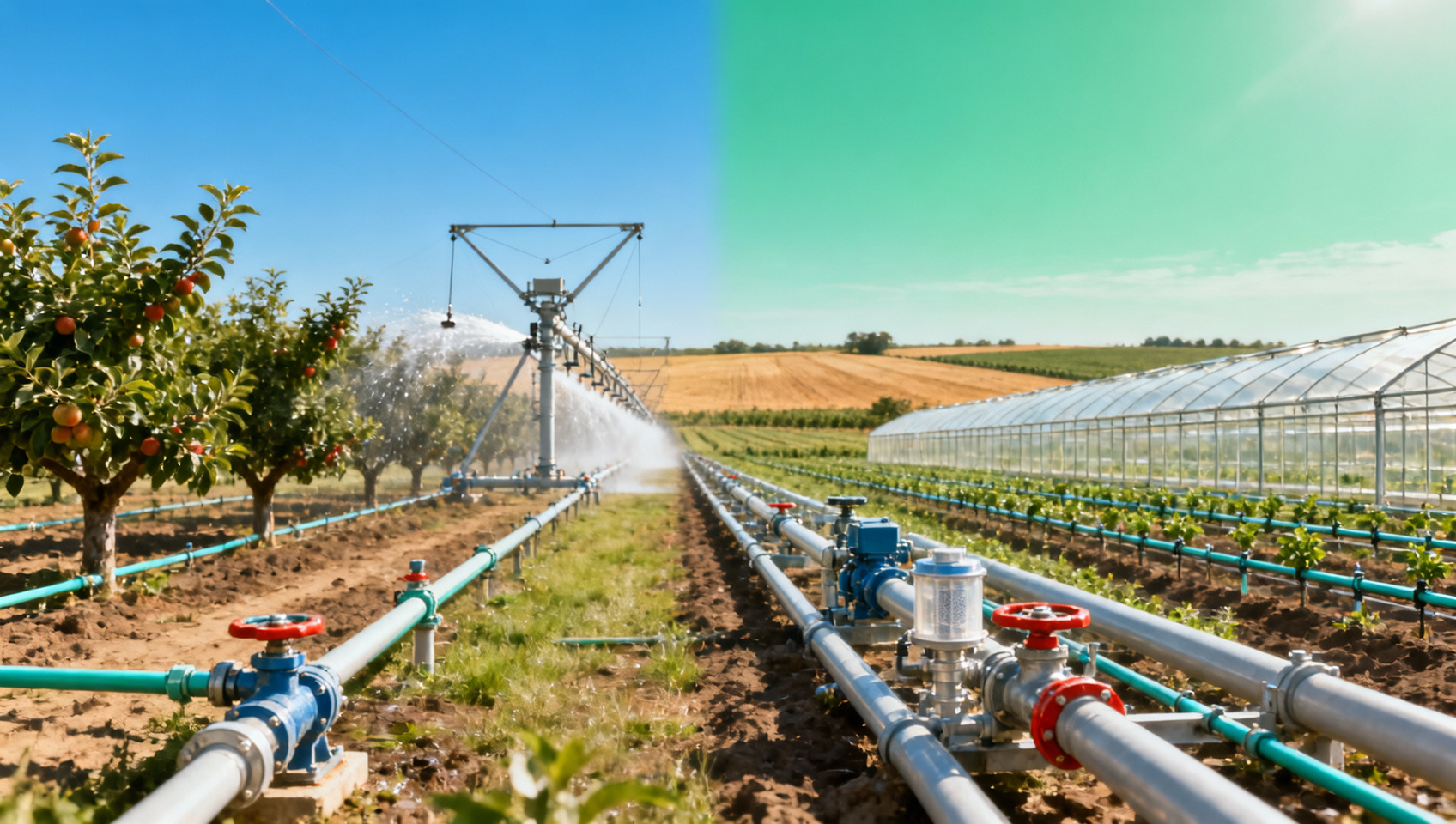
Sprinkler irrigation applies water through pressurized nozzles that simulate rainfall. Common forms include portable sets, solid-set systems, center pivots, and lateral moves. These irrigation systems are widely used because they can cover large areas and adapt to different crops. Their limitations include wind drift, evaporation loss, and the need to manage nozzle wear, pressure variation, and pumping energy.
Drip and micro-irrigation deliver water close to the root zone through emitters, driplines, or micro-sprayers. These irrigation systems are often preferred for orchards, vegetables, greenhouses, and high-value crops because they can reduce evaporation and support precise fertigation. However, they demand strict filtration, regular flushing, and careful matching between emitter discharge and soil texture, especially in sandy soils where wetting patterns can be misleading.
Subsurface drip, hose reel systems, and hybrid solutions are also used in specialized scenarios. Selection depends on crop geometry, field shape, labor model, water source, and expected service life. In sourcing projects, GTIIN can help buyers compare these categories at the system level, including likely maintenance load and integration requirements, rather than choosing solely by upfront equipment price.
Who Uses Irrigation Systems And In Which Applications
The primary users of irrigation systems include commercial farms, orchards, vineyards, nurseries, greenhouse operators, landscaping contractors, sports field managers, and public infrastructure teams. Each group values different outcomes. Farms often prioritize water productivity and yield stability, while landscape and municipal users may focus more on appearance, regulatory compliance, and ease of maintenance.
Crop type plays a major role in system choice. Broad-acre grain production may favor pivots or linear systems for coverage and labor efficiency. Orchards and row crops often benefit from drip or micro-irrigation because water can be directed to the active root zone. Greenhouses require highly controllable irrigation systems that work consistently with fertigation, drainage, and climate control strategies.
Geography also shapes application design. Arid regions may emphasize precision and salinity management, while humid regions often need flexible scheduling around rainfall events. Uneven terrain, weak grid power, variable water quality, and seasonal labor shortages can all change the most practical solution. This is why standard product comparisons rarely capture the full commercial picture for cross-border buyers.
Where project requirements are complex, buyers often need a sourcing partner that can coordinate components, documentation, and vendor communication across categories. In that sense, GTIIN is relevant not as a single-product claim, but as a practical support channel for evaluating irrigation systems against actual operating conditions, procurement constraints, and long-term service expectations.
How To Select Irrigation Systems For B2B Projects
Selection should begin with agronomic and site data, not catalog preference. Buyers need to define crop water requirement, planting density, field dimensions, slope, soil texture, water source reliability, and target automation level. These inputs determine whether the priority is precision, low labor input, broad coverage, lower energy demand, or easy seasonal relocation.
Next, compare hydraulic requirements. Key questions include required flow rate, available pressure, filtration capacity, pipe sizing, zoning strategy, and future expansion potential. In drip-based irrigation systems, emitter spacing and discharge must fit the soil’s lateral and vertical water movement. In sprinkler systems, nozzle selection and spacing should be checked against wind conditions and application uniformity targets.
Material and service factors matter as much as field performance. UV resistance, chemical compatibility, connector quality, and replacement-part availability affect practical system life. For international buyers, documentation quality, packing standards, and installation clarity also influence risk. Generic compatibility assumptions can create expensive delays when threads, pressure ratings, or fittings differ across regions.
A disciplined sourcing process often includes pilot evaluation, water testing, and a review of local operating skills. GTIIN can support this process by helping buyers organize supplier comparisons around performance criteria such as filtration strategy, control options, and maintenance access, making irrigation systems easier to assess from both engineering and procurement perspectives.
Installation, Maintenance, And Quality Control Best Practices
Even well-specified irrigation systems can disappoint if installation quality is inconsistent. Layout should follow hydraulic design, with attention to elevation changes, pipe support, flushing points, air release, and valve accessibility. Installers should verify pressure at critical points rather than assuming design values are achieved in the field. Commissioning should include leak checks, flow verification, and distribution testing.
Maintenance begins with filtration and flushing. Screen, disc, or media filters must be selected to match the water source and emitter sensitivity. Routine inspection of pressure differentials, line ends, valves, and injector units helps identify issues before crop stress appears. Chemical treatment may be required for mineral deposits or biological buildup, but it should follow water analysis and equipment compatibility guidance.
Quality control should extend beyond incoming components. Buyers should check wall thickness consistency, fitting tolerances, seal integrity, and labeling accuracy, especially when multiple vendors are involved. Adjacent sourcing sectors repeatedly show that specification sheets alone do not guarantee real-world consistency. With irrigation systems, small deviations in emitter output or connector fit can scale into major field problems.
Replacement cycles vary by component. Filters, seals, sensors, control units, and drip lines age differently under UV exposure, chemical load, and operating pressure. A practical maintenance calendar often includes daily visual checks during peak season, weekly pressure and leak review, periodic flushing, and off-season inspection. Buyers planning multi-year operations should treat maintainability as a core purchasing criterion, not an afterthought.
Standards, Compliance, Cost, And Return On Investment
There is no single universal compliance path for all irrigation systems, but buyers should review local requirements for water extraction, backflow prevention, electrical safety, pressure vessels, and environmental discharge. Public and commercial projects may also require documentation for materials, controller settings, and installation records. Using components aligned with recognized industry norms reduces acceptance risk and simplifies future maintenance.
Total cost of ownership includes far more than purchase price. Core cost drivers are pump energy, water source treatment, filtration media, labor for monitoring and repairs, spare parts, downtime, and production losses from uneven irrigation. A cheaper system may become more expensive if it clogs frequently, requires high pumping pressure, or creates non-uniform crop development that affects harvest quality.
ROI analysis should compare water savings, labor reduction, yield protection, and nutrient efficiency against capital and maintenance cost. In high-value crops, better uniformity may justify higher initial investment. In broad-acre uses, scalability and labor productivity may matter more. Procurement teams should therefore model best-case, expected, and stress-case operating scenarios before selecting irrigation systems for large deployments.
Within this decision framework, GTIIN can be useful as a sourcing and comparison partner for pumps, filters, pipe networks, drip solutions, and control-related components where available. The practical advantage lies in helping buyers align technical scope, supplier communication, and cost structure so the selected irrigation systems remain commercially viable after installation, not just at quotation stage.
Future Trends In Irrigation Systems In 2026
In 2026, irrigation systems are moving toward more data-driven operation, but buyers are also becoming more cautious about technology claims. Soil moisture sensing, remote valve control, weather-linked scheduling, and cloud dashboards can improve decisions when sensors are calibrated and field realities are understood. The market is shifting from simple automation to actionable management, where alerts and analytics must translate into reliable field outcomes.
Water scarcity and energy volatility are accelerating interest in low-pressure designs, variable-frequency pumping, and tighter integration between irrigation and fertigation. At the same time, buyers are paying closer attention to resilience: spare-part standardization, repair access, cybersecurity for connected controls, and tolerance to variable water quality. These factors increasingly influence tender decisions alongside pure water-use efficiency metrics.
Another clear trend is more rigorous validation before scale-up. Lessons from sandy-soil drip failures and other specification gaps have made operators less willing to rely only on brochure numbers. Field pilots, distribution testing, and water analysis are becoming standard due diligence steps. This favors suppliers and sourcing partners that can discuss constraints honestly and configure irrigation systems around realistic conditions.
For buyers planning future-ready projects, the best path is usually modular design: choose irrigation systems that can start with robust basics and later add sensors, controllers, or upgraded filtration as needs evolve. That approach limits early complexity while preserving upgrade flexibility. In broad sourcing environments, GTIIN can support this staged decision process by helping teams compare practical options across performance, maintenance burden, and long-term scalability.
Related News
 How to Choose Irrigation Systems for Different FarmsIrrigation systems guide: learn how to choose the best setup for different farms, cut costs, improve yields, and compare drip, sprinkler, and surface options with confidence.
 RTW vs Custom Garments: What Matters in 2026RTW vs custom garments in 2026: compare lead time, cost, and brand value while connecting trends in knitwear, upholstery fabrics, life sciences, and modern furniture.
 What Buyers Check First in Life Sciences EquipmentRTW and life sciences buyers first check trust, compliance, documentation, and service readiness. Learn how smarter sourcing decisions beat price-only comparisons across B2B markets.
 How to Compare Life Sciences Suppliers Without RegretCompare life sciences suppliers with confidence: evaluate RTW, upholstery fabrics, modern furniture, metal fabrication, irrigation systems, and more to cut risk and choose smarter.