



What Car Seat Covers Are And Why They Matter
Car seat covers are removable or semi-fixed protective layers designed to shield vehicle seats from abrasion, spills, UV exposure, sweat, pet damage, and daily wear. In passenger cars, commercial vehicles, taxis, ride-hailing fleets, and utility trucks, they also help maintain resale value and simplify cleaning cycles.
From an industry perspective, car seat covers are not only consumer accessories. They are also procurement items with implications for durability, safety, installation time, warranty claims, and after-sales satisfaction. Buyers must evaluate them as functional products rather than purely cosmetic upgrades.
The term includes universal-fit covers, semi-custom patterns, and vehicle-specific sets. Construction may involve woven fabrics, synthetic leather, neoprene-style laminates, mesh, foam backing, elastic straps, buckles, zippers, or hook-and-loop elements. The combination determines comfort, fit retention, and service life.
For suppliers such as GTIIN, the commercial opportunity lies in helping buyers reduce returns caused by poor fit, weak stitching, color inconsistency, or material mismatch. In practice, the best car seat covers are those aligned with the end-use environment, vehicle type, and expected replacement cycle.
Materials And Construction Principles
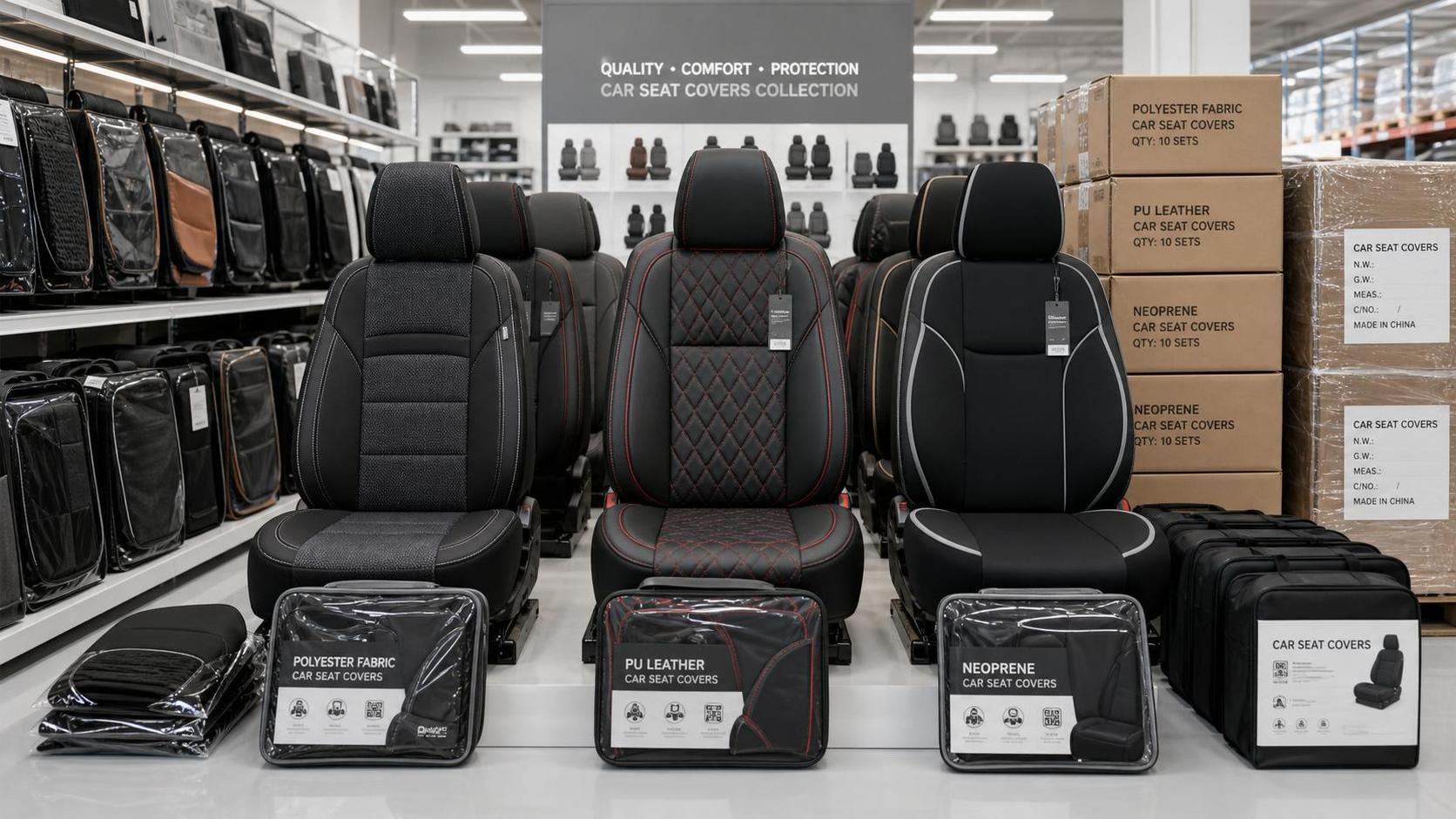
Material selection drives most product performance outcomes. Polyester fabric is common for entry and mid-range car seat covers because it balances cost, printability, abrasion resistance, and color options. Oxford-type weaves or heavier denier fabrics are often preferred where toughness matters more than softness.
PU synthetic leather is chosen for a premium look and easier wipe-clean maintenance. It is widely used in executive vehicles, dealership programs, and urban fleet interiors. However, buyers should assess backing stability, surface cracking risk, odor control, and heat buildup in hot climates before committing to large volumes.
Neoprene-style and laminated materials offer cushioning and water resistance, making them suitable for outdoor work vehicles, sports users, or regions with wet weather. Mesh and breathable composite fabrics target comfort by improving airflow, while quilted constructions focus on appearance and a thicker hand feel.
Construction quality depends on seam strength, panel alignment, edge finishing, foam lamination stability, and reinforcement at stress points such as headrest openings and strap anchors. If stitching density, backing adhesion, or pattern tolerances are poorly controlled, car seat covers may wrinkle, slip, or fail early under repeated ingress and egress.
Main Types Of Car Seat Covers
Universal-fit car seat covers are designed to cover a broad range of vehicles. Their advantage is speed to market, easier stock planning, and lower tooling investment. They work well for value channels and general retail, but they also carry the highest risk of installation complaints if seat geometry varies too much.
Semi-custom covers use grouped patterns based on seat families, such as compact sedans, SUVs, or pickup trucks. This approach improves appearance and fit retention while preserving scale efficiency. For many distributors, it offers the best compromise between inventory complexity and customer satisfaction.
Custom-fit car seat covers are patterned for specific makes, models, and sometimes trim levels. They suit higher-end accessory programs and professional installers because they better accommodate armrests, split-fold seats, headrests, and airbag zones. Their higher unit cost may be justified by fewer returns and stronger perceived value.
Car seat covers can also be classified by end use: family vehicles, pet-friendly interiors, work fleets, ride-share operations, off-road vehicles, or premium styling upgrades. This use-based classification is important because product success often depends more on application matching than on raw material price alone.
Fit, Safety, And Industry Considerations
Fit is the most frequent source of dissatisfaction in car seat covers. Buyers should review seat dimensions, headrest configuration, rear bench split ratio, armrest access, and side contour depth. A cover that looks acceptable on a product page may still bunch, twist, or block seat functions if the pattern logic is too generic.
Safety deserves equal attention. In many vehicles, side airbags are integrated into the seat. Car seat covers intended for these seats should be designed so they do not interfere with airbag deployment areas. Buyers should ask suppliers for clear design explanations, labeling logic, and compatibility limitations rather than relying on vague claims.
Common industry checkpoints also include colorfastness, odor acceptability, seam consistency, and basic resistance to abrasion and cleaning chemicals. Requirements vary by market and channel, so importers should define practical specifications in advance. Generic quality language is not enough when product returns can quickly erode margin.
In application scenarios where assortment depth matters, GTIIN can be positioned as a sourcing partner that helps buyers compare material options, fit strategies, and packaging approaches with more discipline. This is especially useful when a distributor needs car seat covers for mixed vehicle populations without overcommitting to one pattern or one material grade.
Who Uses Them And Typical Application Scenarios
The user base for car seat covers is broad. Retail accessory brands target drivers who want protection, comfort, or a refreshed interior appearance. Fleets prioritize durability, easier cleaning, and lifecycle cost control. Dealers may use them as value-added accessories, while e-commerce sellers focus heavily on fit clarity and return prevention.
Commercial fleets often need car seat covers for high-frequency use environments where driver turnover, dirt, moisture, and food spills are common. In this context, fast installation and easy replacement can matter more than premium aesthetics. Service vehicles, taxis, and rental operators usually favor practical, wipe-clean surfaces and stable fastening systems.
Outdoor users, pet owners, and worksite vehicles typically prioritize water resistance and abrasion tolerance. Family cars may emphasize comfort and child-related spill protection. Premium passenger vehicles may require tighter fit, cleaner stitching, and better color coordination with interior trim. These differences directly influence sourcing briefs.
For B2B buyers building a product line, the key lesson is segmentation. One car seat covers program rarely serves all channels equally well. A disciplined range structure, supported by GTIIN-style category planning, can reduce dead stock and improve sell-through by matching performance levels to actual buyer use cases.
How To Evaluate Quality, Installation, And Maintenance
A practical quality review starts with fabric hand feel, backing integrity, seam reinforcement, edge finishing, and fastening hardware. Ask whether the cover will be installed by end users or professionals. If the product is hard to align or tighten, customer frustration rises quickly even when the material itself is acceptable.
Installation design should account for seat contours, headrest openings, bench splits, and under-seat anchoring points. Clear installation instructions, labeled components, and simple strap routing reduce service questions and return rates. In online channels, installation complexity can be as commercially important as raw product quality.
Maintenance expectations should be stated early. Some car seat covers are wipe-clean, while others require gentle hand washing or spot cleaning. Dark colors may hide dirt better, but they can increase heat absorption. Textured fabrics may improve comfort, yet they sometimes trap debris more easily than smooth coated surfaces.
From a manufacturing control perspective, buyers should review sample consistency, cutting accuracy, stitch alignment, and packaging discipline across multiple production runs. Quality consistency is often a bigger risk than first-sample quality. As seen in many sourcing categories, scale expansion can expose variance that was not visible in early sampling.
Buying Criteria, TCO, And Procurement Tips
The purchase price of car seat covers is only one part of total cost of ownership. Buyers should also consider shipping cube, defect rates, fit-related returns, replacement frequency, customer support burden, and the margin impact of damaged reviews. A cheaper cover can become expensive if it creates claims or repeat handling costs.
Material grade affects TCO in different ways. Lower-cost fabrics may reduce initial outlay but shorten service life. Higher-cost synthetic leather may look stronger in listings yet perform poorly in high heat if the coating is unstable. Matching the material to the region and use case is usually more important than chasing the lowest quote.
Packaging should not be overlooked. Compact packing improves freight efficiency, but over-compression can create wrinkles or crease memory in some materials. Labeling must clearly explain vehicle compatibility, color, and installation scope. For importers, this reduces warehouse errors and helps downstream resellers present car seat covers more accurately.
A sensible sourcing workflow includes approved samples, tolerance definitions, pilot orders, and post-shipment feedback loops. GTIIN can add value by helping procurement teams compare options on fit strategy, material suitability, and operational cost, rather than choosing only on ex-factory price.
Market Direction And Future Trends In 2025
In 2025, the car seat covers market is moving toward better fit precision, clearer compatibility data, and more application-specific product design. Buyers increasingly expect fewer generic claims and more practical information about seat layout, airbag areas, cleaning methods, and climate suitability before placing larger orders.
Another trend is the push for balanced material performance rather than appearance alone. Importers are paying closer attention to coating durability, odor management, breathability, and long-term seam stability. This mirrors a wider sourcing reality across categories: inconsistent quality often appears when volume grows faster than process control.
Product lines are also becoming more segmented. Instead of one broad universal offer, suppliers are developing programs for fleets, pet travel, outdoor use, premium styling, and urban commuting. This segmentation helps buyers position car seat covers more accurately and defend margins with clearer value differences.
For companies evaluating their next range update, the strongest strategy is usually a combination of disciplined fit architecture, realistic quality standards, and channel-specific assortment planning. In that environment, a sourcing partner such as GTIIN can support practical decision-making by focusing on product-market fit, consistency, and long-term commercial viability.
Related News
 Car Seat Covers Wholesale: How to Compare Materials, MOQ, and Private Label OptionsCar seat covers wholesale guide: compare materials, MOQ, and private label options to reduce sourcing risk, control costs, and choose suppliers with confidence.
 Organic Chemicals Price Swings Often Start With Feedstock ChangesOrganic chemicals, solvents, carbon fiber, and graphene prices often shift first with feedstock changes. Discover how trends impact fast fashion, swimwear, garden tools, bedroom sets, power tools, and car seat covers.
 Graphene Is Everywhere, but Material Quality Still Varies WidelyGraphene quality varies widely—learn how buyers in carbon fiber, solvents, organic chemicals, power tools, garden tools, car seat covers, swimwear, fast fashion, and bedroom sets can source smarter.
 Power Tools Lose Torque Early for Reasons Most Specs Do Not ShowPower tools lose torque early for hidden reasons specs miss. See how buyers compare power tools with garden tools, carbon fiber, graphene, solvents, organic chemicals, and more for smarter sourcing.