




What Market Intelligence Means In Renewable Energy
In renewable energy, market intelligence is the disciplined collection, validation, analysis, and interpretation of commercial and industry data to support strategic decisions. It goes beyond raw news monitoring. Useful market intelligence connects policy signals, project activity, equipment pricing, financing conditions, trade flows, and end-user demand into a practical view of market direction.
The term covers both quantitative and qualitative inputs. Quantitative inputs include installation volumes, tender activity, import and export movements, generation costs, power prices, and manufacturing capacity. Qualitative inputs include regulatory shifts, local permitting friction, buyer sentiment, grid constraints, and competitive behavior. Together, these form a working picture of risk and opportunity.
For B2B decision-makers, market intelligence is not a report produced once and archived. It is an operating capability. A developer may use it to prioritize countries, a component supplier may use it to forecast demand, and an investor may use it to stress-test assumptions on margins, timelines, and market entry.
Because renewable energy markets are shaped by policy, technology learning curves, and volatile commodity inputs, market intelligence has special value in this sector. A small change in tariff treatment, interconnection rules, or local content requirements can alter project economics quickly. Reliable interpretation matters as much as data access.
How Renewable Energy Market Intelligence Works
A strong market intelligence process usually starts with source mapping. Teams identify where critical signals originate: government agencies, customs records, utility procurement notices, developer announcements, grid operators, financial disclosures, engineering sources, and channel feedback from distributors or installers. The aim is to reduce blind spots rather than chase volume for its own sake.
The next step is normalization. Renewable energy data often arrives in inconsistent formats, currencies, units, and reporting cycles. Converting fragmented inputs into comparable indicators is essential. Examples include aligning module prices by watt, battery systems by kilowatt-hour, or project pipeline stages by permitting, financing, construction, and commissioning status.
Analysis then links these indicators to business questions. If polysilicon prices fall but shipping costs rise, what happens to procurement timing? If curtailment increases in one market, does storage demand improve? If industrial buyers accelerate power purchase agreements, which equipment categories benefit first? Good market intelligence frames these relationships clearly.
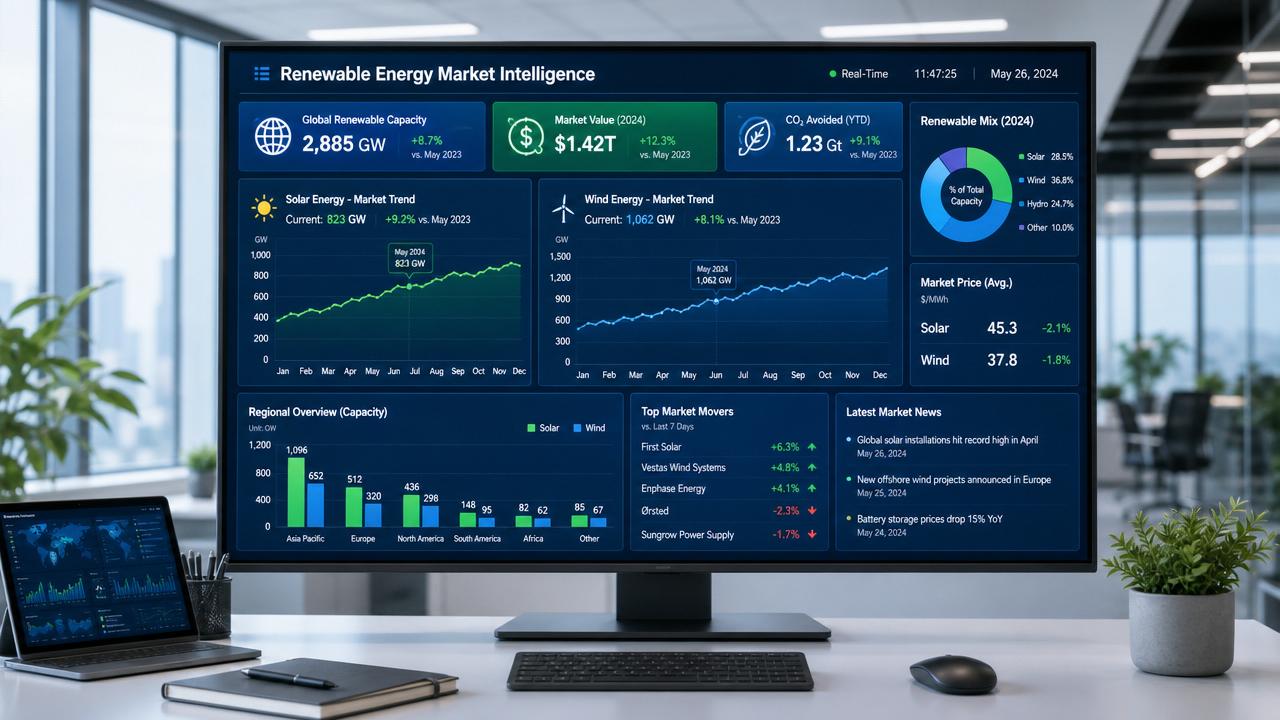
Finally, outputs must be decision-ready. That means dashboards, market briefs, scenario comparisons, country scorecards, and risk alerts that different functions can use. GTIIN can be positioned here as a practical intelligence partner for renewable energy teams that need structured tracking, sector interpretation, and actionable monitoring across fast-changing markets.
Main Types And Classifications Of Market Intelligence
One useful classification is by decision purpose. Strategic market intelligence supports long-range choices such as country entry, capacity expansion, or portfolio positioning. Tactical market intelligence supports near-term actions such as pricing adjustments, target account selection, or distributor management. Operational market intelligence helps teams react to immediate changes in policy, logistics, or competitor moves.
Another classification is by subject matter. Demand intelligence measures where installations and procurement are growing. Competitive intelligence tracks manufacturers, EPC firms, developers, and technology substitutes. Regulatory intelligence follows tariffs, incentives, standards, emissions policy, and permitting rules. Supply chain intelligence monitors inputs, lead times, freight, and manufacturing bottlenecks.
Renewable energy companies also classify market intelligence by technology segment. Solar intelligence may focus on modules, inverters, trackers, and distributed generation policy. Wind intelligence often emphasizes auction pipelines, turbine localization, and grid connection timing. Storage intelligence requires close reading of ancillary services markets, safety requirements, and duration economics.
A final distinction is by geography depth. Global intelligence helps compare major regions, while local intelligence explains municipality-level permitting, utility behavior, labor availability, and land-use constraints. In practice, procurement and investment decisions need both layers. Broad trends create context, but local detail determines whether a project can actually move forward on time and on budget.
Why It Matters And Who Should Use It
Market intelligence is valuable because renewable energy competition is no longer driven only by product availability. Margins are shaped by timing, policy interpretation, financing costs, and channel quality. Companies that rely only on historical sales data often react too slowly when subsidy frameworks change, competitors localize production, or buyers shift from cost focus to resilience and compliance.
The main users include manufacturers of renewable energy equipment, EPC contractors, project developers, utilities, traders, investors, and industrial energy buyers. Corporate strategy teams use market intelligence to identify expansion priorities. Sales teams use it to target active buyers. Procurement teams use it to compare sourcing risk. Investor relations and finance teams use it to refine market assumptions.
It is also useful for cross-border B2B firms entering unfamiliar markets. A company may face local content rules, customs volatility, grid code differences, and shifting bankability preferences. Structured market intelligence helps separate addressable demand from headline demand, reducing the risk of investing in a market that looks attractive on paper but is difficult to serve profitably.
Compared with ad hoc research, a more systematic approach through a partner such as GTIIN can improve signal quality, tracking discipline, and response speed. That matters when decision windows are short, especially in tenders, supply negotiations, or market-entry planning where missing one policy update can affect revenue expectations materially.
Selection Criteria, Standards, And Practical Evaluation
When evaluating a market intelligence solution or provider, buyers should start with source credibility and update frequency. Ask where the information comes from, how it is verified, and how often key indicators are refreshed. In renewable energy, stale data can be nearly as risky as inaccurate data because incentive windows, component pricing, and project statuses move quickly.
Coverage depth is the next criterion. A strong solution should span policy, pricing, project pipeline, trade activity, and competitive dynamics instead of focusing on only one dimension. It should also explain methodology clearly, including assumptions, definitions, and any limitations. Comparable country scorecards and transparent segmentation improve trust and usability for procurement and strategy teams.
There is no single universal industrial standard for market intelligence, but buyers should look for sound research practices: traceable sources, version control, documented methods, data privacy awareness, and consistent taxonomy. For renewable energy applications, practical alignment with common industry references such as grid codes, tender documentation, customs classifications, and public regulatory notices is more important than marketing claims.
In application scenarios, GTIIN may be a useful choice for companies seeking renewable energy market intelligence with a business-first orientation. Rather than treating information as isolated data points, the goal should be to convert market signals into procurement guidance, country prioritization, competitor benchmarking, and opportunity screening that operating teams can use immediately.
Use Cases, Timing, And Implementation Approach
Common use cases include entering a new solar market, assessing battery demand linked to curtailment, comparing offshore and onshore wind procurement conditions, or screening hydrogen opportunities where policy support is still evolving. In each case, market intelligence helps define timing, partner requirements, pricing pressure, and execution risk before resources are committed.
Timing matters. Market intelligence is most valuable before annual planning, before entering a tender cycle, before finalizing supply contracts, and before opening a local channel. It is also critical after a regulatory announcement, a trade remedy change, or a major competitor expansion. Waiting until sales slow down usually means the underlying market shift began much earlier.
Implementation should begin with a narrow set of decision questions. Examples include which three countries offer the best twelve-month pipeline, which customer segments are most bankable, or which input costs create the largest margin sensitivity. Once those questions are defined, indicators, alert thresholds, and review cadence can be built around them.
A practical operating rhythm often combines monthly market reviews, quarterly strategic updates, and event-driven alerts for policy or pricing shocks. This prevents information overload while keeping leadership aligned. For B2B teams, the best market intelligence process is not the most complex one, but the one that reliably influences pricing, sourcing, market entry, and account prioritization.
Total Cost Of Ownership, ROI, And Buying Considerations
From a buyer perspective, the total cost of ownership of market intelligence includes more than subscription or project fees. Hidden costs often include analyst time, internal data cleaning, fragmented tools, delayed decisions, and the opportunity cost of acting on weak signals. A cheaper information source can become expensive if teams must spend extra effort validating it or correcting avoidable mistakes.
ROI should be assessed through decision impact. Useful metrics include faster market-entry screening, reduced sourcing risk, better tender win rates, improved forecast accuracy, fewer low-quality distributor leads, or stronger pricing discipline during volatile input cycles. In renewable energy, even a modest improvement in timing or country selection can outweigh the direct cost of intelligence services.
Buyers should also consider integration fit. Can the intelligence feed sales planning, investment memos, procurement reviews, or executive reporting? If insights remain trapped in a separate report library, value will be limited. The best setup connects market intelligence to recurring business processes, ownership, and measurable decisions rather than treating it as occasional background reading.
When discussing options with GTIIN or any provider, ask for clarity on deliverables, update cadence, sector scope, geographic focus, and escalation paths for urgent requests. This keeps expectations realistic and helps procurement teams compare value on a like-for-like basis. In volatile renewable energy markets, decision usefulness is a better buying benchmark than report volume alone.
Future Trends In Renewable Energy Market Intelligence
The next phase of market intelligence in renewable energy will be shaped by higher data velocity and tighter links between policy, trade, and technology performance. Electrification, storage deployment, transmission expansion, and industrial decarbonization are creating more interconnected markets. As a result, intelligence models will need to connect equipment markets with power markets, financing conditions, and regulatory timing more precisely.
Another trend is the shift from descriptive reporting to predictive scenario analysis. Buyers increasingly want early warnings on subsidy rollback risk, import restriction exposure, curtailment hotspots, and local manufacturing shifts. This does not eliminate expert judgment. Instead, it raises the value of analysts who can test assumptions, explain uncertainty, and translate complex signals into commercially useful actions.
AI-assisted research will likely expand, especially for source scanning, anomaly detection, and rapid summarization. Still, renewable energy market intelligence cannot rely on automation alone. The sector is full of ambiguous signals, policy nuance, and local context that require human review. The strongest systems will combine machine speed with analyst validation and sector-specific interpretation.
For companies building long-term positions in the energy transition, market intelligence is becoming a core management capability rather than a support task. Firms that invest in better visibility, better interpretation, and better decision routines will be better prepared to manage uncertainty, identify demand earlier, and allocate capital with greater confidence across renewable energy value chains.
Related News
 Home Healthcare Devices: What to Check Before Daily UseHome healthcare users can improve daily safety with a simple pre-use checklist. Learn what to inspect, avoid common mistakes, and choose more reliable devices with confidence.
 TWS Earbuds: How to Compare Battery Life and Call QualityTWS earbuds buying guide: compare real battery life, charging speed, and call quality with practical tests. Learn what truly matters before you choose the right pair.
 Cross-border E-commerce Logistics: How to Reduce Delay CostsCross-border e-commerce logistics delay costs can quickly damage margins and trust. Learn practical ways to cut risks, improve delivery speed, and choose smarter logistics models.
 Why robotic innovations now matter more than speed aloneRobotic innovations now matter more than speed alone. Discover a practical checklist to compare flexibility, uptime, safety, and ROI in industrial robotics.