

How food technology is changing shelf life without adding preservatives
Food technology is reshaping how products stay safe, stable, and market-ready for longer without relying on added preservatives. For quality control and food safety managers, this shift matters not only for compliance and shelf-life performance, but also for packaging decisions, processing standards, cold chain planning, and buyer expectations across global supply chains.
The key change is easy to misunderstand. In many cases, shelf life is not being extended by “removing risk” completely. It is being extended by controlling the conditions that allow spoilage, oxidation, moisture migration, texture breakdown, and microbial growth. That distinction matters in quality systems. A product with no added preservatives is not automatically simpler, cleaner, or safer. It often depends more heavily on process discipline, packaging integrity, environmental monitoring, and validated storage conditions.
For teams responsible for quality and safety, the practical question is no longer whether food technology can replace preservatives in some categories. It already can. The real question is where it works reliably, what control points become more critical, and how to verify that “preservative-free” shelf life is supported by process capability rather than marketing language.
Why shelf life is changing now
Several pressures are converging. Retailers and brand owners want cleaner labels. Export markets are becoming less tolerant of vague ingredient claims and more demanding on traceability. At the same time, food waste reduction has become a commercial and regulatory issue in many regions, which increases interest in technologies that slow deterioration without changing formulations in obvious ways.
For manufacturers serving cross-border trade, there is also a logistics driver. Ocean freight variability, customs delay risk, and regional warehouse fragmentation all increase the value of a more robust shelf-life window. In the past, preservatives often acted as a buffer against these uncertainties. Today, buyers may still want the buffer, but not necessarily the additive declaration.
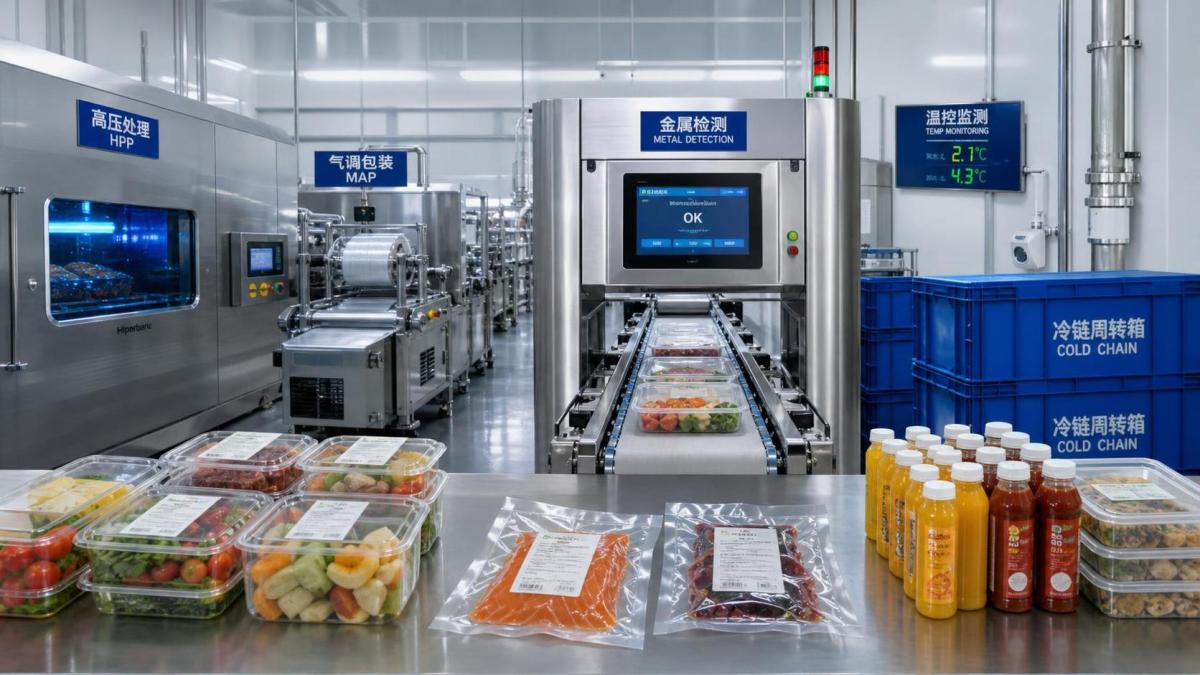
This is why food technology is moving toward system-based shelf-life control: better kill steps, better barrier packaging, smarter atmosphere management, improved hygienic design, data-backed cold chain control, and formulations that are intrinsically less supportive of spoilage even without classic preservatives.
The main technologies extending shelf life without added preservatives
Different food categories rely on different mechanisms, and quality teams should assess them by hazard profile rather than by trend value.
High-pressure processing (HPP)
HPP uses very high hydrostatic pressure, usually on packaged food, to reduce microbial load while avoiding the thermal damage associated with conventional heat treatment. It is widely discussed in chilled juices, ready meals, dips, sauces, and some meat products.
Its main advantage is that it can extend refrigerated shelf life while preserving sensory quality better than aggressive heat treatment. Its limitation is equally important: it is not a universal replacement for thermal sterilization, and product composition matters. Pressure tolerance differs across microorganisms, and post-process contamination remains a serious risk if packaging or handling control is weak.
For quality managers, HPP should be treated as a validated lethality or reduction step within a broader HACCP framework, not as a standalone guarantee.
Modified atmosphere packaging (MAP) and vacuum packaging
These technologies work by altering the gas environment around the product, commonly reducing oxygen and adjusting carbon dioxide and nitrogen levels to slow oxidation and suppress the growth of some spoilage organisms. In meat, bakery, fresh produce, cheese, and snack applications, the approach is already commercially significant.
The mistake many teams make is focusing on gas composition while underestimating seal quality, film permeability, pack geometry, residual oxygen, and temperature abuse. MAP is only as reliable as the weakest part of the package system. A nominal gas specification means very little if the product distribution cycle includes rough handling, condensation, or inconsistent storage temperatures.
Aseptic processing and ultra-high temperature systems
In beverages, dairy alternatives, liquid foods, and some sauces, shelf life can be extended substantially through sterile processing and sterile filling rather than added preservatives. When validated and well controlled, these systems allow long ambient shelf life.
But from a quality perspective, the control burden shifts upstream and into the filling environment. Sterility assurance, equipment maintenance, container integrity, and environmental hygiene become non-negotiable. Aseptic systems can deliver excellent shelf life, but deviations are unforgiving and investigation complexity is high.
Fermentation, pH control, and water activity management
Not all preservative-free shelf life comes from advanced machinery. Some of the oldest food technologies remain highly effective. Fermentation lowers pH and changes the microbial ecology of food. Water activity control through drying, solids concentration, salt, or sugar management reduces the availability of water needed for microbial growth.
These approaches are especially relevant because they are often more internationally transferable than highly capital-intensive systems. However, they are also frequently oversimplified. A low-pH product may still face yeast, mold, or acid-tolerant pathogen concerns depending on process and packaging. A low-water-activity product may still oxidize, stale, or absorb moisture during transport.
Natural antimicrobial systems and bio-protective cultures
Some manufacturers extend shelf life by using fermentation-derived protective cultures, enzymes, smoke fractions, vinegar systems, plant extracts, or other functional ingredients that are not positioned as conventional preservatives. Regulatory treatment and labeling treatment vary by jurisdiction, so this area requires careful review.
From a safety management standpoint, these systems should never be assumed to be equivalent across markets. An ingredient considered acceptable in one market’s clean-label strategy may trigger different labeling, additive, or claim questions elsewhere. For export programs, legal review should sit alongside technical validation.
Technology does not replace shelf-life validation
One of the most persistent misunderstandings in the market is that advanced processing automatically proves shelf life. It does not. It changes the spoilage pathway and risk profile, but evidence is still required.
For quality and safety teams, shelf-life determination should combine several layers of verification:
- microbiological challenge considerations where relevant;
- baseline shelf-life studies under intended storage conditions;
- abuse-condition testing reflecting real distribution variability;
- packaging integrity and seal performance checks;
- sensory and physicochemical stability review;
- trend analysis from market returns, complaints, and retained samples.
The right test plan depends on the product. For chilled RTE foods, Listeria control may be central. For high-fat snacks, oxidation may determine end of shelf life before microbiology does. For bakery products, mold growth and texture loss may compete as failure modes. A technology choice is only credible when it aligns with the actual reason the product fails.
Where standards and compliance become more demanding
When preservatives are reduced or removed, process controls usually come under closer scrutiny from auditors and buyers. This is especially true in private-label supply, export retail programs, and foodservice contracts.
Most manufacturers in international trade are already operating under GFSI-recognized scheme expectations such as BRCGS, FSSC 22000, or SQF. These schemes do not prohibit preservative-free strategies, but they do require documented hazard analysis, validation, verification, and change management. If shelf-life extension depends on a revised process, a new packaging material, or a different atmosphere profile, then the supporting records must be equally robust.
Jurisdiction-specific legal issues also matter. In the United States, low-acid and acidified food rules can be highly relevant for certain shelf-stable products. In the European Union, food information and additive rules shape how ingredients and claims are presented. Thermal process expectations, microbiological criteria, and food contact compliance may differ across markets. Companies should avoid assuming that a technically effective solution is automatically claim-safe or regulation-safe in every destination market.
Where a standard, regulation, or claim interpretation is market-specific and not internally confirmed, the prudent position is simple: mark it for review rather than force a global label strategy that later creates customs, retail, or legal friction.
What changes in the factory when preservatives are removed
In operational terms, moving away from preservatives usually increases dependence on consistency. The factory may need tighter zoning, faster cooling, reduced exposure time between process steps, stronger environmental monitoring, improved CIP verification, and stricter packaging line control.
This is often where implementation fails. Teams approve a new food technology based on pilot results, but the commercial line introduces variability that was not present during trials. Fill temperature drifts, headspace changes, line speed affects seal quality, or product pieces are larger than the validated heat penetration model assumed. Shelf life then becomes unstable not because the technology is ineffective, but because process reproducibility is weaker than expected.
Quality managers should therefore ask a more operational set of questions before approving a preservative-free shelf-life claim:
- What is the main spoilage or safety failure mode?
- Which processing or packaging factor is actually controlling it?
- How sensitive is the outcome to normal production variation?
- What are the measurable critical or quality limits?
- How quickly can deviations be detected and contained?
- Does the warehouse and transport network protect the validated conditions?
Cold chain remains decisive, even with better technology
Many shelf-life extension technologies reduce risk only if temperature discipline is maintained. This is especially true for HPP products, MAP chilled foods, fresh-cut produce, and minimally processed ready-to-eat items.
For exporters and importers, this is not only a technical issue but a supply chain one. A product may pass factory release yet lose meaningful shelf-life value during port dwell time, transshipment delay, regional distribution, or retail backroom abuse. In these cases, “no added preservatives” can narrow tolerance for logistics error.
That means shelf-life strategy should be integrated with logistics planning. Time-temperature indicators, continuous data logging, stricter palletization rules, and destination-specific shelf-life allocation are becoming more relevant than many companies expected. Quality teams increasingly need visibility beyond the plant gate.
Common errors in buyer and supplier communication
Across international supply chains, shelf life is often discussed too loosely. Buyers ask for longer shelf life and cleaner labels in the same sentence, while suppliers respond with technical claims that are not linked to validated market conditions.
Three communication errors appear repeatedly:
- treating “preservative-free” as a safety claim rather than a formulation description;
- quoting shelf life without stating storage conditions, packaging format, and distribution assumptions;
- failing to distinguish microbiological shelf life from sensory shelf life.
For quality documentation, those distinctions matter. A buyer may interpret a 90-day shelf life as commercially usable time on arrival, while the supplier validated 90 days from production under uninterrupted refrigeration. Unless those assumptions are aligned, complaint risk is built into the transaction.
How to judge whether a shelf-life technology is suitable
For technical teams, the best evaluation framework is rarely “Which technology is most advanced?” It is “Which control method is most reliable for this product, process, and route to market?”
A practical assessment should weigh:
- product intrinsic factors such as pH, water activity, fat content, and structure;
- target organisms and likely spoilage mechanisms;
- packaging compatibility and barrier requirements;
- line capability and repeatability;
- intended export route, dwell times, and temperature exposure;
- market-specific labeling and claim constraints;
- cost of validation, monitoring, and deviation management.
In some categories, a modest reformulation combined with better packaging may be more robust than a capital-intensive process change. In others, especially premium chilled products, advanced processing may justify itself by improving quality retention while supporting clean-label positioning. The right answer is usually category-specific and distribution-specific, not ideological.
What to watch next
The next phase of food technology is likely to make shelf-life control more measurable rather than simply more mechanical. Better inline sensors, digital traceability, package leak detection, predictive shelf-life modeling, and stronger integration between factory QA and cold-chain data will shape how preservative-free products are managed.
For quality control and food safety leaders, the strategic shift is clear. Shelf life is becoming less about one ingredient decision and more about a validated system of barriers. Companies that understand this can reduce additives without weakening control. Companies that chase the claim without upgrading process discipline will create instability, complaints, and compliance exposure.
The most reliable shelf-life gains still come from the same core principle: understand exactly why a product fails, then apply the right combination of process, packaging, formulation, and logistics controls. Food technology is making that combination more powerful. It is not making quality management optional.
 What industrial trade intelligence pricing should include before you subscribeIndustrial trade intelligence pricing explained: compare coverage, data quality, access rights, and workflow value before choosing a subscription that supports smarter trade decisions.
 How an industrial trade intelligence dashboard can identify new supplier marketsDiscover how an industrial trade intelligence dashboard helps identify new supplier markets by comparing capacity, landed cost, logistics resilience, and compliance risk.
 Which global market entry barriers should exporters assess first?Global market entry barriers exporters should assess first: tariffs, compliance, buyer qualification, logistics, and payment risk. Build a practical strategy for confident market entry.
 How trade data aggregation analytics can reveal emerging supplier marketsTrade data aggregation analytics reveals emerging supplier markets by connecting trade flows, capacity signals, logistics, and compliance insights for smarter sourcing decisions.
 When an export market analysis platform can validate demand in a new marketExport market analysis platform insights help validate new-market demand through buyer fit, regulations, logistics, competition, and profitable entry conditions.
 What is driving the beauty and personal care market in the USA?Beauty and personal care in USA is driven by targeted solutions, selective premiumization, digital discovery, clean-label trust, diverse needs, and compliance. Explore key growth opportunities.
 How trade flow monitoring reports reveal changing regional demandTrade flow monitoring reports reveal changing regional demand through import volumes, sourcing shifts, product mix, logistics signals, and regulatory trends. Explore actionable market insights.
 How international market intelligence for investors reduces market-entry riskInternational market intelligence for investors reduces market-entry risk by validating demand, regulations, logistics, and competition before capital is committed.
 How international sourcing intelligence helps identify supplier risk earlyInternational sourcing intelligence helps businesses spot supplier risks early, protect supply continuity, and make smarter global procurement decisions.
 How trade data aggregation analytics reveals emerging supplier marketsTrade data aggregation analytics reveals emerging supplier markets through export trends, input flows, logistics, and regulatory signals. Discover smarter sourcing insights.
 What industrial cluster monitoring in Vietnam reveals about site riskIndustrial cluster monitoring Vietnam reveals hidden site risks across labor, utilities, logistics, compliance, and supplier dependencies. Make smarter sourcing and expansion decisions.
 Food Technology Trends Reshaping Shelf Life, Safety, and Product InnovationFood technology is reshaping shelf life, safety, and innovation. Discover the trends helping food businesses cut risk, improve compliance, and unlock stronger global market growth.
 How electronics manufacturing services are changing with low-volume demandElectronics manufacturing services are evolving fast with low-volume demand. Learn how agile EMS partners improve flexibility, compliance, sourcing resilience, and speed to market.
 How Can Buyers Reduce Procurement Risks for Electronic Components?How to reduce procurement risks for electronic components: learn how buyers assess traceability, lead times, compliance, and supplier types to avoid costly sourcing mistakes.
 What Sourcing Intelligence India Reveals About Supplier Risk and Cost ShiftsSourcing intelligence India reveals hidden supplier risk, compliance gaps, logistics pressure, and real cost shifts—helping buyers compare vendors smarter and source with more confidence.
 Fashion Trends 2026: Which Materials, Colors, and Silhouettes Are Gaining Ground?Fashion trends 2026 spotlight tactile fabrics, mineral colors, and controlled volume. Explore the materials, shades, and silhouettes shaping smarter, more wearable style.
 Smart Device Market Outlook: Key Growth Drivers, Segments, and Business OpportunitiesSmart device market trends are shifting toward system value, industrial demand, and resilient supply chains. Explore key growth drivers, high-potential segments, and business opportunities.
 How Global Trade Intelligence Services Help B2B Firms Evaluate Markets and SuppliersGlobal trade intelligence services help B2B firms compare suppliers, assess market potential, and uncover compliance, logistics, and pricing risks before costly decisions are made.
 Manufacturing Sector Updates for Investors: What Signals Matter Most in 2025?Manufacturing sector updates for investors in 2025: track orders, margins, supply chains, regulation, and exports to spot resilient manufacturers and smarter investment signals.
 How Energy Market Intelligence Helps Businesses Track Price Risks and Demand ShiftsEnergy market intelligence helps businesses spot price risks, demand shifts, and supply pressure early—improving procurement, resilience, and faster strategic decisions.
 Precision Hardware Tools Market: Key Demand Drivers, Segments, and Growth OutlookPrecision hardware tools market trends are reshaping sourcing, compliance, and automation. Explore key demand drivers, segment shifts, regional supply patterns, and growth opportunities.





















Global Trade Insights & Industry
Our mission is to empower global exporters and importers with data-driven insights that foster strategic growth.
Search News
Popular Tags
Industry Overview
The global commercial kitchen equipment market is projected to reach $112 billion by 2027. Driven by urbanization, the rise of e-commerce food delivery, and strict hygiene regulations.