

Industrial Chemical Analysis Methods for Process Safety
Industrial chemical analysis plays a critical role in process safety by helping operators detect hazards, verify material consistency, and maintain stable production conditions. From identifying reactive substances to monitoring contamination and emission risks, the right analytical methods support safer decisions on the plant floor. In chemical processing, industrial chemical analysis is not only a laboratory task; it is a practical control tool that reduces incident probability, improves batch reliability, and strengthens compliance with safety, quality, and environmental requirements.
What does industrial chemical analysis mean in process safety?
Industrial chemical analysis refers to the use of analytical techniques to identify, quantify, and monitor chemical substances involved in production, storage, transport, and waste handling. In a process safety context, the objective goes beyond product quality. The goal is to understand how raw materials, intermediates, by-products, solvents, catalysts, and impurities behave under real operating conditions, especially when heat, pressure, mixing, or contamination can trigger dangerous reactions.
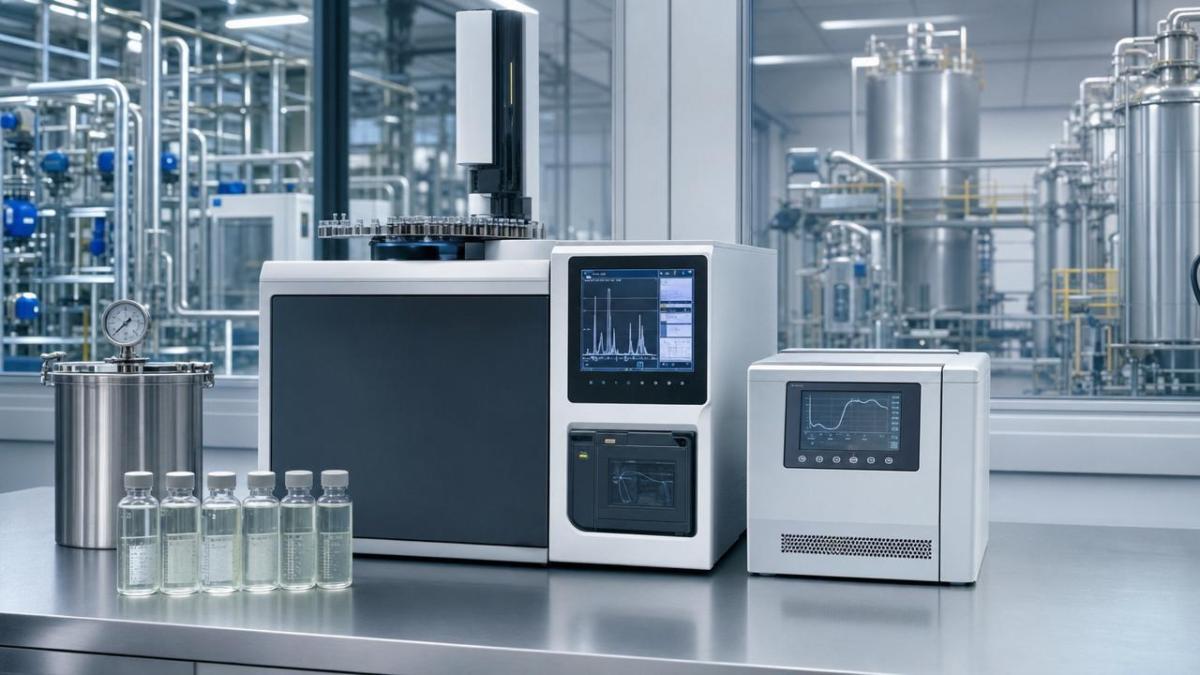
This makes industrial chemical analysis essential for hazard recognition. A plant may already know the target formula, yet small variations in moisture, acidity, oxidizer content, metal contamination, or residual monomer can change reaction kinetics and create runaway potential. Reliable analytical data helps verify feed composition before charging a reactor, confirm concentration during processing, and identify instability before it escalates into overpressure, fire, toxic release, or off-spec waste generation.
In practice, industrial chemical analysis supports three safety layers: prevention, monitoring, and response. Prevention includes incoming material verification and compatibility checks. Monitoring includes in-process measurements such as pH, conductivity, spectroscopy, and gas composition. Response includes incident investigation, residue testing, and root-cause confirmation after an upset. When these layers are integrated, safety decisions become faster and more evidence-based.
Which industrial chemical analysis methods are most useful for identifying hazards?
The best industrial chemical analysis methods depend on the hazard profile, the material state, and the speed required. No single method covers every risk, so chemical operations often combine screening techniques with confirmatory tests.
- Gas chromatography (GC): useful for volatile organic compounds, solvent purity, residual monomers, and contamination tracing.
- High-performance liquid chromatography (HPLC): suitable for non-volatile compounds, degradation products, stabilizers, and impurity profiling.
- Fourier transform infrared spectroscopy (FTIR): effective for fast material identification, functional group confirmation, and abnormal batch comparison.
- Mass spectrometry (MS): supports trace-level identification when unknown contaminants or decomposition products are suspected.
- Thermal analysis such as DSC and TGA: critical for evaluating exothermic behavior, decomposition onset, and thermal stability.
- Titration and wet chemistry: still highly practical for acidity, alkalinity, oxidant value, water content, and active ingredient checks.
- Online sensors: pH, dissolved oxygen, conductivity, and process gas analyzers provide real-time insight where speed matters most.
For process safety, thermal methods deserve special attention. A material that appears chemically correct may still have dangerous heat-release behavior. Differential scanning calorimetry can reveal whether a mixture starts decomposing near the intended process temperature. Thermogravimetric analysis can show weight loss linked to solvent evaporation or decomposition. These results are often more safety-relevant than composition data alone.
Gas analysis is equally important in confined systems. Monitoring oxygen, hydrogen, carbon monoxide, volatile hydrocarbons, and acid gases helps identify flammability, poisoning risk, and incomplete reaction. In storage and transfer operations, industrial chemical analysis of vapor space and vent streams can prevent ignition hazards and support emission compliance at the same time.
How do you choose the right industrial chemical analysis method for a chemical process?
Method selection should start with the process question, not the instrument. If the main concern is reactivity, thermal analysis and compatibility testing may be more valuable than detailed chromatographic profiling. If contamination is the key risk, trace detection methods with strong specificity become more important. Good industrial chemical analysis aligns the method with decision time, sample matrix, required detection limit, and consequence of error.
A practical selection framework includes:
Sampling strategy matters as much as method selection. An accurate laboratory method cannot compensate for a poor sample that misses stratification, settling, vapor loss, or contamination during transfer. In hazardous chemical systems, samples should be representative of temperature, phase, and location. Where manual sampling adds exposure risk or delays control action, at-line or online industrial chemical analysis can provide better safety value than high-precision offline testing.
What are the most common mistakes when using industrial chemical analysis for safety decisions?
One common mistake is treating quality analysis as a full substitute for safety analysis. A batch can meet composition specifications and still pose a hazard because of instability, incompatible trace metals, peroxide formation, or unexpected moisture sensitivity. Industrial chemical analysis for process safety must address behavior, not just identity and purity.
Another mistake is relying on delayed data. If a reaction can drift into an unsafe zone within minutes, end-of-shift laboratory results arrive too late. In such cases, faster screening methods or continuous analyzers may be less detailed but far more useful. Speed, actionability, and alarm integration should be part of the analysis design.
A third issue is ignoring matrix effects. Chemical samples from industrial environments are rarely clean. High solids, emulsions, corrosive media, and mixed solvents can distort results if the method was developed only under ideal laboratory conditions. Validation under real process conditions is essential. Calibration should also be reviewed when feedstock changes, catalysts age, or cleaning chemistry is modified.
There is also a governance risk: analytical data may exist, but it is not connected to operating limits, management of change, or incident learning. The strongest industrial chemical analysis program links test results to explicit actions, such as hold points, charge approvals, temperature restrictions, venting requirements, or waste segregation rules.
How can industrial chemical analysis improve compliance and long-term operational control?
Industrial chemical analysis supports compliance by documenting what is being produced, emitted, stored, and discarded. This is valuable for environmental permits, hazardous waste classification, transport documentation, and occupational exposure management. Consistent analytical records help demonstrate due diligence and provide defensible evidence during audits, inspections, and incident reviews.
Over the long term, trend-based industrial chemical analysis often reveals weak signals before they become safety events. A slow increase in chloride contamination may forecast corrosion risk. Rising peroxide values may point to storage instability. Small shifts in solvent profile may indicate leakback, cross-contamination, or incomplete separation. When these trends are reviewed routinely, corrective action can be taken before the process enters a dangerous condition.
A strong program usually includes baseline characterization, critical parameter limits, scheduled verification, exception escalation, and periodic method review. It should also define which deviations require shutdown, rework, isolation, or engineering review. This turns industrial chemical analysis into an operational discipline rather than a disconnected laboratory function.
What is a practical implementation plan for safer chemical operations?
An effective starting point is to map the process by hazard stage: incoming materials, storage, charging, reaction, separation, packaging, and waste handling. For each stage, identify what must be known to avoid unsafe decisions. Then assign the most suitable industrial chemical analysis method to each control point.
- Define critical hazards such as runaway reaction, toxic gas release, corrosion, incompatibility, or dust explosion contribution.
- Set action limits for temperature-sensitive species, impurities, moisture, oxidizers, or residual reactants.
- Choose a mix of offline, at-line, and online industrial chemical analysis tools based on response time.
- Validate sampling methods under actual plant conditions, not only in the laboratory.
- Connect analytical alarms and exceptions to operating procedures and escalation paths.
- Review trends after feedstock, equipment, solvent, or recipe changes.
For broader market intelligence on chemical operations, safety expectations, and industrial trends across global supply chains, GTIIN and TradeVantage provide data-driven visibility that helps strengthen technical decision-making and digital trust. Combining internal plant data with external industry intelligence creates a more resilient foundation for process safety planning.
Quick FAQ summary table
Industrial chemical analysis is one of the most practical ways to reduce uncertainty in chemical processing. When methods are chosen according to hazard type, sampling is representative, and results are tied to operating actions, analysis becomes a frontline safety control rather than a back-office report. The next step is to review the highest-risk process stages, identify where faster or more relevant industrial chemical analysis is needed, and build those checkpoints into everyday operating discipline.
 How an industrial trade intelligence dashboard can identify new supplier marketsDiscover how an industrial trade intelligence dashboard helps identify new supplier markets by comparing capacity, landed cost, logistics resilience, and compliance risk.
 Which global market entry barriers should exporters assess first?Global market entry barriers exporters should assess first: tariffs, compliance, buyer qualification, logistics, and payment risk. Build a practical strategy for confident market entry.
 How trade data aggregation analytics can reveal emerging supplier marketsTrade data aggregation analytics reveals emerging supplier markets by connecting trade flows, capacity signals, logistics, and compliance insights for smarter sourcing decisions.
 When an export market analysis platform can validate demand in a new marketExport market analysis platform insights help validate new-market demand through buyer fit, regulations, logistics, competition, and profitable entry conditions.
 What is driving the beauty and personal care market in the USA?Beauty and personal care in USA is driven by targeted solutions, selective premiumization, digital discovery, clean-label trust, diverse needs, and compliance. Explore key growth opportunities.
 How trade flow monitoring reports reveal changing regional demandTrade flow monitoring reports reveal changing regional demand through import volumes, sourcing shifts, product mix, logistics signals, and regulatory trends. Explore actionable market insights.
 How international market intelligence for investors reduces market-entry riskInternational market intelligence for investors reduces market-entry risk by validating demand, regulations, logistics, and competition before capital is committed.
 How international sourcing intelligence helps identify supplier risk earlyInternational sourcing intelligence helps businesses spot supplier risks early, protect supply continuity, and make smarter global procurement decisions.
 How trade data aggregation analytics reveals emerging supplier marketsTrade data aggregation analytics reveals emerging supplier markets through export trends, input flows, logistics, and regulatory signals. Discover smarter sourcing insights.
 What industrial cluster monitoring in Vietnam reveals about site riskIndustrial cluster monitoring Vietnam reveals hidden site risks across labor, utilities, logistics, compliance, and supplier dependencies. Make smarter sourcing and expansion decisions.
 Food Technology Trends Reshaping Shelf Life, Safety, and Product InnovationFood technology is reshaping shelf life, safety, and innovation. Discover the trends helping food businesses cut risk, improve compliance, and unlock stronger global market growth.
 How electronics manufacturing services are changing with low-volume demandElectronics manufacturing services are evolving fast with low-volume demand. Learn how agile EMS partners improve flexibility, compliance, sourcing resilience, and speed to market.
 How Can Buyers Reduce Procurement Risks for Electronic Components?How to reduce procurement risks for electronic components: learn how buyers assess traceability, lead times, compliance, and supplier types to avoid costly sourcing mistakes.
 What Sourcing Intelligence India Reveals About Supplier Risk and Cost ShiftsSourcing intelligence India reveals hidden supplier risk, compliance gaps, logistics pressure, and real cost shifts—helping buyers compare vendors smarter and source with more confidence.
 Fashion Trends 2026: Which Materials, Colors, and Silhouettes Are Gaining Ground?Fashion trends 2026 spotlight tactile fabrics, mineral colors, and controlled volume. Explore the materials, shades, and silhouettes shaping smarter, more wearable style.
 Smart Device Market Outlook: Key Growth Drivers, Segments, and Business OpportunitiesSmart device market trends are shifting toward system value, industrial demand, and resilient supply chains. Explore key growth drivers, high-potential segments, and business opportunities.
 How Global Trade Intelligence Services Help B2B Firms Evaluate Markets and SuppliersGlobal trade intelligence services help B2B firms compare suppliers, assess market potential, and uncover compliance, logistics, and pricing risks before costly decisions are made.
 Manufacturing Sector Updates for Investors: What Signals Matter Most in 2025?Manufacturing sector updates for investors in 2025: track orders, margins, supply chains, regulation, and exports to spot resilient manufacturers and smarter investment signals.
 How Energy Market Intelligence Helps Businesses Track Price Risks and Demand ShiftsEnergy market intelligence helps businesses spot price risks, demand shifts, and supply pressure early—improving procurement, resilience, and faster strategic decisions.
 Precision Hardware Tools Market: Key Demand Drivers, Segments, and Growth OutlookPrecision hardware tools market trends are reshaping sourcing, compliance, and automation. Explore key demand drivers, segment shifts, regional supply patterns, and growth opportunities.
 How to Use Customs Import Data to Find Buyers, Track Competitors, and Spot Demand?Customs import data helps you find real buyers, track competitors, and spot demand shifts early. Learn practical ways to turn trade records into smarter global business decisions.





















Global Trade Insights & Industry
Our mission is to empower global exporters and importers with data-driven insights that foster strategic growth.
Search News
Popular Tags
Industry Overview
The global commercial kitchen equipment market is projected to reach $112 billion by 2027. Driven by urbanization, the rise of e-commerce food delivery, and strict hygiene regulations.