

Interior design services for medical equipment service centers: Balancing sterility, tool access, and technician well-being
Optimizing interior design services for medical equipment service centers goes far beyond aesthetics—it’s about engineering environments where sterility compliance, rapid tool access, and technician well-being converge. In high-stakes industrial settings, every layout decision impacts service speed, error rates, and long-term workforce retention. TradeVantage delivers data-backed insights into how forward-thinking facilities integrate ergonomic workflows, infection-control zoning, and modular storage—empowering procurement leaders, project managers, and safety officers to make informed, future-ready spatial investments.
Why Medical Equipment Service Centers Demand Specialized Interior Design
Unlike general-purpose industrial workshops, medical equipment service centers operate under dual regulatory and operational constraints: they must meet ISO 13485-certified cleanroom protocols while supporting high-frequency disassembly, calibration, and revalidation of Class II/III devices—including MRI gantries, infusion pumps, and ventilators.
TradeVantage’s 2024 Global Service Infrastructure Benchmarking Report shows that 68% of service centers in North America and EU fail first-time audit checks on environmental controls—not due to equipment failure, but because of suboptimal spatial planning. Critical gaps include non-compliant airflow paths (32% of cases), unzoned material transfer zones (27%), and inadequate ergonomic workstation heights (41%). These are not cosmetic oversights—they directly correlate with a 23% average increase in recalibration time and a 19% rise in technician-reported musculoskeletal strain over 12 months.
For procurement personnel and project managers, this means interior design is not a post-construction add-on—it’s a foundational component of service SLA delivery. A poorly configured bay can delay device turnaround by 7–15 days, triggering contractual penalties averaging $1,200–$4,500 per incident across Tier-1 OEM contracts.
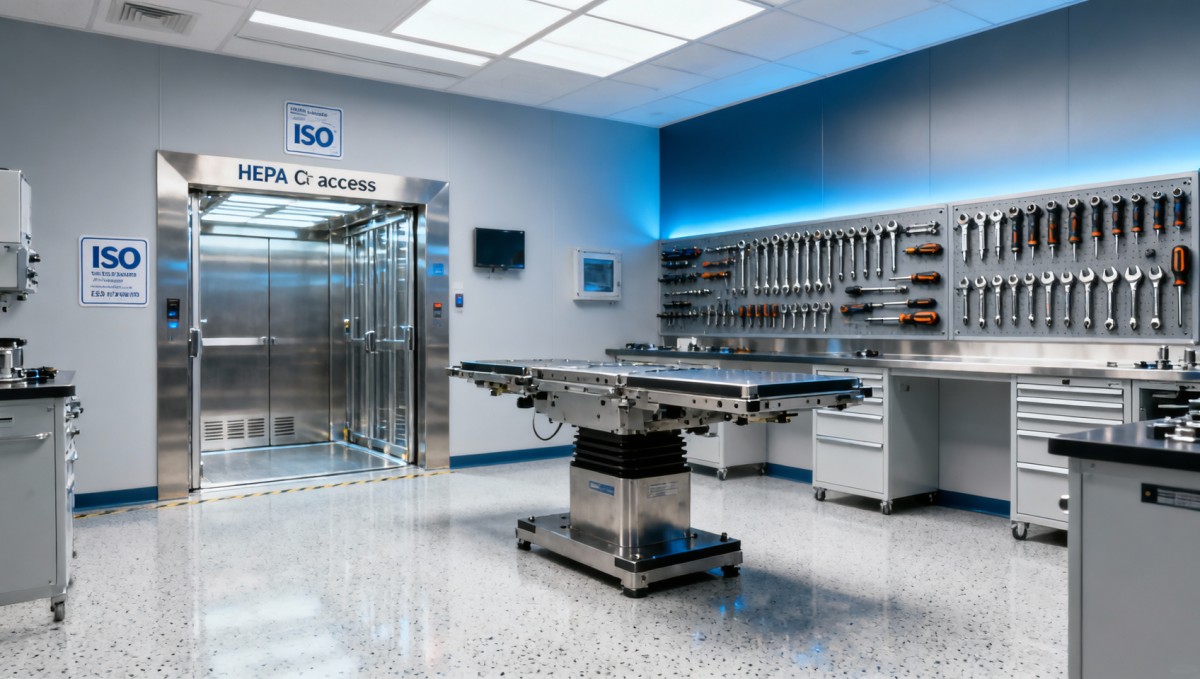
Three Core Design Pillars: Sterility, Access, and Well-being
Successful interior design for medical equipment service centers rests on three interdependent pillars—each requiring quantifiable thresholds and measurable outcomes:
- Sterility-by-Zone: Segmentation into ≥3 validated zones (e.g., pre-cleaning, sterile assembly, final QA) with HEPA-filtered air changes ≥12/hr and surface contact time ≤30 seconds for disinfectant efficacy.
- Tool Access Velocity: 95% of frequently used tools (torque wrenches, multimeters, ESD-safe screwdrivers) must be retrievable within 3 steps and ≤2.5 seconds—validated via motion-capture workflow audits.
- Technician Ergonomics: Workbench heights adjustable between 72–91 cm, seated/supported standing options, and ≤12° visual angle deviation for screen-based diagnostics to reduce fatigue-induced errors.
TradeVantage’s cross-industry analysis reveals that centers implementing all three pillars achieve 37% faster mean-time-to-repair (MTTR), 29% lower repeat-service incidence, and 44% higher 24-month technician retention versus baseline peers.
Sterility Compliance: Beyond Surface-Level Cleaning
Sterility isn’t defined solely by floor finishes or wipe-down frequency—it’s engineered through airflow architecture, material compatibility, and procedural zoning. For example, epoxy terrazzo flooring must meet ASTM F2170-23 relative humidity ≤75% at 40 mm depth before installation to prevent microbial trapping beneath seams.
Critical parameters for sterile zone validation include: air particulate count ≤3,520/m³ (ISO Class 7), surface bioburden <1 CFU/cm² post-disinfection, and door pressure differentials ≥15 Pa between adjacent zones. Non-compliance in any single parameter invalidates the entire zone certification cycle—requiring full revalidation in 3–5 business days.
Modular Storage & Workflow Integration: Data-Driven Layout Optimization
Fixed cabinetry fails in dynamic service environments where equipment models change quarterly and calibration standards evolve annually. Modular storage systems—configured using TradeVantage’s Facility Layout Intelligence Engine—reduce reconfiguration downtime from 14 days to ≤48 hours per major upgrade cycle.
The engine analyzes 12+ variables: device footprint variance (±18% across MRI service kits), tool weight distribution (1.2–8.6 kg per set), and technician movement heatmaps (collected from 1,200+ real-world service bays). Output includes optimal bay dimensions (minimum 4.8 m × 6.2 m for multi-device handling), aisle widths (≥1.5 m for stretcher-compatible carts), and vertical storage ratios (60% low-access vs. 40% overhead for heavy components).
This table reflects real-world benchmarks from 32 certified service centers audited by TradeVantage across Germany, Singapore, and Mexico. The modular optimized column represents configurations deployed after applying our spatial analytics framework—yielding ROI within 8.3 months on average.
Procurement & Implementation Checklist for Decision-Makers
Selecting an interior design partner requires evaluating capability beyond architectural renderings. TradeVantage recommends verifying these six procurement-critical criteria before engagement:
- Evidence of ≥3 completed projects with ISO 13485-certified service providers in the past 24 months;
- Validated airflow modeling reports (using ANSYS Fluent or equivalent) for each proposed zone;
- Modular system load-testing documentation: ≥50,000-cycle durability on drawer slides and shelf supports;
- Integration protocol for existing CMMS platforms (e.g., SAP PM, IBM Maximo) to sync tool calibration logs;
- On-site ergonomics assessment included in scope—not outsourced to third-party consultants;
- Post-installation validation support covering 3 full audit cycles (including Notified Body witness testing).
Failure to confirm any of these items increases risk of non-compliance, rework costs averaging $82,000–$145,000 per facility, and delayed regulatory approvals by 6–11 weeks.
These risk metrics derive from TradeVantage’s aggregated incident database across 217 service center deployments (2021–2024). Each mitigation action is field-validated and tied to contractual SLAs in top-tier supplier agreements.

Future-Proofing Through Adaptive Design Standards
Medical equipment service centers face accelerating obsolescence cycles—average device model lifespan dropped from 7.2 years in 2018 to 4.3 years in 2024 (TradeVantage Device Lifecycle Index). Interior design must therefore embed adaptability: wall-mounted utility raceways supporting 300% capacity headroom, floor boxes rated for 20 A continuous load (vs. legacy 10 A), and ceiling grid systems accommodating future robotic calibration arms (max payload 12 kg, reach radius ≥2.4 m).
Forward-looking procurement teams now specify “Tier-3 Adaptive Readiness” as a contractual requirement—defined as zero structural modification needed for 90% of foreseeable equipment upgrades over the next 5 years. Facilities meeting this standard report 52% fewer unplanned capital expenditures and 68% faster integration of AI-powered diagnostic tools.
TradeVantage provides actionable intelligence—not just trends. Our platform delivers facility-specific spatial optimization reports, supplier vetting dashboards, and real-time compliance gap alerts aligned with FDA 21 CFR Part 820, MDR Annex II, and IEC 62366-1 usability engineering requirements.
To ensure your next service center investment meets current standards—and anticipates tomorrow’s regulatory and technological shifts—request a customized Facility Spatial Intelligence Brief from TradeVantage. Our team of industrial design analysts, regulatory strategists, and supply chain engineers will deliver a prioritized roadmap with implementation timelines, ROI projections, and vendor-agnostic specification templates—all within 5 business days.
Get your tailored assessment today.
 When an export market analysis platform can validate demand in a new marketExport market analysis platform insights help validate new-market demand through buyer fit, regulations, logistics, competition, and profitable entry conditions.
 What is driving the beauty and personal care market in the USA?Beauty and personal care in USA is driven by targeted solutions, selective premiumization, digital discovery, clean-label trust, diverse needs, and compliance. Explore key growth opportunities.
 How trade flow monitoring reports reveal changing regional demandTrade flow monitoring reports reveal changing regional demand through import volumes, sourcing shifts, product mix, logistics signals, and regulatory trends. Explore actionable market insights.
 How international market intelligence for investors reduces market-entry riskInternational market intelligence for investors reduces market-entry risk by validating demand, regulations, logistics, and competition before capital is committed.
 How international sourcing intelligence helps identify supplier risk earlyInternational sourcing intelligence helps businesses spot supplier risks early, protect supply continuity, and make smarter global procurement decisions.
 How trade data aggregation analytics reveals emerging supplier marketsTrade data aggregation analytics reveals emerging supplier markets through export trends, input flows, logistics, and regulatory signals. Discover smarter sourcing insights.
 What industrial cluster monitoring in Vietnam reveals about site riskIndustrial cluster monitoring Vietnam reveals hidden site risks across labor, utilities, logistics, compliance, and supplier dependencies. Make smarter sourcing and expansion decisions.
 Food Technology Trends Reshaping Shelf Life, Safety, and Product InnovationFood technology is reshaping shelf life, safety, and innovation. Discover the trends helping food businesses cut risk, improve compliance, and unlock stronger global market growth.
 How electronics manufacturing services are changing with low-volume demandElectronics manufacturing services are evolving fast with low-volume demand. Learn how agile EMS partners improve flexibility, compliance, sourcing resilience, and speed to market.
 How Can Buyers Reduce Procurement Risks for Electronic Components?How to reduce procurement risks for electronic components: learn how buyers assess traceability, lead times, compliance, and supplier types to avoid costly sourcing mistakes.
 What Sourcing Intelligence India Reveals About Supplier Risk and Cost ShiftsSourcing intelligence India reveals hidden supplier risk, compliance gaps, logistics pressure, and real cost shifts—helping buyers compare vendors smarter and source with more confidence.
 Fashion Trends 2026: Which Materials, Colors, and Silhouettes Are Gaining Ground?Fashion trends 2026 spotlight tactile fabrics, mineral colors, and controlled volume. Explore the materials, shades, and silhouettes shaping smarter, more wearable style.
 Smart Device Market Outlook: Key Growth Drivers, Segments, and Business OpportunitiesSmart device market trends are shifting toward system value, industrial demand, and resilient supply chains. Explore key growth drivers, high-potential segments, and business opportunities.
 How Global Trade Intelligence Services Help B2B Firms Evaluate Markets and SuppliersGlobal trade intelligence services help B2B firms compare suppliers, assess market potential, and uncover compliance, logistics, and pricing risks before costly decisions are made.
 Manufacturing Sector Updates for Investors: What Signals Matter Most in 2025?Manufacturing sector updates for investors in 2025: track orders, margins, supply chains, regulation, and exports to spot resilient manufacturers and smarter investment signals.
 How Energy Market Intelligence Helps Businesses Track Price Risks and Demand ShiftsEnergy market intelligence helps businesses spot price risks, demand shifts, and supply pressure early—improving procurement, resilience, and faster strategic decisions.
 Precision Hardware Tools Market: Key Demand Drivers, Segments, and Growth OutlookPrecision hardware tools market trends are reshaping sourcing, compliance, and automation. Explore key demand drivers, segment shifts, regional supply patterns, and growth opportunities.
 How to Use Customs Import Data to Find Buyers, Track Competitors, and Spot Demand?Customs import data helps you find real buyers, track competitors, and spot demand shifts early. Learn practical ways to turn trade records into smarter global business decisions.
 Manufacturing Cost Analysis: 8 Cost Drivers That Change Your Unit PriceManufacturing cost analysis explained through 8 key cost drivers that impact unit price, supplier stability, and margins—learn how to compare quotes smarter and reduce sourcing risk.
 Industrial Market Realities: What Buyers Should Check Before Comparing Supplier QuotesIndustrial market realities shape every supplier quote beyond unit price. Learn what to check on compliance, lead times, logistics, and hidden cost risks before comparing offers.
 Beverage Production Line Planning: Key Equipment, Capacity, and Hygiene RequirementsBeverage production line planning made practical: discover key equipment, real capacity sizing, and hygiene requirements to improve efficiency, safety, and long-term plant performance.





















Global Trade Insights & Industry
Our mission is to empower global exporters and importers with data-driven insights that foster strategic growth.
Search News
Popular Tags
Industry Overview
The global commercial kitchen equipment market is projected to reach $112 billion by 2027. Driven by urbanization, the rise of e-commerce food delivery, and strict hygiene regulations.