

Why Certification and Material Traceability Matter When Selecting a 3D Printing Manufacturer for Medical Equipment Parts
Choosing the right 3D printing manufacturer for medical equipment parts isn’t just about precision—it’s about compliance, accountability, and patient safety. With stringent FDA, ISO 13485, and MDR requirements, certification and full material traceability are non-negotiable. This article explores why these factors critically impact regulatory approval, risk mitigation, and long-term supply chain resilience—especially for procurement teams, quality managers, and engineering decision-makers evaluating global 3D printing manufacturer partners.
Why Certification Is a Regulatory Gatekeeper—Not Just a Checkbox
In medical device manufacturing, certification isn’t decorative—it’s the foundational layer of legal market access. ISO 13485:2016 certification confirms that a supplier maintains a quality management system specifically designed for medical devices. Unlike generic ISO 9001, it mandates documented procedures for design history files, risk management (per ISO 14971), and post-market surveillance—each directly tied to FDA 21 CFR Part 820 and EU MDR Article 10.
A certified manufacturer must demonstrate control across all 6 key process stages: raw material receipt, storage, processing, inspection, packaging, and release. For example, audit-ready records—including batch-specific calibration logs for SLS or DMLS machines—must be retained for minimum retention periods: 2 years post-device expiration (FDA) or 15 years post-last-unit-sale (MDR). Without this, even technically flawless parts face rejection during Notified Body review.
Non-certified suppliers may offer lower quotes, but they introduce critical delays: average time-to-approval increases by 7–15 days when certification documentation is incomplete or inconsistent. That delay compounds across product lines—especially problematic for Class II/III devices requiring Design Verification Reports (DVRs) linked to certified processes.
Key Certification Requirements by Market
This table highlights how certification standards diverge—not in principle, but in enforcement depth. A manufacturer compliant only with ISO 9001 fails at the first gate: no regulatory body accepts it for implantables or life-supporting equipment. TradeVantage’s real-time intelligence dashboard tracks over 320 certified 3D printing facilities globally, cross-referencing their latest audit outcomes, scope limitations, and geographic service coverage—enabling procurement teams to filter by exact certification validity date and device class authorization.

Material Traceability: From Powder Batch to Patient Outcome
Traceability in additive manufacturing goes far beyond serial numbers. It’s the unbroken digital thread linking each gram of Ti-6Al-4V powder to its original smelting furnace, oxygen content (<0.13%), particle size distribution (D10/D50/D90), and laser scan path parameters used in the build chamber. Without this, failure analysis becomes speculative—not actionable.
Consider a spinal cage printed via EBM: if microfractures appear in clinical use, regulators require root cause analysis down to the powder lot’s hydrogen content (max 0.015%) and thermal history. A traceable supplier provides a complete “digital twin dossier” within 24 hours—including machine log files, environmental sensor data (chamber O₂ < 100 ppm), and post-build HIP cycle reports. Non-traceable vendors often deliver only a generic CoC—leaving OEMs exposed to Class I recalls costing $2.6M+ on average (PwC 2023 MedTech Recall Report).
Effective traceability requires integration across 4 systems: ERP (for order/batch linkage), MES (for machine-level parameter logging), LIMS (for material testing), and blockchain-enabled audit trails (for immutable timestamping). Leading manufacturers implement real-time dashboards showing live traceability status across 5 build chambers—critical for multi-site production of ventilator components or surgical guides.
What Full Traceability Includes—And Why Gaps Matter
- Raw material certificate of conformance (CoC) with full chemical composition and mechanical test results (tensile/yield/elongation at break)
- Build-specific process parameters: laser power (195–205 W), scan speed (1.2–1.8 m/s), layer thickness (30–45 µm), and inert gas flow rate (12–15 L/min)
- Post-processing records: stress relief (2h @ 750°C), HIP cycle (4h @ 920°C/105 MPa), surface roughness Ra (≤2.5 µm), and final dimensional CMM report
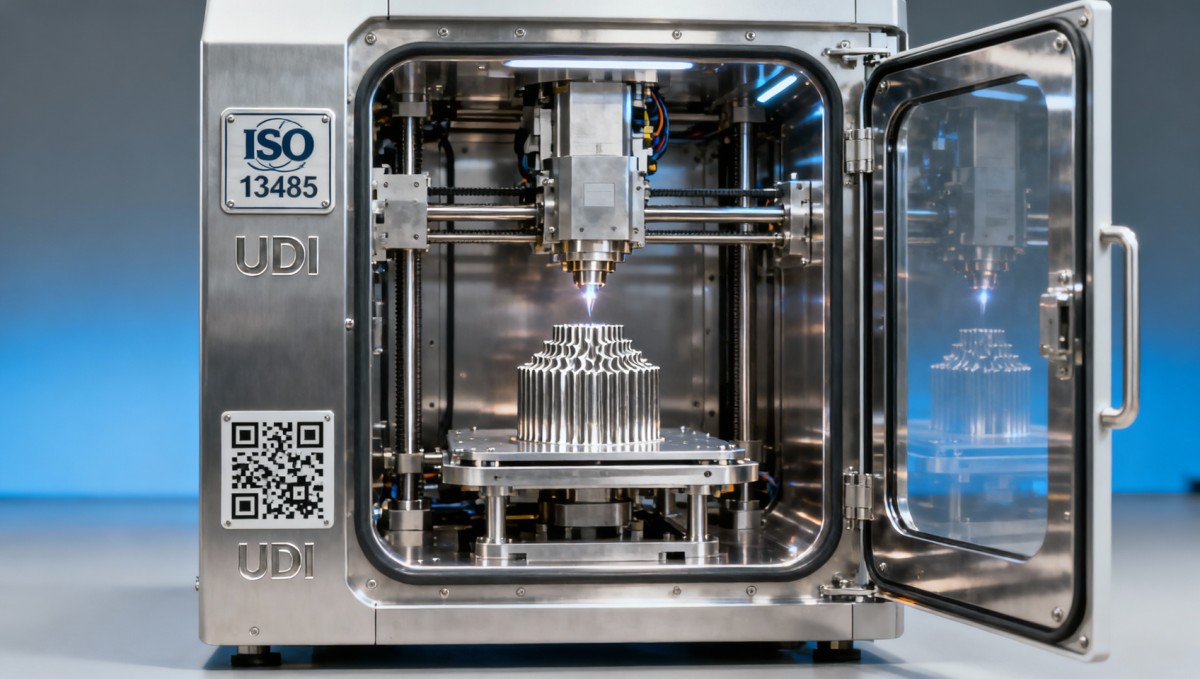
- Device-level serialization: UDI-DI embedded in part geometry or QR code, mapped to build ID, operator ID, and QA sign-off timestamp
Procurement Teams: 5 Non-Negotiable Checks Before Vendor Shortlisting
When sourcing 3D printed medical parts, procurement professionals must move beyond RFQ price comparisons. These 5 verification steps separate compliant partners from high-risk outliers:
- Certification Validity Audit: Confirm ISO 13485 scope explicitly covers “additive manufactured medical devices”—not just “machined components.” Check current certificate issue/expiry dates via official registrar portals (e.g., BSI, TÜV SÜD).
- Traceability Demo Request: Ask for a live walkthrough of one completed build’s traceability record—from powder lot ID through final inspection. Reject vendors unable to show full chain in under 5 minutes.
- Change Control Protocol Review: Verify documented procedure for material/process changes (e.g., switching from Grade 5 to Grade 23 Ti alloy). Requires re-validation within 72 business hours per MDR Annex XIV.
- Supplier Qualification Depth: Ensure sub-tier material suppliers (e.g., powder producers) are themselves ISO 13485-certified—not just ISO 9001.
- Regulatory Support SLA: Require written commitment for audit response: ≤48h for FDA Form 483 follow-up, ≤72h for MDR Notified Body queries.
TradeVantage’s proprietary Supplier Intelligence Index evaluates over 1,800 global 3D printing providers across 12 compliance dimensions—including real-time certificate status, traceability system maturity (rated 1–5), and historical audit outcome transparency. Users can instantly compare 3 vendors side-by-side using our interactive matrix—filtering by FDA clearance history, CE marking scope, and regional warehouse presence.
Why TradeVantage Is Your Trusted Partner in Medical Device Sourcing
Selecting a 3D printing partner for regulated medical applications demands more than technical capability—it requires verified trust signals recognized by global regulators and search algorithms alike. TradeVantage delivers precisely that: a high-authority, data-verified intelligence layer built for industrial buyers navigating complex compliance landscapes.
Our platform aggregates and validates real-time certification status, material traceability infrastructure maturity, and regulatory incident history across 50+ industrial sectors—including orthopedics, diagnostics, and life-support equipment. Unlike generic directories, we verify claims via cross-reference with official registrar databases, customs records, and third-party audit summaries—giving you confidence before the first RFQ.
Whether you need help identifying ISO 13485-certified metal AM providers in Germany with HIP capability, comparing traceability documentation depth across 5 Asian suppliers, or validating a vendor’s MDR Annex XVI conformity statement—we provide actionable insights, not just listings. Our team supports your next step with:
- Custom shortlist generation based on your exact device classification (Class I/IIa/IIb/III), material specs (e.g., CoCrMP, PEEK-OPTIMA), and delivery timeline (standard: 3–4 weeks; expedited: 7–10 business days)
- Free regulatory alignment check: We map your target market requirements (FDA 510(k)/De Novo vs. EU MDR Class III) to supplier certification scope and traceability readiness
- Direct access to verified supplier contacts—including quality managers and regulatory affairs leads—pre-vetted for responsiveness and technical fluency
Ready to accelerate your medical device component sourcing—with zero compliance guesswork? Contact TradeVantage today for a free supplier intelligence briefing tailored to your specific 3D printing part requirements, target markets, and certification deadlines.
 When an export market analysis platform can validate demand in a new marketExport market analysis platform insights help validate new-market demand through buyer fit, regulations, logistics, competition, and profitable entry conditions.
 What is driving the beauty and personal care market in the USA?Beauty and personal care in USA is driven by targeted solutions, selective premiumization, digital discovery, clean-label trust, diverse needs, and compliance. Explore key growth opportunities.
 How trade flow monitoring reports reveal changing regional demandTrade flow monitoring reports reveal changing regional demand through import volumes, sourcing shifts, product mix, logistics signals, and regulatory trends. Explore actionable market insights.
 How international market intelligence for investors reduces market-entry riskInternational market intelligence for investors reduces market-entry risk by validating demand, regulations, logistics, and competition before capital is committed.
 How international sourcing intelligence helps identify supplier risk earlyInternational sourcing intelligence helps businesses spot supplier risks early, protect supply continuity, and make smarter global procurement decisions.
 How trade data aggregation analytics reveals emerging supplier marketsTrade data aggregation analytics reveals emerging supplier markets through export trends, input flows, logistics, and regulatory signals. Discover smarter sourcing insights.
 What industrial cluster monitoring in Vietnam reveals about site riskIndustrial cluster monitoring Vietnam reveals hidden site risks across labor, utilities, logistics, compliance, and supplier dependencies. Make smarter sourcing and expansion decisions.
 Food Technology Trends Reshaping Shelf Life, Safety, and Product InnovationFood technology is reshaping shelf life, safety, and innovation. Discover the trends helping food businesses cut risk, improve compliance, and unlock stronger global market growth.
 How electronics manufacturing services are changing with low-volume demandElectronics manufacturing services are evolving fast with low-volume demand. Learn how agile EMS partners improve flexibility, compliance, sourcing resilience, and speed to market.
 How Can Buyers Reduce Procurement Risks for Electronic Components?How to reduce procurement risks for electronic components: learn how buyers assess traceability, lead times, compliance, and supplier types to avoid costly sourcing mistakes.
 What Sourcing Intelligence India Reveals About Supplier Risk and Cost ShiftsSourcing intelligence India reveals hidden supplier risk, compliance gaps, logistics pressure, and real cost shifts—helping buyers compare vendors smarter and source with more confidence.
 Fashion Trends 2026: Which Materials, Colors, and Silhouettes Are Gaining Ground?Fashion trends 2026 spotlight tactile fabrics, mineral colors, and controlled volume. Explore the materials, shades, and silhouettes shaping smarter, more wearable style.
 Smart Device Market Outlook: Key Growth Drivers, Segments, and Business OpportunitiesSmart device market trends are shifting toward system value, industrial demand, and resilient supply chains. Explore key growth drivers, high-potential segments, and business opportunities.
 How Global Trade Intelligence Services Help B2B Firms Evaluate Markets and SuppliersGlobal trade intelligence services help B2B firms compare suppliers, assess market potential, and uncover compliance, logistics, and pricing risks before costly decisions are made.
 Manufacturing Sector Updates for Investors: What Signals Matter Most in 2025?Manufacturing sector updates for investors in 2025: track orders, margins, supply chains, regulation, and exports to spot resilient manufacturers and smarter investment signals.
 How Energy Market Intelligence Helps Businesses Track Price Risks and Demand ShiftsEnergy market intelligence helps businesses spot price risks, demand shifts, and supply pressure early—improving procurement, resilience, and faster strategic decisions.
 Precision Hardware Tools Market: Key Demand Drivers, Segments, and Growth OutlookPrecision hardware tools market trends are reshaping sourcing, compliance, and automation. Explore key demand drivers, segment shifts, regional supply patterns, and growth opportunities.
 How to Use Customs Import Data to Find Buyers, Track Competitors, and Spot Demand?Customs import data helps you find real buyers, track competitors, and spot demand shifts early. Learn practical ways to turn trade records into smarter global business decisions.
 Manufacturing Cost Analysis: 8 Cost Drivers That Change Your Unit PriceManufacturing cost analysis explained through 8 key cost drivers that impact unit price, supplier stability, and margins—learn how to compare quotes smarter and reduce sourcing risk.
 Industrial Market Realities: What Buyers Should Check Before Comparing Supplier QuotesIndustrial market realities shape every supplier quote beyond unit price. Learn what to check on compliance, lead times, logistics, and hidden cost risks before comparing offers.
 Beverage Production Line Planning: Key Equipment, Capacity, and Hygiene RequirementsBeverage production line planning made practical: discover key equipment, real capacity sizing, and hygiene requirements to improve efficiency, safety, and long-term plant performance.





















Global Trade Insights & Industry
Our mission is to empower global exporters and importers with data-driven insights that foster strategic growth.
Search News
Popular Tags
Industry Overview
The global commercial kitchen equipment market is projected to reach $112 billion by 2027. Driven by urbanization, the rise of e-commerce food delivery, and strict hygiene regulations.