

What to check before outsourcing electronics manufacturing services
Before a company outsources electronics manufacturing services, the real question is usually not whether outsourcing is possible. It is whether the chosen partner can protect margin, delivery reliability, product quality, and customer commitments at the same time. That is why experienced business evaluators rarely stop at quoted unit cost. In electronics, a lower price can be erased quickly by unstable component sourcing, poor process control, rework, certification gaps, field failures, or missed launch windows.
For procurement and commercial teams, the evaluation process should answer a more practical set of questions. Can this manufacturer build the product consistently? Can it manage supply risk when components tighten? Does it understand the compliance demands of the target market? And if the product changes, demand shifts, or a quality issue appears, will the supplier respond like a long-term operating partner or only like a contract processor?
Price matters, but total exposure matters more
Many outsourcing discussions begin with labor arbitrage or factory overhead comparisons. That is understandable, especially when cost pressure is immediate. But electronics programs fail commercially for reasons that rarely appear in the first quotation sheet. A low assembly rate does not say much about engineering support, yield management, traceability, test coverage, or component authenticity controls.
In practice, the cost of a weak manufacturing partner often shows up later through indirect channels: excess scrap, delayed approvals, emergency freight, unresolved non-conformities, higher warranty reserve, customer complaints, and more internal management time. For a business evaluator, the right comparison is not simply one EMS quote versus another. It is the expected total operating cost under realistic conditions, including demand swings, engineering changes, and supply chain disruption.
This is particularly important when the outsourced product is part of a regulated device, industrial control system, power application, communications product, or brand-sensitive consumer item. In these cases, process discipline often matters as much as nominal production capacity.
Start with manufacturing fit, not supplier size
A common mistake is to assume that a larger EMS provider is automatically safer. Scale can help, especially for procurement leverage and regional coverage, but it does not guarantee fit. Some large manufacturers are optimized for high-volume, stable, mature products. Others are better at new product introduction, low-to-medium volume, high-mix production, or technically demanding builds. A smaller partner may be better aligned if the program requires engineering interaction, faster change management, or closer account attention.
Business evaluators should look at whether the supplier’s operating model matches the product and the commercial plan. A few practical questions usually reveal this quickly:
- Is the product low-volume/high-mix or high-volume/repeatable?
- How often will engineering changes occur after launch?
- How many SKUs, variants, and regional configurations are involved?
- Does the product require SMT only, or also box build, cable assembly, test, programming, coating, or final packaging?
- Will the supplier need to support aftermarket service, repair, or returns analysis?
A factory that performs well on a mature consumer electronics line may not be the right choice for industrial boards with long lifecycle requirements and irregular order patterns. Fit should be treated as a commercial control point, not a secondary detail.
Check component sourcing capability early
In electronics manufacturing services, the factory’s ability to buy, verify, allocate, and manage components is often more decisive than the assembly line itself. Many delivery failures begin upstream, especially when lead times lengthen, allocation returns, or pricing becomes volatile. A supplier may show clean production lines and still struggle to secure critical semiconductors, connectors, passives, or custom parts without schedule or cost shocks.
Evaluators should examine how the supplier handles approved vendor lists, alternates, lifecycle monitoring, last-time-buy situations, and broker usage. Broker sourcing is not automatically unacceptable, but it is a clear risk trigger and should lead to deeper scrutiny on counterfeit prevention, incoming inspection, documentation, and customer approval controls.
The key issue is not whether the supplier can buy parts today. It is whether it can manage continuity over the life of the program. For products sold into industrial, infrastructure, medical, or long-support environments, this becomes even more critical because redesign costs can be substantial and customer tolerance for substitution may be low.
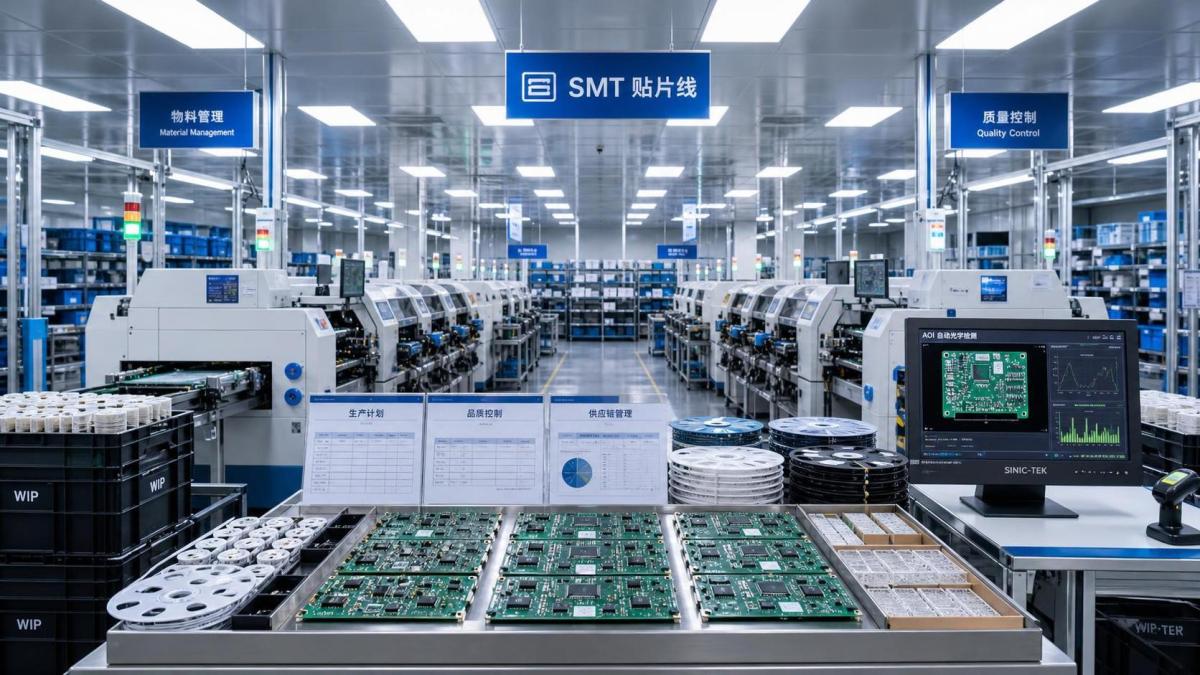
Quality systems should be visible in day-to-day operations
Most suppliers know how to present a quality manual. That is not the same as running a controlled process. Business evaluators should look for evidence that the factory’s quality system is operational, measurable, and enforced under production pressure.
Useful review points include incoming material inspection, SMT process control, first article procedures, AOI and X-ray usage where relevant, test strategy, failure analysis workflow, ESD controls, calibration management, lot traceability, and corrective action closure. When these areas are weak, quality problems tend to move downstream and become harder and more expensive to isolate.
Certification status matters, but it should be interpreted correctly. General quality certifications can indicate a baseline management system, while sector-specific certifications may be necessary depending on end use. For example, products entering automotive, aerospace, medical, or certain industrial applications often require stricter process and documentation expectations. Exact requirements depend on market, product category, and customer contract terms, so certification sufficiency should be treated as application-specific rather than assumed.
One useful test during supplier evaluation is to ask how the factory handled its last meaningful quality incident. The speed of containment, root-cause discipline, communication clarity, and recurrence prevention usually say more than a polished presentation deck.
Engineering support is part of manufacturing value
Outsourcing decisions are often framed as build-versus-buy choices, but in electronics they are also capability choices. A manufacturer that can review DFM, DFT, panelization, component risk, test access, and process constraints before volume production may prevent expensive redesigns later. This matters especially when the internal buyer team is lean or when the product is moving from prototype to scaled production.
Some EMS providers are essentially execution shops. Others provide meaningful NPI support, process optimization, documentation discipline, and change control. Neither model is inherently better, but the buyer should know which one it is paying for. If the product roadmap will evolve, weak engineering coordination can create recurring delays and hidden cost leakage across multiple revisions.
Evaluators should also check how engineering changes are implemented on the factory floor. Revision control errors in electronics can create mixed builds, wrong firmware loads, labeling issues, or incompatible component substitutions. Those mistakes may not be visible at shipment but can become serious field problems later.
Regulatory readiness should be tied to destination markets
For internationally traded electronics products, compliance risk is rarely theoretical. Market access can be affected by product safety rules, environmental restrictions, labeling obligations, documentation expectations, import procedures, and buyer-specific audit requirements. A factory does not need to own every certification itself, but it does need to understand what documentation and process support the product will require.
That includes material declarations, traceability records, test reports, production records, and control over restricted substances where applicable. Requirements vary by region and product category, and they also change over time. Business teams should be cautious about broad claims such as “fully compliant for all markets” unless the scope is clearly defined and verified.
Where regulations, customs treatment, or buyer mandates are uncertain, the right approach is to mark the requirement as 【待核实】 and resolve it before commercial commitment. This is particularly important for products entering the EU, North America, or regulated industrial sectors, where documentation gaps can delay customs clearance, customer acceptance, or downstream sales.
Delivery performance is more than on-time shipment
Quoted lead time is easy to compare. Delivery reliability is harder. A supplier may report acceptable on-time metrics while relying on partial shipments, schedule resets, premium freight, or informal prioritization that will not hold during demand peaks. Evaluators should ask how on-time delivery is defined and what the recent performance trend looks like by product type, not just across the whole business.
Capacity also needs a closer look. The question is not only whether the factory has enough placement machines or operators today. It is whether it can absorb upside demand, labor fluctuations, line changeovers, and supply interruptions without destabilizing quality or customer service. In high-mix environments, scheduling discipline can be just as important as installed equipment count.
Regional logistics should also enter the discussion. Cross-border electronics programs are affected by shipping lanes, customs routines, port congestion, airfreight availability, geopolitical exposure, and inventory positioning strategy. A strong manufacturing quote can become less attractive if transport volatility forces the buyer to carry more buffer stock or accept longer replenishment cycles.
Transparency often predicts how problems will be managed
One of the clearest dividing lines between a manageable supplier and a difficult one is transparency. Not every issue can be prevented. Components go on allocation, yields dip, shipments slip, and engineering changes arrive late. What matters is whether the supplier identifies problems early, quantifies them clearly, and escalates them in time for a business response.
This is why reporting discipline deserves attention during sourcing. Evaluators should look at dashboard quality, responsiveness, action tracking, and the clarity of operational data. Can the supplier provide meaningful visibility on WIP, shortages, quality escapes, test results, and aging orders? Or does information become vague when pressure increases?
Transparency is not only a communication preference. It is a risk control. In outsourced electronics operations, late visibility usually means fewer options and higher recovery cost.
Commercial terms should reflect operational reality
Procurement teams often focus on unit price, tooling charges, and payment terms, but contract structure should also cover the operational risks that matter in electronics manufacturing services. That may include liability around excess inventory, ownership of customer-supplied tools and test fixtures, treatment of NCNR components, obsolescence responsibility, quality claim mechanisms, change-order timing, and service-level expectations.
For some programs, minimum order quantities and forecast commitments can create more financial exposure than the assembly price itself. If demand visibility is weak, a buyer should be careful about agreeing to aggressive material commitments without clear rules for pull-ins, push-outs, or cancellation windows.
It is also worth checking whether the supplier’s quote assumptions match the real operating scenario. Pricing that depends on highly stable forecasts, narrow approved component choices, or idealized yields may not hold after launch. When assumptions are hidden, future cost disputes become more likely.
Reference checks should target comparable programs
General references are of limited value if they do not resemble the intended program. A supplier may perform well for one customer segment and poorly for another. Business evaluators should seek examples that match on complexity, regulatory pressure, production volume, and service scope.
A useful reference conversation usually explores practical matters: how the supplier handled component shortages, whether quality reporting was timely, how engineering changes were controlled, how often promised lead times shifted, and whether commercial behavior remained reasonable when issues emerged. These details are often more revealing than headline satisfaction statements.
A simple decision frame helps separate acceptable risk from avoidable risk
When comparing candidates, it helps to organize findings into a short decision table rather than rely on a broad impression.
The point is not to find a risk-free supplier. In global electronics outsourcing, that standard rarely exists. The point is to distinguish controllable risk from structural weakness. A supplier with a fair price, honest visibility, solid controls, and a realistic fit for the program is often a better commercial choice than one with a lower quote and fragile execution.
For business evaluators, that is usually the real decision. Not who can build the sample fastest, but who can support the business when volume, compliance, supply conditions, and customer expectations become harder to manage.
 Which global manufacturing trends by sector matter most for sourcing plans?Global manufacturing trends by sector: identify sourcing risks, supplier resilience, compliance demands, and cost drivers to build smarter, more reliable procurement plans.
 What industrial trade intelligence pricing should include before you subscribeIndustrial trade intelligence pricing explained: compare coverage, data quality, access rights, and workflow value before choosing a subscription that supports smarter trade decisions.
 How an industrial trade intelligence dashboard can identify new supplier marketsDiscover how an industrial trade intelligence dashboard helps identify new supplier markets by comparing capacity, landed cost, logistics resilience, and compliance risk.
 Which global market entry barriers should exporters assess first?Global market entry barriers exporters should assess first: tariffs, compliance, buyer qualification, logistics, and payment risk. Build a practical strategy for confident market entry.
 How trade data aggregation analytics can reveal emerging supplier marketsTrade data aggregation analytics reveals emerging supplier markets by connecting trade flows, capacity signals, logistics, and compliance insights for smarter sourcing decisions.
 When an export market analysis platform can validate demand in a new marketExport market analysis platform insights help validate new-market demand through buyer fit, regulations, logistics, competition, and profitable entry conditions.
 What is driving the beauty and personal care market in the USA?Beauty and personal care in USA is driven by targeted solutions, selective premiumization, digital discovery, clean-label trust, diverse needs, and compliance. Explore key growth opportunities.
 How trade flow monitoring reports reveal changing regional demandTrade flow monitoring reports reveal changing regional demand through import volumes, sourcing shifts, product mix, logistics signals, and regulatory trends. Explore actionable market insights.
 How international market intelligence for investors reduces market-entry riskInternational market intelligence for investors reduces market-entry risk by validating demand, regulations, logistics, and competition before capital is committed.
 How international sourcing intelligence helps identify supplier risk earlyInternational sourcing intelligence helps businesses spot supplier risks early, protect supply continuity, and make smarter global procurement decisions.
 How trade data aggregation analytics reveals emerging supplier marketsTrade data aggregation analytics reveals emerging supplier markets through export trends, input flows, logistics, and regulatory signals. Discover smarter sourcing insights.
 What industrial cluster monitoring in Vietnam reveals about site riskIndustrial cluster monitoring Vietnam reveals hidden site risks across labor, utilities, logistics, compliance, and supplier dependencies. Make smarter sourcing and expansion decisions.
 Food Technology Trends Reshaping Shelf Life, Safety, and Product InnovationFood technology is reshaping shelf life, safety, and innovation. Discover the trends helping food businesses cut risk, improve compliance, and unlock stronger global market growth.
 How electronics manufacturing services are changing with low-volume demandElectronics manufacturing services are evolving fast with low-volume demand. Learn how agile EMS partners improve flexibility, compliance, sourcing resilience, and speed to market.
 How Can Buyers Reduce Procurement Risks for Electronic Components?How to reduce procurement risks for electronic components: learn how buyers assess traceability, lead times, compliance, and supplier types to avoid costly sourcing mistakes.
 What Sourcing Intelligence India Reveals About Supplier Risk and Cost ShiftsSourcing intelligence India reveals hidden supplier risk, compliance gaps, logistics pressure, and real cost shifts—helping buyers compare vendors smarter and source with more confidence.
 Fashion Trends 2026: Which Materials, Colors, and Silhouettes Are Gaining Ground?Fashion trends 2026 spotlight tactile fabrics, mineral colors, and controlled volume. Explore the materials, shades, and silhouettes shaping smarter, more wearable style.
 Smart Device Market Outlook: Key Growth Drivers, Segments, and Business OpportunitiesSmart device market trends are shifting toward system value, industrial demand, and resilient supply chains. Explore key growth drivers, high-potential segments, and business opportunities.
 How Global Trade Intelligence Services Help B2B Firms Evaluate Markets and SuppliersGlobal trade intelligence services help B2B firms compare suppliers, assess market potential, and uncover compliance, logistics, and pricing risks before costly decisions are made.
 Manufacturing Sector Updates for Investors: What Signals Matter Most in 2025?Manufacturing sector updates for investors in 2025: track orders, margins, supply chains, regulation, and exports to spot resilient manufacturers and smarter investment signals.
 How Energy Market Intelligence Helps Businesses Track Price Risks and Demand ShiftsEnergy market intelligence helps businesses spot price risks, demand shifts, and supply pressure early—improving procurement, resilience, and faster strategic decisions.





















Global Trade Insights & Industry
Our mission is to empower global exporters and importers with data-driven insights that foster strategic growth.
Search News
Popular Tags
Industry Overview
The global commercial kitchen equipment market is projected to reach $112 billion by 2027. Driven by urbanization, the rise of e-commerce food delivery, and strict hygiene regulations.