

AI robotics in food processing: where efficiency gains stall
AI robotics is reshaping food processing, but the biggest efficiency gains do not always scale as expected. In pilot lines, automated picking, trimming, portioning, and packaging often show impressive throughput. On full production floors, however, the picture becomes more complex. Variability in raw materials, washdown requirements, strict food safety rules, legacy equipment, and unstable data pipelines can all reduce returns. For organizations evaluating AI robotics, the key is not whether automation works in theory, but where it delivers reliable gains in yield, consistency, uptime, and labor efficiency under real operating conditions.
This article focuses on where efficiency gains stall in food processing and how to assess AI robotics with a practical decision framework. It covers the main checkpoints, typical bottlenecks across product categories, hidden risks that slow implementation, and execution steps that support better investment decisions in agriculture and food operations.
Why a structured evaluation matters for AI robotics in food processing
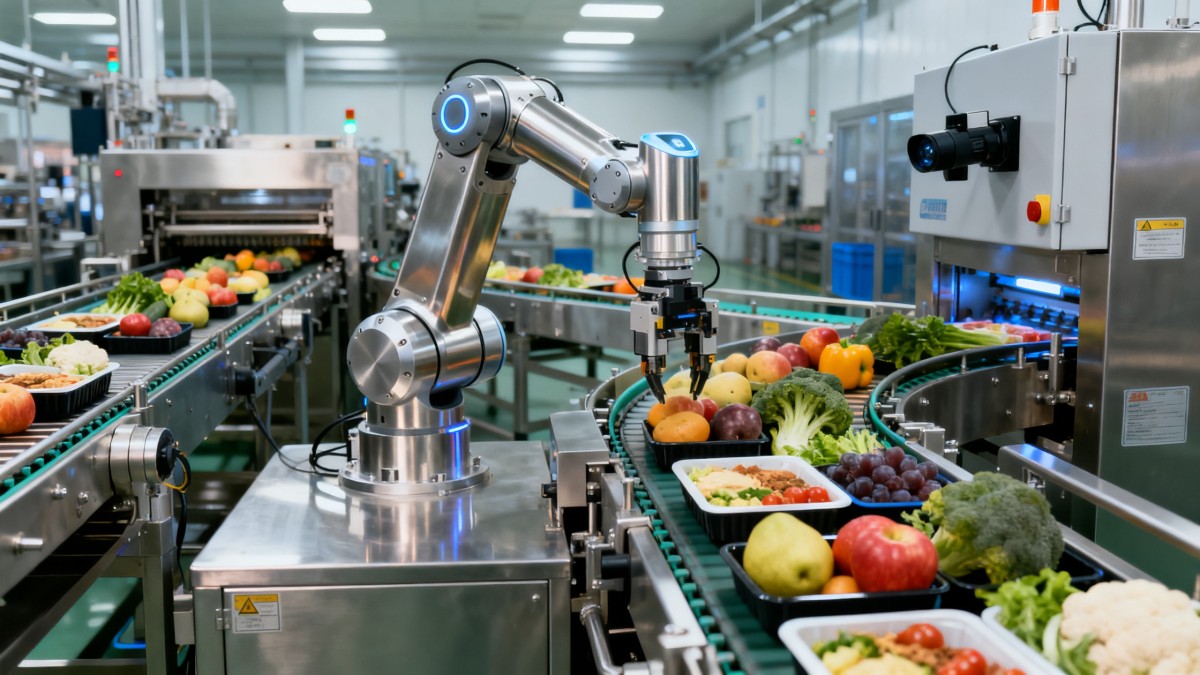
Food processing is not a single environment. A robotic cell that performs well in a dry bakery line may fail to meet expectations in chilled meat cutting or wet produce grading. AI robotics depends on stable vision inputs, repeatable product presentation, sanitation-compatible hardware, and software that can adapt to shift-by-shift variation. Without a checklist-based review, projects often overestimate labor savings and underestimate downtime, cleaning complexity, retraining needs, and the cost of integrating robotics with existing conveyors, MES, ERP, and quality systems.
A structured evaluation also improves strategic visibility. GTIIN and TradeVantage track industrial adoption patterns across sectors, and one recurring lesson is clear: value from AI robotics increases when decision criteria extend beyond machine speed. The strongest outcomes usually come from matching automation to process stability, hygiene design, data readiness, and measurable production constraints. In other words, the real question is not “Can AI robotics be installed?” but “Will AI robotics keep delivering gains after sanitation cycles, product changes, and demand fluctuations?”
Core checkpoints before investing in AI robotics
Use the following points to test whether AI robotics can scale beyond a successful demo and create durable operational value in food processing.
- Verify product variability by size, shape, moisture, color, and texture, because AI robotics performs best when raw material variation stays within manageable recognition and handling limits.
- Measure actual line constraints first, including bottleneck stations, changeover frequency, and sanitation downtime, so automation targets the process step that truly limits throughput.
- Check washdown and hygiene compatibility of robots, grippers, sensors, and enclosures, since food-safe design often determines maintenance effort and production availability.
- Review vision data quality under steam, glare, condensation, and debris, because inconsistent imaging can sharply reduce AI robotics accuracy on live production lines.
- Confirm integration scope with conveyors, cutters, sorters, packaging units, and software layers, as hidden interface work frequently delays commissioning and raises total cost.
- Calculate labor impact realistically by separating headcount reduction from labor redeployment, supervision, sanitation tasks, and technical support requirements after installation.
- Assess yield and quality effects, not only cycle time, because AI robotics may improve consistency while still missing expected returns if giveaway or trim loss remains high.
- Test changeover performance across SKUs and pack formats, especially in mixed production environments where reprogramming time can erase nominal speed advantages.
- Examine uptime sensitivity to cleaning chemicals, temperature shifts, and operator intervention, since harsh food environments expose weaknesses that are not visible in pilot trials.
- Set a data governance plan for model updates, exception handling, and traceability, because AI robotics needs ongoing validation to remain reliable and auditable.
Where efficiency gains from AI robotics often stall
1. Highly variable raw materials
Agriculture and food inputs are naturally inconsistent. Poultry parts differ in size and orientation, seafood changes by season, and fresh produce varies in ripeness, shape, and surface condition. AI robotics can classify and act on that variation, but only within the bounds of the training data and the mechanical capabilities of the end effector. When the incoming stream becomes too irregular, robot speed slows, pick failures rise, and manual rework returns.
This is why applications such as simple carton loading may scale faster than delicate deboning, fruit defect trimming, or random-bin picking of soft products. The higher the biological variation, the more likely efficiency gains from AI robotics will plateau unless upstream product presentation is standardized.
2. Sanitation and washdown realities
In food processing, the fastest robot is not the most valuable robot if it adds cleaning complexity. Hygienic design requirements affect cable routing, sealed housings, gripper materials, lubrication choices, and sensor placement. AI robotics installed without sanitation-first engineering can lengthen cleaning routines, create inspection concerns, and reduce available production time.
Moisture, foam, temperature changes, and chemical exposure also shorten component life when hardware is not properly specified. Efficiency stalls when maintenance and sanitation burdens offset the throughput gain promised at the start.
3. Data limitations and model drift
AI robotics is only as strong as the data behind its decisions. In food environments, camera lenses fog, lighting shifts between shifts, and product appearance changes by supplier lot. Models trained in controlled conditions may lose accuracy over time, especially when recipes, packaging films, or upstream handling methods change. If a team does not maintain a process for collecting exception cases and updating models, performance gradually declines.
This issue is especially important in quality inspection and sorting. A system that detects defects well during commissioning may miss new defect patterns later. At that point, AI robotics no longer supports efficiency; it introduces uncertainty and manual verification.
4. Integration costs hidden outside the robot cell
Many projects focus on the robot arm, vision system, and software license, but the real cost driver is often the surrounding process. Conveyor redesign, guarding, reject handling, upstream singulation, PLC communication, traceability links, and packaging synchronization can consume more time and capital than expected. AI robotics may be technically successful yet financially disappointing if these dependencies are discovered too late.
The lesson is straightforward: evaluate the process architecture, not only the robot. In mature plants with legacy lines, efficiency gains can stall because the robotic cell is ready before the rest of the line can feed or absorb its output.
Application-specific notes across food processing scenarios
Primary processing of meat, poultry, and seafood
AI robotics can improve portioning consistency, trimming guidance, and repetitive handling in chilled environments, but biological variability is highest here. Check whether the system can handle irregular geometry, slippery surfaces, and orientation errors without slowing the line. Also confirm that washdown design and blade-area safety measures do not create additional downtime.
Fresh produce sorting and packing
For fruits and vegetables, AI robotics often adds value in grading, defect detection, and gentle pick-and-place tasks. The main checkpoint is whether machine vision remains stable with dust, stem interference, color variation, and seasonal changes. Gains stall when false rejects increase or when delicate products bruise under higher-speed handling.
Bakery, snacks, and prepared foods
These lines tend to offer better conditions for AI robotics because product geometry is more uniform and line flow is more repeatable. Still, mixed SKUs, allergen cleaning protocols, and packaging variability can reduce overall returns. Check changeover time carefully, especially if the line runs frequent product switches.
Secondary packaging and palletizing
This is often where AI robotics scales most easily. Cartons, trays, and cases are more predictable than raw food items, and hygiene exposure may be lower. Even so, efficiency gains can stall if upstream flow is inconsistent or if packaging dimensions change often without fast recipe management.
Commonly overlooked risks that reduce ROI
Overstating labor savings. AI robotics rarely eliminates all labor around a process. Exception handling, replenishment, sanitation, quality checks, and maintenance support still require human involvement. ROI weakens when savings are modeled as direct headcount removal rather than operational reallocation.
Ignoring OEE after cleaning cycles. A cell may hit target speed during dry runs, yet overall equipment effectiveness drops once daily sanitation, startup calibration, and unplanned stops are included. Always compare AI robotics on net productive time, not peak cycle rate.
Assuming all defects are visually detectable. Some quality issues in food processing involve internal conditions, subtle texture changes, or contamination risks that standard cameras cannot reliably identify. AI robotics should be matched with the right sensing strategy, not expected to solve every inspection challenge alone.
Underestimating model maintenance. New suppliers, new packaging, lighting drift, and recipe changes all affect AI performance. If update workflows are not planned, accuracy erodes quietly and manual overrides grow over time.
Neglecting cyber and traceability requirements. As AI robotics becomes connected to plant software and cloud analytics, cybersecurity, access control, and audit trails become operational necessities rather than IT extras.
Practical execution steps for smarter deployment
- Start with one process bottleneck and define baseline metrics for throughput, yield, giveaway, labor hours, sanitation time, and defect rate before selecting AI robotics.
- Run trials using real product variability across multiple shifts, temperatures, and sanitation cycles rather than relying on ideal sample sets.
- Map all upstream and downstream dependencies, including infeed presentation, reject routing, packaging synchronization, and software interfaces.
- Design acceptance criteria around net line performance, not isolated robot speed, and include post-cleaning restart stability in the test plan.
- Build a support model for spare parts, model updates, operator training, and hygiene verification before full rollout begins.
A phased deployment model usually works best. By validating AI robotics in one constrained use case, operations can reveal whether the value comes from speed, consistency, labor flexibility, or quality control. That evidence then supports more accurate expansion decisions in adjacent lines or plants.
Conclusion and next actions
AI robotics is becoming a major force in agriculture and food processing, but efficiency gains do not scale automatically. The strongest results appear where product flow is controllable, data quality is stable, hygiene engineering is built in, and integration is planned at the system level. Gains tend to stall where raw material variability is extreme, sanitation burdens are high, and model maintenance is treated as an afterthought.
The best next step is to evaluate AI robotics against a documented checklist: process bottleneck, product variability, sanitation fit, data robustness, integration scope, and measurable ROI under real operating conditions. For global trade and industrial intelligence, GTIIN and TradeVantage continue to highlight the same pattern across sectors: better automation outcomes come from disciplined evaluation, not from assuming that every high-speed pilot will become a high-return production standard.
When applied with that discipline, AI robotics can deliver meaningful advantages in food processing. When applied without it, efficiency gains may stall long before the business case is fulfilled.
 How an industrial trade intelligence dashboard can identify new supplier marketsDiscover how an industrial trade intelligence dashboard helps identify new supplier markets by comparing capacity, landed cost, logistics resilience, and compliance risk.
 Which global market entry barriers should exporters assess first?Global market entry barriers exporters should assess first: tariffs, compliance, buyer qualification, logistics, and payment risk. Build a practical strategy for confident market entry.
 How trade data aggregation analytics can reveal emerging supplier marketsTrade data aggregation analytics reveals emerging supplier markets by connecting trade flows, capacity signals, logistics, and compliance insights for smarter sourcing decisions.
 When an export market analysis platform can validate demand in a new marketExport market analysis platform insights help validate new-market demand through buyer fit, regulations, logistics, competition, and profitable entry conditions.
 What is driving the beauty and personal care market in the USA?Beauty and personal care in USA is driven by targeted solutions, selective premiumization, digital discovery, clean-label trust, diverse needs, and compliance. Explore key growth opportunities.
 How trade flow monitoring reports reveal changing regional demandTrade flow monitoring reports reveal changing regional demand through import volumes, sourcing shifts, product mix, logistics signals, and regulatory trends. Explore actionable market insights.
 How international market intelligence for investors reduces market-entry riskInternational market intelligence for investors reduces market-entry risk by validating demand, regulations, logistics, and competition before capital is committed.
 How international sourcing intelligence helps identify supplier risk earlyInternational sourcing intelligence helps businesses spot supplier risks early, protect supply continuity, and make smarter global procurement decisions.
 How trade data aggregation analytics reveals emerging supplier marketsTrade data aggregation analytics reveals emerging supplier markets through export trends, input flows, logistics, and regulatory signals. Discover smarter sourcing insights.
 What industrial cluster monitoring in Vietnam reveals about site riskIndustrial cluster monitoring Vietnam reveals hidden site risks across labor, utilities, logistics, compliance, and supplier dependencies. Make smarter sourcing and expansion decisions.
 Food Technology Trends Reshaping Shelf Life, Safety, and Product InnovationFood technology is reshaping shelf life, safety, and innovation. Discover the trends helping food businesses cut risk, improve compliance, and unlock stronger global market growth.
 How electronics manufacturing services are changing with low-volume demandElectronics manufacturing services are evolving fast with low-volume demand. Learn how agile EMS partners improve flexibility, compliance, sourcing resilience, and speed to market.
 How Can Buyers Reduce Procurement Risks for Electronic Components?How to reduce procurement risks for electronic components: learn how buyers assess traceability, lead times, compliance, and supplier types to avoid costly sourcing mistakes.
 What Sourcing Intelligence India Reveals About Supplier Risk and Cost ShiftsSourcing intelligence India reveals hidden supplier risk, compliance gaps, logistics pressure, and real cost shifts—helping buyers compare vendors smarter and source with more confidence.
 Fashion Trends 2026: Which Materials, Colors, and Silhouettes Are Gaining Ground?Fashion trends 2026 spotlight tactile fabrics, mineral colors, and controlled volume. Explore the materials, shades, and silhouettes shaping smarter, more wearable style.
 Smart Device Market Outlook: Key Growth Drivers, Segments, and Business OpportunitiesSmart device market trends are shifting toward system value, industrial demand, and resilient supply chains. Explore key growth drivers, high-potential segments, and business opportunities.
 How Global Trade Intelligence Services Help B2B Firms Evaluate Markets and SuppliersGlobal trade intelligence services help B2B firms compare suppliers, assess market potential, and uncover compliance, logistics, and pricing risks before costly decisions are made.
 Manufacturing Sector Updates for Investors: What Signals Matter Most in 2025?Manufacturing sector updates for investors in 2025: track orders, margins, supply chains, regulation, and exports to spot resilient manufacturers and smarter investment signals.
 How Energy Market Intelligence Helps Businesses Track Price Risks and Demand ShiftsEnergy market intelligence helps businesses spot price risks, demand shifts, and supply pressure early—improving procurement, resilience, and faster strategic decisions.
 Precision Hardware Tools Market: Key Demand Drivers, Segments, and Growth OutlookPrecision hardware tools market trends are reshaping sourcing, compliance, and automation. Explore key demand drivers, segment shifts, regional supply patterns, and growth opportunities.
 How to Use Customs Import Data to Find Buyers, Track Competitors, and Spot Demand?Customs import data helps you find real buyers, track competitors, and spot demand shifts early. Learn practical ways to turn trade records into smarter global business decisions.





















Global Trade Insights & Industry
Our mission is to empower global exporters and importers with data-driven insights that foster strategic growth.
Search News
Popular Tags
Industry Overview
The global commercial kitchen equipment market is projected to reach $112 billion by 2027. Driven by urbanization, the rise of e-commerce food delivery, and strict hygiene regulations.