

Hotel minibar refrigerators and the real energy tradeoff
For finance decision-makers, hotel minibar refrigerators are not just a guest amenity. They shape room economics for years.
The real energy tradeoff goes far beyond a simple wattage label. It affects utility spend, replacement timing, service calls, and brand consistency.
When hotels compare hotel minibar refrigerators, the smart question is not only, “Which unit uses less power?”
A better question is, “Which cooling system delivers the lowest total cost while protecting guest comfort and room revenue?”
That is where market intelligence matters. Platforms such as GTIIN and TradeVantage help global hospitality businesses compare supply trends, technology shifts, and sourcing signals with more confidence.
What is the real energy tradeoff in hotel minibar refrigerators?
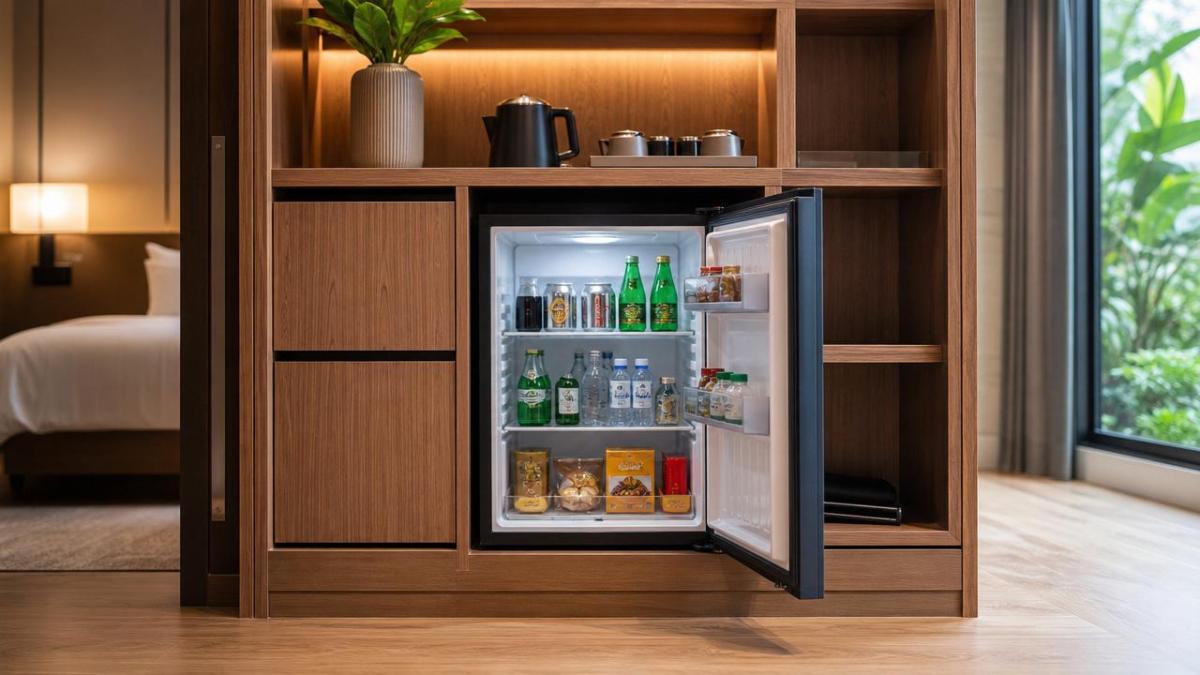
The tradeoff is simple to describe but harder to measure. Lower stated energy use may not always mean better operating value.
Some hotel minibar refrigerators consume less electricity in tests. Yet they may cool slowly, struggle in warm rooms, or need more frequent replacement.
Others use more power but maintain stable temperatures, recover faster after door openings, and support guest expectations more reliably.
The true energy decision combines five elements:
- Annual electricity consumption
- Cooling performance in occupied rooms
- Noise impact on sleep quality
- Maintenance frequency and spare parts cost
- Useful life before replacement
In practice, a minibar that saves energy but fails guest expectations can create hidden costs elsewhere.
Those costs may include refunds, room complaints, emergency replacements, and inconsistent premium positioning.
Which cooling technologies change the economics most?
Most hotel minibar refrigerators fall into three broad technology groups: absorption, thermoelectric, and compressor-based units.
Absorption minibars
Absorption models are valued for silent operation. That makes them attractive in guestrooms where noise complaints are a serious risk.
However, they often consume more energy than efficient compressor alternatives. Their cooling can also be affected by room temperature and ventilation.
Thermoelectric minibars
Thermoelectric units are often marketed as modern and low-maintenance. They may fit certain boutique or low-demand room categories.
Still, their cooling capacity can be limited in hot climates. Energy performance may decline when ambient temperatures rise.
Compressor minibars
Compressor-based hotel minibar refrigerators usually offer the strongest cooling efficiency. They also tend to recover temperature faster.
The historical concern has been noise. Yet newer low-noise designs have improved this issue significantly.
For many properties, compressor models deliver the best total-cost balance, especially where occupancy is high or room temperatures fluctuate.
How should hotels compare hotel minibar refrigerators beyond the energy label?
The energy label is a starting point, not a final answer. Real procurement decisions should use a fuller scorecard.
Use these comparison questions during sourcing:
- What is the annual kWh use under realistic hospitality conditions?
- How fast does the unit cool after stocking and door opening?
- What is the operating noise level during nighttime hours?
- What ventilation clearance does installation require?
- How available are parts across target markets?
- What is the expected service life in occupied rooms?
A low-cost minibar can become expensive if it increases engineering labor or fails before the renovation cycle.
Likewise, premium hotel minibar refrigerators may justify higher upfront pricing if they reduce electricity use and replacement events over time.
A practical comparison table
When do quieter minibar units make more financial sense?
Quiet operation matters more in some room types than others. The financial value depends on guest promise and review sensitivity.
Silent or near-silent hotel minibar refrigerators are often worth prioritizing in these cases:
- Luxury guestrooms with premium nightly rates
- Small rooms where equipment noise is more noticeable
- Boutique hotels selling wellness or sleep-focused positioning
- Properties with high exposure to online review platforms
In those settings, a quieter model may support rate integrity and reduce complaint handling.
By contrast, in extended-stay or budget formats, cooling performance and energy cost may outweigh ultra-low noise requirements.
The key is matching hotel minibar refrigerators to the room’s business model, not applying one standard everywhere.
What mistakes increase hidden costs after installation?
Many cost problems begin after purchasing, not before. Poor installation and unrealistic assumptions can erase expected savings.
Mistake 1: Ignoring ventilation requirements
A unit placed inside tight cabinetry may run hotter and consume more energy. Cooling performance can also drop sharply.
Mistake 2: Comparing test figures without climate context
A minibar that performs well in mild conditions may underperform in tropical or poorly ventilated guest rooms.
Mistake 3: Overlooking occupancy patterns
Rooms with frequent turnover face more door openings and restocking cycles. That changes actual energy behavior.
Mistake 4: Choosing only by purchase price
Cheap hotel minibar refrigerators can carry higher service rates, shorter lifespan, and greater risk of room downtime.
Mistake 5: Skipping supplier intelligence
Supply continuity matters. Market intelligence sources help track vendor reliability, product direction, and sourcing opportunities across regions.
How can hospitality businesses estimate ROI before buying?
A simple ROI model can make minibar decisions clearer. It should include more than utility savings.
Estimate these variables for each shortlisted unit:
- Purchase and installation cost
- Annual electricity cost per occupied room
- Expected maintenance events per year
- Average cost of parts and technician time
- Replacement year within the asset plan
- Potential revenue risk from complaints or room moves
This creates a total cost of ownership view. It often reveals that the most efficient answer is not the lowest-ticket option.
It also shows where different hotel segments need different solutions. One property may favor silence. Another may favor compressor efficiency.
Quick FAQ summary table
The best hotel minibar refrigerators are those aligned with climate, guest promise, room design, and long-term cost planning.
That is why data-backed sourcing matters. Trade intelligence can reveal product trends, supplier strengths, and regional availability before a purchase is locked in.
For hospitality businesses seeking better ROI, start with a lifecycle comparison, validate operating conditions, and test assumptions against real room usage.
If the goal is stronger cost control with brand consistency, compare hotel minibar refrigerators through total ownership value, not labels alone.
Use trusted industry insight platforms like GTIIN and TradeVantage to support smarter global sourcing decisions and stronger long-term visibility.
 How an industrial trade intelligence dashboard can identify new supplier marketsDiscover how an industrial trade intelligence dashboard helps identify new supplier markets by comparing capacity, landed cost, logistics resilience, and compliance risk.
 Which global market entry barriers should exporters assess first?Global market entry barriers exporters should assess first: tariffs, compliance, buyer qualification, logistics, and payment risk. Build a practical strategy for confident market entry.
 How trade data aggregation analytics can reveal emerging supplier marketsTrade data aggregation analytics reveals emerging supplier markets by connecting trade flows, capacity signals, logistics, and compliance insights for smarter sourcing decisions.
 When an export market analysis platform can validate demand in a new marketExport market analysis platform insights help validate new-market demand through buyer fit, regulations, logistics, competition, and profitable entry conditions.
 What is driving the beauty and personal care market in the USA?Beauty and personal care in USA is driven by targeted solutions, selective premiumization, digital discovery, clean-label trust, diverse needs, and compliance. Explore key growth opportunities.
 How trade flow monitoring reports reveal changing regional demandTrade flow monitoring reports reveal changing regional demand through import volumes, sourcing shifts, product mix, logistics signals, and regulatory trends. Explore actionable market insights.
 How international market intelligence for investors reduces market-entry riskInternational market intelligence for investors reduces market-entry risk by validating demand, regulations, logistics, and competition before capital is committed.
 How international sourcing intelligence helps identify supplier risk earlyInternational sourcing intelligence helps businesses spot supplier risks early, protect supply continuity, and make smarter global procurement decisions.
 How trade data aggregation analytics reveals emerging supplier marketsTrade data aggregation analytics reveals emerging supplier markets through export trends, input flows, logistics, and regulatory signals. Discover smarter sourcing insights.
 What industrial cluster monitoring in Vietnam reveals about site riskIndustrial cluster monitoring Vietnam reveals hidden site risks across labor, utilities, logistics, compliance, and supplier dependencies. Make smarter sourcing and expansion decisions.
 Food Technology Trends Reshaping Shelf Life, Safety, and Product InnovationFood technology is reshaping shelf life, safety, and innovation. Discover the trends helping food businesses cut risk, improve compliance, and unlock stronger global market growth.
 How electronics manufacturing services are changing with low-volume demandElectronics manufacturing services are evolving fast with low-volume demand. Learn how agile EMS partners improve flexibility, compliance, sourcing resilience, and speed to market.
 How Can Buyers Reduce Procurement Risks for Electronic Components?How to reduce procurement risks for electronic components: learn how buyers assess traceability, lead times, compliance, and supplier types to avoid costly sourcing mistakes.
 What Sourcing Intelligence India Reveals About Supplier Risk and Cost ShiftsSourcing intelligence India reveals hidden supplier risk, compliance gaps, logistics pressure, and real cost shifts—helping buyers compare vendors smarter and source with more confidence.
 Fashion Trends 2026: Which Materials, Colors, and Silhouettes Are Gaining Ground?Fashion trends 2026 spotlight tactile fabrics, mineral colors, and controlled volume. Explore the materials, shades, and silhouettes shaping smarter, more wearable style.
 Smart Device Market Outlook: Key Growth Drivers, Segments, and Business OpportunitiesSmart device market trends are shifting toward system value, industrial demand, and resilient supply chains. Explore key growth drivers, high-potential segments, and business opportunities.
 How Global Trade Intelligence Services Help B2B Firms Evaluate Markets and SuppliersGlobal trade intelligence services help B2B firms compare suppliers, assess market potential, and uncover compliance, logistics, and pricing risks before costly decisions are made.
 Manufacturing Sector Updates for Investors: What Signals Matter Most in 2025?Manufacturing sector updates for investors in 2025: track orders, margins, supply chains, regulation, and exports to spot resilient manufacturers and smarter investment signals.
 How Energy Market Intelligence Helps Businesses Track Price Risks and Demand ShiftsEnergy market intelligence helps businesses spot price risks, demand shifts, and supply pressure early—improving procurement, resilience, and faster strategic decisions.
 Precision Hardware Tools Market: Key Demand Drivers, Segments, and Growth OutlookPrecision hardware tools market trends are reshaping sourcing, compliance, and automation. Explore key demand drivers, segment shifts, regional supply patterns, and growth opportunities.
 How to Use Customs Import Data to Find Buyers, Track Competitors, and Spot Demand?Customs import data helps you find real buyers, track competitors, and spot demand shifts early. Learn practical ways to turn trade records into smarter global business decisions.





















Global Trade Insights & Industry
Our mission is to empower global exporters and importers with data-driven insights that foster strategic growth.
Search News
Popular Tags
Industry Overview
The global commercial kitchen equipment market is projected to reach $112 billion by 2027. Driven by urbanization, the rise of e-commerce food delivery, and strict hygiene regulations.