

How quiet should hotel minibar refrigerators really be?
When choosing hotel minibar refrigerators, noise matters more than many travelers expect. A unit that hums, clicks, or vibrates at night can disturb sleep and weaken the room experience. The ideal minibar should keep drinks cool without becoming part of the room’s soundscape. To judge that balance, it helps to understand decibel levels, cooling technologies, placement issues, and the difference between “marketed as quiet” and truly quiet performance.
What noise level is considered quiet for hotel minibar refrigerators?
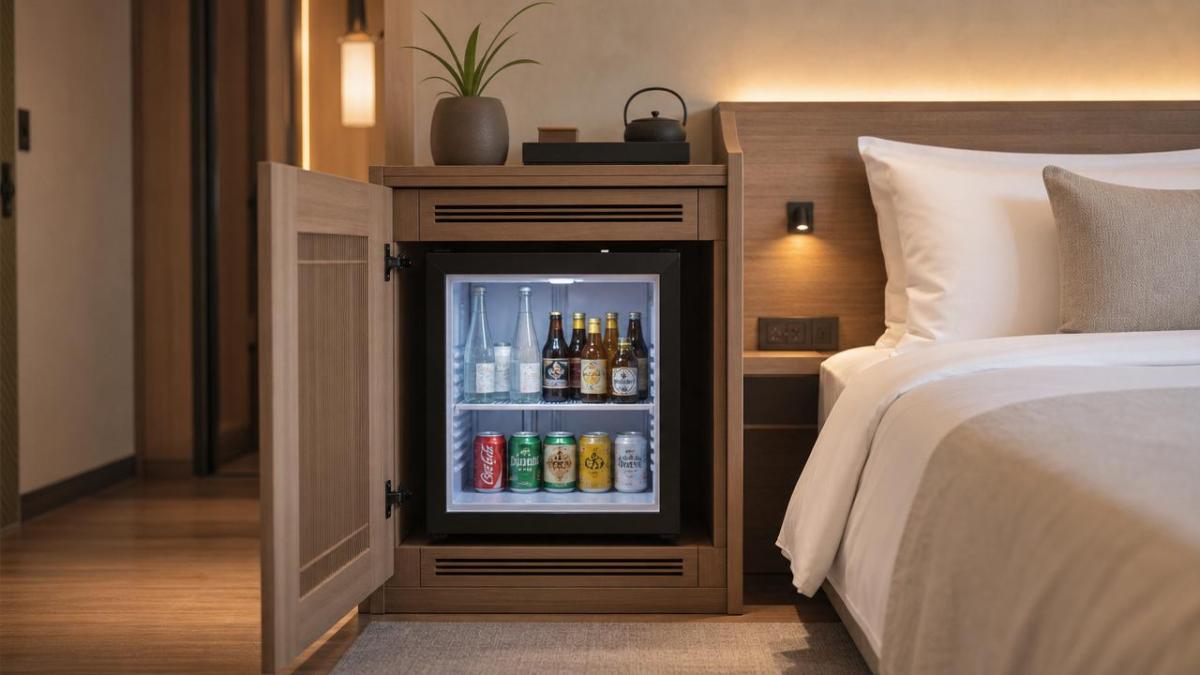
For most hotel rooms, hotel minibar refrigerators should operate at around 25 to 30 dB if they are placed near the bed.
That range is comparable to a whisper or a very quiet bedroom at night. It usually feels unobtrusive for sleeping guests.
Once noise rises above 35 dB, more people begin to notice it, especially during quiet nighttime hours.
Above 40 dB, a minibar refrigerator may be acceptable in a busy room, but it can feel intrusive in premium, boutique, or wellness-focused properties.
The challenge is that manufacturer ratings do not always reflect real in-room conditions. Cabinet resonance, floor vibration, and wall contact may amplify sound.
A minibar rated at 28 dB in testing may sound louder after installation. That is why room context matters as much as the specification sheet.
A practical benchmark
- Below 25 dB: excellent for sleep-sensitive rooms
- 25 to 30 dB: strong target for most guestrooms
- 31 to 35 dB: acceptable if placement is well managed
- Above 35 dB: may trigger complaints in quiet rooms
Why do some hotel minibar refrigerators sound louder than expected?
Not all noise comes from the cooling system alone. In many cases, the room furniture makes the sound seem worse.
Traditional compressor models may produce humming, start-stop clicks, and occasional vibration. These sounds can echo inside wooden cabinets.
If the refrigerator touches side panels or the back wall, vibration may transfer directly into the furniture frame.
Poor leveling is another common cause. Even a quiet unit may develop a faint rattle when the feet are uneven.
Ventilation also matters. Restricted airflow can force the unit to work harder, increasing runtime and creating more noticeable sound.
Door shelves, glass bottles, and loose internal trays can add secondary noise when the cooling cycle starts.
Common sound sources to check
- Compressor cycling or fan movement
- Cabinet vibration against furniture
- Unstable feet or uneven flooring
- Poor ventilation around the unit
- Bottle or shelf rattling inside
Which cooling technology is best for quiet hotel minibar refrigerators?
The quietest hotel minibar refrigerators are often absorption models or advanced thermoelectric units, depending on room expectations and climate.
Absorption minibars are widely valued for near-silent operation. They do not rely on a traditional compressor, so there is less mechanical noise.
That makes them popular in hotels where sleep quality is a key selling point. They are especially suitable near beds.
Thermoelectric models can also be quiet, but performance may vary with ambient temperature. In warmer spaces, cooling efficiency can drop.
Compressor models usually cool faster and more reliably, but they are rarely the first choice when silence is the top priority.
Still, modern low-noise compressors may work well in rooms where the minibar is positioned farther from the sleeping area.
How can you judge whether hotel minibar refrigerators are quiet enough before choosing them?
Do not rely on decibel numbers alone. A better approach combines technical data, installation details, and real-world testing.
First, check the measured sound rating and ask how it was tested. Distance, room conditions, and cabinet installation affect results.
Second, review the cooling technology. If silence is critical, near-silent systems deserve priority over standard compressor units.
Third, consider placement. A unit inside a sealed cabinet may become noisier than the same unit in open air.
Fourth, inspect build details. Soft-close shelves, stable feet, anti-vibration supports, and proper rear clearance all matter.
Finally, test one unit in an actual room overnight. Real guestroom conditions reveal issues that showroom listening may miss.
Useful evaluation checklist
- Is the rated noise level under 30 dB?
- What cooling method does the unit use?
- Can the cabinet design allow proper ventilation?
- Are vibration-control parts included?
- Has the model been tested overnight in a guestroom?
What mistakes make hotel minibar refrigerators seem noisier in actual use?
One common mistake is assuming “silent” means silent in every environment. Even quiet hotel minibar refrigerators need proper installation.
Another mistake is focusing only on cooling power. Strong cooling may help beverages, but guest sleep usually matters more.
Installing the unit too close to the bed is also risky. Small sounds feel louder during the night when everything else is still.
Ignoring maintenance creates noise over time. Dust buildup, loose trays, worn feet, or warped cabinetry can increase sound gradually.
A final mistake is neglecting room category. What works in a busy city hotel may not suit a resort, spa, or luxury suite.
Do quieter hotel minibar refrigerators cost more, and are they worth it?
Quieter hotel minibar refrigerators often cost more upfront, especially when they use absorption technology or premium anti-vibration design.
However, value should be measured against guest comfort, review quality, and reduced complaints about sleep disruption.
In hospitality, one small nighttime irritation can shape the memory of the entire stay. Noise has outsized emotional impact.
For rooms marketed as restful, upscale, or wellness-oriented, the quieter option is often worth the premium.
For other settings, a moderate-noise model may still work if installed properly and placed away from the bed.
The best decision is not simply the cheapest unit or the quietest label. It is the one that supports the intended guest experience.
Quick FAQ summary table
In the end, truly quiet hotel minibar refrigerators should fade into the background of the room. Guests should notice cold drinks, not nighttime humming.
Look beyond basic specifications. Compare technologies, review real decibel performance, and pay close attention to installation details.
A thoughtful choice can improve sleep quality, support better guest feedback, and align the minibar with the comfort standards expected in modern hospitality.
If evaluating options, start with one test installation, monitor nighttime sound, and use actual room conditions to confirm whether the unit is quiet enough.
 How an industrial trade intelligence dashboard can identify new supplier marketsDiscover how an industrial trade intelligence dashboard helps identify new supplier markets by comparing capacity, landed cost, logistics resilience, and compliance risk.
 Which global market entry barriers should exporters assess first?Global market entry barriers exporters should assess first: tariffs, compliance, buyer qualification, logistics, and payment risk. Build a practical strategy for confident market entry.
 How trade data aggregation analytics can reveal emerging supplier marketsTrade data aggregation analytics reveals emerging supplier markets by connecting trade flows, capacity signals, logistics, and compliance insights for smarter sourcing decisions.
 When an export market analysis platform can validate demand in a new marketExport market analysis platform insights help validate new-market demand through buyer fit, regulations, logistics, competition, and profitable entry conditions.
 What is driving the beauty and personal care market in the USA?Beauty and personal care in USA is driven by targeted solutions, selective premiumization, digital discovery, clean-label trust, diverse needs, and compliance. Explore key growth opportunities.
 How trade flow monitoring reports reveal changing regional demandTrade flow monitoring reports reveal changing regional demand through import volumes, sourcing shifts, product mix, logistics signals, and regulatory trends. Explore actionable market insights.
 How international market intelligence for investors reduces market-entry riskInternational market intelligence for investors reduces market-entry risk by validating demand, regulations, logistics, and competition before capital is committed.
 How international sourcing intelligence helps identify supplier risk earlyInternational sourcing intelligence helps businesses spot supplier risks early, protect supply continuity, and make smarter global procurement decisions.
 How trade data aggregation analytics reveals emerging supplier marketsTrade data aggregation analytics reveals emerging supplier markets through export trends, input flows, logistics, and regulatory signals. Discover smarter sourcing insights.
 What industrial cluster monitoring in Vietnam reveals about site riskIndustrial cluster monitoring Vietnam reveals hidden site risks across labor, utilities, logistics, compliance, and supplier dependencies. Make smarter sourcing and expansion decisions.
 Food Technology Trends Reshaping Shelf Life, Safety, and Product InnovationFood technology is reshaping shelf life, safety, and innovation. Discover the trends helping food businesses cut risk, improve compliance, and unlock stronger global market growth.
 How electronics manufacturing services are changing with low-volume demandElectronics manufacturing services are evolving fast with low-volume demand. Learn how agile EMS partners improve flexibility, compliance, sourcing resilience, and speed to market.
 How Can Buyers Reduce Procurement Risks for Electronic Components?How to reduce procurement risks for electronic components: learn how buyers assess traceability, lead times, compliance, and supplier types to avoid costly sourcing mistakes.
 What Sourcing Intelligence India Reveals About Supplier Risk and Cost ShiftsSourcing intelligence India reveals hidden supplier risk, compliance gaps, logistics pressure, and real cost shifts—helping buyers compare vendors smarter and source with more confidence.
 Fashion Trends 2026: Which Materials, Colors, and Silhouettes Are Gaining Ground?Fashion trends 2026 spotlight tactile fabrics, mineral colors, and controlled volume. Explore the materials, shades, and silhouettes shaping smarter, more wearable style.
 Smart Device Market Outlook: Key Growth Drivers, Segments, and Business OpportunitiesSmart device market trends are shifting toward system value, industrial demand, and resilient supply chains. Explore key growth drivers, high-potential segments, and business opportunities.
 How Global Trade Intelligence Services Help B2B Firms Evaluate Markets and SuppliersGlobal trade intelligence services help B2B firms compare suppliers, assess market potential, and uncover compliance, logistics, and pricing risks before costly decisions are made.
 Manufacturing Sector Updates for Investors: What Signals Matter Most in 2025?Manufacturing sector updates for investors in 2025: track orders, margins, supply chains, regulation, and exports to spot resilient manufacturers and smarter investment signals.
 How Energy Market Intelligence Helps Businesses Track Price Risks and Demand ShiftsEnergy market intelligence helps businesses spot price risks, demand shifts, and supply pressure early—improving procurement, resilience, and faster strategic decisions.
 Precision Hardware Tools Market: Key Demand Drivers, Segments, and Growth OutlookPrecision hardware tools market trends are reshaping sourcing, compliance, and automation. Explore key demand drivers, segment shifts, regional supply patterns, and growth opportunities.
 How to Use Customs Import Data to Find Buyers, Track Competitors, and Spot Demand?Customs import data helps you find real buyers, track competitors, and spot demand shifts early. Learn practical ways to turn trade records into smarter global business decisions.





















Global Trade Insights & Industry
Our mission is to empower global exporters and importers with data-driven insights that foster strategic growth.
Search News
Popular Tags
Industry Overview
The global commercial kitchen equipment market is projected to reach $112 billion by 2027. Driven by urbanization, the rise of e-commerce food delivery, and strict hygiene regulations.