

Is a Refurbished MRI Scanner Cheaper Than a New One Over Five Years?
Is a Refurbished MRI Scanner Cheaper Than a New One Over Five Years?
A refurbished MRI scanner can be cheaper than a new one over five years, but a lower purchase price does not settle the question. Installation, service coverage, software access, energy consumption, downtime, and eventual resale all affect the result. An attractive equipment quote can become an expensive operating commitment if the scanner cannot reliably deliver the examinations your facility needs.
The useful comparison is five-year total cost of ownership, measured against clinical capability and completed examinations. A well-supported refurbished system may preserve substantial upfront savings. A newer system may justify its premium when its workflow, support horizon, or application capabilities produce benefits the facility can actually use.
Neither outcome should be assumed. The decision starts with defining comparable equipment and ends with testing how much uncertainty the budget can absorb.
Compare the clinical job, not just the scanner price
Two MRI quotations are not equivalent simply because both systems have the same magnetic field strength. Bore dimensions, gradient performance, available coils, software applications, reconstruction tools, and patient handling can change what the department can deliver. Comparing a basic refurbished configuration with a fully equipped new system exaggerates the apparent saving.
Define the examination mix before requesting final prices. Routine musculoskeletal and neurological work may place different demands on equipment than cardiac imaging, advanced oncology protocols, or technically demanding research applications. Radiologists and technologists should confirm that each proposed configuration supports the intended protocols at acceptable image quality and examination times.
“Refurbished” also needs a contractual definition. It can describe anything from a used system that has been cleaned and tested to equipment that has undergone extensive component replacement and documented performance verification. Ask what was inspected, repaired, replaced, and tested, and obtain records for the actual system being offered.
Calendar age matters, but it is not a complete condition assessment. Service history, operating environment, major repairs, component condition, and remaining manufacturer support can be more useful than the year printed on a listing.
Build the five-year model around cash flows
A practical starting point is:
Five-year ownership cost = equipment and deployment costs + service, operating, and upgrade costs + downtime-related costs + financing costs − net residual value.
Deployment includes more than delivery. Capture site preparation, transport, rigging, installation, commissioning, acceptance testing, and initial training. Operating costs should include utilities and equipment-specific requirements, while service costs should reflect the actual warranty and maintenance contracts rather than a generic annual allowance.
Use the same currency, tax treatment, operating assumptions, and evaluation period for both alternatives. Show costs by year so a short warranty or planned upgrade does not disappear inside an average. For a discounted cash-flow comparison, use the same discount rate and timing conventions.
Avoid mixing accounting and purchasing costs. Depreciation is not an additional cash payment on top of the equipment price. Likewise, if loan repayments already include the financed purchase amount, adding the full acquisition cost again would double-count it.
Calculate a base case and a downside case. The downside should test plausible service delays, uncovered repairs, and weaker resale proceeds—not arbitrary penalties assigned only to the refurbished option. New equipment also has installation, operational, and support risks.
Installation can consume savings before the first patient
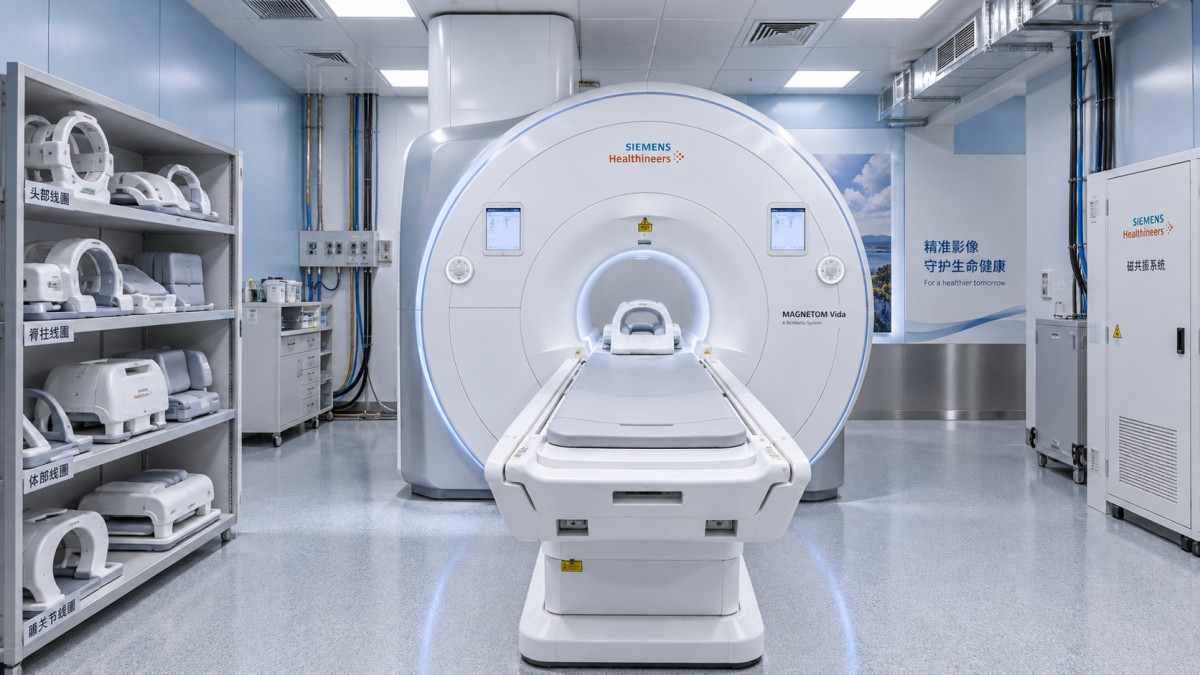
Replacing an existing MRI does not guarantee that the room is ready for another model. Structural loading, access routes, radiofrequency shielding, electrical supply, cooling, and magnetic fringe-field management need review against the proposed system’s site-planning documents. Quench venting requirements, where applicable, also need specialist assessment.
A refurbished machine that requires extensive room alterations may be less economical than a higher-priced system compatible with the facility. Conversely, a new scanner may also require major infrastructure changes. The correct comparison uses model-specific surveys, not assumptions about equipment age.
For equipment purchased overseas, define responsibility for deinstallation, export packing, freight insurance, customs clearance, storage, and final positioning. Magnet transport and recommissioning need coordinated specialist work. A delivery commitment is not necessarily a clinical go-live commitment.
Include the cost of any interruption to an existing imaging service during replacement. Temporary referral arrangements, construction delays, and delayed acceptance can affect both alternatives, particularly when the facility has only one scanner.
Service coverage is often the deciding variable
A maintenance price has little meaning without its scope. Check whether coverage includes coils, gradient equipment, radiofrequency components, cooling systems, cold-head work, and helium-related services where relevant. Identify exclusions, deductibles, labor charges, travel charges, and any limits on replacement parts.
Do not assume every superconducting MRI has the same helium requirements. Magnet and cooling designs differ. Obtain system-specific information about routine requirements, monitoring, and responsibility for abnormal events rather than assigning a standard replenishment budget.
The distinction between response time and restoration time is particularly important. An engineer may respond promptly while a replacement component takes much longer to arrive. Ask where critical parts are stocked, who services the machine locally, and what happens if a component cannot be sourced.
For an older platform, seek written clarification of the support horizon through the planned ownership period. Third-party service may remain available after manufacturer support changes, but it does not automatically provide access to every proprietary tool, software update, or component.
A new system’s warranty also deserves scrutiny. Confirm when coverage starts, what happens after it expires, and how subsequent service pricing can change. Five-year affordability cannot be inferred from first-year coverage alone.
Price downtime without inflating the loss
Downtime can erase acquisition savings, especially in a busy single-scanner facility. Its financial effect depends on scheduled demand, backup capacity, rescheduling options, and referral arrangements. The same outage may cause a temporary backlog at one hospital and permanent lost examinations at another.
For examinations that cannot be recovered, use lost contribution margin rather than gross billed revenue. Add demonstrable costs such as outsourcing or overtime, but avoid counting the same consequence twice. Patient access and disruption to care should also inform the decision, even when they cannot be credibly converted into money.
A useful break-even test asks how much additional refurbished-system cost would eliminate its initial saving. Compare that remaining allowance with plausible repair, downtime, and upgrade exposure. A decision that works only under uninterrupted operation is financially fragile.
Software and throughput can change the economics
Verify that the quoted applications and licenses will remain valid after ownership transfer and installation at your site. Confirm access to required sequences, reconstruction capabilities, workstation functions, and connectivity. Integration with PACS and other hospital systems may involve separate work and charges.
An older scanner may perform the current examination mix well yet offer a limited upgrade path. That matters if the service plans to add applications during the next five years. Obtain written compatibility and pricing information instead of relying on a broad assurance that upgrades are available.
Newer equipment may shorten parts of the imaging workflow, but faster acquisition does not automatically create more billable examinations. Staffing, patient preparation, room turnover, reporting capacity, and demand can remain the real bottlenecks. Count additional throughput only when the facility can realistically schedule and complete it.
Review energy in the same way. Compare documented power requirements and expected operating patterns, including standby operation and associated cooling equipment. Neither “new” nor “refurbished” is a reliable substitute for a model-specific utility assessment.
Cross-border savings depend on local readiness
An internationally sourced scanner may have an appealing equipment price while carrying additional import, documentation, and service risks. Requirements for used medical equipment, market authorization, installation, and facility operation vary by jurisdiction. Eligibility should be checked before shipment with the relevant authorities and qualified local advisers.
A certification claim or prior use in another country does not, by itself, establish permission to import or operate the system locally. Procurement teams should distinguish the equipment’s technical condition from its regulatory eligibility and the facility’s operating obligations.
This is where trade intelligence supports the purchasing decision. Global Trade Insights & Industry Network (GTIIN) focuses on the connection between supply chains, regulatory changes, procurement trends, and cross-border business risks. For an MRI purchase, that perspective means examining customs exposure, logistics responsibilities, supplier documentation, and after-sales availability alongside the technical offer—not treating the export price as the landed operating cost.
Before committing, assemble a decision file containing:
- The exact configuration, serial identification, service history, and refurbishment records.
- A site survey and a responsibility schedule covering transport through clinical acceptance.
- Written license-transfer terms, upgrade compatibility, and support availability.
- A service agreement with exclusions, escalation procedures, and parts arrangements.
- Locally verified import and operating requirements, plus an agreed acceptance-testing plan.
When the refurbished option is genuinely cheaper
Refurbished equipment is more likely to retain its cost advantage when the configuration fits a stable clinical workload, installation changes are manageable, support is dependable, and required software is already included. It becomes less convincing when the business case depends on uncertain component availability or assumes that no major upgrade will be needed.
Treat resale cautiously for both options. Estimate net proceeds after removal, transport, broker costs, and any disposal obligations. Future saleability will depend on condition, support status, market demand, and the next buyer’s requirements. Test the decision with a conservative residual value rather than using resale to rescue a weak operating case.
The final comparison should show five-year ownership cost and cost per completed examination, subject to equivalent clinical requirements. A refurbished MRI is genuinely cheaper when its acquisition saving survives realistic installation, maintenance, downtime, and exit costs. Before approving the purchase, resolve the assumptions most capable of reversing that result—especially service exclusions, parts availability, and software rights.
 Can you trust flexible packaging market intelligence forecasts?Can you trust flexible packaging market intelligence forecasts? Learn how to verify sources, challenge assumptions, and assess demand before making costly investment or sourcing decisions.
 When is supply chain disruption management consulting worth the cost?When is supply chain disruption management consulting worth the cost? Learn how to compare fees, avoidable losses, and recovery options to make a confident investment decision.
 How to use macroeconomic analysis to forecast industrial demandApply an industrial macro analysis methodology to forecast demand, interpret economic signals, and plan inventory and capacity. Discover practical steps for smarter business decisions.
 How to assess Singapore suppliers with global supply chain intelligenceExplore international supply chain intelligence Singapore buyers can use to verify suppliers, assess capabilities and delivery risks, and make confident sourcing decisions.
 Which macroeconomic indicators help forecast U.S. industrial demand?Explore industrial macro analysis USA decision-makers can use to forecast demand. Track new orders, inventories, and credit signals to sharpen procurement and capacity decisions.
 Can a food processing manufacturer meet your small-batch needs?Can a food processing manufacturer meet your small-batch needs? Discover how to assess minimum orders, costs, packaging, and safety to choose the right partner for your launch.
 How to verify sourcing intelligence data before selecting suppliersVerify sourcing intelligence data before choosing suppliers. Learn how to check company records, certifications, and capacity to reduce procurement risk and build a reliable shortlist.
 How to use supplier risk analysis to spot financial warning signsUse supplier risk analysis to spot cash flow pressure, debt risks, and delivery warning signs. Learn practical steps to reduce exposure and protect supply continuity.
 When dual sourcing makes sense in a sourcing strategy for manufacturersSourcing strategy for manufacturers: learn when dual sourcing strengthens supply continuity, reduces disruption risk, and protects production without adding unnecessary complexity.
 How bulk commodities pricing affects long-term supply contractsBulk commodities pricing shapes long-term supply contracts through index rules, freight, quality, volume, and currency risk. Explore strategies for resilient costs and supply security.
 Which global manufacturing trends by sector matter most for sourcing plans?Global manufacturing trends by sector: identify sourcing risks, supplier resilience, compliance demands, and cost drivers to build smarter, more reliable procurement plans.
 What industrial trade intelligence pricing should include before you subscribeIndustrial trade intelligence pricing explained: compare coverage, data quality, access rights, and workflow value before choosing a subscription that supports smarter trade decisions.
 How an industrial trade intelligence dashboard can identify new supplier marketsDiscover how an industrial trade intelligence dashboard helps identify new supplier markets by comparing capacity, landed cost, logistics resilience, and compliance risk.
 Which global market entry barriers should exporters assess first?Global market entry barriers exporters should assess first: tariffs, compliance, buyer qualification, logistics, and payment risk. Build a practical strategy for confident market entry.
 How trade data aggregation analytics can reveal emerging supplier marketsTrade data aggregation analytics reveals emerging supplier markets by connecting trade flows, capacity signals, logistics, and compliance insights for smarter sourcing decisions.
 When an export market analysis platform can validate demand in a new marketExport market analysis platform insights help validate new-market demand through buyer fit, regulations, logistics, competition, and profitable entry conditions.
 What is driving the beauty and personal care market in the USA?Beauty and personal care in USA is driven by targeted solutions, selective premiumization, digital discovery, clean-label trust, diverse needs, and compliance. Explore key growth opportunities.
 How trade flow monitoring reports reveal changing regional demandTrade flow monitoring reports reveal changing regional demand through import volumes, sourcing shifts, product mix, logistics signals, and regulatory trends. Explore actionable market insights.
 How international market intelligence for investors reduces market-entry riskInternational market intelligence for investors reduces market-entry risk by validating demand, regulations, logistics, and competition before capital is committed.
 How international sourcing intelligence helps identify supplier risk earlyInternational sourcing intelligence helps businesses spot supplier risks early, protect supply continuity, and make smarter global procurement decisions.
 How trade data aggregation analytics reveals emerging supplier marketsTrade data aggregation analytics reveals emerging supplier markets through export trends, input flows, logistics, and regulatory signals. Discover smarter sourcing insights.





















Global Trade Insights & Industry
Our mission is to empower global exporters and importers with data-driven insights that foster strategic growth.
Search News
Popular Tags
Industry Overview
The global commercial kitchen equipment market is projected to reach $112 billion by 2027. Driven by urbanization, the rise of e-commerce food delivery, and strict hygiene regulations.