

How Can You Check Whether a PPE Supplier’s CE Certificate Is Valid?
A PPE supplier’s “CE certificate” is not, by itself, proof that the goods comply with Regulation (EU) 2016/425. The decisive checks are whether the document is legally relevant to the product’s risk category, whether its issuer was authorized to perform that assessment, and whether it covers the exact manufacturer and model being supplied.
Verification therefore has two separate parts: establishing that the certificate is authentic and establishing that it applies to the order. A genuine certificate for a different model, an expired type approval, or a document issued outside the certification body’s authorized scope can all leave the proposed supply without adequate compliance evidence.
Identify which document the product actually requires
“CE certificate” is a commercial shorthand, not the name of a single document required for all PPE. Under Regulation (EU) 2016/425, the conformity assessment route depends on the risks against which the equipment is intended to protect.
Classification follows the claimed protective function, not simply the product name. Gloves protecting against superficial mechanical injury can fall into Category I, while gloves intended to protect against hazardous chemicals fall into Category III. Respiratory protection against substances hazardous to health also falls into Category III. The exact intended use must be established before judging whether a certificate package is sufficient.
This distinction prevents two opposite mistakes: rejecting Category I PPE because it has no notified body certificate, and accepting Category III PPE because it has a type-examination certificate but no evidence of production oversight.
Compare an EU type-examination certificate with look-alike documents
The document’s title and legal basis matter more than its appearance. Logos, seals, QR codes and references to European standards do not establish that a document has the required regulatory function.
A laboratory can be technically competent without being a notified body for PPE. Likewise, an organization may provide both voluntary testing and statutory certification, but those services remain legally different. Its reputation does not make every document it issues suitable for CE compliance.
A certificate referring only to the former PPE Directive 89/686/EEC requires particular scrutiny. The transitional validity of certificates issued under that directive ended no later than 21 April 2023. Such a document is not a current certification basis for newly manufactured PPE; questions concerning older goods already placed on the market require separate assessment.
Check the issuer’s authorization through NANDO
The European Commission’s NANDO notified body information provides the official starting point for checking whether an organization is notified under the PPE Regulation. Search by the body’s four-digit identification number or legal name, then examine its notification for Regulation (EU) 2016/425.
A name match alone is insufficient. Compare:
- Legal identity: the organization on the certificate must correspond to the notified entity, not merely an affiliated laboratory or similarly named company.
- Applicable legislation: notification for another regulatory regime does not authorize PPE certification.
- Product scope: the notification must cover the relevant PPE area.
- Assessment procedure: check authorization for Module B, C2 or D, as relevant to the document being assessed.
A body authorized for certain protective equipment or procedures cannot automatically certify every PPE product or perform every conformity assessment module. If the scope description is unclear, obtain clarification from the body rather than interpreting a broad company service description as official authorization.
NANDO identifies notified bodies and their scopes; it is not a complete central database of individual PPE certificates. Finding the issuer there establishes a necessary authorization check, not certificate authenticity. Conversely, changes to a body’s notification status require examination of the relevant dates and arrangements rather than an automatic assumption about every historical certificate.
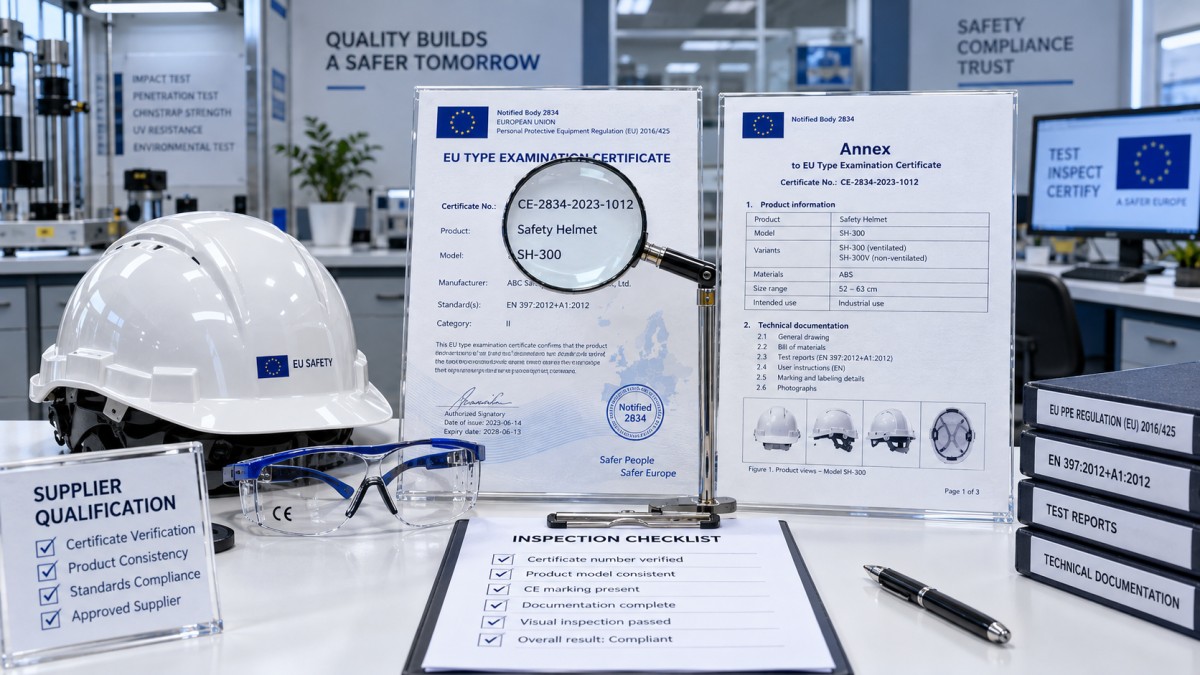
Confirm the certificate with the issuer independently
Use contact details obtained from the notified body’s official website or official listing, not only those printed on the supplier’s PDF. A falsified document can include a genuine body’s name and identification number alongside an imitation email address or verification website.
If the issuer operates a certificate verification service, enter the certificate number directly through its official website. If there is no public service, send the complete document, including annexes, and request confirmation of:
- The certificate number, revision and issue date.
- The named manufacturer and covered product models.
- The document’s current status and expiry date.
- Any restrictions, amendments, suspension or withdrawal affecting its use.
- Whether the supplied copy is complete and consistent with the issuer’s records.
A failed database search is not conclusive evidence of fraud: some certificates are not publicly searchable. Equally, a successful search does not establish that the offered goods are covered if the database entry describes another model.
EU type-examination certificates issued under the PPE Regulation have a validity period not exceeding five years. Renewal and revision must be considered where relevant. An unexpired date is therefore only one check; a document can be suspended, withdrawn or superseded before that date.
Where a certificate has expired, distinguish new production from stock already lawfully placed on the market. The certificate’s expiry date alone does not settle the status of every item in circulation. For a new order, however, an expired certificate without a substantiated current conformity basis should not be treated as sufficient evidence.
Match the certificate to the exact goods—not just the product family
An authentic certificate can still be irrelevant to the proposed order. Compare the certificate and its annexes against the product specification, markings, packaging, instructions and sample. The critical identifiers include the manufacturer’s legal name, model designation, product description, protective claims and any covered variants.
Differences in size or colour may be covered by the certificate’s scope, but that coverage should not be assumed. Changes to materials, filters, seams, lenses, coatings or other protective components can affect conformity with the approved type. A visually similar product is not necessarily the same certified product.
The relationship between the seller and the manufacturer also needs to be documented. A trading company need not be the certificate holder, but it must be possible to trace the supplied goods to the manufacturer and approved type. A reseller’s invoice does not establish that connection by itself.
Private-label supply deserves closer examination. Placing PPE on the market under one’s own name or trademark can bring manufacturer obligations under the regulation. An original equipment manufacturer’s certificate is not automatically a transferable authorization for any brand name. Any difference between the certificate holder, declared manufacturer and product branding needs a documented explanation consistent with the conformity assessment arrangements.
For Category III, distinguish type approval from production oversight
Module B assesses the product type. Category III additionally requires Module C2 or Module D to address continuing production conformity. These are distinct functions, and the notified body performing production oversight may differ from the body that issued the type-examination certificate.
Under Module C2, conformity assessment involves supervised product checks at random intervals. Under Module D, it involves assessment and surveillance of the production quality system. Request evidence identifying the applicable route, responsible body and coverage of the manufacturer and product concerned. There is no need to assume that every issuer uses the same document title or format.
For Category III PPE, the CE marking must be followed by the identification number of the notified body involved in the production control phase. That number should correspond to the C2 or D body—not necessarily the Module B certificate issuer.
For Categories I and II, the PPE conformity assessment route does not require that production-oversight number after the CE mark. Treating a four-digit number as a universal badge of higher credibility can therefore produce the wrong conclusion.
Read the EU Declaration of Conformity as a consistency check
The EU Declaration of Conformity is required across all three categories. PPE must be accompanied either by the declaration or by instructions containing the internet address where it can be accessed.
Check that the declaration identifies the PPE, names the responsible manufacturer, refers to Regulation (EU) 2016/425, and contains the relevant conformity information, signature and issue details. For Categories II and III, it should identify the notified body that performed EU type-examination and the certificate reference. For Category III, it should also identify the applicable C2 or D procedure and responsible notified body.
References to harmonised standards should be checked against the applicable references published in the EU Official Journal. The presence of an EN standard number is not sufficient: the edition, protective function and relevant requirements matter. Harmonised standards provide a route to presumption of conformity for the requirements they cover; using them is not the only possible technical route to compliance.
A declaration listing one model while the certificate covers another is a substantive discrepancy. So is a Category III declaration that omits the production conformity route. These inconsistencies require corrected, verifiable documentation rather than a general assurance that the products are “CE approved.”
Use unresolved discrepancies to control the order decision
Documentation is reasonably persuasive when the assessment route fits the intended protection, the issuer’s authorization and certificate status are independently confirmed, the exact product is covered, and the declaration and markings agree. Category III additionally needs a demonstrable production oversight arrangement.
Minor administrative differences may be resolvable, but uncertainty about the manufacturer, covered model, certificate status or required assessment module should prevent acceptance of the compliance claim. Keep the complete certificate, annexes, declaration, verification correspondence and product identification records together so that the basis for acceptance remains traceable.
Certificate verification does not prove that delivered goods perform as claimed. Shipment inspection, traceability checks and risk-based testing address that separate question. The useful distinction is between confirming a valid regulatory approval and confirming that the goods supplied actually correspond to it: a sound purchasing decision needs both.
 Can you trust flexible packaging market intelligence forecasts?Can you trust flexible packaging market intelligence forecasts? Learn how to verify sources, challenge assumptions, and assess demand before making costly investment or sourcing decisions.
 When is supply chain disruption management consulting worth the cost?When is supply chain disruption management consulting worth the cost? Learn how to compare fees, avoidable losses, and recovery options to make a confident investment decision.
 How to use macroeconomic analysis to forecast industrial demandApply an industrial macro analysis methodology to forecast demand, interpret economic signals, and plan inventory and capacity. Discover practical steps for smarter business decisions.
 How to assess Singapore suppliers with global supply chain intelligenceExplore international supply chain intelligence Singapore buyers can use to verify suppliers, assess capabilities and delivery risks, and make confident sourcing decisions.
 Which macroeconomic indicators help forecast U.S. industrial demand?Explore industrial macro analysis USA decision-makers can use to forecast demand. Track new orders, inventories, and credit signals to sharpen procurement and capacity decisions.
 Can a food processing manufacturer meet your small-batch needs?Can a food processing manufacturer meet your small-batch needs? Discover how to assess minimum orders, costs, packaging, and safety to choose the right partner for your launch.
 How to verify sourcing intelligence data before selecting suppliersVerify sourcing intelligence data before choosing suppliers. Learn how to check company records, certifications, and capacity to reduce procurement risk and build a reliable shortlist.
 How to use supplier risk analysis to spot financial warning signsUse supplier risk analysis to spot cash flow pressure, debt risks, and delivery warning signs. Learn practical steps to reduce exposure and protect supply continuity.
 When dual sourcing makes sense in a sourcing strategy for manufacturersSourcing strategy for manufacturers: learn when dual sourcing strengthens supply continuity, reduces disruption risk, and protects production without adding unnecessary complexity.
 How bulk commodities pricing affects long-term supply contractsBulk commodities pricing shapes long-term supply contracts through index rules, freight, quality, volume, and currency risk. Explore strategies for resilient costs and supply security.
 Which global manufacturing trends by sector matter most for sourcing plans?Global manufacturing trends by sector: identify sourcing risks, supplier resilience, compliance demands, and cost drivers to build smarter, more reliable procurement plans.
 What industrial trade intelligence pricing should include before you subscribeIndustrial trade intelligence pricing explained: compare coverage, data quality, access rights, and workflow value before choosing a subscription that supports smarter trade decisions.
 How an industrial trade intelligence dashboard can identify new supplier marketsDiscover how an industrial trade intelligence dashboard helps identify new supplier markets by comparing capacity, landed cost, logistics resilience, and compliance risk.
 Which global market entry barriers should exporters assess first?Global market entry barriers exporters should assess first: tariffs, compliance, buyer qualification, logistics, and payment risk. Build a practical strategy for confident market entry.
 How trade data aggregation analytics can reveal emerging supplier marketsTrade data aggregation analytics reveals emerging supplier markets by connecting trade flows, capacity signals, logistics, and compliance insights for smarter sourcing decisions.
 When an export market analysis platform can validate demand in a new marketExport market analysis platform insights help validate new-market demand through buyer fit, regulations, logistics, competition, and profitable entry conditions.
 What is driving the beauty and personal care market in the USA?Beauty and personal care in USA is driven by targeted solutions, selective premiumization, digital discovery, clean-label trust, diverse needs, and compliance. Explore key growth opportunities.
 How trade flow monitoring reports reveal changing regional demandTrade flow monitoring reports reveal changing regional demand through import volumes, sourcing shifts, product mix, logistics signals, and regulatory trends. Explore actionable market insights.
 How international market intelligence for investors reduces market-entry riskInternational market intelligence for investors reduces market-entry risk by validating demand, regulations, logistics, and competition before capital is committed.
 How international sourcing intelligence helps identify supplier risk earlyInternational sourcing intelligence helps businesses spot supplier risks early, protect supply continuity, and make smarter global procurement decisions.
 How trade data aggregation analytics reveals emerging supplier marketsTrade data aggregation analytics reveals emerging supplier markets through export trends, input flows, logistics, and regulatory signals. Discover smarter sourcing insights.





















Global Trade Insights & Industry
Our mission is to empower global exporters and importers with data-driven insights that foster strategic growth.
Search News
Popular Tags
Industry Overview
The global commercial kitchen equipment market is projected to reach $112 billion by 2027. Driven by urbanization, the rise of e-commerce food delivery, and strict hygiene regulations.