

How to reduce supplier disruption in the mining supply chain
A single supplier failure can stop a mill, delay a shutdown, or leave a mine waiting for a part that cannot be sourced locally. Reducing disruption in the mining supply chain requires procurement teams to look beyond purchase price and examine supplier capacity, shared dependencies, transport routes, and regulatory readiness. The objective is straightforward: keep essential equipment, spare parts, and materials available when operations need them.
Resilience does not mean carrying extra inventory of everything or appointing a second supplier for every purchase. It means identifying where interruption would cause the greatest operational loss, then choosing controls that address the actual failure mechanism.
Start with the items that can stop production
Build the risk register around operational consequences, not annual spend alone. A low-cost seal, control board, or reagent can have a greater effect on output than a high-value item with several approved substitutes. Maintenance, operations, engineering, and procurement should agree on the list before sourcing decisions are made.
For each item or service, record its function, approved specifications, current stock, consumption pattern, replenishment lead time, and the time operations can continue without it. Include planned shutdown requirements as well as unplanned failures; demand for a component may be irregular but highly concentrated around maintenance events.
Pay particular attention to:
- Long-lead equipment and components: gearboxes, mill parts, large bearings, transformers, and other items that may require custom manufacture or testing.
- Consumables tied to process continuity: grinding media, explosives, fuel, lubricants, filters, and processing reagents, where applicable to the site.
- Specialist services: field technicians, equipment inspections, repairs, and contractors needed during shutdowns.
- Site-specific dependencies: remote access roads, seasonal transport constraints, power availability, and local storage limits.
Rank each dependency using a consistent combination of production impact, time to recover, and likelihood of interruption. The ranking can be qualitative at first. Its purpose is to decide where a buyer should spend time validating evidence and funding safeguards.
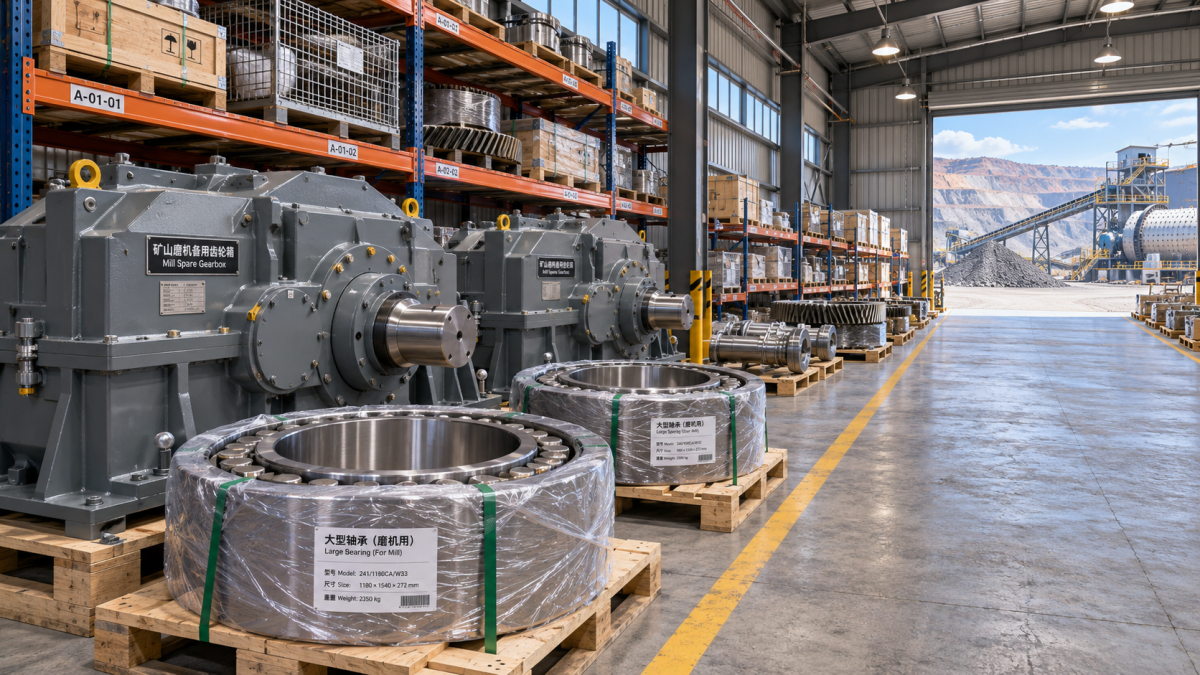
Trace the mining supply chain beyond the purchase order
Two suppliers do not necessarily provide two independent sources. They may buy castings from the same foundry, rely on one subcomponent manufacturer, or ship through the same port. Ask suppliers to identify the upstream facilities and transport links that matter for critical items, including outsourced machining, testing, and specialist materials.
Detailed disclosure may be commercially sensitive. Where a supplier cannot name a sub-tier company, ask for the country and facility type, the presence of an approved alternative, and the expected recovery time if that facility becomes unavailable. Record what has been verified and what remains an assumption.
Geographic diversification matters most when it reduces a common exposure. Moving orders to another distributor in the same region may improve commercial coverage, but it will not solve a shared factory, port, or border dependency. Conversely, a distant source may add transit time and customs complexity even if its manufacturing risk is lower.
Qualify alternatives before an emergency
A secondary supplier is useful only when its product can be purchased, installed, and supported within the available recovery window. For safety-critical or equipment-specific components, qualification may involve engineering review, material verification, testing, and approval from the asset owner or equipment manufacturer. Start that work while the primary source is still delivering.
- Define interchangeability. Document dimensions, materials, operating conditions, interfaces, performance requirements, and any installation restrictions. Distinguish a true substitute from a part that requires modification.
- Verify capacity. Ask for evidence of available production slots, tooling, key materials, and subcontractor support. Quoted capacity is less useful if it is already committed to other customers.
- Complete technical and commercial checks. Review samples or trial results, quality records, warranty terms, lead times, payment conditions, and after-sales support.
- Test the ordering process. Place a controlled order where appropriate, confirm documentation and delivery, and resolve any discrepancies before relying on the source during a disruption.
- Maintain readiness. Review approvals after specification changes, facility moves, or long periods without orders. A supplier that passed a trial years ago may no longer be ready to deliver.
Splitting a portion of demand between qualified suppliers can preserve familiarity and production readiness. It can also increase unit prices or reduce volume discounts. Use it where the value of a working alternative justifies those costs, rather than applying a fixed split across the entire category.
Check supplier health and delivery capability
Supplier assessments should connect financial and operational signals to the item being purchased. A strong balance sheet does not guarantee a production slot, while a small specialist may be reliable if it has suitable capacity, experienced staff, and a credible recovery plan.
For critical suppliers, review order backlog, capacity constraints, maintenance plans, workforce coverage, major subcontractors, and the availability of raw materials. Compare promised lead times with actual order history, and ask how the supplier allocates capacity when demand exceeds supply. Where possible, verify information through site visits, quality audits, production records, or agreed reporting.
Early warning indicators include repeated date changes, declining communication, unexplained changes in subcontractors, and delays in providing inspection documents. None proves that failure is imminent. Together, however, they justify a conversation about recovery actions, inventory, and alternative capacity before a missed delivery becomes a site outage.
Make contracts support recovery
Contracts for critical items should specify notification requirements for disruptions, production location changes, material substitutions, and missed milestones. They can also define inspection rights, escalation contacts, forecast-sharing arrangements, and expectations for recovery plans. Where appropriate, negotiate reserved capacity or access to tooling and technical documentation, subject to ownership and confidentiality terms.
A contractual promise alone cannot create spare capacity during a widespread shortage. Procurement should check that the supplier can perform the obligation and that the mine has an actionable response if it cannot.
Set inventory against recovery time, not habit
Inventory is a practical buffer when qualification or replenishment takes longer than the site can tolerate. The right quantity depends on demand variability, supplier lead time, transport reliability, shelf life, storage conditions, and the operational cost of a stockout. Coordinate the decision with maintenance and finance; a spare that has deteriorated in storage is not effective protection.
For a critical repair part, compare the expected time to obtain and install a replacement with the maximum acceptable outage. If procurement and freight together exceed that window, assess whether to hold a spare on site, at a regional warehouse, or under an agreed supplier stocking arrangement. Confirm who owns the stock, who may draw it, and how quickly it can be dispatched.
Pooling expensive spares across sites can reduce tied-up capital, but it works only if the part is compatible and transport to each site fits the recovery window. Check lifting equipment, preservation requirements, customs procedures, and competing claims on the shared spare.
Compare the full cost of protection
Evaluate resilience options on total cost of ownership rather than unit price. Include qualification, tooling, freight, duties, storage, insurance, obsolescence, financing, and the cost of expediting. Against these, assess the potential cost of production interruption, contractor standby, missed customer commitments, and emergency repairs.
Use scenarios rather than a single assumed loss figure. For example, compare the cost of holding a spare with the consequences of a supplier delay that exceeds available stock coverage. Where outage costs or probabilities are uncertain, show the range and the assumptions so management can judge the trade-off.
Prepare logistics and compliance for the actual route
Remote mines can face a reliable manufacturer and still suffer a delivery failure. Map the complete journey from factory to site, including export clearance, port handling, inland freight, border crossings, and the final road or rail leg. Confirm equipment dimensions and weights early; oversized loads may need route surveys, permits, escorts, or special handling.
For chemicals, explosives, and other regulated goods, verify the applicable transport, storage, import, and site requirements for the specific product and jurisdictions. Obtain the necessary classifications, safety documentation, permits, and handling instructions from qualified parties. Requirements vary by material and route, so a checklist from another site should be treated as a starting point rather than proof of compliance.
Maintain an alternate routing plan with named carriers, indicative transit times, handling constraints, and the documents needed to use it. Test whether the alternative has capacity during the same disruption: a second carrier using the same closed road does not provide an independent route.
Turn disruption signals into a site response
A contingency plan should tell people what to do when a supplier misses a milestone, a shipment is held, or demand suddenly rises. Assign an owner for each critical item and define the decision points that trigger escalation. Keep the plan accessible to procurement, operations, maintenance, logistics, and management.
- Confirm exposure: identify affected purchase orders, inventory, open work orders, and the date operations will need the item.
- Get a recovery commitment: request a revised production and dispatch plan, with milestones and a named supplier contact.
- Compare response options: assess alternate stock, qualified suppliers, repair, substitution, and freight routes against technical and safety requirements.
- Authorize the decision: give the appropriate manager a clear view of cost, operational impact, and remaining uncertainty.
- Track to receipt: monitor manufacture, documentation, shipment, inspection, and delivery to the point of use.
Practice the plan against a realistic scenario, such as a failed gearbox or a delayed reagent shipment. A tabletop exercise can reveal missing contacts, unclear approval authority, or an alternative source that has never completed site onboarding. Update the plan after an incident or a material change in demand, supplier capacity, or routing.
Review a small set of measures and act on exceptions
Track measures that help buyers make decisions: delivery performance against confirmed dates, lead-time variation, inventory coverage for critical items, overdue supplier milestones, and the number of critical dependencies with a qualified recovery option. Review results alongside site maintenance plans and upcoming shutdowns.
Do not let a good average hide a dangerous exception. A supplier may deliver routine consumables on time while one custom component remains months late. Review critical orders individually, assign an owner to each unresolved risk, and agree on the next action and date.
Begin with the few items most likely to interrupt production. For each one, establish the time available before operations are affected, verify the real supply path, and decide whether qualification, inventory, capacity reservation, or a logistics change provides the strongest protection. That creates a defensible procurement plan grounded in the mine’s actual operating needs.
 How to reduce supplier disruption in the mining supply chainReduce mining supply chain disruption with practical strategies for qualifying suppliers, managing critical inventory, and protecting production.
 WTO Report: G20 Trade Restrictions Hit Record as Facilitation Measures Offset PressureWTO report highlights record G20 trade restrictions and rising facilitation measures. Explore what they could mean for costs, compliance and supply chains.
 Indonesia and EU Sign Trade Agreement With Zero Tariffs on 90.4% of Tariff LinesExplore the Indonesia-EU trade agreement, its proposed zero tariffs on 90.4% of tariff lines, and what exporters and investors need to know.
 South Korea's Car Imports From China and Trade Deficit Hit RecordsSouth Korea’s car imports from China and automotive trade deficit hit records. Explore how Shanghai-made Tesla EVs are reshaping bilateral trade.
 How to check if supplier verification reports are authenticVerify supplier verification reports with confidence. Learn how to confirm the issuer, match supplier details, spot red flags, and reduce purchasing risk.
 Mexico’s President Seeks US Trade Deal at December Miami G20 SummitMexico–US trade deal talks could reach a turning point at the December Miami G20 summit. Explore what a potential agreement may mean for cross-border business.
 How to assess data quality in export market analysis servicesCompare export market analysis services with confidence. Learn how to evaluate data sources, coverage and forecasts before committing to a new market.
 Li Qiang Calls for Digital and Green Cooperation at China-Thailand Business MeetingLi Qiang calls for China-Thailand cooperation in digital and green sectors, highlighting opportunities in AI, new energy and agriculture.
 How are life sciences different from healthcare?Life sciences and healthcare overlap, but how do they differ? Explore their roles, real-world examples, and what the distinction means for sourcing.
 How is resale changing the UK apparel and fashion market?Explore how resale is reshaping apparel and fashion in UK markets, from shifting customer demand to pricing, sourcing and opportunities for brands.
 China's Trade Reaches 44.81 Trillion Yuan in First 10 Months, Up 20%China's trade reportedly reached 44.81 trillion yuan in the first 10 months, up 20%. Explore the implications for sourcing, technology exports and ASEAN markets.
 China Extends Pause on 24% US Tariff as US Extends Product ExclusionsChina-US tariffs: China extends its 24% tariff pause while the US extends 178 product exclusions. Discover what the measures mean for trade costs and planning.
 How to verify a mass production supplier’s capacityVerify a mass production supplier’s true capacity with practical checks for production records, available resources, quality controls and delivery readiness.
 He Lifeng Holds Trade Video Call with US Treasury Secretary and Trade RepresentativeHe Lifeng discusses China-US trade restrictions with US officials. Explore what the call could mean for exporters, buyers and supply chains.
 U.S. Trade Deficit Narrows to $105 Billion in September 2026U.S. trade deficit narrowed to $105 billion in September 2026 as exports rose 1.9%. Explore what the latest figures reveal about trade flows.
 How to verify international trade intelligence updatesVerify international trade intelligence updates with practical checks for sources, regulations, trade data, and disruptions. Turn complex claims into reliable insights.
 How investors can assess cyclicality in the manufacturing industryManufacturing industry analysis for investors: learn to assess cyclical demand, cash flow and downside risks to make more informed investment decisions.
 US ISM Manufacturing PMI Rises to 55.5% in October, Beating ForecastsUS ISM Manufacturing PMI rose to 55.5% in October 2026, beating forecasts. Explore what stronger orders and production could mean for manufacturers.
 China Manufacturing PMI Falls to 49.3 in OctoberChina manufacturing PMI fell to 49.3 in October, signaling renewed contraction. Explore the role of weak export orders and domestic demand.
 Can you trust flexible packaging market intelligence forecasts?Can you trust flexible packaging market intelligence forecasts? Learn how to verify sources, challenge assumptions, and assess demand before making costly investment or sourcing decisions.
 When is supply chain disruption management consulting worth the cost?When is supply chain disruption management consulting worth the cost? Learn how to compare fees, avoidable losses, and recovery options to make a confident investment decision.


















Global Trade Insights & Industry
Our mission is to empower global exporters and importers with data-driven insights that foster strategic growth.
Search News
Popular Tags
Industry Overview
The global commercial kitchen equipment market is projected to reach $112 billion by 2027. Driven by urbanization, the rise of e-commerce food delivery, and strict hygiene regulations.