

How to verify a mass production supplier’s capacity
A supplier’s stated monthly capacity does not establish whether it can deliver your order. The useful figure is the quantity it can produce to your specification, with acceptable yield, in the required delivery window, after accounting for existing commitments and constraints outside its factory.
Verification means connecting a capacity claim to evidence: production records, the loading of the relevant line, available labor and materials, and recent delivery performance. A factory can have substantial total output and still lack capacity for a particular process, product configuration or shipment date.
Define the capacity you actually need
Before requesting figures, specify the product version, quality requirements, order quantity, delivery schedule and expected order pattern. A requirement for 120,000 units over six months is different from a requirement for 120,000 units in the first month. Likewise, several sizes, colors or technical variants can require more changeovers than a single uninterrupted production run.
Ask the supplier to identify the proposed manufacturing site and production route. Clarify which operations it performs itself and which are outsourced. Depending on the product, capacity may depend on molding, machining, assembly, coating, testing, sterilization or packaging. The relevant number is the output of the complete route, not the capacity of the largest machine or the factory as a whole.
Distinguish among three figures when comparing suppliers:
- Theoretical capacity: Output under stated ideal operating conditions. It is useful for understanding equipment limits, but not sufficient for a delivery commitment.
- Demonstrated capacity: Output supported by records for a defined period and comparable products. Check whether it represents total production or accepted units.
- Available capacity: The portion of realistic output that can be allocated to your order during the required period, after other commitments and planned downtime.
A supplier’s highest-output month can be informative, but it should not be treated as normal performance without understanding overtime, staffing, product mix and other exceptional conditions.
Reconstruct capacity from the production route
Request a process-level calculation rather than a single monthly total. For each major operation, ask for the number of usable machines or workstations, operating hours, expected production rate, changeover time and yield. Confirm whether those resources are dedicated to the proposed product or shared with other orders.
A practical starting calculation is:
Potential accepted output = scheduled production hours × effective hourly rate × expected yield
The rate should reflect the actual product and include the operational losses not already deducted from scheduled hours. Avoid deducting the same downtime twice. For a multi-step process, calculate each critical operation on a comparable time basis; the operation with the lowest sustainable output constrains the whole route.
For example, suppose a line is scheduled for 400 hours in a month and can produce 250 units per hour for the proposed configuration. If the supplier’s documented planning assumptions allow 10% of those hours for changeovers and downtime, and 96% of produced units pass final acceptance, the estimated output is 400 × 90% × 250 × 96%, or 86,400 accepted units. This is an illustration, not proof of a factory’s capability. It also assumes downstream operations can support that volume.
If testing can release only 75,000 units during the same period, testing becomes the constraint. Adding assembly shifts alone will not solve the shortfall. Conversely, if the test station serves several customers, its full capacity cannot be assigned to one order without examining the schedule.
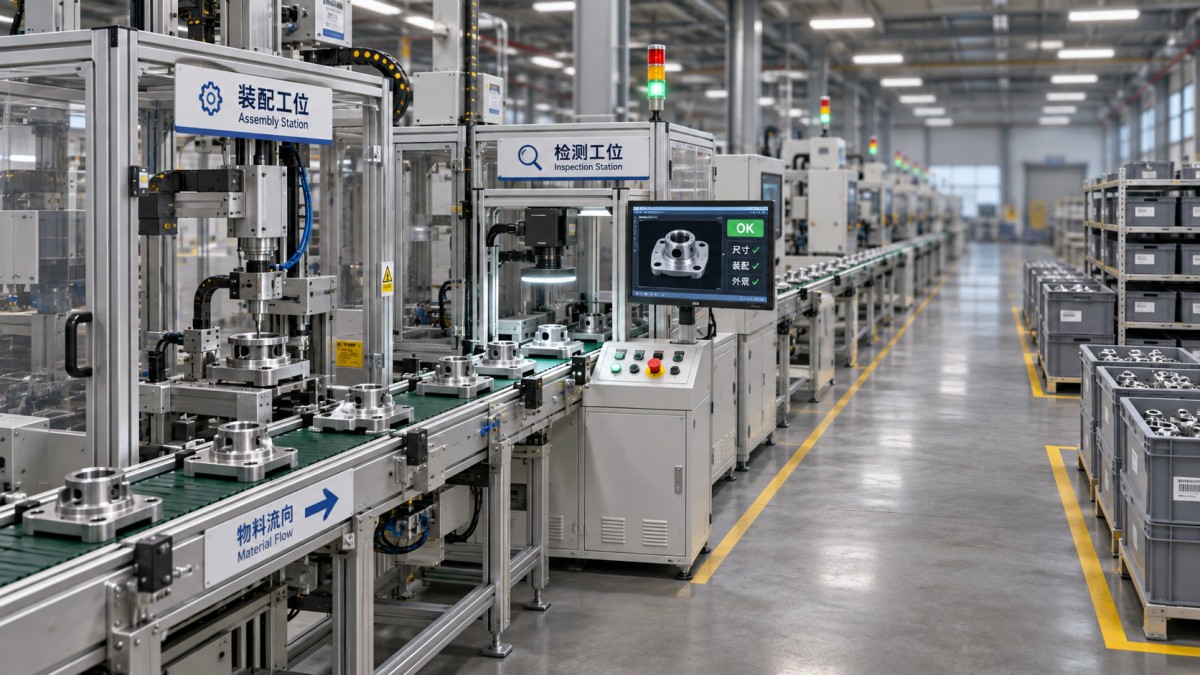
Pay particular attention to units of measurement. A claim expressed in machine cycles, pairs, sets or kilograms may not correspond to finished, saleable units. Capacity measured before inspection also differs from output accepted after defects, rework and any required hold periods.
Match capacity claims to production records
Request records covering a representative period, including ordinary months and, where relevant, periods of heavier demand. Useful evidence can include production plans, daily output reports, equipment logs, quality reports, finished-goods records and shipment records. Confidential customer information can be redacted; the dates, product categories, quantities and links between records should remain clear enough to assess.
Compare planned output with actual output and accepted quantities. If the factory claims it regularly produces 100,000 units per month, records showing 100,000 units started but only 80,000 accepted tell a different story. Rework deserves separate attention: units repaired and accepted may still meet the specification, but rework consumes time and can reduce capacity available for later orders.
Check comparability before relying on historical figures. A record for a simple product does not necessarily demonstrate capacity for a version with tighter tolerances, additional components or a longer test cycle. New tooling, a different material or a revised packaging requirement can also change the production rate.
Shipment history adds another perspective. Compare promised dates with actual dispatch dates and look for partial shipments, rescheduling and backorders. Dispatch is not the same as delivery to the final destination, so clarify whether the supplier’s performance measure ends at factory release, handover to a carrier or arrival at the agreed location.
Check whether the capacity is available for your order
Past production proves that output was achieved under past conditions. It does not establish that the same line is free during your delivery window. Request a loading plan showing existing commitments, planned maintenance, holidays and the proposed allocation for your order. Where customer names are confidential, occupied hours or aggregate scheduled volumes can still provide a basis for review.
Test the schedule backward from the required shipment date. Include material arrival, production, inspection, rework allowance, packaging, any required approvals and release for shipment. For international orders, distinguish the factory-ready date from the delivery date and allow for the agreed transport and customs responsibilities. A schedule that uses every available day leaves little room for a material delay or failed inspection.
Ask what the quoted capacity assumes about overtime and extra shifts. Additional hours are useful only if the necessary operators, supervisors, maintenance staff and quality personnel are available. A night shift without equivalent inspection coverage may increase unfinished inventory rather than accepted output.
Where the order depends on capacity being reserved, the reservation should be reflected in the commercial agreement or an agreed production plan. Clarify the quantity reserved, the period covered, when forecasts become binding and what happens if either party changes the schedule.
Validate materials, subcontractors and quality constraints
A factory’s internal capacity is only one part of the supply chain. Ask which components or materials control the lead time, where they come from, and whether the supplier has confirmed quantities for the proposed order. Inventory on hand is stronger evidence than an unconfirmed replenishment estimate, but check whether that inventory is already allocated elsewhere.
For critical inputs, review lead times, minimum order quantities and alternatives approved for the product. A substitute material or component should not be assumed acceptable merely because it is available; it may require testing, customer approval or a change in applicable documentation.
Subcontracted operations need the same scrutiny as in-house processes. Identify the subcontractor, the operation performed, its available capacity and the time needed to move goods between sites. If a coating or specialized test is outsourced, a production plan that stops at the supplier’s factory gate can conceal the actual bottleneck. Where access is restricted, request supporting evidence or an appropriately scoped independent assessment, subject to permission.
Quality controls can constrain throughput as much as equipment. Confirm the inspection method, sampling or testing requirements, test duration, release authority and treatment of nonconforming units. Where certification or regulatory approval is required for the product or facility, check its scope and validity against the proposed site, process and destination. A certificate alone does not establish available production capacity or guarantee that every shipment will conform.
Use a site assessment and production trial to test the evidence
A site visit can show whether the stated equipment, workflow and staffing exist at the nominated location. Observe the process proposed for the order, not just a showroom or unrelated line. Compare equipment identification, operating status and visible work-in-progress with the documents provided. A video assessment can help when travel is impractical, although it offers a narrower view and depends heavily on what the supplier chooses to show.
One visit is a snapshot, not proof of sustained monthly output. Combine observation with records and, where the commercial risk justifies it, a trial or controlled initial order using the intended material, tooling, staffing, quality checks and packaging. Agree in advance on what will be measured: elapsed production time, accepted quantity, defects, rework, changeovers and adherence to the schedule.
Interpret trial results in context. A short run may demonstrate that the product can be made, but not that the line can sustain the rate across multiple shifts or while handling other orders. Equally, a trial using extra technicians or priority access to shared equipment should not be treated as routine capacity unless those resources will also be available for mass production.
Make the sourcing decision against the delivery requirement
Compare the order profile with evidenced available accepted output, not just advertised monthly capacity. A supplier whose normal, documented capacity exceeds the requirement and whose schedule reserves the necessary resources offers a stronger basis for commitment than one relying on unconfirmed overtime, new equipment or a subcontractor’s verbal assurance.
If the evidence falls short, adjust the decision rather than assuming the gap will disappear. Options include staging deliveries, reducing the initial volume, approving an additional production site or qualifying another source. Each change should be reflected in the schedule and quality arrangements; splitting an order does not help if both sources depend on the same constrained component or subcontractor.
Where uncertainty remains but the supplier is otherwise suitable, use a limited initial commitment with clear acceptance criteria, production milestones and reporting requirements. Release later volumes against demonstrated performance. The decision point is not whether the factory can quote a large number, but whether it can substantiate the specific quantity, quality and timing it is being asked to deliver.
 How is resale changing the UK apparel and fashion market?Explore how resale is reshaping apparel and fashion in UK markets, from shifting customer demand to pricing, sourcing and opportunities for brands.
 China's Trade Reaches 44.81 Trillion Yuan in First 10 Months, Up 20%China's trade reportedly reached 44.81 trillion yuan in the first 10 months, up 20%. Explore the implications for sourcing, technology exports and ASEAN markets.
 China Extends Pause on 24% US Tariff as US Extends Product ExclusionsChina-US tariffs: China extends its 24% tariff pause while the US extends 178 product exclusions. Discover what the measures mean for trade costs and planning.
 How to verify a mass production supplier’s capacityVerify a mass production supplier’s true capacity with practical checks for production records, available resources, quality controls and delivery readiness.
 He Lifeng Holds Trade Video Call with US Treasury Secretary and Trade RepresentativeHe Lifeng discusses China-US trade restrictions with US officials. Explore what the call could mean for exporters, buyers and supply chains.
 U.S. Trade Deficit Narrows to $105 Billion in September 2026U.S. trade deficit narrowed to $105 billion in September 2026 as exports rose 1.9%. Explore what the latest figures reveal about trade flows.
 How to verify international trade intelligence updatesVerify international trade intelligence updates with practical checks for sources, regulations, trade data, and disruptions. Turn complex claims into reliable insights.
 How investors can assess cyclicality in the manufacturing industryManufacturing industry analysis for investors: learn to assess cyclical demand, cash flow and downside risks to make more informed investment decisions.
 US ISM Manufacturing PMI Rises to 55.5% in October, Beating ForecastsUS ISM Manufacturing PMI rose to 55.5% in October 2026, beating forecasts. Explore what stronger orders and production could mean for manufacturers.
 China Manufacturing PMI Falls to 49.3 in OctoberChina manufacturing PMI fell to 49.3 in October, signaling renewed contraction. Explore the role of weak export orders and domestic demand.
 Can you trust flexible packaging market intelligence forecasts?Can you trust flexible packaging market intelligence forecasts? Learn how to verify sources, challenge assumptions, and assess demand before making costly investment or sourcing decisions.
 When is supply chain disruption management consulting worth the cost?When is supply chain disruption management consulting worth the cost? Learn how to compare fees, avoidable losses, and recovery options to make a confident investment decision.
 How to use macroeconomic analysis to forecast industrial demandApply an industrial macro analysis methodology to forecast demand, interpret economic signals, and plan inventory and capacity. Discover practical steps for smarter business decisions.
 How to assess Singapore suppliers with global supply chain intelligenceExplore international supply chain intelligence Singapore buyers can use to verify suppliers, assess capabilities and delivery risks, and make confident sourcing decisions.
 Which macroeconomic indicators help forecast U.S. industrial demand?Explore industrial macro analysis USA decision-makers can use to forecast demand. Track new orders, inventories, and credit signals to sharpen procurement and capacity decisions.
 Can a food processing manufacturer meet your small-batch needs?Can a food processing manufacturer meet your small-batch needs? Discover how to assess minimum orders, costs, packaging, and safety to choose the right partner for your launch.
 How to verify sourcing intelligence data before selecting suppliersVerify sourcing intelligence data before choosing suppliers. Learn how to check company records, certifications, and capacity to reduce procurement risk and build a reliable shortlist.
 How to use supplier risk analysis to spot financial warning signsUse supplier risk analysis to spot cash flow pressure, debt risks, and delivery warning signs. Learn practical steps to reduce exposure and protect supply continuity.
 When dual sourcing makes sense in a sourcing strategy for manufacturersSourcing strategy for manufacturers: learn when dual sourcing strengthens supply continuity, reduces disruption risk, and protects production without adding unnecessary complexity.
 How bulk commodities pricing affects long-term supply contractsBulk commodities pricing shapes long-term supply contracts through index rules, freight, quality, volume, and currency risk. Explore strategies for resilient costs and supply security.
 Which global manufacturing trends by sector matter most for sourcing plans?Global manufacturing trends by sector: identify sourcing risks, supplier resilience, compliance demands, and cost drivers to build smarter, more reliable procurement plans.


















Global Trade Insights & Industry
Our mission is to empower global exporters and importers with data-driven insights that foster strategic growth.
Search News
Popular Tags
Industry Overview
The global commercial kitchen equipment market is projected to reach $112 billion by 2027. Driven by urbanization, the rise of e-commerce food delivery, and strict hygiene regulations.